- 416 pages
- English
- ePUB (mobile friendly)
- Available on iOS & Android
eBook - ePub
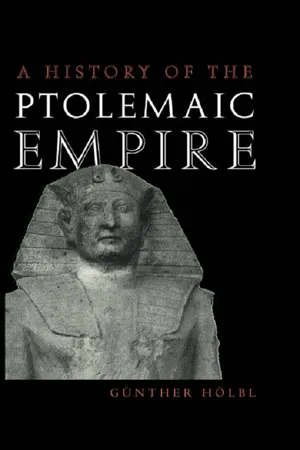
A History of the Ptolemaic Empire
About this book
This compelling narrative provides the only comprehensive guide in English to the rise and decline of Ptolemaic rule in Egypt over three centuries - from the death of Alexander in 323 BC to the tragic deaths of Antony and Cleopatra in 30 BC.
The skilful integration of material from a vast array of sources allows the reader to trace the political and religious development of one of the most powerful empires of the ancient eastern Mediterranean. It shows how the success of the Ptolemies was due in part to their adoption of many features of the Egyptian Pharaohs who preceded them - their deification and funding of cults and temples throughout Egypt.
Part I
The beginning and the golden age of Ptolemaic rule
1 Alexander the Great and Ptolemy I Soter (332—282)
ALEXANDER AND EGYPT (332–323)
After his great victory at Issos in November 333, Alexander the Great conquered Tyre in 332 following a seven month-long siege. Afterwards, he moved southwards with his army against Egypt. Only Gaza put up two months of stubborn resistance. From there, after marching for several days in the desert, Alexander reached the border fortress of Pelusion, where without encountering any resistance, he set up a garrison. Egypt was drained of troops because the satrap had gone with a large levy to Issos and he himself fell there (Arr. An. II. 11.8). The commander of the rest of the armed forces, Mazakes, who had been made satrap by the Great King himself after Issos, could not contemplate resistance. He therefore received Alexander in a friendly manner and handed the country over to him (Arr. An. III. 1.1–3).
Alexander's motives for not pursuing the Great King eastwards but instead turning toward the land of the Nile will have been manifold.1 As the history of Persian Egypt showed, the establishment of a national dynasty was essential. The east-Mediterranean empire that Alexander had up to this point founded could be considered a complete entity, both from a political and an economic point of view (the latter on account of Egyptian grain export), only with the integration of Egypt. Furthermore, Alexander's grand design will slowly have come to encompass the idea that all peoples were to be subjugated for the formation of a new world order; for this purpose, the Egyptian pharaonic system presented a very suitable ideology that was well established and has been accepted for millennia.
In Egypt, therefore, Alexander observed the traditional protocol associated with a pharaoh's accession to power: he visited Heliopolis, the city of the sun god, and the capital, Memphis, where he sacrificed to the gods in the shrines and especially to the royal god, Apis, in the precinct of the temple of Ptah. Since, in Egypt, making offerings to the gods was taken to be a pharaoh's prerogative, it was an inextricable part of Alexander's accession as an Egyptian king, as the Alexander Romance reports (Ps. Kallisthenes 1.34.1). Alexander did not take the time for an extravagant coronation ceremony, something which would have required rather elaborate preparations.2 He nonetheless held athletic and musical contests following Greek tradition (Arr. An. III. 1.3–4). After Alexander assumed power and until 323, official documents in Egypt were dated according to the year of his reign.
At the beginning of 331, the king went down the Canopic branch of the Nile with a small detachment of troops and gave orders for the founding of the city of Alexandria near the site of Rhakotis,2a probably an Egyptian settlement at an especially favourable location on the isthmus between the ocean and Lake Mariut. True to his nature, Alexander himself apparently laid out the plans for the most important streets on a grid system as well as the position of the market square and individual temples (Arr. An. III. 1.4–5; cf. Ps. Kallisthenes 1.31.5–32.6). The rest of the urban planning, however, was delegated to the architect Deinokrates of Rhodes (Vitr. II, praef. 4).3 The foundation date for Alexandria was traditionally celebrated on the 25 th of Tybi (Ps. Kallisthenes 1.32.7); this fell on 7 April 331.4 The new city rapidly became Egypt's gateway to the Mediterranean world, since it bound the Nile country completely to the network of commercial and political relations between Mediterranean peoples.
At the beginning of 331, even before the foundation date of the city, Alexander undertook his journey to the world-famous oracle of Amun (in Greek, Ammon or better still, Zeus-Ammon) in the Siwah oasis. He first went along the Libyan coast westwards towards Paraitonion (today, Marsa Matruh), where envoys from Cyrene brought gifts. Alexander formed a pact with them and in this way apparently guaranteed the city its independence as a free polis (Diod. XVII.49.2–3; Curt. IV.7.9).
At Siwah, Alexander wanted to ask the oracle both about the future and about his own personal nature, ‘since he traced a part of his ancestry to Ammon, just as the myths traced the descent of Herakles and Perseus (forefathers of the Macedoniaian royal house of the Argeads) to Zeus’ (Arr. An. III.3.2). As the analogy to both sons of Zeus shows, Alexander was probably not thinking of a distant lineage but of a father—son relationship. In any case, his motivation for the journey was explicitly to obtain more information on his birth (Arr. An. III.3.2.; cf. Curt. IV.7.8.), and, in view of the timely arrival in Memphis of the embassies from the oracle in Asia Minor5 the objective of his expedition must have previously been discussed with Alexander. Nonetheless, Philip II was still then as before credited with being his mortal father.
Zeus-Ammon of Siwah and Cyrene, an offshoot of the Theban Amun, represented, furthermore, the best link to Macedonia in the cultic-religious domain: he was honoured in all of Greece as Libyan Ammon and had a cult from the late fifth century onwards in Macedonian Aphytis (Chalkidike), where the temple has been excavated;6 Alexander was thus visiting the god in his original home.
Alexander's personal belief in his own divine nature easily harmonized with the Egyptian conception of the pharaoh as son of god. The title ‘son of Re’ and the notion that the successor to the throne was begotten by Amun, an idea which was especially widespread in the New Kingdom, gave legitimacy to the idea that the king was divine and a representative of the gods on earth. No doubt the trip to Siwah was undertaken to have Alexander declared the son of Amun and thereby legitimize the Egyptian regal titles soon to be conferred on him.7
And so Alexander moved with his train (among whom was Ptolemy, who himself later wrote about the trip) from Paraitonion southwards through the desert; owing to divine providence, there was sufficient rainwater and the way was found (Arr. An. III.3.3–6).8 Having reached Siwah, the companions had to remain outside of the temple of Amun-Re which lay on the hill of Aghurmi. Only Alexander himself was led into the inner sanctum, to the cult image, after one or several priests betook themselves into the secret chamber above the sanctuary (whose existence has since been confirmed by archaeologists) to listen to the questions put to the oracle. This was a kingly oracle and so it was carried out in accordance with ancient custom, in which the king alone could ask his questions of the godhead. Afterwards, Alexander will have been taken back by the priests and led into the neighbouring room. The high priest entered there and he greeted the king as son of Zeus (-Ammon), by which he explicitly indicated that what followed were the words of the god; then he announced to Alexander the rest of the oracle's words (Kallisthenes: FGrHist. 124 F 14 in Strabo XVII.1.43; Diod. XVII.51). Thereafter followed the public oracular procession for Alexander's companions: the boat with the aniconic image of Amun,9 which was adorned (Diod. XVII.50.6) and similar to an umbilicus (Curt. IV.7.23), was carried by 80 priests from Aghurmi on the street going straight to the temple of Amun of Umm cUbayda which lay opposite it; in this way, the boat answered the various questions by means of corresponding movements.
Alexander could be well content with the oracular achievement of the priesthood of Amun of Siwah. He returned to Memphis and organized sacrifices in honour of ‘Zeus Basileus’ (i.e. to Amun as king of the gods) accompanied by a ceremonial parade of his troops as well as a second athletic and musical Agon (Arr. An. III.5.2). Alexander kept mostly to himself the revelations of the oracle, but not his ideologically significant status as son of god. There is evidence for two other questions put to the oracle (e.g. Plu. Alex. 27), but while these may not be as certain, they are that much more politically important. These had to do with the question of world domination and with the issue of whether the murder of Philip II had already been avenged; with the latter question, Alexander will have wished to free his mother from suspicion of having instigated the act. It is important to realize that soon after Alexander's return from Siwah, envoys from the oracle of Apollo at Didyma (near Miletus) and from the Sibyl at Erythrae arrived at the court in Memphis to confirm his divine birth (Kallisthenes: FGrHist. 124 F 14). It was no coincidence that all these events took place at the same time and so it follows naturally that these envoys had been given their orders already some time before the journey to Siwah and that Alexander had brought with him there the idea that he was the son of Zeus(-Ammon).10
Alexander had rearranged the administration of Egypt and in this he encouraged the separation of powers (Arr. An. III.5): two governors for civil matters, Doloaspis (perhaps an Iranian and already a functionary in the Persian administration) and the Egyptian Peteisis, were to have divided their responsibilities geographically (probably between Upper and Lower Egypt); a short time thereafter Peteisis resigned and Doloas...
Table of contents
- Cover Page
- Half Title Page
- Title Page
- Copyright Page
- Dedication
- Contents
- List of illustrations
- Foreword
- Preface
- Acknowledgements
- List of abbreviations and references
- Introduction
- Part I The beginning and the golden age of Ptolemaic rule
- Part II Change and decline of the Hellenistic state of the Ptolemies
- Part III The Ptolemaic kingdom under the shadow of Roman power
- Bibliographical supplement
- Appendix
- Index
Trusted by 375,005 students
Access to over 1.5 million titles for a fair monthly price.
Study more efficiently using our study tools.
Frequently asked questions
Yes, you can cancel anytime from the Subscription tab in your account settings on the Perlego website. Your subscription will stay active until the end of your current billing period. Learn how to cancel your subscription
No, books cannot be downloaded as external files, such as PDFs, for use outside of Perlego. However, you can download books within the Perlego app for offline reading on mobile or tablet. Learn how to download books offline
Perlego offers two plans: Essential and Complete
- Essential is ideal for learners and professionals who enjoy exploring a wide range of subjects. Access the Essential Library with 800,000+ trusted titles and best-sellers across business, personal growth, and the humanities. Includes unlimited reading time and Standard Read Aloud voice.
- Complete: Perfect for advanced learners and researchers needing full, unrestricted access. Unlock 1.5M+ books across hundreds of subjects, including academic and specialized titles. The Complete Plan also includes advanced features like Premium Read Aloud and Research Assistant.
We are an online textbook subscription service, where you can get access to an entire online library for less than the price of a single book per month. With over 1.5 million books across 990+ topics, we’ve got you covered! Learn about our mission
Look out for the read-aloud symbol on your next book to see if you can listen to it. The read-aloud tool reads text aloud for you, highlighting the text as it is being read. You can pause it, speed it up and slow it down. Learn more about Read Aloud
Yes! You can use the Perlego app on both iOS and Android devices to read anytime, anywhere — even offline. Perfect for commutes or when you’re on the go.
Please note we cannot support devices running on iOS 13 and Android 7 or earlier. Learn more about using the app
Please note we cannot support devices running on iOS 13 and Android 7 or earlier. Learn more about using the app
Yes, you can access A History of the Ptolemaic Empire by Günther Hölbl, Tina Saavedra in PDF and/or ePUB format, as well as other popular books in History & Ancient History. We have over 1.5 million books available in our catalogue for you to explore.