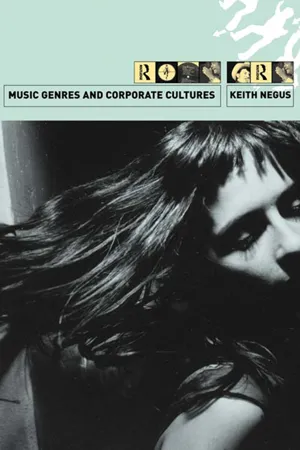
Music Genres and Corporate Cultures explores the seemingly haphazard workings of the music industry, tracing the uneasy relationship between economics and culture; `entertainment corporations' and the artists they sign. Keith Negus examines the contrasting strategies of major labels like Sony and Polygram in managing different genres, artists and staff. How do takeovers affect the treatment of artists? Why has Polygram been perceived as too European to attract US artists? And how did Warner's wooden floors help them sign Green Day? Through in-depth case studies of three major genres; rap, country, and salsa, Negus explores the way in which the music industry recognises and rewards certain sounds, and how this influences both the creativity of musicians, and their audiences. He examines the tension between raps public image as the spontaneous `music of the streets' and the practicalities of the market, and asks why country labels and radio stations promote top-selling acts like Garth Brooks over hard-to-classify artists like Mary Chapin-Carpenter, and how the lack of soundscan systems in Puerto Rican record shops affects salsa music's position on the US Billboard chart. Drawing on over seventy interviews with music industry personnel in Britain and the United States, Music Genres and Corporate Cultures shows how the creation, circulation and consumption of popular music is shaped by record companies and corporate business styles while stressing that music production takes within a broader culture, not totally within the control of large corporations.
- 224 pages
- English
- ePUB (mobile friendly)
- Available on iOS & Android
eBook - ePub
Music Genres and Corporate Cultures
About this book
Information
Chapter 1
Culture, industry, genre: conditions of musical creativity
A central theme of this book is the idea that an industry produces culture and culture produces an industry. This motif frames my account of the music business and production of different genres, and is used to propose a particular way of thinking about those activities and spheres of life which are often artificially separated according to the categories of ‘economics’ and ‘culture’. In this opening chapter I wish to explain in more detail why I am adopting this approach, what I mean by using these terms and to acknowledge my debts to other writers. In doing this I will introduce some of the main themes which will feature throughout this book and which I shall illustrate in more detail in later chapters. In providing a brief and schematic outline of the theoretical ideas that have guided my thinking and that are embedded in the remainder of this book, I shall be untangling some intellectual threads that in practice are often tangled—whether during everyday arguments about music at a concert, or in the theoretical reflections and empirical studies of various writers. Indeed, this will be a temporary explanatory strategy, as I shall weave them back together in later chapters of this book.
FROM THE PRODUCTION OF CULTURE TO THE CULTURE OF PRODUCTION
By using the term industry produces culture I am referring to how entertainment corporations set up structures of organization and institute distinct working practices to produce identifiable products, commodities and ‘intellectual properties’. This approach draws ideas from political economy and organization studies and uses these to interrogate the various corporate strategies and business practices of music and media companies. Writers who have followed this broad line of reasoning have tended to narrate a tale of the ‘production of culture’ during which the practices, form and content of popular music (and other cultural forms) are influenced in various ways by a range of organizational constraints and commercial criteria.
Many studies of cultural production in general and the music business in particular are informed by the assumptions of political economy, or what is sometimes prefixed ‘critical’ political economy, a label used by writers who wish to stress that they are concerned not simply with technical problems or issues of business administration but also with normative judgements concerning ‘justice, equality and public good’ (Golding and Murdock, 1996).1 A central issue for those engaged in this tradition of enquiry can be summed up in the following question: How do owners exercise and maintain control within corporations and what are the consequences of this for workers and public life in general? With regard to the music business, this raises questions about the impact of patterns of capitalist ownership on the creative work of artists and the options available to consumers.
Political economy has provided many insights into the various ways that corporate ownership impinges upon cultural practices, highlighting how production occurs within a series of unequal power relations, how commercial pressures can limit the circulation of unorthodox or oppositional ideas and how the control of production by a few corporations can contribute to broader social divisions and inequalities of information, not only within nations but across the world.2 That the major entertainmentarts corporations are continually seeking to control and thus maximize their profits from cultural production is a point that has been repeatedly emphasized by political economists. One of the key ways that modern corporations have attempted to maintain control is through the adoption of various corporate strategies (Fligstein, 1990) and I shall focus on these and their consequences in Chapter 2.
Despite its insights, however, the conclusions reached from the perspective of political economy are often predictable, portraying corporate ownership leading to rigid forms of social control and having a detrimental impact upon the creative activities of musicians, the workers employed within the corporations and the audiences for recordings. According to Steve Chappie and Reebee Garofalo (1977) in a comprehensive historical account of the recording industry in the United States, the commodification of music and the control of its production by a few major corporations also has a detrimental impact on the sounds we get to hear, leading to the erosion of oppositional or ‘anti-materialist’ performances as musicians and music business personnel are co-opted into an entertainment business which is ‘firmly part of the American corporate structure’ (ibid., p. 300). Similar conclusions have been reached by other writers who have followed political economy in seeking to understand the music industries.3
The pessimistic conclusions reached by much political economy leave us with an image of powerful owners exercising an almost omnipotent control over the practices of musicians and choices of consumers. This immediately rubs up against the moving and enjoyable experiences that many of us gain through the products that have come to us from the music industry. I've always found political economy to be attractive when thinking about my own angst-ridden moments while a member of bands signed to record labels, but less convincing when thinking about the composition and performance of songs and the many activities that are involved in musical consumption.
One of the problems here is what Peter Golding and Graham Murdock (1996) have referred to as ‘structuralism’. The term ‘structure’ is used in everyday discussions and in the disciplines of social science as a metaphor to explain how specific social relationships and activities seem to acquire a solid characteristic—structures of society, power structures, corporate structures within the music business, for example. This gives the impression of imposing, constraining, building-like edifices that are static, permanent and unchanging—easy to assume if you visit some of the corporate blocks in Manhattan. Yet Golding and Murdock remind us that such ‘structures’ are produced through everyday human activities which are dynamic, change over time and contribute to the maintenance of such ‘structures’. These human activities involve musicians as much as audiences and staff working within a corporation and for its various subcontracted labels, affiliates and companies.
A related problem, again identified by Golding and Murdock, is that of ‘instrumentalism’: the observation that capitalist corporations have specific interests (accumulation of capital, pursuit of profits, particular way of organizing production) does not inevitably mean that the work of musicians and workers within the media industry in general can simply be reduced to and explained according to one instrumental logic. As Garofalo (1986) later acknowledged when reassessing the critique of the music industry that he had written with Chappie, ‘there is no point-to-point correlation between controlling the marketplace economically and controlling the form, content and meaning of music’ (p. 83). The industry cannot simply set up structures of control and operate these in such an instrumental manner. Those who focus on ownership and control through the prism of political economy often forget the less orderly organizational life within the companies; the human beings who inhabit the corporate structures. An instrumentalist approach neglects the many human mediations which come in between the corporate structures and the practices and sounds of musicians, most notably the work of the intermediaries of the music and media industries.
For many years the activities of these workers within music business organizations, and of those engaged in commercial cultural production more generally, were explained through analogies with an ‘assembly line’ or ‘production line’. The production of hit songs, along with Hollywood movies and novels, was observed to resemble industrial manufacturing. Critical observers conjured up an image of bureaucratic ‘song factories’ engaged in the routine bolting together of standardized and interchangeable melodies, lyrics and rhythms, or proposed an analytic model of anonymous administrators mechanically shifting products sequentially from artists to the public.4
Such mechanistic models have often been uncritically incorporated into claims that the music business was, like other industries, organized in ‘Fordist’ terms, utilizing mass production techniques similar to those developed by Henry Ford and selling its wares to an undifferentiated mass market (Lash and Urry, 1994). This argument may conveniently fit with a general theory about the universal emergence of a type of flexible ‘post- Fordism’, but it ignores the historical specificities of how the recorded music industry has developed. Since its emergence at the end of the nineteenth century, the recorded music business (and indeed the sheet-music publishing industry from which many working practices were drawn) has been organized according to small-scale productions and selling to changing niche markets alongside the creation of big hits and blockbusters (most of the recordings issued throughout the twentieth century were never simply marketed to or purchased by a ‘mass’ audience). In addition, since its earliest days the recording industry has employed various legal and illegal, small-scale and team-based, marketing and promotional activities as a way of approaching consumers—practices which might well be labelled ‘flexible’.5 The point, therefore, is not that the music industry has undergone a profound change—from the assembly line to a more chaotic ‘flexible disintegration’ (Lash and Urry, 1994). It is that the recording industry has been misleadingly characterized as mechanical and factorylike in the first place.
Long before debates about ‘post-Fordism’, Richard Peterson (1976) had sought to challenge superficial parallels with bureaucratic manufacturing industries, calling for a ‘production of culture perspective’ which he also advocated in opposition to the idea that cultural artefacts are simply the work of individual artists (from whom they are then filtered to the public). Drawing on Howard Becker's (1974, 1976) ideas about the collaborative ‘art worlds’ within which culture is created, Peterson (1976) wished to stress how culture is ‘fabricated’ by a range of occupational groups and within specific social milieus. This he illustrated with a series of increasingly detailed studies of the ‘organizational structures’ and ‘production systems’ within which country music has been manufactured, culminating in his historical study of the ‘institutionalization’ of country music as a process involving a complex of people in an ironically knowing task of ‘fabricating authenticity’ (Peterson, 1997).
Peterson's ‘production of culture’ perspective is a deliberate challenge to those writers who attempt to understand creative work according to what he calls the ‘rare genius of a few select people’. Instead, he stresses ‘the structural arrangements within which innovators work’ (Peterson, 1997, p. 10). Rather than accept the partial perspective provided by individual biographies, Peterson argues that we should pay attention to the specific conditions which have shaped the way that talent has been able to emerge and be recognized in the first place. In his own writings Peterson has shown how particular types of singers were privileged as ‘country’ (white performers adopting specific rustic styles) and how a range of artists, managers, broadcasters, producers, musicians, songwriters and publishers played a part in systematically selecting and shaping what came to be known as ‘authentic’ country music. I follow Peterson's emphasis on understanding the conditions within which great individuals will be able to realize their talent, and will explicitly follow up some of his work on country music in Chapter 6.
While Peterson was writing in the United States, Antoine Hennion (1982, 1983, 1989), was researching musical production in France and reaching similar conclusions about ‘collective creation’, adding that music industry personnel act as mediators, continually connecting artists and audiences. Hennion observed that music business staff work as ‘intermedaries’, not only during the most obvious marketing and promotion activities, but also when ‘introducing’ the idea of an imagined audience into the writing, producing and recording of songs in the studio. Stressing how this involves a large degree of human empathy and intuition rather than organizational formulae, assembly lines and corporate structures, Hennion argued that record business staff do not ‘manipulate the public so much as feel its pulse’ (1983, p. 191).
The work of mediators has also been pursued by Pierre Bourdieu, who has adopted the concept of the ‘cultural intermediary’ to refer to those occupations engaged in ‘presentation and representation…providing symbolic goods and services' (1986, p. 359). Like Hennion, Bour dieu has stressed how these workers occupy a position between producer and consumer, or artist and audience. Unlike Hennion, however, Bourdieu has stressed the importance of various social divisions according to shared lifestyles, class backgrounds and ways of living (or habitus) rather than the intuitive feeling of audience pulses. Bourdieu has argued that the cultural intermediaries who work in artistic production do not gain their positions as a result of formal qualifications, nor are they promoted through a bureaucratic occupational meritocracy. Instead, admission and advancement is acquired by exerting influence within class-divided networks of connections gained through shared life experiences formed among members of distinct social groups.
Bourdieu (1993, 1996) has also highlighted how artistic work is realized across a broad series of intersecting social ‘fields’ and not simply within an organization. He has emphasized the broader social, economic and political contexts within which aesthetic judgements are made, cultural hierarchies established and within which artists have to struggle for position. Such an idea can clearly be extended to consider the broader contexts within which musicians have to struggle to be recognized and rewarded and how this occurs across the social activities which are conventionally designated as ‘production’ and ‘consumption’. Despite such insights, however, Bourdieu neglects to consider how such struggles are part of the formal working world of cultural organizations and commercial corporations, and how members of organizations operate across and contribute to the formation of various ‘fields’ as part of their daily routine.6
In this book I shall also be thinking about the mediations and connections between production and consumption and considering how a broader series of social divisions and ways of living intersect with the corporate organization. Rather than intuitive understanding or a sense of affiliation through shared habitus, I will be highlighting the more formal ways in which knowledge about consumers is collected, produced and circulated and how this informs strategic decision-making and repertoire policies. One of the issues I wish to stress in later chapters is how staff within the music industry seek to understand the world of musical production and consumption by constructing knowledge about it (through various forms of research and information-gathering), and then by deploying this knowledge as a ‘reality’ that guides the activities of corporate personnel. In economic terms this refers to the production, circulation and use of various forms of market data or ‘consumer intelligence’. However, there is an additional ‘anthropological’ aspect to the way in which knowledge is produced within the music industry. By this I mean the construction of a type of knowledge through which production is understood by those involved in it via a series of apparently intuitive, obvious and commonsense categories which do not so much involve an understanding of ‘reality’ as a construction and intervention into reality (most notably through ideas about distinct ‘markets’—r ’n’ b market, country market, Latin market). The way this comes about and its consequences will be discussed throughout this book, and lead me to the second phrase of my central theme, the way the ‘industry’ intersects with the broader ‘culture’ within which the corporate office is located.
To pursue this issue I have adopted the term culture produces an industry to stress that production does not take place simply ‘within’ a corporate environment structured according to the requirements of capitalist production or organizational formulae, but in relation to broader culture formations and practices that are within neither the control nor the understanding of the company. This idea acknowledges the critique of production put by those who argue that the industry and media cannot simply determine the meaning of musical products, and assumes that these may be used and appropriated in various ways by musicians and groups of consumers.7 More specifically, in adopting this perspective I am drawing insights from cultural studies, and in particular from the trajectory of thinking initiated by Raymond Williams' (1961, 1965) conception of culture as a ‘whole way of life’ and the writings of Stuart Hall (1997; Morley and Chen, 1996) in which he has placed an emphasis on culture as the practices through which people create meaningful worlds in which to live.
The implications of drawing on this type of approach are twofold, and also follow from Bourdieu's approach to cultural production. First, the activities of those within record companies should be thought of as part of a ‘whole way of life’; one that is not confined to the formal occupational tasks within a corporate world, but stretched across a range of activities that blur such conventional distinctions as public/private, professional judgement/personal preference and work/leisure time. Second, it is misleading to view practices within music companies as primarily economic or governed by an organizational logic or structure. Instead, work and the activities involved in producing popular music should be thought of as meaningful practices which are interpreted and understood in different ways (often within the same office) and given various meanings in specific social situations. This is one of the insights provided by some of the writings within the huge body of work on the cultur...
Table of contents
- Cover
- Half Title
- Full Title
- Copyright
- Contents
- Acknowledgements
- Introduction
- 1 Culture, industry, genre: conditions of musical creativity
- 2 Corporate strategy: applying order and enforcing accountability
- 3 Record company cultures and the jargon of corporate identity
- 4 The business of rap: between the street and the executive suite
- 5 The corporation, country culture and the communities of musical production
- 6 The Latin music industry, the production of salsa and the cultural matrix
- 7 Territorial marketing: international repertoire and world music
- 8 Walls and bridges: corporate strategy and creativity within and across genres
- Notes
- Bibliography
- Index
Trusted by 375,005 students
Access to over 1.5 million titles for a fair monthly price.
Study more efficiently using our study tools.
Frequently asked questions
Yes, you can cancel anytime from the Subscription tab in your account settings on the Perlego website. Your subscription will stay active until the end of your current billing period. Learn how to cancel your subscription
No, books cannot be downloaded as external files, such as PDFs, for use outside of Perlego. However, you can download books within the Perlego app for offline reading on mobile or tablet. Learn how to download books offline
Perlego offers two plans: Essential and Complete
- Essential is ideal for learners and professionals who enjoy exploring a wide range of subjects. Access the Essential Library with 800,000+ trusted titles and best-sellers across business, personal growth, and the humanities. Includes unlimited reading time and Standard Read Aloud voice.
- Complete: Perfect for advanced learners and researchers needing full, unrestricted access. Unlock 1.5M+ books across hundreds of subjects, including academic and specialized titles. The Complete Plan also includes advanced features like Premium Read Aloud and Research Assistant.
We are an online textbook subscription service, where you can get access to an entire online library for less than the price of a single book per month. With over 1.5 million books across 990+ topics, we’ve got you covered! Learn about our mission
Look out for the read-aloud symbol on your next book to see if you can listen to it. The read-aloud tool reads text aloud for you, highlighting the text as it is being read. You can pause it, speed it up and slow it down. Learn more about Read Aloud
Yes! You can use the Perlego app on both iOS and Android devices to read anytime, anywhere — even offline. Perfect for commutes or when you’re on the go.
Please note we cannot support devices running on iOS 13 and Android 7 or earlier. Learn more about using the app
Please note we cannot support devices running on iOS 13 and Android 7 or earlier. Learn more about using the app
Yes, you can access Music Genres and Corporate Cultures by Keith Negus in PDF and/or ePUB format, as well as other popular books in Media & Performing Arts & Ethnomusicology. We have over 1.5 million books available in our catalogue for you to explore.