This volume presents the work of an international group of academics from a range of disciplines including sociology, media and cultural studies, social anthropology and geography, all of whom are involved not only in thinking `culture? into the economy but thinking culture and economy together.
eBook - ePub
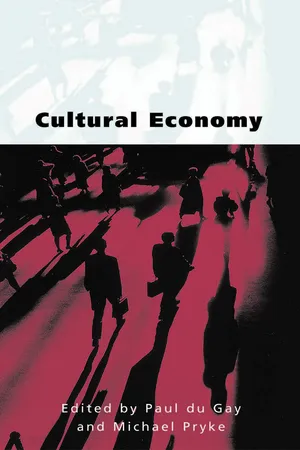
Cultural Economy
Cultural Analysis and Commercial Life
- 256 pages
- English
- ePUB (mobile friendly)
- Available on iOS & Android
eBook - ePub
Cultural Economy
Cultural Analysis and Commercial Life
About this book
Phrases such as `corporate culture?, `market culture? and the `knowledge economy?, have now become familiar clarion calls in the world of work. They are calls that have echoed through organizations and markets. Clearly something is happening to the ways markets and organizations are being represented and intervened in and this signals a need to reassess their very constitution. In particular, the once clean divide that placed the economy, dealt with mainly by economists, on one side, and culture, addressed chiefly by those in anthropology, sociology and the other `cultural sciences?, on the other, can no longer hold.
Information
Publisher
SAGE Publications LtdYear
2002Print ISBN
9780761959939
9780761959922
Edition
1eBook ISBN
9781446225783
1
economics as interference
The range of chapters in this book suggests that there are many ways of thinking of cultural economy. Perhaps it has to do with the growth of the culture industries. Perhaps it has to so with what is taken to be the ‘culturalization’ of activities that might previously have been more ‘economic’ in character. And/or perhaps it has to do with the so-called ‘cultural turn’ in social science – the increasing preoccupation with the analysis of culture that has grown up with a parallel growth in the sense that culture is everywhere, and that what was previously taken to be economic was always, in addition, essentially cultural in character.
These three possibilities are not necessarily mutually exclusive. However, this chapter belongs more or less uneasily to the third approach, the so-called ‘cultural turn’, because it has nothing to say about culturalization, and still less about the culture industries. Indeed, it has relatively little to say about any form of change in the character of economic activity. Instead, it proposes an analysis of economically relevant activity which is cultural, at least in a broad sense. The assumption I work from, then, is that culture is everywhere and that little has changed in this respect. I assume that economically relevant activity has always been cultural and that the tools of cultural analysis may be applied to what one might imagine to be ‘strictly economic’ activity.
Nevertheless, though it fits with the cultural turn, the approach that I develop belongs only more or less uneasily to it. This is because it is first and foremost an analysis of material practices, and of certain practices, orderings or discourses which produce economically relevant activity. Though in some loose sense practice is no doubt broadly ‘cultural’, the extent to which the term ‘culture’ is appropriate to an analysis of practice is uncertain. I take this to be the case for several reasons. First, to be sure, ‘culture’ is a term which covers such a multitude of sins – or approaches. Its initial significance is unclear. Second, in many of its more classic uses the term implies homogeneity in the meanings or beliefs held by a group of people. This, to put it no higher, is distinctly uncomfortable, tending to reflect what one might think of as a ‘bias to continuity’ by seeking out similarities rather than differences or tensions.1 Third, it exists, at least classically, as one of the terms in a series of unfortunate dualisms in which it is relegated to a more or less idealist world of beliefs, ideas and symbols. Culture as opposed to economy, that is one version of this division. Culture versus structure is another. Culture versus practice (where culture has to do with beliefs) is a third. Culture versus technical or practical efficacy (as in the analysis of ritual behaviour that cannot be explained in terms of its practical outcomes) is a fourth. And culture versus the material world, this is a fifth variant.
As is obvious, it is possible to use the term in other ways, and I entirely accept that it is indeed widely used in ways that break down these dualisms. The increasing popularity of the analysis of ‘material culture’ bears witness to this, as does the general attempt, reflected in several of the other chapters in this book, to understand the economy in a cultural mode. So, though it largely avoids the term, the argument of this chapter should not be read as an objection to the possibility of a cultural analysis of economy. Instead, it should be understood in two ways. First, as an attempt to develop a toolkit for making sense of certain material practices that might be understood both as ‘economic’ and as ‘cultural’. As will become clear, it is a toolkit that derives from semiotics and post-structuralism, and in particular a version of these approaches from within the discipline of Science, Technology and Society (STS). And, second, it should be understood as an argument about complexity: practices, it is suggested, carry and enact complex interferences between orders or discourses, and if we are to understand economically relevant practice it is important to investigate those interferences.
office I’ve got an image in my mind from about 1990. It’s the office of the Director of the Daresbury SERC Laboratory near Warrington in Cheshire.2 Picture this office. It’s got a nice oiled-wood desk with a comfy working chair. It’s got a conference table, again in a better class of wood, with about half a dozen well-upholstered upright chairs. It’s got three low easy chairs and a coffee table. This is where the Director – I’ll call him Andrew – meets with distinguished visitors. It’s also where the ethnographer sits, the fly on the wall, when he listens in to the meetings of the Daresbury management board. And the room as a whole, without being luxurious – the director of a public establishment does not equip his office in the style of the better-heeled reaches of the private sector – speaks of comfort, privilege and command.3
Part of the apparatus of command lies on the desk. It is interesting how the materials of discretionary power change as the generations pass. Gold pens and silver ink-stands like those on my grandfather’s respectable middle-class businessman’s desk? No. Instead there is a telephone, a dictaphone and a personal computer. The personal computer is networked. And it is, as we know, a versatile tool. For communication. For instance, Andrew has just told the other men who make up the senior management that if they don’t check their electronic diaries then he’s not responsible if they miss out on crucial meetings – because that’s how they’ll be told about them from now on. He reads his email here too. In principle he can send and receive faxes – though his secretaries in the next room, the gendered buffer room that surrounds many of the sites of power, send and receive most of them. For communication but also for word-processing, treating texts. And of course, for building spreadsheets, of which more in a moment.
Andrew is a powerful man. He is also a calculative agent. There are important differences between calculative agency, on the one hand, and economic agency, on the other. Yet, as is obvious, they are also closely related. In this chapter I explore the character and some of the limits of calculative (and therefore of economic) agency and its practices by using STS tools and drawing primarily, though not exclusively, on empirical material derived from Daresbury.
First, I argue that practices, subjects and ‘cultures’ (including those of calculation and economics) may be understood as materially heterogeneous relations. This is a particular claim of STS, though it resonates with other – for instance, Foucauldian and feminist – traditions
Second, I suggest that these relations, subjects and cultures are enacted or performed, and that it is important to explore the strategies or styles of those enactments and performances. This is a claim which is again more or less consistent with a Foucauldian approach, though the turn to performance (and the exploration of its implications) take us far beyond Foucault. One of its implications is that performances are somewhat unpredictable, and that the relations, subjects and cultures are thus in some measure variable between different performances.4
Third, I suggest that if we are to understand economic practices in their different and multiple specificities, then it becomes important to understand how these interfere in different and specific performances with other, alternative strategies and styles. This, then, is a second form of heterogeneity. Economic subjectivities, while impeded by their Others in interference, are also constituted with and by those Others.
Finally, I argue that the calculative and discretionary agent required in economics is always incomplete. More precisely, I argue that in practice the logic of economic liberalism lives within and alongside other logics or discourses, and cannot survive without this irreducible excess.
materiality No doubt, over ten years on, and caught in the eye of a storm about the future of synchrotron radiation research in the United Kingdom, the office that I remember at Daresbury has changed. Certainly the Director whom I knew has gone as the generations of top managers replace themselves. And it would be astonishing if a Pentium IV computer didn’t grace the desk of Andrew’s successor instead of, what, a 386, a 486? But the details don’t matter because my first point is not about change but about stability. It is that if we are to talk about culture at all, then it certainly doesn’t exist in the abstract. It doesn’t even simply exist as a set of discourses programmed into bodies – although bodies are, to be sure, crucial in the performances of culture. Instead, or in addition, it is located and performed in human and non-human material practices. And these are material practices which extend beyond human beings, subjects and their meanings, and implicate also technical, architectural, geographical and corporeal arrangements.
This is – or it ought to be – old news. Perhaps Marx told us this. Certainly Michel Foucault and a series of feminist and non-feminist partial successors have done so.5 Many anthropologists and social geographers too6 – though from my uneasy hybrid location somewhere between sociology and STS it seems to me that it still remains quite difficult to avoid the kinds of dualisms I touched on in the introduction. But what have STS and STS influenced approaches to say about this? The answer is that in the recent past there have been a number of studies of economically relevant practice, and in particular of the constitution of markets.7
One of the nicest, simplest, earliest and most straightforward studies is by French sociologist Marie-France Garcia (1986). Written in the tradition of Pierre Bourdieu, this describes the way in which a market for the wholesale buying and selling of strawberries was set up physically and socially (though Garcia’s argument is precisely that the two cannot be levered apart). Physically, because a building was constructed where transactions were brought together, transactions previously distributed here and there around the countryside in specific negotiations between buyers and growers. A building where the strawberries to be sold were brought together, arrayed, made visible for inspection. A building with an electronic display to make the bidding visible to all concerned. A building where, though all could see the scoreboard and the auctioneer, the buyers could not see the sellers, or vice versa. Indeed a kind of panopticon. Physically, then, the new market was a place, a set of socio-technologies, and a set of practices. But socially it was also a set of rules. ‘Bring the strawberries here, to the market. Do not sell them on the side to wholesalers.’ ‘Grow recognized brands of strawberries – or they won’t be accepted into the market.’ ‘Label them properly and pack them in an appropriate manner.’ And so on, and so on.
In his edited book The Laws of the Markets (1998c), Michel Callon has extended and developed this argument. He argues that markets aren’t given but constructed. Which means, among other things, that there is not ‘a market’, or ‘the perfect market’, with various deviations from this natural state of grace in the non-platonic realities of the world. Instead he’s saying that there are markets, and markets, and then there are more markets. Different forms, different material forms. His particular additional twist is that economic theory – for instance neo-classical theory – has been vitally important, indeed performative, for the formation of particular markets. Beware, he is saying. The old idea that social sciences are an ornament that freewheels around in mid-air is quite wrong: they do make a difference. And this is a lesson that has been also been drawn by those who point (for instance) to the social engineering that has produced the ‘single unified market’ of the EU, or to the discourses enacted to produce the possibility of the massive exchange of commodities and currencies that constitutes the globalization of economic activity (e.g. Massey, 1997; Thrift, 1996). Or, for the case of the strawberries in the Sologne in France, the activities of a particular, economically proselytizing Enarchiste fresh from his Paris training about the necessities and benefits of economic liberalization, on his first stint out in the real world to bring the benefits of marketization to the French provinces. As if preposterously, somehow, liberalization meant less rather than more.
Markets, then, or economics (note, as does Callon, that both appear in English in the plural), involve performing calculations, monetary interchanges, transactions and relations of all kinds. But what does this take in practice? Any answer to this question becomes an investigation of practice. It becomes an investigation of the ordering of materially heterogeneous socio-technical economically relevant relations, their enactment and performance. It also becomes an investigation of the constitution of relevant forms of agency and subjectivity. To explore this further I am now going to return to the Daresbury SERC Laboratory.
manpower Andrew is sitting at his desk. He’s about to call an emergency meeting of the management board. He’s bothered because the ‘second Wiggler project’, the so-called ‘flagship project’ for the laboratory, is starting to fall seriously behind schedule. But what is there to see of this second Wiggler project? Does it look as if it is behind schedule? The answer is, it doesn’t. Not really. Not in any way that you or I could see. For as he sits fretting in his office, it is nothing more than a hole in the ground, and a bunch of construction workers pouring concrete. There’s no particular sign that anything is wrong. It’s a mess all right, but only a mess in the way that all construction sites are a mess: hard hats, hard shoes and mud everywhere.
So what does Andrew see of this project? The answer is that he sees something that no-one else sees, at least not easily: he sees some figures in a spreadsheet. And the spreadsheet tells him (forgive my use of the laboratory vernacular) that about 11 ‘man-years’ have been devoted to the project, whereas at this stage the figure should have been 18. This is what he sees: that the project is not getting the effort that it needs. It is falling behind schedule. In fact, though this is invisible, so to speak, on the ground, the project has already used up all the contingency time built into the original schedule.
How does Andrew know about the inadequate manpower? To answer this question we need to follow the materialities of socio-technologies – and in the present context, two of these, though they are intimately related.
First, courtesy of the Microsoft Corporation, there is a spreadsheet. Obviously the spreadsheet is not some kind of accident. As with every calculative system from the invention of double-entry book-keeping on, it works in certain ways, tending to create some possibilities and delete others.8 Without ignoring the possibilities of subversion and misuse (we have moved a long way from technological determinism in STS and there is a large literature on the subversion and reappropriation of technologies9), to a fair extent it works in ways that reflect and perform the logics of power. But, at the same time, it constitutes, reproduces, remakes, the needs of powerful actors, collective or individual. Locally, then, Andrew becomes some kind of visionary, someone who has seen the future and knows that it ...
Table of contents
- Cover Page
- Title Page
- Copyright Page
- Contents
- Notes on contributors
- Acknowledgements
- Cultural economy: An introduction
- 1 Economics as interference
- 2 Symbolic economies: the ‘culturalization’ of economic knowledge
- 3 Capturing markets from the economists
- 4 Work ethics, soft capitalism and the ‘turn to life’
- 5 From Holloway to Hollywood: happiness at work in the new cultural economy?
- 6 Identities and industries: the cultural formation of aesthetic economies
- 7 Re-imagining the ad agency: the cultural connotations of economic forms
- 8 Advertising, persuasion and the culture/economy dualism
- 9 The unintended political economy
- 10 Production, consumption and ‘cultural economy’
- 11 Performing cultures in the new economy
- Index
Trusted by 375,005 students
Access to over 1.5 million titles for a fair monthly price.
Study more efficiently using our study tools.
Frequently asked questions
Yes, you can cancel anytime from the Subscription tab in your account settings on the Perlego website. Your subscription will stay active until the end of your current billing period. Learn how to cancel your subscription
No, books cannot be downloaded as external files, such as PDFs, for use outside of Perlego. However, you can download books within the Perlego app for offline reading on mobile or tablet. Learn how to download books offline
Perlego offers two plans: Essential and Complete
- Essential is ideal for learners and professionals who enjoy exploring a wide range of subjects. Access the Essential Library with 800,000+ trusted titles and best-sellers across business, personal growth, and the humanities. Includes unlimited reading time and Standard Read Aloud voice.
- Complete: Perfect for advanced learners and researchers needing full, unrestricted access. Unlock 1.5M+ books across hundreds of subjects, including academic and specialized titles. The Complete Plan also includes advanced features like Premium Read Aloud and Research Assistant.
We are an online textbook subscription service, where you can get access to an entire online library for less than the price of a single book per month. With over 1.5 million books across 990+ topics, we’ve got you covered! Learn about our mission
Look out for the read-aloud symbol on your next book to see if you can listen to it. The read-aloud tool reads text aloud for you, highlighting the text as it is being read. You can pause it, speed it up and slow it down. Learn more about Read Aloud
Yes! You can use the Perlego app on both iOS and Android devices to read anytime, anywhere — even offline. Perfect for commutes or when you’re on the go.
Please note we cannot support devices running on iOS 13 and Android 7 or earlier. Learn more about using the app
Please note we cannot support devices running on iOS 13 and Android 7 or earlier. Learn more about using the app
Yes, you can access Cultural Economy by Paul du Gay, Michael Pryke, Paul du Gay,Michael Pryke in PDF and/or ePUB format, as well as other popular books in Social Sciences & Cultural & Social Anthropology. We have over 1.5 million books available in our catalogue for you to explore.