- 304 pages
- English
- ePUB (mobile friendly)
- Available on iOS & Android
eBook - ePub
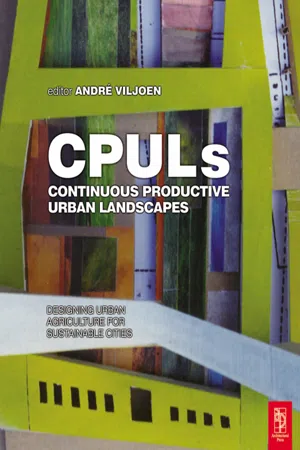
Continuous Productive Urban Landscapes
About this book
This book on urban design extends and develops the widely accepted 'compact city' solution. It provides a design proposal for a new kind of sustainable urban landscape: Urban Agriculture. By growing food within an urban rather than exclusively rural environment, urban agriculture would reduce the need for industrialized production, packaging and transportation of foodstuffs to the city dwelling consumers. The revolutionary and innovative concepts put forth in this book have potential to shape the future of our cities quality of life within them.
Urban design is shown in practice through international case studies and the arguments presented are supported by quantified economic, environmental and social justifications.
Information
Part
One
Carrot and City:
The Concept of Cpuls
1
New Space for Old Space:
An Urban Vision
Continuous Productive Urban Landscapes (CPULs) started to develop in London around 2005. Forty years later they were everywhere, having reached a maturity that enables us to study their success in relation to the very initial design intention.
When first mentioned around the year 2000, there was no precedent for CPULs anywhere in the world, though various attempts had been successfully started to integrate both continuous landscapes and urban agriculture into cities. As a strategy based on the genius loci of place, it was clear early on, that CPULs would have to be developed individually for each country and for each city, and that any manifesto would only provide a general framework and vision …
Continuous Productive Urban Landscapes: London in 2045
On a sunny summer Sunday morning, a CPUL in London resembles Brighton beach or Hyde Park. People have left their homes to enjoy fresh air, spaciousness and various activities of the adjacent CPUL. In the park-like areas, they do morning exercises, sit on large blankets having breakfast, sunbathe, repair their bikes or read their papers and palm top news. Children are running and playing with their friends on the grassy land between the agricultural fields or in the small canals built to water or drain the fields. Although there may be more apartment dwellers around, the CPUL is fairly evenly used by people from every housing type. One has to note, that the popularity of high-rise and dense buildings around CPULs has increased enormously since the building facades became gardens, the garden’s landscapes and the views from the towers offer a visual feast.
The three local farmers’ markets situated at the CPUL edge start selling fresh food, being busier today than during weekdays, when only two of them are open at any one time. (London-wide, there are now about 150 farmers’ markets.) Ice cream and fresh fruit juice vendors are setting up their stalls around the main CPUL routes. The cafés and restaurants bordering the CPUL put their chairs and tables out, the smell of coffee and fresh bread blows over the fields. Tennis players exchange first balls on the nearby tennis court. Close to it, the bowls and boules groups are getting together. The various canopied outside offices, situated in the quieter areas of the CPUL, are less busy today. With their fixed-seating laptop plug-ins or their workbenches, they are now used by kids playing computer games or making aeroplane models. (During weekdays, children use computer playgrounds or youth workshops, often located closely to CPULs so as to allow safe access and the use of outside space.)
Most of the commercial farmers celebrate the weekend and the low gates to their fields are now shut, but instead other fields are busy with allotment growers and communal farm projects. There are numerous allotments within this CPUL, but they do not threaten to take over the larger, more generous urban agricultural fields: the number of allotments in London quickly stabilised, once everybody wanting to grow their own food was supplied with one. Often, the produce from the land is sold straight off the fields via one of the various small kiosks that are situated within the CPUL allowing farmers to weigh, price and record produce appropriately. For the past 20 years, since about 2025, air pollution has no longer been an issue and ground contamination is being cleared through systematic soil treatment and continuous planting. The organic produce on offer is therefore in high demand, making the markets and kiosks a bustling counterpoint to the tranquillity of this Sunday morning.

Figure 1.1 London, population 7 million, exploded to accommodate mini- and SUPER-market gardens. An early study from 1998, demonstrating the area required to supply all of London’s fruit and vegetable requirements from urban agriculture. Yields from mini and SUPER-market gardens are based on 100m2 of urban agriculture per person.
Around midday, people pack their stuff and leave, provided they are not staying for lunch in one of the restaurants or going for a swim in the local open-air pool, or starting work in the work areas. Later, they might walk or cycle to Tate Modern or Covent Garden, out into the countryside or to the River Thames. With a quarter of roads converted to accommodate CPULs since 2005, one can now reach virtually any point in London by walking or cycling in less than an hour or two. Most London boroughs pride themselves on having designed their open space so as to allow people to access a CPUL after no more than a 15-minute walk.
If people don’t feel like walking back from where they are now, they can take one of the regular (every 10 minutes) buses or trains, pick up a taxi or hire one of the cars or bicycles which they can later leave close to their home to be used by the next person.
Meanwhile, the CPUL is heaving with children and youngsters engaging in all sorts of sports and fun, with people (and dogs) going for walks, sunbathing or enjoying tea, games and books.
Families gather in the various state-of-the-art activity grounds, which during the week are mostly booked by schools and clubs. The small open-air swimming pool has its busiest time.
In the early evening, the CPUL fills with people coming home or going out for dinner and/or into town. Teenagers meet their friends in the more hidden areas between the fields, musicians start playing and people start to dance. Children do their last races around the lanes and lawns. People have picnics and barbecues, do sports or hire a deck chair to relax. At the same time, others cycle or walk back from work, enjoying the evening air and sun and some quiet activity which will change into urban bustle and business the closer one gets to the city centre or the borough sub-centres.
This evening, the CPUL hosts a film event: a big screen is temporarily hang over its main space, people sit and lie around watching, the restaurants are busy, the pubs and cafes …
On a rainy winter weekday, though, things look different. Cyclists pass in rain clothes, people hasten to work, train or car sharing stations. Farmers, who at that time of year prepare soil, seeds and tools for the next spring, work in the CPUL sheds and product stores. The poly tunnels that are now occupying most of the fields open up automatically to soft rain allowing the seasonal vegetables to catch it. A few children play in a playground and explore the demonstration rain water mills – differently sized sculptures that collect rain. Apart from the aforementioned, and some dogs or lovers who enjoy running around in that weather, the CPULs lie empty, sucking in the rain. It is a busy time for delivery services, the CPUL is full of delivery cycles racing to bring food and other shopping to their clients. A man is moaning that his car sharing station has run out of cars, but cheers up when the gas-driven bus, with a five minute frequency, arrives. The weather forecaster celebrates the rain and tries to predict the benefit it will bring to the productivity of particular urban areas. Today, it is also windy but it blows too hard for kite flying or kite sailing, which people would otherwise do. The CPUL is really deserted. The staff on the farmers’ market hide under retractable canopies, unless the whole market has already retreated to the small covered or heated market hall, of which there is at least one close to every CPUL. At this time of year, the business booms for imported fruit and vegetables.
Then the rain stops. Now, the refreshed oxygen-rich air, that the wind brought in from the sea via the many open urban corridors, stands clear above the CPUL and its adjacent buildings. Some farmers walk along checking the huge underground rainwater tanks for how well they have filled. Sun will later operate the PV driven pumps that distribute the rainwater to particular fields and houses for productive and private use. The numerous small overground water canals are busy and bustling; children with wellies (and no bellies) sail boats and sticks.
This winter day, indoor activities, both at home and in leisure centres, offer endless possibilities to play, learn, do sports, get involved in the arts, meet up, etc., at any time after work or during the day. The local leisure centres, situated at the CPUL edge, can now always boast outside parts such as swimming pools, racing tracks or sauna seating areas where sitting in the rain is ever so exciting. And for the evening, the city centre is still only a quick train ride away …
Ecological Intensification
The urban strategy that enabled CPULs to happen and to grow to what they are now, in 2045, was called Ecological Intensification (named ‘Carrot City’ by London architects a few years later). In London (as in most European cities), this incremental strategy has been applied since about the year 2005.
Ecological Intensification worked by prioritising environmental urban layers, which were either connected to open space use, or to implementing sustainable technology and activity patterns. Usually, these environmental layers were then superimposed with other locally appropriate layers, such as economic, social, cultural, historical, etc.
As a result of this process, London has become (and is still becoming) a real ‘Carrot City’: sustainable, integral, working out of itself, but within its capacities, allowing and needing the participation of its citizens as well as offering real lifestyle choices.
The London boroughs, for example, applied individual development strategies centred around innovative ways of connecting and reconnecting urban work, trade and leisure activities. These were thought of as the basis for an exchange of products and services, and succeeded in supporting local productivity patterns and thereby an economic prosperity all over London.
Over the last 40 years, since about 2005, London has developed into a city where national and international exchange brought mainly those goods and services into the city which it was not possible to provide from within. Through concentration on its local expertise and workforce, London (and Greater London) has grown to strong economic identity through its excellent and eccentric products. At the same time, it regained a national and international market lost for decades because of the closure or takeover of most of its unique factories, farms, foods and fashions. Employment figures in London (and all over Britain) have rocketed over the past twenty years. London was also able to share in tackling the international problems originating from export-based production in developing and poorer countries, such as exploitation, cheap/child labour, mono-cultures or – industries, and uncontrolled environmental damage. Most of those problems had long been recognised as reasons for the large population influx into twentieth century cities in the first place.
All this development has highlighted the exotic in international products, i.e. food products such as – example for this book – fruit and vegetables. Contrary to food trading methods in the early twenty-first century, exotic fruit and vegetables were now only sold when ripe and tasty. Suddenly, these ‘special foods’ could promote their true flavour, colour or texture, celebrating their geographical and cultural difference at London tables. As people now favoured, for various reasons, a majority of locally produced foods, the exotic compliment became again exotic, leaving room to explore the local. Food and eating – an informed choice between staple and healthy, fresh and exotic, local and organic – grew to real importance in people’s daily routines. In London (and anywhere else), this did not only result in people’s improved general health. Economically, it led to higher payment for better quality farming and retail, higher employment rates due to more careful handling of food, i.e. in smaller retail units, and less food and therefore energy waste, both on a national and international level. Altogether, the changes to the food sector resulted in decreasing environmental problems as over-production, mono-cultures and mass-transportation became issues of the past …
Such shifts in urban lifestyle were crucial for any shifts in urban landscape. In London, as well as other ‘Carrot Cities’, Ecological Intensification generated not only employment, capital and liveliness, but also a different relationship to open urban space. The new lifestyle options on offer in combination with the multitude of efforts to improve the urban fabric, restored positive attitudes towards the city, discouraging, for example, people from moving out of cities into suburbia, one of the major urban problems of the turn of the century.
London in 2045: Postscript
It is now widely acknowledged that CPULs have grown alongside three main urban prerequisites: population stability, successful public transport and borough balance.
London’s population had stabilised since about 2040 at nearly 9 million and both the city’s skyline and the city’s outline had ceased expanding.
This was mainly due to the reduced in...
Table of contents
- Cover
- Half Title
- Title Page
- Copyright
- Contents
- Foreword
- Preface
- Acknowledgements
- Illustrations: credits and permissions
- Contributors
- An introductory glossary
- Part One: Carrot and City: The Concept of CPULs
- Part Two: Planning for CPULs: Urban Agriculture
- Part Three: Planning for CPULs: Open Urban Space
- Part Four: Planning for CPULs: International Experience
- Part Five: Carrot and City: Practical Visioning
- Contacts
- Index
Trusted by 375,005 students
Access to over 1.5 million titles for a fair monthly price.
Study more efficiently using our study tools.
Frequently asked questions
Yes, you can cancel anytime from the Subscription tab in your account settings on the Perlego website. Your subscription will stay active until the end of your current billing period. Learn how to cancel your subscription
No, books cannot be downloaded as external files, such as PDFs, for use outside of Perlego. However, you can download books within the Perlego app for offline reading on mobile or tablet. Learn how to download books offline
Perlego offers two plans: Essential and Complete
- Essential is ideal for learners and professionals who enjoy exploring a wide range of subjects. Access the Essential Library with 800,000+ trusted titles and best-sellers across business, personal growth, and the humanities. Includes unlimited reading time and Standard Read Aloud voice.
- Complete: Perfect for advanced learners and researchers needing full, unrestricted access. Unlock 1.5M+ books across hundreds of subjects, including academic and specialized titles. The Complete Plan also includes advanced features like Premium Read Aloud and Research Assistant.
We are an online textbook subscription service, where you can get access to an entire online library for less than the price of a single book per month. With over 1.5 million books across 990+ topics, we’ve got you covered! Learn about our mission
Look out for the read-aloud symbol on your next book to see if you can listen to it. The read-aloud tool reads text aloud for you, highlighting the text as it is being read. You can pause it, speed it up and slow it down. Learn more about Read Aloud
Yes! You can use the Perlego app on both iOS and Android devices to read anytime, anywhere — even offline. Perfect for commutes or when you’re on the go.
Please note we cannot support devices running on iOS 13 and Android 7 or earlier. Learn more about using the app
Please note we cannot support devices running on iOS 13 and Android 7 or earlier. Learn more about using the app
Yes, you can access Continuous Productive Urban Landscapes by Andre Viljoen, Joe Howe, Andre Viljoen,Joe Howe in PDF and/or ePUB format, as well as other popular books in Architecture & Architecture General. We have over 1.5 million books available in our catalogue for you to explore.