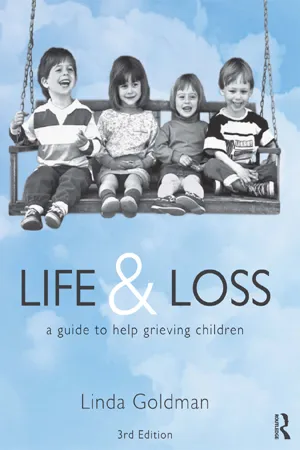
Many clinicians recognize that denying or ignoring grief issues in children leaves them feeling alone and that acknowledging loss is crucial part of a child's healthy development. Really dealing with loss in productive ways, however, is sometimes easier said than done. For decades, Life and Loss has been the book clinicians have relied on for a full and nuanced presentation of the many issues with which grieving children grapple as well as an honest exploration of the interrelationship between unresolved grief, educational success, and responsible citizenry. The third edition of Life and Loss brings this exploration firmly into the twenty-first century and makes a convincing case that children's grief is no longer restricted only to loss-identified children. Children's grief is now endemic; it is global. Life and Loss is not just the book clinicians need to understand grief in the twenty-first century—it's the book they need to work with it in constructive ways.
- 266 pages
- English
- ePUB (mobile friendly)
- Available on iOS & Android
eBook - ePub
About this book
Information
CHAPTER 1
CHILDREN’S LOSS AND GRIEF
There are two things we can hope to give our children One of these is roots; the other, wings.
—Hodding Carter III
WHAT’S THE MATTER WITH KIDS TODAY?
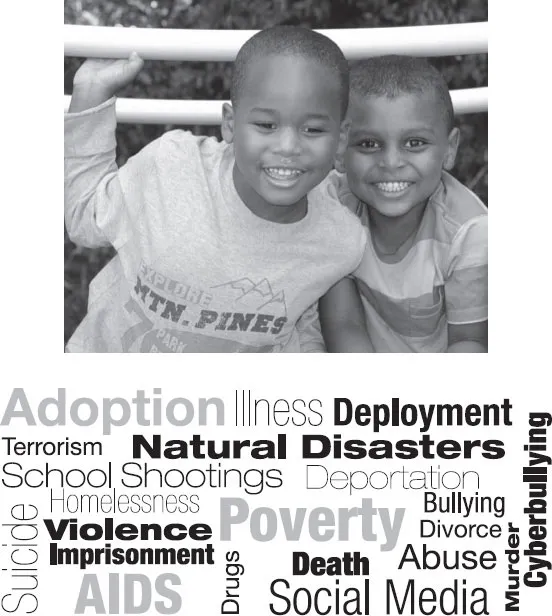
We may ask ourselves, “What’s the matter with kids today?” and realize the very fact that we are asking this question is in itself an answer. We adults have created this grieving world, and our children are left with its fear, its chaos, and its denial.
Donna O’Toole, children’s grief educator and author of Growing Through Grief (1989), warns that so often the children “are the forgotten ones, lacking role models and assurances for a safe journey, they accumulate losses—attaching themselves to their memories,” and can be left “frozen in time and buried alive in inner space” if they don’t have the opportunity to work through their feelings.
We ask ourselves, “What’s the matter with kids today?” The answer is that the world is very different from the one in which we grew up.
Today’s children witness violence daily. A little boy asked his teacher who George Washington was. “He was our first president” was the reply. “Who shot him?” he asked, automatically assuming all presidents get shot. In the movie, “Grand Canyon,” a teenager involved in gang violence was asked by his uncle, “Why are you doing this? What will you do when you’re 20?” “Are you kidding me?” The teenager responded, “I’ll be dead by 20.”
FACTS ABOUT THE GRIEVING CHILD
Today’s children live in a world of experiences and memories inundated with children’s loss and death issues. The following statistics illustrate the picture of the grieving child as the norm in the present millennium.
Each Day in America
2 mothers die in childbirth.
4 children are killed by abuse or neglect.
5 children or teens (die by) suicide.
7 children or teens are killed by firearms.
24 children or teens die from accidents.
67 babies die before their first birthdays.
208 children are arrested for violent crimes.
467 children are arrested for drug crimes.
892 babies are born at low birth weight.
1,208 babies are born to teen mothers.
838 public school students are corporally punished.
1,825 children are confirmed as abused or neglected.
1,208 babies are born without health insurance.
2,712 babies are born into poverty.
2,857 high school students drop out.
4,500 children are arrested.
4,475 babies are born to unmarried mothers.
16,244 public school students are suspended.
—Children’s Defense Fund (2013)
THE NORM IS THE GRIEVING CHILD
Death
The death of a parent, which is experienced by 4% of children in Western countries, is consistently rated as one of the most stressful life events that a child can experience.
Bereaved children had a threefold increased risk of depression.
—Melhem, Walker, Moritz, and Brent (2008)
More than 1.25 million children receive benefits as the result of their parent’s death.
—Paventi (2010)
Children’s Deaths by Guns
In 2007, 3,042 children and teens died from gunfire in the United States—8 every day—as a result of homicide, suicide, or accidental or undetermined shootings.
—Children’s Defense Fund (2010)
Attention Deficit Hyperactivity Disorder and Learning Disability
In 2006, NCHS (National Center for Health Statistics) estimated that 4.5 million school-aged children (5–17 years of age) had been diagnosed with ADHD and 4.6 million children with LD.
—Pastor and Rueben (2008, p. 5)
Children who lived in a mother-only family were more likely than those in a two-parent family to have each of the three diagnoses (ADHD without LD, LD without ADHD, and both conditions (children 6–17 years of age until 2006).
—Pastor and Rueben (2008, p. 3)
Divorce
Half of all divorces involve minor children, with 1 million children a year joining the ranks.
—Portnoy (2008)
Half of all marriages are expected to fail before a child reaches 18.
—Fagan, Fitzgerald, and Rector (2009)
Adoption
Approximately 120,000 children are adopted each year in the United States.
—American Academy of Child & Adolescent Psychiatry (2011)
Grandparents Raising Children
Almost 7.8 million children under age 18 live in homes where the householders are grandparents or other relatives (10.5% of all children under 18).
—AARP et al., citing 2010 U.S. Census
Single Parents
An estimated 13.7 million parents had custody of 22.0 million children under 21 yeas of age while the other parent lived somewhere else.
—Grall, 2011
Blended Family
Seventeen percent of all children under age 18 (12.2 million) live in blended families.
Forty-six percent of the children in blended families, or 5.5 million, live with at least one stepparent.
One in 10 children living with two parents lives with a stepparent or adoptive parent.
2.9 million children live with no parents (308,000 children live with one or more foster parents).
—Kreider (2007)
Economic Loss
Child poverty increased by almost 10% between 2008 and 2009.
A total of 15.5 million children, or 1 in every 5 children in America, lived in poverty in 2009, an increase of nearly 4 million children since 2000.
Almost 60% of all children in poverty lived in single-parent families.
In 2009, more than 1 in 3 Black children and 1 in 3 Hispanic children lived in poverty, compared to more than 1 in 10 White non-Hispanic children.
The number of homeless preschool-age children increased by 43% in the past two school years. The number of homeless children and youth enrolled in public schools increased 41% between the 2006–2007 and the 2008–2009 school years.
Millions of children and families fell into poverty in 2008 from the economic downturn.
—Children’s Defense Fund (2011, p. B2)
A record 46 million Americans were living in poverty in 2010.
Children under 18 suffered the highest poverty rate, 22%, compared with adults and the elderly.
—Morgan (2011)
Children With Imprisoned Parents
Fifty-three percent of the 1.5 million people held in U.S. prisons in 2007 were the parents of one or more minor children. This percentage translates into more than 1.7 million minor children with an incarcerated parent.
African American children are 7 and Latino children 2.5 times more likely to have a parent in prison than White children. The estimated risk of parental imprisonment for White children by the age of 14 is 1 in 25, while for Black children it is 1 in 4 by the same age.
—Justice Strategies (2011)
Deportation
Of the nearly 2.2 million immigrants deported in the decade ending 2007, more than 100,000 were the parents of children who, having been born in the United States, were American citizens.
—Falcone (2009)
More than 5 million children live in the United States with at least one undocumented parent. Close to 75% of those children are U.S. citizens. When one or both parents are deported, children often have to choose between living with their immediate family—in another country—or living without them in the United States.
—Reitmayer (2010)
TV Viewing
Preschoolers, aged 2 to 5, spend 32.5 hours a week in front of the television. Children aged 6 to 11 spend 28 hours a week.
—McDonough (2009)
Social Media Use
From 2005 to 2010, there has been a huge increase in ownership among 8- to 18-year-olds 18% to 76% for iPods and other MP3 players: from 39% to 66% for cell phones.
During an average day, 8- to 18-year-olds devote an average of 7 hours and 38 minutes to using entertainment media (more than 53 hours a week).
The proportion of young ...
Table of contents
- Cover
- Half Title
- Title Page
- Copyright Page
- Dedication
- Table of Contents
- Preface
- Acknowledgments
- Introduction
- 1. Children’s Loss and Grief
- 2. Myths of Grief
- 3. Four Psychological Tasks of Grief Work
- 4. Techniques for Grief Work
- 5. Preparing for a Good-bye Visit
- 6. Saying Good-bye to a Pet
- 7. The Child’s World of Technology
- 8. Family Diversity—The New Norm: Challenges for Children
- 9. Family Complications and Separation: Gone but Not Forgotten
- 10. Especially for Educators
- 11. The Global Grief Team
- 12. Let’s Explore Resources
- References
- About the Author
- Index
Trusted by 375,005 students
Access to over 1.5 million titles for a fair monthly price.
Study more efficiently using our study tools.
Frequently asked questions
Yes, you can cancel anytime from the Subscription tab in your account settings on the Perlego website. Your subscription will stay active until the end of your current billing period. Learn how to cancel your subscription
No, books cannot be downloaded as external files, such as PDFs, for use outside of Perlego. However, you can download books within the Perlego app for offline reading on mobile or tablet. Learn how to download books offline
We are an online textbook subscription service, where you can get access to an entire online library for less than the price of a single book per month. With over 1.5 million books across 990+ topics, we’ve got you covered! Learn about our mission
Look out for the read-aloud symbol on your next book to see if you can listen to it. The read-aloud tool reads text aloud for you, highlighting the text as it is being read. You can pause it, speed it up and slow it down. Learn more about Read Aloud
Yes! You can use the Perlego app on both iOS and Android devices to read anytime, anywhere — even offline. Perfect for commutes or when you’re on the go.
Please note we cannot support devices running on iOS 13 and Android 7 or earlier. Learn more about using the app
Please note we cannot support devices running on iOS 13 and Android 7 or earlier. Learn more about using the app
Yes, you can access Life and Loss by Linda Goldman in PDF and/or ePUB format, as well as other popular books in Psychology & Developmental Psychology. We have over 1.5 million books available in our catalogue for you to explore.