- 296 pages
- English
- ePUB (mobile friendly)
- Available on iOS & Android
eBook - ePub
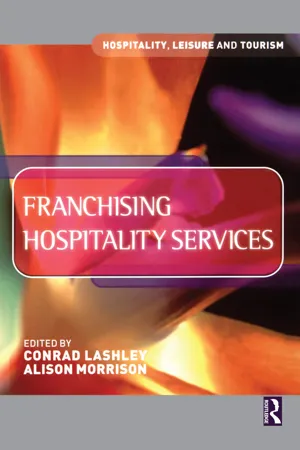
Franchising Hospitality Services
About this book
'Franchising in the Hospitality Industry' provides an overview of the issues, debates and challenges associated with business franchising.
In two parts, this text firstly looks at the issues from both an academic and practitioner perspective. The second part looks more closely at service sector groups in the hospitality industry, such as hotels, leisure and catering using national and international examples and illustrations. These demonstrate how the theories and debates discussed in the first part, are tackled in real life situations. Examples used are from well known companies such as McDonalds, Baskin Robbins, Burger King, Choice Hotels, Holiday Inn, Domino Pizza, Pierre Victoire amongst others.

Franchising
Organization and
Debates

An introduction
Key points
• Franchising represents a mode of organization that can be interpreted and understood from the perspective of the theory of the firm.
• In essence,sence, a business format franchise is concerned with the transference of intellectual property rights that provides both parties to the transaction with access to valuable benefits.
• The existence of franchising as an organizational form can be explained through two main theories: resource scarcity and agency.
• The key to any successful franchise strategy is that franchisors recognize as an economic imperative the importance of having an ongoing interest in, and relationship with, franchisees.
Introduction
In the second half of this century a major revolution in business organization occurred. Originating in the USA during the postwar economic boom of the 1950s, franchising emerged as a powerful new way of facilitating the growth of service organizations. It was to prove to have a particularly strong efficacy within the hospitality services sector and became readily adopted by many hotel, fast food and restaurant organizations. Indeed, in the USA today, it is almost certainly the dominant organizational mode across these sub-sectors. It is estimated that franchising accounts for 41 per cent of all retail sales in the USA, which amounts to some $800 billion annually. Behind these figures are 550,000 franchised businesses and 8 million employees. In the UK it is estimated that there are 29,100 franchised businesses employing around 273,000 people. Around an eighth of these franchises operate in the UK hospitality services sector (NatWest/BFA, 1998).
While franchising has historically been less prevalent in a UK and, more generally, the wider European context, here too in the past twenty years it has emerged as an important element of the hospitality services sector. Further afield, in the newly emerged markets of Asia and the Far East, franchising is proving to represent a major instrument of growth in the modern hospitality services sector. In many instances this reflects the internationalization of the US-developed franchising organizations such as McDonald's (fast food), Holiday Inns (hotels) and Starbucks (coffee). However, there has also been a growing trend of indigenously developed concepts such a Wimpy (UK), Jollibee (Philippines) and Novotel (France). Accordingly, franchising is not simply an American phenomenon, but rather represents a more fundamental development in business organization that enjoys an increasingly global presence in the hospitality services sector. None the less, the questions remain as to what actually is franchising and why has it proved to be so successful in recent decades?
What is franchising?
While this is a seemingly innocuous question, franchising as a concept can be characterized as one that has been subject to a wide range of definitions resulting in a great deal of confusion. As Price (1997) highlights in his seminal contribution to the franchising literature, this confusion, in part, stems from the disparate types of business relationships to which this term has been applied. Indeed, ‘franchising definition’ can almost be viewed as a stream of literature in its own right. It is not intended to revisit this debate here (see Chapters 2 and 10), but rather to adopt a more pragmatic approach with a view to delimiting the focus of this chapter and those that follow. The franchising context with which this book is concerned is business format franchising (which is sometimes referred to as second generation franchising) as this represents the franchising mode most frequently deployed within the hospitality services sector. However, it is worth noting that franchising as a concept has its origins in the tied public house system in eighteenth-century Britain (Stern, 1998). These origins are discussed in full in Chapter 9. The business format franchise involves the owner of a brand name and business system (the franchisor) transferring the right via a contract (the franchise agreement) to use this name and format to another party (the franchisee), usually for a fixed time period in a prescribed geographic area. In return, the franchisee agrees to pay an initial up-front fee and thereafter a royalty based upon a percentage of actual revenues generated (see Chapter 6).
In essence, a business format franchise is concerned with the transference of intellectual property rights (in the form of trademarks and technical know-how) that provides both parties to the transaction with access to valuable benefits. In the case of the franchisor, these benefits are primarily in the form of access to a means of rapid growth at a minimum level of capital investment (the franchisee is responsible for capital expenditure on plant and equipment), and the ‘recruitment’ of highly motivated owner–managers to operate the business units. For the franchisor this provides the basis for establishing the critical mass (minimum efficient scale) required to gain access to the benefits inherent in operating a chain of hotels or restaurants. The franchisee benefits from acquiring the rights to own and operate a proven business format while gaining access to a level of support (managerial assistance, marketing support etc.) typically found only in large chain hospitality organizations. A critical advantage frequently cited for the franchisee is a considerably reduced level of risk of failure compared to other small business start-ups. That said, in Chapter 3 Price controversially challenges the empirical foundations of such propositions. Furthermore, the extent to which franchisees can be classified as entrepreneurs is debatable given the high level of conformity typically inherent in a business format franchise (see Chapters 4 and 5).
Franchising and the theory of the firm
Within economics, approaches to the theory of the firm seek to provide explanations for the existence of the firm, its scale and scope or, in other words, its existence as a mode of economic organization. For our purposes here, these can be broadly grouped into two distinct literature streams (Foss, 1996). As will be demonstrated below, the foci of these research paradigms closely mirrors that of the two main theories advanced to explain franchising (Carney and Gedajlovic, 1991):
• the resource scarcity thesis, which shares some of the concerns of the knowledge perspective of the firm; and
• the agency thesis, which shares some of the concerns of the efficient contracting literature on the theory of the firm.
However, before turning our attention to these explanations of franchising per se, it is useful as a means of providing a wider theoretical context, briefly to review these two broad groupings of research which attempt to explain the existence of the firm.
The first stream of literature in the theory of the firm are those explanations which are concerned with and share a resource perspective (e.g. the resource-based view: Conner, 1991; Conner and Prahalad, 1996; and the literature sharing a more evolutionary focus: for example, Kogut and Zander, 1992). Here the focus is upon investigating successful firm growth strategies, their technological development and the creation of competitive advantage. In this first group of explanations the main emphasis is upon the role of valuable resources (capital, managerial, knowhow, reputation etc.) in the context of organizational growth and evolution. The resource-based category, is generally acknowledged to have its antecedents in the seminal contribution by Penrose (1959), The Theory of the Growth of the Firm, which was concerned with explaining firm evolution.
The second category of explanations are those which are concerned with the efficient contracting perspective (for example, Alchian and Demsetz, 1972; Williamson, 1975), where the focus is upon explaining firm existence, boundaries and internal organization. This efficient contracting approach has its origins in Coase's (1937) seminal contribution ‘The Nature of the Firm’, which posed the question: ‘why do firms exist?’. Coase argued that ‘the distinguishing mark of the firm was the suppression of the price mechanism’ (1937/1952, p. 334). Instead of using the price mechanism to co-ordinate external transactions, the firm utilized the power of fiat (authority) for internal co-ordination. The resultant dichotomy of markets versus hierarchies (which is also referred to as the ‘make or buy’ decision – albeit with the order of the terms reversed), has been an enduring theme within this literature stream. Ultimately, a primary concern here is the issue of organizational control.
Why franchise?
A central question that occupies academic researchers is why firms choose to expand through franchising (equivalent to the market mode and the ‘buy’ decision) rather than through company-owned units (equivalent to the hierarchy mode and the ‘make’ decision). Two reviews of the franchising literature (Elango and Fried, 1997; Fulop and Forward, 1997) suggest that it is possible to identify two competing theories in relation to this question. These are, as indicated above, termed resource scarcity (or resource allocation theory) and agency theory. The former is concerned with resource constraints to firm growth, while the latter is concerned with the issue of incentives and organizational control (Lafontaine and Kaufmann, 1994). As such, these two theories closely parallel the two literature streams on the theory of the firm outlined above. That this is the case should not be surprising as each seeks to offer an explanation for the popularity of franchising as a mode of economic organization and, in addition, why firms frequently operate a mix of franchised and company-owned units.
Resource scarcity theory
This stream of research explains franchising as being a response to a shortage of the necessary resources required for firm expansion, such as financial capital, labour capital, managerial talent (Oxenfeldt and Kelly, 1969; Norton, 1988a) or local market knowledge (Minkler, 1990). This view has its origins in the seminal work of Oxenfeldt and Kelly (1969), who suggested a life-cycle model of franchising in which a firm utilizes franchising as a means of overcoming resource constraints in the early stages of its growth. These constraints are typically seen as being mainly in relation to financial resources, although as Thompson (1994) has argued, a scarcity of managerial talent may be an even greater constraint for the growing organization. The desire for rapid early growth is associated with the need to achieve a minimum efficient scale and to develop the brand name capital that is so vital for retail oriented operations (Combs and Castrogiovanni, 1994). The life-cycle model suggests that as the firm grows in size, resource constraints ease and the firm will ultimately acquire the more profitable units operated by franchisees (see Thomas et al., 1990). Those in low volume locations where there is a danger of ‘free-riding’ in the form of lower investment, poor maintenance of quality standards and so on, by franchisees (see agency theory below in relation to this particular issue) will also tend to be acquired by the franchisor. Full vertical integration (i.e. full company ownership) will be avoided as greater economic benefits can be derived from quasi-vertical integration, albeit with a dominant percentage of company-owned units. Implicit in this view is that company ownership is the preferred mode of economic organization.
Hunt (1972) provided early empirical support for the Oxenfeldt and Kelly conjecture. He examined the US fast food industry and detected an aggregate trend towards company-owned units. Later research by Caves and Murphy (1976), which examined hotel, motel and restaurant sectors in the USA, reported similar findings. More recently, Anderson (1984) found evidence of a systematic increase in the percentage of franchisor-owned units over a ten-year period (Elango and Fried, 1997). None the less, subsequent reviews of this stream of research suggested that, while interesting, the empirical support for this ownership redirection thesis remains equivocal (see Dant et al., 1992, 1996). Indeed, data gathered over the period 1975 to 1990 indicate a very steady ratio of 80:20 in favour of franchised units (Trutko et al., 1993).
The resource scarcity thesis thus suggests that firms use franchising as a means of reducing financial and managerial constraints and to transfer a measure of risk from the firm to a franchis...
Table of contents
- Cover Page
- Half-Title Page
- Title Page
- Copyright Page
- Table Of Contents
- Editors and contributing authors
- Foreword
- Preface
- Part One Franchising Organization and Debates
- Part Two Franchising at Sub-Sector Level
- Index
Trusted by 375,005 students
Access to over 1.5 million titles for a fair monthly price.
Study more efficiently using our study tools.
Frequently asked questions
Yes, you can cancel anytime from the Subscription tab in your account settings on the Perlego website. Your subscription will stay active until the end of your current billing period. Learn how to cancel your subscription
No, books cannot be downloaded as external files, such as PDFs, for use outside of Perlego. However, you can download books within the Perlego app for offline reading on mobile or tablet. Learn how to download books offline
Perlego offers two plans: Essential and Complete
- Essential is ideal for learners and professionals who enjoy exploring a wide range of subjects. Access the Essential Library with 800,000+ trusted titles and best-sellers across business, personal growth, and the humanities. Includes unlimited reading time and Standard Read Aloud voice.
- Complete: Perfect for advanced learners and researchers needing full, unrestricted access. Unlock 1.5M+ books across hundreds of subjects, including academic and specialized titles. The Complete Plan also includes advanced features like Premium Read Aloud and Research Assistant.
We are an online textbook subscription service, where you can get access to an entire online library for less than the price of a single book per month. With over 1.5 million books across 990+ topics, we’ve got you covered! Learn about our mission
Look out for the read-aloud symbol on your next book to see if you can listen to it. The read-aloud tool reads text aloud for you, highlighting the text as it is being read. You can pause it, speed it up and slow it down. Learn more about Read Aloud
Yes! You can use the Perlego app on both iOS and Android devices to read anytime, anywhere — even offline. Perfect for commutes or when you’re on the go.
Please note we cannot support devices running on iOS 13 and Android 7 or earlier. Learn more about using the app
Please note we cannot support devices running on iOS 13 and Android 7 or earlier. Learn more about using the app
Yes, you can access Franchising Hospitality Services by Conrad Lashley,Alison Morrison in PDF and/or ePUB format, as well as other popular books in Business & Entrepreneurship. We have over 1.5 million books available in our catalogue for you to explore.