Small businesses are the backbone of the tourism and hospitality industry and, depending on which statistics one uses, represent somewhere between 75 to 95 percent of all firms globally in this sector. The number of entrepreneurs has dramatically and uniformly increased globally over the last ten years.
Divided into four sections, Entrepreneurship and Small Business Management in the Hospitality Industry takes an intuitive step-bystep progression through each stage of the entrepreneurial process: context, theoretical perspectives and definitions; Concept to reality; The business plan; Growth and the future.
Ideal for students at any level, the chapters of this book invite you to ponder upon your reading through a series of 'reflective practice' activities. These, along with case studies, clearly defined chapter objectives, reflections, role-play activities and experiential exercises, allow you to both think actively about themes, concepts and issues and then apply them to a number of suggested scenarios. Perfect preparation for the up-and-coming entrepreneur!

eBook - ePub
Entrepreneurship & Small Business Management in the Hospitality Industry
- 304 pages
- English
- ePUB (mobile friendly)
- Available on iOS & Android
eBook - ePub
Entrepreneurship & Small Business Management in the Hospitality Industry
About this book
Trusted by 375,005 students
Access to over 1.5 million titles for a fair monthly price.
Study more efficiently using our study tools.
Information
Index
BusinessCHAPTER 1
Context, Theoretical Perspectives and Definitions
After working through this chapter you should be able to:
■ Understand that defining entrepreneurship is problematic but hinges on an interplay between key personal attributes and appropriate environmental opportunities
■ Recognize key changes in the macro environment enabling increased entrepreneurial activity
■ Define small firms and identify their key characteristics and distinguish between entrepreneurs and owner/managers
■ Identify the contribution of small firms and entrepreneurism to the service and hospitality sectors of economies
INTRODUCTION
Most of us have an intuitive understanding of what entrepreneurs are due to much publicized activities of characters such as Richard Branson (Virgin), Anita Roddick (Bodyshop), Bill Gates (Microsoft) and others. The international hospitality industry of course has its own icons such as Charles Forte, Conrad Hilton and Ray Croc. Indeed, some of these figures have almost reached superstar status appearing on reality television programs and having cameo roles in movies. Therefore, it would be reasonable to suggest that most of us would link entrepreneurship with a particular personality trait or type and many writers have sought to do so (for example, see Hornaday 1982; Timmons Smollen, and Dingee, 1985; Lessem, 1986; Gibb, 1990; & Wickham, 1998). The likely ones here are ‘charismatic’ and ‘extrovert’. However, these characteristics are too simplistic to provide an adequate description of what constitutes the entrepreneur. Definitions of entrepreneurship emanate from several disciplines including the ‘great person’ school; classical and neoclassical economics; psychology; sociology; and management (Yeung, 2002). Other researchers have sought to explain entrepreneurship by linking it with national culture (for example see, Shane, 1995; McGrath, MacMillan, and Scheinberg, 1992; and Mueller and Thomas, 2001). Others including Meredith, Nelson et al. (1982) and Zimmerer and Scarborough (2005) have focused on the entrepreneurial environment. Therefore understandably, one single universal definition of entrepreneurship is problematic given its multidisciplinary nature.
Many writers agree with Kirby (2003) and Chell, Haworth & Brealey (1991) who state respectively that:
‘there is no agreed definition of…what constitutes…enterpreneurship’ (p. 10).
‘there is still no standard, universally accepted definition of entrepreneurship’ (p. 1).
Baumol (1993) goes further suggesting that:
“Any attempt at rigid definition of the term entrepreneur…[should] be avoided…because whatever attributes are selected, they are sure to prove excessively restrictive, ruling out some feature, activity, or accomplishment of this inherently subtle and elusive character” (p. 7).
However, if we stay with the idea of popular media icons, especially fictitious ones such as Dell Boy Trotter and Arthur Daley from UK television programs ‘Only Fools and Horses’ and ‘Minder’ in the 1990s it becomes fairly obvious that any definition must necessarily include elements of both the individual and the environmental opportunities present.
Excerpt from ‘Only Fools and Horses’ BBCTV, UK, 1983
1. Del Boy has just sold a number of broken lawnmower engines to his brother Rodney and business partner Mickey Pearce via an auction. Both Rodney and Mickey do not, as yet, realize that del is the vendor:
| Del: | I never thought I’d get rid of ‘em Rodney but you know me, ‘He who dares wins’. Actually, I’ve made a tidy little profit. |
| Rodney: | What are we gonna do with ‘em. |
| Del: | Why don’t you do what I did. Find yourself a couple of right little plonkers (idiots) with cash on the hip. |
Up until the end of the last century many definitions failed to consider the key role played by the environment upon entrepreneurs and entrepreneurial success and vice versa. Definitions tended to fall into two exclusive categories, one featured personality traits and behavioural characteristics of (for example, see Hornaday 1982; Wickham, 1998). However, others looked at the environment for situations where entrepreneurs were likely to develop and thrive (see Meredith, Nelson and Neck 1982; Zimmerer and Scarborough, 2005). Essentially, the area of entrepreneurship necessarily involves more than just a simple enquiry of who the person is and what they do or the environment. The phenomenon is a complex amalgam of both the individual and opportunity. Common sense suggests that any definition of entrepreneurship should include both dimensions by considering what Shane (2003) refers to as the individual–opportunity nexus. Given the above, it would seem reasonable to define the entrepreneur as:
‘…one who creates a new business in the face of risk and uncertainty for the purpose of achieving profit and growth by identifying significant opportunities and assembling necessary resources to capitalize on them’ (Zimmerer and Scarborough, 2005, p. 3).
Just as entrepreneurs are difficult to define so too is identifying a typical one as they come in all shapes and sizes from different educational, cultural and industrial backgrounds. However, using data from over 35 countries, Minniti, Bygrace and Autio (2006) help us to provide a composite picture of the entrepreneur. He or she is likely to:
■ Be based in a middle income country;
■ Survive in high income countries;
■ Be opportunity-driven as success if necessity-driven is less likely;
■ Not offer new products or services;
■ Own businesses likely to have limited or no growth potential;
■ Be between 25 and 34 years (early stage entrepreneurs);
■ Be a man;
■ Have post school or graduate qualifications; and
■ Be more likely to have confidence in own skills, know other entrepreneurs, be more alert to unexploited opportunities and less likely to let fear of failure prevent them from starting new business.
Adapted from: Minniti et al. (2006, pp. 10–11).
Key point 1.1
Defining entrepreneurs is difficult as they are a composite of variables. These include personal traits and characteristics and environmental enablers. Some argue that entrepreneurial success stands or falls by the right person being in the right place at the right time.
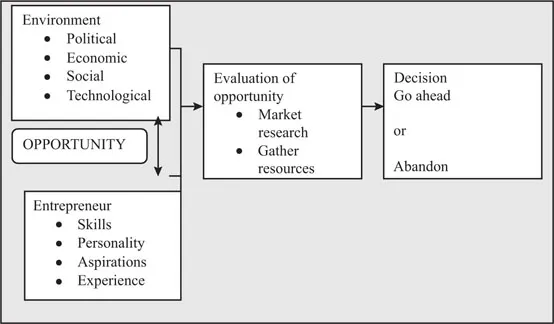
Using our above definition and type, entrepreneurs and entrepreneurship may now be understood as a certain individual or individuals (‘copreneurs’) engaged in the process of creating a new business venture as shown in Figure 1.1.
FIGURE 1.1 Entrepreneurial process of creating a new business venture.
Adapted from: Schaper and Volery (2004).
A key element here is the entrepreneur as the person who identifies an opportunity. The propensity for being able to spot a gap in the market is a difficult and complex area to describe. So too is identifying a sustainable competitive advantage setting the idea apart from the competition. Several authors have identified various specific traits (Hornaday, 1982; Timmons Smollen, and Dingee, 1985; Lessem, 1986; Gibb 1990; Wickham, 1998) believed to play a role in this regard, with locus of control, need for achievement and risk-taking being key. However, traits alone do not adequately explain entrepreneurial behaviour. Other elements such as aspirations, experience and cultural background undoubtedly make a contribution. Moreover, responding appropriately to the environment is also a fundamental enabler of new venture formation. The political, economic, social and technological landscape must therefore also be favourable for entrepreneurship to flourish.
Reflective practice
1. Can you think of a famous entrepreneur or someone you know would be recognized as an entrepreneur? To what do you attribute their success, luck, skill, talent, propensity for risk-taking, leadership ability or a combination of them?
Once an opportunity is identified, the potential venture must be assessed by various means at the entrepreneur’s disposal. There is no standard way of doing this and the complexity and extent of feasibility studies, business plans, marketing plans and so on will vary depending on the idea and the market. A decision has then to be taken whether to continue with the notion or to abandon it. Typically, decisions to pursue (or not) an entrepreneurial idea are taken within the context of either a ‘push’ or ‘pull’ environment. The former is where the individual has been made redundant or is unhappy with their current working conditions. The latter pull factors concern market attractiveness such as opportunity to increase personal wealth, personal development and status. Once all of these variables have been assessed, compared and scrutinized, a final decision to continue with the venture can be made. This is a crucial phase in the process and Figure 1.1 suggests that it is a rational one. However in practice, decisions to exploit an opportunity through venture creation are often a complete mystery! In other words, they appear to be illogical, especially if the rate of small business failures is anything to go by.1
Key point 1.2
Typically, entrepreneurial activity is initiated by push or pull factors. Push factors include, being made redundant, low level of income or general unhappiness with current employment. Pull factors include the chance of increasing personal wealth, chance to be own boss and status.
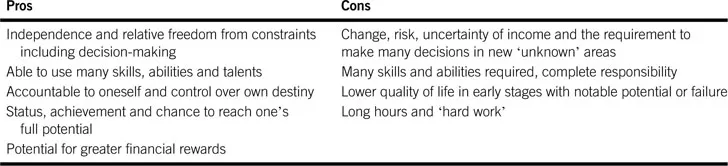
There are a number of reasons for business failure but most fall into the categories of managerial incompetence and lack of experience (Kirby, 2003). Another is that often, budding entrepreneurs become emotionally attached to their business ideas and, despite the odds, will pursue them even though objective evidence suggesting the contrary. This is particularly the case in the hospitality industry where individuals consistently fall in love with the idea of opening their own restaurant or public house or opt to become self-employed for non-economic reasons (see Thomas, Friel, Jameson, and Parsons, 1997). For example, there seems to be a notion that running a restaurant or bar is not really serious work at all. Besides, fraternizing and socializing with customers cannot be that difficult or taxing can it? Well actually, it can. In practice, owners will be working incredibly long hours occupying many different roles ranging from bar tender, bookkeeper, receptionist, room attendant, chef, wait person whilst at all times maintaining an air of ‘mein host’. Indeed, several studies have shown that a lengthy working hours contributes to early business failure (for example, see William and Collins, 1995). Therefore before taking the ‘plunge’, entrepreneurs should always remember not to ‘fall in love’ with the idea of owning and running their own business.
Reflective practice
1. Give some examples of business entrepreneurs who despite prevailing economic conditions or against advice of others continued with their dream; were they successful or unsuccessful?
There are undoubtedly benefits of being an entrepreneur but there are also a number of challenges; Table 1.1 provides a summary.
TABLE 1.1 Entrepreneurs: pros and cons
Adapted from: Zimmerer and Scarborough (1996) and Coulter (2001).
HISTORY, GOVERNMENT AND THE ECONOMY
Entrepreneurship is not a modern concept and the term is said to have originated with the 18th century economist Richard Cantillon who used it to describe someone who bore risk, made plans, organized and owned factors of production–land, labour and capital (Coulter, 2001). The term entrepreneur evolved over the next two centuries and with the advent of the industrial revoluti...
Table of contents
- Cover
- Halftitle
- Title
- Copyright
- Contents
- CHAPTER 1. Context, Theoretical Perspectives and Definitions
- CHAPTER 2. Indigenous And Ethnic Entrepreneurship: A Cultural Perspective
- CHAPTER 3. Entrepreneurs and Small Firm Ownership
- CHAPTER 4. Creativity and the Entrepreneur
- CHAPTER 5. Innovation, Opportunity and Protection
- CHAPTER 6. The Feasibility Analysis
- CHAPTER 7. The Family Business: Who’s to Bless and Who’s to Blame?
- CHAPTER 8. Hospitality, Commercial Homes and Entrepreneurship
- CHAPTER 9. Preparing a Business Plan
- CHAPTER 10. Leadership and the Entrepreneur: “I’m right Behind You Leading the Way”
- CHAPTER 11. Growth: the Harder I Work the Luckier I Get
- References
- Index
Frequently asked questions
Yes, you can cancel anytime from the Subscription tab in your account settings on the Perlego website. Your subscription will stay active until the end of your current billing period. Learn how to cancel your subscription
No, books cannot be downloaded as external files, such as PDFs, for use outside of Perlego. However, you can download books within the Perlego app for offline reading on mobile or tablet. Learn how to download books offline
Perlego offers two plans: Essential and Complete
- Essential is ideal for learners and professionals who enjoy exploring a wide range of subjects. Access the Essential Library with 800,000+ trusted titles and best-sellers across business, personal growth, and the humanities. Includes unlimited reading time and Standard Read Aloud voice.
- Complete: Perfect for advanced learners and researchers needing full, unrestricted access. Unlock 1.5M+ books across hundreds of subjects, including academic and specialized titles. The Complete Plan also includes advanced features like Premium Read Aloud and Research Assistant.
We are an online textbook subscription service, where you can get access to an entire online library for less than the price of a single book per month. With over 1.5 million books across 990+ topics, we’ve got you covered! Learn about our mission
Look out for the read-aloud symbol on your next book to see if you can listen to it. The read-aloud tool reads text aloud for you, highlighting the text as it is being read. You can pause it, speed it up and slow it down. Learn more about Read Aloud
Yes! You can use the Perlego app on both iOS and Android devices to read anytime, anywhere — even offline. Perfect for commutes or when you’re on the go.
Please note we cannot support devices running on iOS 13 and Android 7 or earlier. Learn more about using the app
Please note we cannot support devices running on iOS 13 and Android 7 or earlier. Learn more about using the app
Yes, you can access Entrepreneurship & Small Business Management in the Hospitality Industry by Darren Lee-Ross,Conrad Lashley in PDF and/or ePUB format, as well as other popular books in Business & Hospitality, Travel & Tourism Industry. We have over 1.5 million books available in our catalogue for you to explore.