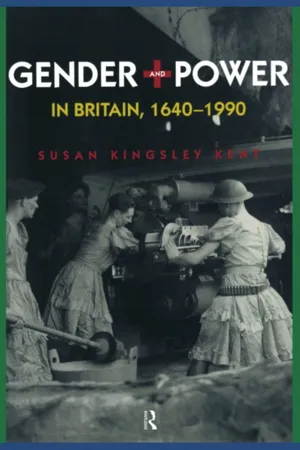
Gender and Power in Britain is an original and exciting history of Britain from the early modern period to the present focusing on the interaction of gender and power in political, social, cultural and economic life. Using a chronological framework, the book examines:
* the roles, responsibilities and identities of men and women
* how power relationships were established within various gender systems
* how women and men reacted to the institutions, laws, customs, beliefs and practices that constituted their various worlds
* class, racial and ethnic considerations
* the role of empire in the development of British institutions and identities
* the civil war
* twentieth century suffrage
* the world wars * industrialisation
* Victorian morality.
- 384 pages
- English
- ePUB (mobile friendly)
- Available on iOS & Android
eBook - ePub
Gender and Power in Britain 1640-1990
About this book
Part I
The seventeenth century
Gender and the crises of authority
GENERAL INTRODUCTION
The seventeenth century was marked by extraordinary change and upheaval. In every area of life – from the economy, to society, to religion, to politics, to the family – traditions, customs, and eternal verities faced challenge and resistance. On farms and in workshops, new capitalist methods of production and organization began to take hold, transforming the relations between landlords and tenants, masters and journeymen and -women. A new social grouping appeared – called “middling” because of their ranking between the landed gentry, who did no work, and the rest of society, who worked with their hands – which challenged the traditional exercise of power in society by the landed classes. In religion, puritans questioned the right of the bishops of the Church of England to organize religious life, and sought to implement their own godly order. In politics, many of these “middling” people, and puritans drawn from the gentry, resisted the efforts of the Stuart kings to rule absolutely, and fought a civil war in order to assert the supremacy of parliament. Within the family, sons challenged their fathers for the right to inherit property, and wives demanded more than mere spiritual equality with their husbands.
In every one of these areas, authority – the source of power in any given jurisdiction – came under direct assault. Throughout the seventeenth century, debates about the location of authority in the state, in the church, in society, and in the family raged, marking the period as, in the words of one of its most prominent historians, “the century of revolution.”1
Protagonists involved in these struggles over authority – puritans, parliamentarians, royal supporters, men and women of all ranks – often argued their points using metaphors of gender. Contemporaries frequently framed their support for a particular position about monarchical power, for instance, by comparing it to the power of the father in the family. By drawing upon current – and often contradictory – ideas about masculinity and femininity, about the natures of men and women, about the roles they played, and about the state of the relationship between parents and children, and husbands and wives, spokespeople for one side or another could hope to ground their arguments in “nature,” to justify them on the basis of what looked to society as the natural and, therefore, right and proper way to conduct affairs. By doing so, however, they often also forced a reconceptualization of the gender organization of their society; their opponents, disagreeing with their arguments about political authority, might be compelled to dispute the very premises on which the arguments were based – the ideas about masculinity and femininity, about the natures of men and women, about the roles they played, and about the state of the relationship between parents and children, and husbands and wives. Although new ideas about the family and about gender thrown up by struggles for power in the political, religious, economic, or social realm rarely had any immediate effect on the ways in which families, and men and women, went about their business on a day-to-day basis, they did operate to both open up and close down possibilities for individuals to rethink their place in the familial, political, and social order, which could produce longer-term changes in that order. By articulating the crises of authority of the seventeenth century in gendered and sexualized language, contemporary men and women also created crises of gender that would themselves have to be addressed as those of more conventional authority were resolved.
NOTES
1. Christopher Hill, A Century of Revolution (New York, 1975).
Chapter 1
Challenging authority at
mid-century
State, family, and society in 1600
The lands that comprised the “British Isles,” as they were known to map-makers and geographers in 1600 – England and Wales, Scotland, and Ireland – contained a vast array of peoples who perceived no common tie among themselves beyond that of geography. Differences of language, culture, history, law, customs, and religion divided the inhabitants of each kingdom. A single monarch, Queen Elizabeth, ruled over England and Wales; another, James VI, reigned in Scotland. During the twelfth century, Ireland had been conquered by Henry II and rendered a “lordship” of the English crown; in 1541, Henry VIII declared himself king of Ireland and commenced the process of bringing the country under the administrative purview of England. In a bid to secure their power in a now-protestant state, he and Elizabeth established “plantations” of loyal protestant followers in Ireland, massacring catholics, confiscating their lands, and granting them to English colonists. In 1608, the plantation of Ulster took place: James VI of Scotland, now also James I of England, ousted Gaelic landowners in five counties in the northern reaches of Ireland and transferred the land to Scottish and English protestants. More than 10,000 Scots ultimately came to settle there.
Early seventeenth-century Britons understood the world in which they lived to be fundamentally, properly, and irrevocably hierarchical. They imagined their social order to be a “great chain of being,” with God the Father and the angels at the top, followed by monarchs, aristocrats, gentry, and everyone else. Women held their various positions on the chain by virtue of their relationship to men as wives or daughters; as women, they were inferior and subordinate to men, as God had demonstrated in making Eve out of Adam’s rib. Moreover, Eve’s transgressions had stained all women with her sin. Construed as insatiably lustful, with sexual appetites equal to or greater than men’s, women of the seventeenth century were perceived to be potential agents of damnation and destruction, requiring the mastery of men to preserve their propriety and honor, and even the stability of the social order itself.
“Scientific” theories asserted women’s defectiveness relative to men. Where men were composed of hot and dry humors, early modern medical treatises declared that women were made up of the less perfect cold and wet humors. Women were, the medical men asserted, lesser men, the weaker vessel. Their passive role in reproduction – the womb serving merely as the receptacle and incubator for the active male seed in which all of the elements of life were contained – offered a “physiological” justification for their social, political, and legal disabilities.
Hierarchies of gender mirrored those of status based on land ownership in rural areas and on guild structures in the towns. Just as subjects of the crown knew themselves to be subordinate to their monarch, farmers knew themselves to be fully subordinate to their landlords, and apprentices and journeymen and -women to their guild masters, so too women understood themselves to be subordinate to their fathers and their husbands. Patriarchal rule – whether it be of master to man or man to woman – prevailed.
Patriarchy in state and society as well as in the family rested on the ancient presumption that the male head of household held property not simply in his land and his animals, but in his wife and his children as well. That property was to be handed down to the eldest son, part of the inheritance system known as primogeniture. Although never legally classified as chattel – property – of men, married English, Welsh, and Scottish women faced restrictions in common law that rendered them, for all intents and purposes, the property of their husbands. At the very least, common-law doctrines institutionalized the inferiority and subordination of women to men. Under the law of coverture, unique to England, married women had no legal existence apart from their husbands: they had no legal rights to property, to earnings, to freedom of movement, to conscience, to their bodies, or to their children; all belonged to their husbands. If a woman was raped, the crime was perceived as a form of theft, not from her, but from her husband or male relatives; cases of adultery were prosecuted only in those instances where the woman involved was married. Women lost their names when they married. All of these circumstances combined to suggest that women were the property of men in fact if not in law. Certainly they meant that women did not enjoy the autonomy, the independence, that was a vital prerequisite for formal political participation (which, indeed, most men did not possess either, though not because they were excluded by law). By 1600, only in rare and exceptional cases did individual women vote for or hold public office. In the Gaelic areas of Ireland where English common law did not prevail, married women may well have enjoyed a higher legal status and greater property rights. Gaelic women, it appears, could hold property and administer it as they saw fit, independently of their husbands.
In practice, the facts of demography, the existence of four other systems of law, and the need to ensure the survival of all members of the family tended to mitigate against the inheritance and legal disabilities of English, Welsh, and Scottish women, daughters, and younger sons experienced under common law.1 First, because death rates were so high and life expectancy so low compared to those in the late twentieth century, the inheritance patterns and legal disabilities enshrined in common law often did not come to pass as expected. Some 40 percent of marriages never produced a son; in that 20 percent of marriages that produced only daughters, they would inherit land jointly from their father. Even when marriages produced a son, it was very likely that he would not be of age at the time of his father’s death; thus, the inheritance would, for some time at least, pass into the hands of his mother to be administered by her until he turned twenty-one. Because married women regained their own legal identity upon the death of their husbands, mothers negotiated their children’s marriage agreements as often as did fathers.
Second, four additional systems of law enjoyed jurisdiction over property ownership and acted to ameliorate the severity of common law, especially as it pertained to women’s property and rights to inheritance. Equity courts, ecclesiastical law, manorial or borough law, and parliamentary statutes could be resorted to for much of the seventeenth century to preserve women’s and children’s property rights that common law did not recognize. Through equity, a father could establish the marriage portion his daughter took into a marriage as her own separate property. Upper-class women such as Lady Anne Clifford or Mistress Alice Thornton defended their property rights in drawn-out court cases, confident that custom and law would uphold their claims. Ordinary women, too, made marriage settlements that protected their property interests. Ecclesiastical courts, regulating the division of personal property rather than land, recognized a form of communal property within marriage and the division of parents’ wealth among all children equally. Manorial or borough courts determined the inheritance of land on a local basis, varying considerably according to location; in many places, all sons could expect to inherit a portion of the estate, a system known as partible inheritance. In London and other boroughs, married women could attain the special status of “feme sole trader,” giving them for business purposes – as long as their business was separate from their husbands’ – access to courts as if they were single women with their own legal identities.
Perhaps most importantly, the survival of individuals in the seventeenth century depended on the survival of the entire family; women’s material contribution to the family economy made the difference between life and death. New households could not set up until couples had obtained the necessary financial resources to sustain themselves and the children they expected to have – the availability of a plot of land or a cottage, the completion of artisanal training, the inheritance of a marriage portion. Wives were expected to bring to the marriage a dowry, also called a marriage portion, equal to the contribution that their husbands made. Fathers, aware that the most significant component of wealth consisted of an inheritance, tried to ensure that the inheritances they left their children were equal and sufficient for them to marry and set up households; what the eldest son received in land was very often matched in value by the moveable household goods left to the other children, though those children had no legal claim on them and were at the mercy of their fathers’ goodwill.
A lease to a cottage, a cow, a bed, clothing, utensils, tools – the inheritance of these items made it possible for daughters and younger sons to marry and set up independent households. They were not usually able to do so until relatively late in their life; men of ordinary rank married in their late twenties, women in their mid- to late twenties. Amongst the aristocracy, for whom marriage constituted a kind of alliance between powerful families, or the gentry, for whom it was the means by which family economic, social, and political interests were furthered, women and men married earlier, some in their mid-teens. They did not have to wait to amass the resources necessary to establish separate households.
The household was the site of economic activity; whether it be a farm or an artisanal workshop, work and family could not be separated from one another. The family economy characteristic of early modern society depended on the labor of all members of the household; marriage was above all an economic partnership. Within this economic enterprise, clearly demarcated spheres of activity for men and women provided the gender boundaries that ordered everyday life. In rural areas, men worked in the fields, free to travel fairly long distances from the household in order to farm and to labor for long undisturbed periods of time. Women tended to do work that was located closer to the house so that the constant interruptions of small children and the necessities of running a household could be accommodated. They looked after the raising of livestock, dairying, brewing, baking, and cultivation of vegetable gardens. Women sold the dairy and vegetable products at market and managed whatever household cash income there might be. This was so at all social levels, though in the case of the gentry and aristocracy, wives supervised rather than undertook these activities themselves.
In urban areas and those parts of the countryside where artisanal manufacturing took place, wives in workshops and small shops proved indispensable to the family economy. They sold the products of the workshop and provided for the needs of both family members and apprentices, who lived with the family as part of their apprenticeship agreement. In those families that depended primarily upon wages to survive, marriage age could be earlier, as the material prerequisites for setting up a household did not require waiting for a plot of land or a position in a workshop to come open. Because they married earlier, these parents might produce more children than those without waged income. The existence of wages might also mitigate against the companionship that must have developed among men and women as they worked together to sustain the enterprises that upheld the economic partnership that was marriage, as husbands and wives often had to work away from home. In professional families – the church, the law, medicine, teaching, the military, crown administration – where husbands worked away from home, women’s family lives were not so closely integrated with work. As with more ordinary people who had to leave home to find labor, work and home might be separate worlds. Among gentry, where neither husband nor wife worked, both nevertheless had to co-ordinate their efforts to oversee the management of the estates and to protect the interests of the families. In law and in custom, women might be the subordinate, inferior sex; in practice, their contributions to the family enterprise and the management of whatever cash income came in, without which the family could not survive, provided them with economic leverage.
Households were generally nuclear, that is, consisting of parents and children. Most families, except for the very poorest, contained live-in servants. The number of people living in these households varied according to social class, the kind of work families did, and the extent to which families relied on the labor of children to survive. Among ordinary people, economic survival could mean a constant balancing act between producing enough children to fulfill the necessary labor of farm or shop and not producing too many children so as not to outrun the ability to provide for them. The wealthiest households usually contained the greatest number of people in them because they could afford more servants and to keep adult children at home. In the middle of the sixteenth century, wealthy merchant families in Coventry contained an average of 7.4 people; the gentry some 6.6 people. The poorest households were also the smallest, containing perhaps only three or four people.
Fertility in any given family was most often a consequence of that family’s economic situation. Mortality rates, especially among infants under the age of one, were so high that women gave birth to a large number of children with the expectation that perhaps half of them would not live to see their twenty-first birthdays. Death rates among the infants of the upper classes were actually higher than among ordinary families: in upper-class families, parents sent their babies out to wet nurse, where they did not necessarily receive the care and attention that children who were nursed at home could expect from their mothers. Poor women who served as wet nurses for upper-class infants might neglect their own children in order to provide the milk for which they had contracted with upper-class parents. Because breast-feeding women are generally infertile, we can speculate that upper-class women, who did not generally nurse their children, and whose only other methods of contraception consisted of abstinence, coitus interruptus, or abortion, were not able to space their births as widely – between eighteen and twenty-four months – as the majority of ordinary women did. Upper-class women married earlier and were better nourished. Their birth rates, presumably, would have been higher, but we have little evidence that in fact they were any greater than those of ordinary people. Before 1650, across all social classes, women marrying before they reached the age of thirty had on average 6.4 children. Between 1650 and 1750, that number fell to between a range of 4.2 and 4.4; after 1750 it rose again to nearly six. We must remember that these figures represent only a static snapshot of families at any given time; they do not tell us how many children were stillborn, were born but did not live to adulthood, or how many women suffered miscarriages, a fairly common experience. Jane Josselin, for example, the wife of a seventeenth-century clergyman, miscarried fully a third of her pregnancies.
Marriage was the expected norm for all men and women, but the harsh realities of seventeenth-century life conspired to frustrate the realization of that ideal. Only some 10 percent of the English population did not ever marry (that percentage was higher for Scotland), but about one-third of the adult women at any given time were either single or widowed. High mortality rates among all age groups meant that the average marriage lasted no more than seventeen to twenty years, and although remarriage was common after the death of a husband, widows who did not have the resources to contribute to the setting up of another household, or who, conversely, had enough to live on without the contribution of a husband, tended not to remarry. Poor widows found themselves dependent upon their grown children, who, contemporaries believed, were more often than not reluctant to help them. In those cases where the support of children was not forthcoming, poor widows turned to parish relief, which could provide for only the most marginal existence. By far the greatest portion of those on poor relief were women.
Single women could anticipate few options. Because survival required membership in a household, most single women could not hope for an independent life....
Table of contents
- Cover Page
- Half Title page
- Title Page
- Copyright Page
- Dedication
- List of figures
- Acknowledgements
- Part I The seventeenth century Gender and the crises of authority
- Part II The eighteenth century Engendering virtue: politics and morality in the age of commercial capitalism
- Part III The nineteenth century “The angel in the house” and her critics: virtue and politics in the age of bourgeois liberalism
- Part IV The twentieth century Crises of conflict, crises of gender
- Index
Trusted by 375,005 students
Access to over 1.5 million titles for a fair monthly price.
Study more efficiently using our study tools.
Frequently asked questions
Yes, you can cancel anytime from the Subscription tab in your account settings on the Perlego website. Your subscription will stay active until the end of your current billing period. Learn how to cancel your subscription
No, books cannot be downloaded as external files, such as PDFs, for use outside of Perlego. However, you can download books within the Perlego app for offline reading on mobile or tablet. Learn how to download books offline
We are an online textbook subscription service, where you can get access to an entire online library for less than the price of a single book per month. With over 1.5 million books across 990+ topics, we’ve got you covered! Learn about our mission
Look out for the read-aloud symbol on your next book to see if you can listen to it. The read-aloud tool reads text aloud for you, highlighting the text as it is being read. You can pause it, speed it up and slow it down. Learn more about Read Aloud
Yes! You can use the Perlego app on both iOS and Android devices to read anytime, anywhere — even offline. Perfect for commutes or when you’re on the go.
Please note we cannot support devices running on iOS 13 and Android 7 or earlier. Learn more about using the app
Please note we cannot support devices running on iOS 13 and Android 7 or earlier. Learn more about using the app
Yes, you can access Gender and Power in Britain 1640-1990 by Susan Kingsley Kent in PDF and/or ePUB format, as well as other popular books in History & British History. We have over 1.5 million books available in our catalogue for you to explore.