Encountering the City provides a new and sustained engagement with the concept of encounter. Drawing on cutting-edge theoretical work, classic writings on the city and rich empirical examples, this volume demonstrates why encounters are significant to urban studies, politically, philosophically and analytically. Bringing together a range of interests, from urban multiculture, systems of economic regulation, security and suspicion, to more-than-human geographies, soundscapes and spiritual experience, Encountering the City argues for a more nuanced understanding of how the concept of 'encounter' is used. This interdisciplinary collection thus provides an insight into how scholars' writing on and in the city mobilise, theorise and challenge the concept of encounter through empirical cases taken from Africa, Asia, Australia, Europe, North America and South America. These cases go beyond conventional accounts of urban conviviality, to demonstrate how encounters destabilise, rework and produce difference, fold together complex temporalities, materialise power and transform political relations. In doing so, the collection retains a critical eye on the forms of regulation, containment and inequality that shape the taking place of urban encounter. Encountering the City is a valuable resource for students and researchers alike.
eBook - ePub
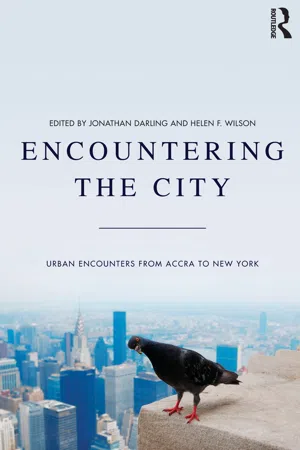
Encountering the City
Urban Encounters from Accra to New York
- 238 pages
- English
- ePUB (mobile friendly)
- Available on iOS & Android
eBook - ePub
About this book
Information
1 The Possibilities of Encounter
DOI: 10.4324/9781315579467-1
Introduction
Encounters, it seems, are everywhere and nowhere. The recent proliferation of work on encounters within Human Geography and across the social sciences demonstrates an emergent concern for engaging encounters as points of analytical interest. From the challenges of living with difference and negotiating diversity (Amin 2008; 2012; Wilson 2011; Watson 2006), to the possibilities of radical urban politics (Halvorsen 2015; Merrifield 2013), the concept of encounter has been variously name-checked, mobilised, valorised and critiqued (Valentine 2008; 2013). Yet despite the proliferation of interest there is a lack of critical attention given to questioning just exactly what it means to ‘encounter’. As a result, there is a risk that encounters become an ill-specified and under-theorised analytical category; a metaphor or concept stretched too far to accommodate an ever-widening array of social interactions, forms of contact and modes of relation (see Wilson 2016 for a critique of precisely this tendency). This volume sets out to address this lack of analytical specificity. It asks what the term ‘encounter’ is taken to mean in recent scholarly work, what sets it apart from other forms of relation and what a focus on encounter enables. Encountering the City thus aims to provide an insight into how a range of scholars writing on and in the city use, theorise and challenge the concept of ‘encounter’. By asking how it has been used as an analytical lens to explore a range of urban issues – from systems of economic regulation, security and suspicion, to more-than-human geographies, soundscapes and spiritual experience – we tease out some of the continuities that bring this work together and thus demonstrate how encounters have been variously conceptualised as events of relation (Wilson 2016; 2016a).
To take encounters seriously, we argue, is not about providing another metaphor for the social and material assembling of urban life. Rather, it is to critically attend to the many complexities, contestations and contradictions of contemporary urbanism, with a specific attention to difference. 1 As such, Encountering the City is concerned with encounter in all its varied forms and includes reflections on its temporal resonances and limits but also its spatial contours, conditions and possibilities. As a necessary starting point, the remainder of this introduction works to better conceptualise encounters. We begin by contextualising the recent interest in encounters and consider how this has been connected to the city as a key site of study. In so doing, concerns with practice, performance, materiality, difference and the political possibilities of the city come to the fore and provide an academic context from which a multifaceted ‘ontology of encounter’ might be seen to have emerged (Amin and Thrift 2002). With this background established, we demonstrate how encounters have been coded in particular ways. We argue that encounters are centrally about the maintenance, production and reworking of difference; that encounters fundamentally frame urban experiences and subjectivities; that encounters produce and encompass multiple temporal registers; and that encounters offer points of possible transformation and an opening to change. These four concerns shed light on how we might better understand encounters as distinct forms of relation. In so doing, we seek to address the lack of clarity and precision that has been notable in recent work on ‘encounter’, whilst outlining the value of taking encounter as an analytical site of study (see Wilson 2016). Having outlined these four concerns, we then move to summarise the key contributions of each subsequent chapter, highlighting the varied fields of study upon which they draw.
Urban encounters in context
We want to begin by placing the recent work on urban encounters in context and highlight two important lineages of social theory from which a concern with urban encounters has arisen. The first is the longstanding body of work that has positioned the city as a key site for the negotiation of difference, be this through staged forms of interaction or the propinquities of the urban everyday. The second, is a range of theoretical work that considers the excessive qualities of urban life, most notably drawing on non-representational modes of thought and ‘new materialist’ theories of practice, sensation and the everyday. In addition, we want to further situate a concern with urban encounters in relation to the political potentials of the city as a space of transformative capacity and relational interconnections. Here, we suggest that a concern with encounters is less prominent, yet there are significant and productive connections to be made, not least in discussions of political subjectivity, and the ‘mobile’ dimensions of urban policy. To situate Encountering the City, we take each of these areas of work in turn.
City difference, social mixing and moving beyond contact
Encounters are at the heart of work that has a long and deep-rooted history of celebrating the city as a site of ‘throwntogetherness’ (Massey 2005), where different, previously unrelated trajectories, objects and people come together (Amin and Thrift 2002; Fincher and Jacobs 1998; Jacobs 1961; Sandercock 2003; Watson 2006; Young 1990). For Lefebvre, encounters are what make the urban a site of ‘permanent disequilibrium’ (1996, 129), where ‘normalities and constraints’ are continuously dissolved. In this vein, it has been held that chance encounters between different people are what give urban life its ‘distinctive character’, liveliness and risk (Stevens 2007; Simmel 1903). This can be seen in Jacobs’ (1961, 50) much referenced celebration of the sidewalk, which described a site of vitality, improvisation and experiment, where trivial contact between strangers produced ‘intricate ballets’ of change and movement (Sandercock 2003; Stevens 2007; Tonkiss 2005; 2013; Wise this volume). In Jacobs’ writing on North American cities, regular and supposedly incidental encounters were central to the development of trust, respect and the organisation of public life. This is a sentiment notable in a wide range of work on urban civility and collective culture, which has traced the virtues of ‘public spaces that are open, crowded, diverse, incomplete, improvised, disorderly or lightly regulated’ (Amin 2008, 8; Laurier and Philo 2006a, 2006b; Watson 2006).
Linked to this celebration of the city and its interest in urban sociality has been a concern with ‘the stranger’ as one of the city’s defining figures (Ahmed 2000; Amin 2012; Diken 1998; Donald 1999; Schuermans this volume). A concern with the urban stranger reflects longstanding anxieties about the presence of unknown others in urban life. Drawing on Simmel’s (1903) pioneering analysis of the demands of modernity and its intensification of obligatory associations, considerations of urban sociality have foregrounded the aversion, repulsion and potential conflict that are attendant in urban street life (Amin 2012; Diken 1998; Donald 1999). Simmel’s analysis of the ‘stranger’ in the modern metropolis has thus been utilised as a reminder that urban sociality is never a wholly romantic or progressive affair (Parker 2011; Sennett 1970). At the same time, Ervine Goffman’s (1963) work on the ‘rules of conduct’ that shape public interactions has also been influential in critically questioning how people negotiate ‘strange’ encounters. Rules of conduct, he argued, play a key role in shaping the social organisation of gatherings and face-to-face interactions between the unacquainted. Goffman’s insights have thus laid the grounds for studies that have catalogued the norms, rules and procedures of interaction that shape encounters and compose urban life (Jensen 2006; Laurier and Philo 2006a; Wilson 2011).
From this work on urban sociality, whether the celebration of ‘thrown-togetherness’ or the negotiation of unknown others, we would highlight four interests that relate to the role of urban encounter. First, is with the ethical imperative to be open to the city’s alterity or ‘unassimilated otherness’ as part of a wider politics of cultural recognition (Young 1990, 314). This is about cherishing the city as a site where strangers can intermingle without the desire for homogeneity or idealised notions of community (Carter 2011; Fortier 2010), and is therefore focused on ensuring the democracy of city politics, rather than embracing encounters as a matter of pragmatics (Young 1990). Second, is a concern with the role of design in supporting the inter-mingling of strangers (Fincher 2003; Tonkiss 2013; Wood and Landry 2008). Premised on the assumption that declining opportunities for contact will result in the death of public space and a decline in sociality, Sennett’s (1978, 1991) writing has been particularly influential in promoting public interaction as a means to deter the longing for intimacy and insularity associated with private life. Work that has built on these ideas tends to advocate for something more than the general indifference that has often characterised descriptions of urban sociality (see van Leeuwen 2014 for a critique).
Third, and responding directly to some of the celebratory accounts of urban intermingling and its potential, Valentine’s (2008) intervention into discussions of living with difference, highlights a failure to outline exactly how encounters might build the respect, trust and dialogue that is so often present in accounts of urban possibility, accusing earlier writing on the city of ‘naivety’. Emerging from this intervention is an interest in the gap between values and practices and a recognition that positive encounters in public space do not necessarily address prejudice or private beliefs and values (Valentine and Waite 2012). 2 This work further builds on previous critiques. Amin and Thrift (2002) for example, emphasise just how unpredictable the dynamics of ‘mingling’ are (Amin 2002, 2008), while highlighting that the other sites, influences, connections and experiences that are significant to the formation of urban culture are regularly overlooked (Amin 2004). These critiques have resulted in calls for research into the more ‘irregular, haphazard and ordinary’ spaces of the city and for a better investment in the ‘complex and textured’ understandings of the people and places that are evoked by these debates (Watson 2006:14; Laurier and Philo 2006b).
Table of contents
- Cover
- Halftitle Page
- Dedication Page
- Title Page
- Copyright Page
- Contents
- List of Figures
- Notes on Contributors
- Acknowledgements
- 1 The Possibilities of Encounter
- 2 Mobilising Sentiment for Multiplicity
- 3 From Urban Talent to Commodity City: Encountering Marketplaces in the Informal Economy
- 4 Transspecies Urban Theory: Chickens in an African City
- 5 Atmospheric Politics and Entangled Encounters: Freedom Square in Tallinn
- 6 On the Politics of Vision and Touch: Encountering Fearful and Fearsome Bodies in Cape Town, South Africa
- 7 Encountering Keighley: More-than-Human Geographies of Difference in a Former Mill Town
- 8 Encountering Religion through Accra's Urban Soundscape
- 9 Art Tactics and Urban Improvisation
- 10 Working Across Class Difference in Popular Assemblies in Buenos Aires
- 11 Encountering Suspicion: Preemptive Security and the Urban Field of Suspects
- 12 Encountering Havana: Texts, Aesthetics and Documentary Encounters
- 13 Deadly and Lively Encounters
- 14 Encountering What Is (Not) There
- Index
Trusted by 375,005 students
Access to over 1.5 million titles for a fair monthly price.
Study more efficiently using our study tools.
Frequently asked questions
Yes, you can cancel anytime from the Subscription tab in your account settings on the Perlego website. Your subscription will stay active until the end of your current billing period. Learn how to cancel your subscription
No, books cannot be downloaded as external files, such as PDFs, for use outside of Perlego. However, you can download books within the Perlego app for offline reading on mobile or tablet. Learn how to download books offline
Perlego offers two plans: Essential and Complete
- Essential is ideal for learners and professionals who enjoy exploring a wide range of subjects. Access the Essential Library with 800,000+ trusted titles and best-sellers across business, personal growth, and the humanities. Includes unlimited reading time and Standard Read Aloud voice.
- Complete: Perfect for advanced learners and researchers needing full, unrestricted access. Unlock 1.5M+ books across hundreds of subjects, including academic and specialized titles. The Complete Plan also includes advanced features like Premium Read Aloud and Research Assistant.
We are an online textbook subscription service, where you can get access to an entire online library for less than the price of a single book per month. With over 1.5 million books across 990+ topics, we’ve got you covered! Learn about our mission
Look out for the read-aloud symbol on your next book to see if you can listen to it. The read-aloud tool reads text aloud for you, highlighting the text as it is being read. You can pause it, speed it up and slow it down. Learn more about Read Aloud
Yes! You can use the Perlego app on both iOS and Android devices to read anytime, anywhere — even offline. Perfect for commutes or when you’re on the go.
Please note we cannot support devices running on iOS 13 and Android 7 or earlier. Learn more about using the app
Please note we cannot support devices running on iOS 13 and Android 7 or earlier. Learn more about using the app
Yes, you can access Encountering the City by Jonathan Darling,Helen F. Wilson in PDF and/or ePUB format, as well as other popular books in Politics & International Relations & City Planning & Urban Development. We have over 1.5 million books available in our catalogue for you to explore.