- 424 pages
- English
- ePUB (mobile friendly)
- Available on iOS & Android
eBook - ePub
About this book
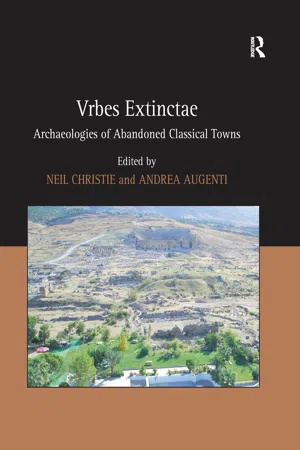
Core tourist sites for the classical world are the ruins of those many and scattered examples of 'lost' and abandoned towns - from Pompeii to Timgad to Ephesus and Petra. Usually studied for their peaks and growth, rarely are their ends explored in detail, to consider the processes of loss and also to trace their 'afterlives', when they were often robbed for materials even if still hosting remnant populations.This volume breaks new ground by examining the phenomenon of urban loss and abandonment from Roman to medieval times across the former Roman Empire. Through a series of case studies two main aspects are examined: firstly, the sequences and chronologies of loss of sites, roles, structures, people, identity; and secondly the methodologies of study of these sites - from early discoveries and exploitation of such sites to current archaeological and scientific approaches (notably excavation, urban survey, georadar and geophysics) to studying these crucial centres and their fates. How can we determine the causes of urban failure - whether economic, military, environmental, political or even religious? How drawn out was the process of urban decay and abandonment? What were the natures of the afterlives of these sites which archaeology is beginning to trace? How far does scrutiny of these 'extinct' sites help in discussion of archaeological trajectories of sites that persisted? The fourteen core chapters in this collection consider specific examples and case studies of such 'lost' classical cities from across the many Roman provinces in order to address these questions. Bringing together an array of archaeological and historical voices to share views on and findings from excavations and surveys of 'failed' towns, this volume offers much to scholars of Roman, late antique and early medieval and medieval archaeology and history.
Chapter 1
Vrbes Extinctae: Archaeologies of and
Approaches to Abandoned Classical Cities
‘Se tu riguardi Luni e Orbisaglia
come sono ite, e come se ne vanno
di retro ad esse Chiusi e Sinigaglia,
udir come le schiatte si disfanno
non ti parrà nova cosa né forte,
poscia che le cittadi termine hanno’
(Dante Alighieri, Divine Comedy – Paradise, XVI. 73–79: ‘Consider Luni, Urbisaglia, how they went to ruin (Senigaglia follows, and Chiusi, too, will soon have vanished); then, if you should hear of families undone, you will find nothing strange or difficult in that, since even cities meet their end’)
Introduction
Ostia, Paestum, Wroxeter, Tiermes, Conimbriga, Gorsium, Narona, Olbia, Timgad, Palmyra, Ephesus, Apameia, Amorion… These are all important sites, well known to many archaeologists and ancient historians, which all played significant roles in the political, economic and religious lives of the provinces in which they lay within the classical and late classical world. Their monuments, inscriptions, streets, tombs, coins and ceramics all help tell stories of urban origins, growth, prosperity, populations, hardships, and decay. They are all, however, ‘lost’ sites in the sense of now being abandoned ruins, devoid of a major modern successor, even if now ‘found’ by archaeologists and tourists alike. To the general visitor these are of course also the ‘classic’ sites, places where imagination can be released and where one can better grasp what it may have been like to live in such a city or town of stone, brick and marble many centuries past; monumental buildings like public baths and theatres may seem both alien and familiar, but being able to walk into rooms, courtyards and gardens helps populate such spaces with people like ourselves. Roman Pompeii encapsulates so much of this, since the scale of preservation there and its ‘frozen’ state (even if the eruption of Vesuvius and the subsequent traumas of ash, pumice, heat and dust, were anything but cold) make it somehow more ‘real’. Similar are the less well known but equally inspiring abandoned Byzantine ‘villages’ and small towns in Syria, such as Serjilla, Schinschara and Dehes, with various fine stone-built public and private structures preserved to roof and pediment level, scattered among gardens and fields, and quitted seemingly at pace in the sixth or seventh centuries (Tchalenko 1953–58; Sodini et al. 1980; cf. Dalrymple 1998, 177–84. Stunning aerial photos are presented in Gerster and Wartke 2003, 48–51).
Frequently these sites are the ones that appear as illustrations in text books discussing Rome’s decline and fall, and are the core sites exploited when books explore classical urban plans, temple designs, entertainment structures, ancient roads and houses, and so on. They are atmospheric and evocative and point to lost and distant pasts (a nice example is Ascherson 1996, 67–79, who conjures up well the rise, fall, loss and rediscovery of Olbia, the ancient Greek colony on the northern shores of the Black Sea). But for many regions of the old Roman Empire, both West and East, these ‘lost’ sites are in a minority of centres that failed to continue – if sometimes stumbling – as active urban seats into the post-Roman, early medieval, medieval and modern eras. Thriving and less thriving modern cities and towns such as York, Chester, Paris, Marseilles, Trier, Barcelona, Turin, Sopron, Geneva, Syracuse, Thessaloniki, Ankara, Jerusalem and Djemila have Roman or Greek roots which were planted firmly enough to enable largely continuous human presences and administrative, religious and economic activities: locations at communications nodes (by sea, river and land and combinations of each), the availability of suited hinterlands, the assigning of specific territorial roles, and the gathering of participating elites and populations provided the core ingredients for success, combined, frequently, with provision of artificial defences and human resiliences. Such active and continuous towns are of course far more challenging artefacts: for historians these centres provide ever accumulating documentary sources; architecturally they grow more ‘permanent’ with bigger buildings and deeper foundations, and yet are ready to regularly re-design themselves; and demographically they spill far beyond any ancient confines and merge with once distinct rural communities. To archaeologists the challenges lie in the impact of this continued growth and modernisation: often substantial loss of ancient deposits; a fragmentation and disturbance of other buried deposits; a detachment of deposits and urban body parts; restricted access to built spaces; recognition of specific losses (houses, old street fronts, burial populations); sometimes prohibitive depths to early deposits; communication between the scattered data; and urban recession and limited urban development preventing archaeological access. Accordingly archaeological images for some current cities may be underdeveloped, yet in others fairly advanced: thus, for example, for Pavia in northern Italy, despite a good number of archaeological interventions and recognitions through rescue excavations, research-led explorations, watching briefs, plus records of finds since the eighteenth century, their scale and scattered nature means a still imprecise understanding prevails of Roman public structures and urban design, late Roman trajectories and urban change in the early Middle Ages prior to the much more tangible twelfth-century cityscape with its walls, street systems, and churches. More is known of church and monastic impositions and growth as these (e.g. Santa Maria delle Cacce, San Sisto, but also the Torre Civica adjoining the cathedral) have been the preferred archaeological focus (Blake 1995; Nepoti 2000). In contrast, major redevelopment in the eastern (Santa Giulia) zone of the historic core of Brescia (c. 60 km distant from Pavia) enabled substantial and highly influential research excavations from 1980 to 1992, providing notable insights into Roman town planning, public monumental evolutions, domus evolution and decay, sixth-century depopulation, early medieval housing and burials, eighth-century revitalisation, and medieval religious and economic expansion (Brogiolo 1993 and 1999b, and Brogiolo et al. 2006 as the main excavation and finds volumes, but with many related articles).
In theory, therefore, the ‘lost’ sites offer far more scope to explore and understand aspects, structures, and sequences of classical and post-classical life which can otherwise only ever be partially traced and interpreted in these continuously occupied towns. At the same time, however, does the failure of a site make the settlement archaeology at these extinct centres less representative? In other words, do the finds and sequences, even if fragmentary, provide a more reliable guide to human efforts to live in and work in towns? Arguably, the answer varies depending on the questions asked: abandoned towns surely will provide the greatest scope to chart urban form and development across the prime periods of classical activity and in particular will reveal much more of private spaces and individual presences, since the private spaces are frequently the most damaged components in the archaeologies of continuously occupied towns. Having available full building plans and being able to recognise relationships with adjoining units and roads, etc. enables discussion on context, neighbourhoods, exploitation of space, services, and so on. Questions of transitions – from pagan to Christian, from Roman to Byzantine or to early medieval, from stone to timber technology, from wide to narrow economic participation – may also be tackled most easily from exploration of abandoned sites, which may yield more coherent stratigraphic sequences to chart changing material cultures, in contrast with the problem of residuality that affects the archaeologies of active towns. Indeed, the latter reveal how the past urban histories are actively reused, recycled, churned up, dug down into, replaced, remodelled, built over, and cleared, the layering of such activities in some cities like Rome reaching up to 10 or more metres of depth from modern to ancient ground levels. Robbing and reuse are frequently met on abandoned sites too, but on a far reduced scale and will tell us more of non-urban afterlives to these sites rather than the ways that living urban communities persisted and exploited the past.
But each town is different and abandoned sites conform to no norm: their ends vary by context and place; their ends can be drawn out over generations or centuries; their urban status may remain in documents; their ruins may be heavily robbed or selectively exploited; components may persist to dictate specific afterlives, whether religious or military; nature may reclaim some or none of their space. Yet the same is true for living towns: each differs in social, economic, structural and physical trajectory; demographics and their density and wealth will impact on intramural space, suburban growth, investment in buildings and walled space; success will mean greater growth and damage to the underlying past; economic stability may mean growth is restricted rather than substantial; and local, regional and wider roles play a major part in the presence and scale of, for example, markets, industries, religious institutions, and civic structures.
These are issues all archaeologists and historians are aware of. What matters is that despite these differences, each instance provides more information on how classical and post-classical towns looked and worked, the ranges of structures and services in these, and the populations that lived in and used them. The fuller our studies, the fuller and richer the data gathered on all these aspects. Vrbes extinctae are therefore vital archaeological resources and while some have suffered already through eager, early exploration, clearance and restoration, the majority retain much that is still to be examined and their careful investigation and assessment are essential. As important are issues of what should be left untouched, ways of preventing damage from people, tourism, animal and environment (notably exposure to the air and climate), and creating suited strategies for study and heritage preservation (see papers in Amendolea 1995 – e.g. Lentini 1995 on the archaeological park for the Greek colony site of Naxos in Sicily). Below are considered some of the questions we should be asking, with my examples drawn principally from Italy; other papers in this volume explore individual sites from elsewhere in the old Empire (Roman and Byzantine) and show the ways that their archaeologies and landscapes are now being questioned and developed.
Questioning Loss and Decline in Late Roman and Early Medieval Italy
First we might question what is meant by ‘lost’ or ‘extinct’. As noted above, Pompeii is extinct as a Roman town, but hardly lost in modern eyes, and its archaeology and monuments are more than active as points of academic study and touristic admiration. Indeed, its site was long remembered in Roman times and the extended history of exploration of its buried remains and extraction of artworks from the sixteenth century through into concerted excavation campaigns in the nineteenth and twentieth centuries is well known (Cooley 2003). Here, too, a modern town gathers round the ancient one, if less immediate than the presence of a modern township directly over nearby Herculaneum. A contrast thus lies with Rome’s ports of Ostia and Portus – the latter on private land, its hexagonal harbour a visible feature from planes taking off from Fiumicino airport, and with many remains hidden beneath tree cover; and the former a largely open site, the scene of extensive excavations (with Mussolini a prime mover in exposing much to clear down to solid Roman levels), but with much unexcavated space still under grass to north and south of the displaced river Tiber; here the medieval successor township lies away to the east and does not impinge on the archaeological site. Ostia is of course a site with an extended history, a failed port-town that did not disappear overnight, but saw sizeable changes in its role and population from the third century onward, its economic and mercantile role shrunken as Portus took priority; there was an attraction of elite to the old city in the fourth and fifth centuries, with domus and new fountains imposed while other structures faded and were robbed, with ready recycling and storage as well as transfer of marbles, columns, and statuary; then came sixth-century decay (still poorly understood) and likely massive shrinkage of the residual population to a settlement (and Church) nucleus at the Christian basilica of Pianabella in the southern suburbs; this eventually ended with efforts by Pope Gregory to re-found the city, partly as a defended site to counter Arab threats in the mid-ninth century (the present township of Borgo di Ostia is presumed to overlie this Gregoriopolis). Here, however, memory of Ostia antica never faded, the site being regularly exploited and robbed by popes, especially for marble and artworks across the Middle Ages. Its extended life and demise therefore provide much material for debates on late Roman to early medieval change – in public and private space, economics, reuse, Christian imprints, breakdowns in services and amenities – and yet the emphasis has long been on charting the Roman heyday (the core text being Meiggs 1973, revisited in Gallina Zevi and Claridge 1996), if with slowly developing efforts to understand the post-classical archaeologies (NB Paroli 1993 and 1996, with Pensabene 2000 on reuse of marbles, etc.; cf. Coccia 1993 and 1996 on Portus, and Keay et al. 2005 for major project work at the site; see summaries also in Augenti 2010, 39–43).
The Ostia example throws up a series of points and possibilities. Was there a single root cause for the city’s demise? Were economic changes the prime factor, in terms of shifting emphasis across to Portus? This may well explain losses in warehousing and some population loss (with port workers, traders, clerks and officials relocating also to Portus), but, arguably, income from trade was also what fuelled the appearance of well-to-do housing in the fourth century at Ostia. The provision of a bishop and substantial episcopal church in the south of the city (at the expense, it seems, of older house blocks), plus the building of other churches, including at suburban Pianabella, reflect likewise an ongoing urban concern. Current survey, allied with small scale excavation work and cleaning in some of the core zones, meanwhile is indicating a town with a much tidier image in c. AD 400 than previously assumed (for the Kent-Berlin project – see http://lateantiqueostia.wordpress.com/historical-overview/). Did insecurity play a role in decline? Fifth-century assaults by Alaric’s Visigoths and later by Vandals damaged both ports: Portus may have seen a reduced and fortified harbour and port fabric, and more goods may have been trans-shipped to be taken more promptly by canal to Rome, but Ostia may well have faced a loss of its elites, although data for determining when many of the domus went out of use are as yet limited. Material finds from domestic deposits and dumps certainly show traded items still circulated in Ostia in the sixth and seventh centuries, although some of the churches had probably deteriorated by then. Insecurity is seen as core in the creation of ninth-century Gregoriopolis and the presumed relocation of the residual population (or the importing of new colonists), although Paroli has argued that this fortified centre was as much to safeguard saltworks her...
Table of contents
- Cover Page
- Title Page
- Copyright Page
- Contents
- Preface and Acknowledgements
- List of Illustrations
- List of Contributors
- 1 Vrbes Extinctae: Archaeologies of and Approaches to Abandoned Classical Cities
- 2 Classe: Archaeologies of a Lost City
- 3 Potentia: A Lost New Town
- 4 After the Rats: Cosa in the Late Empire and Early Middle Ages
- 5 Urban Change on the Balearics in Late Antiquity
- 6 Recopolis
- 7 Deciphering ‘Lost’ Urban Landscapes at Cyrene
- 8 An ‘Ice Age settling on the Roman Empire’: Post-Roman Butrint between Strategy and Serendipity
- 9 Memory and Loss in the Late Antique Cities of Knossos and Sparta
- 10 Hierapolis of Phrygia: The Drawn-Out Demise of an
- 11 Dura Deserta: The Death and Afterlife of Dura-Europos
- 12 Calleva Atrebatum (Silchester, Hampshire, UK) An Early Medieval Extinction
- 13 Concluding Remarks. A Tale of Many (Lost) Cities Past, Present and Future
- Index
Trusted by 375,005 students
Access to over 1.5 million titles for a fair monthly price.
Study more efficiently using our study tools.
Frequently asked questions
Yes, you can cancel anytime from the Subscription tab in your account settings on the Perlego website. Your subscription will stay active until the end of your current billing period. Learn how to cancel your subscription
No, books cannot be downloaded as external files, such as PDFs, for use outside of Perlego. However, you can download books within the Perlego app for offline reading on mobile or tablet. Learn how to download books offline
Perlego offers two plans: Essential and Complete
- Essential is ideal for learners and professionals who enjoy exploring a wide range of subjects. Access the Essential Library with 800,000+ trusted titles and best-sellers across business, personal growth, and the humanities. Includes unlimited reading time and Standard Read Aloud voice.
- Complete: Perfect for advanced learners and researchers needing full, unrestricted access. Unlock 1.5M+ books across hundreds of subjects, including academic and specialized titles. The Complete Plan also includes advanced features like Premium Read Aloud and Research Assistant.
We are an online textbook subscription service, where you can get access to an entire online library for less than the price of a single book per month. With over 1.5 million books across 990+ topics, we’ve got you covered! Learn about our mission
Look out for the read-aloud symbol on your next book to see if you can listen to it. The read-aloud tool reads text aloud for you, highlighting the text as it is being read. You can pause it, speed it up and slow it down. Learn more about Read Aloud
Yes! You can use the Perlego app on both iOS and Android devices to read anytime, anywhere — even offline. Perfect for commutes or when you’re on the go.
Please note we cannot support devices running on iOS 13 and Android 7 or earlier. Learn more about using the app
Please note we cannot support devices running on iOS 13 and Android 7 or earlier. Learn more about using the app
Yes, you can access Vrbes Extinctae by Andrea Augenti, Neil Christie in PDF and/or ePUB format, as well as other popular books in History & Ancient History. We have over 1.5 million books available in our catalogue for you to explore.