eBook - ePub
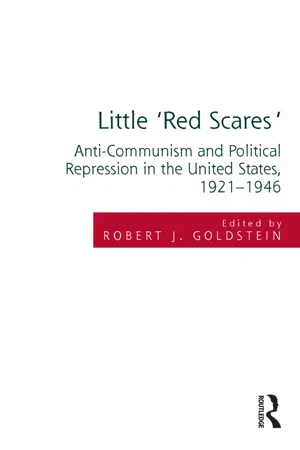
Little 'Red Scares'
Anti-Communism and Political Repression in the United States, 1921-1946
- 380 pages
- English
- ePUB (mobile friendly)
- Available on iOS & Android
eBook - ePub
Little 'Red Scares'
Anti-Communism and Political Repression in the United States, 1921-1946
About this book
Anti-communism has long been a potent force in American politics, capable of gripping both government and popular attention. Nowhere is this more evident that the two great 'red scares' of 1919-20 and 1946-54; the latter generally - if somewhat inaccurately - termed McCarthyism. The interlude between these two major scares has tended to garner less attention, but as this volume makes clear, the lingering effects of 1919-20 and the gathering storm-clouds of 'McCarthyism' were clearly visible throughout the 20s and 30s, even if in a more low-key way. Indeed, the period between the two great red scares was marked by frequent instances of political repression, often justified on anti-communist grounds, at local, state and federal levels. Yet these events have been curiously neglected in the history of American political repression and anti-communism, perhaps because much of the material deals with events scattered in time and space which never reached the intensity of the two great scares. By focusing on this twenty-five year 'interim' period, the essays in this collection bridge the gap between the two high-profile 'red scares' thus offering a much more contextualised and fluid narrative for American anti-communism. In so doing the rationale and motivations for the 'red scares' can be seen as part of an evolving political landscape, rather than as isolated bouts of hysteria exploding onto - and then vanishing from - the political scene. Instead, a much more nuanced appreciation of the conflicting interests and fears of government, politicians, organised labour, free-speech advocates, employers, and the press is offered, which will be of interest to anyone wishing to better understand the political history of modern America.
Chapter 1 After the Red Scare
Civil Liberties in the Era of Harding and Coolidge
DOI: 10.4324/9781315592732-1
As Warren Harding took office in March 1921, the United States had just come through the worst self-inflicted assault on its tradition of civil liberties in the nation’s history. In 1798 John Adams had jailed some of his Jeffersonian critics; later the rights of abolitionists had been trampled by mob violence and a Congressional gag rule; and during the Civil War Lincoln had claimed emergency powers to suspend habeas corpus and silence Copperhead Democrats. But none of these compared to the wide and systematic assault on pacifists, labor radicals and war dissenters during the Great War and its immediate aftermath. Young men with conscientious objections to the draft had been jailed, and often physically and mentally abused; thousands of men and women were arrested by state and federal authorities for making anti-war statements the government considered seditious; the Post Office punished anti-war newspapers and magazines; and where state action failed to silence war critics, mobs intimidated, beat and even lynched those suspected of insufficient patriotism.
The beleaguered advocates of free speech could only shake their heads over the contradiction—the Wilson administration leading the charge to silence dissent and impose uniformity of thought, all in the name of a supposedly progressive “People’s War” that promised to “make the world safe for democracy.” In order to fight German militarism, the United States had created what the American Civil Liberties Union’s Roger Baldwin called “new machinery for the suppression of opinion [and] traditional rights.” Surveying the American scene as Woodrow Wilson left office in 1921, he concluded that “the forces of reaction” enjoyed unprecedented power over the nation’s political and economic life. “Never before were the civil rights guaranteed by constitutional provision so generally ignored and violated.”1
Those who shared Baldwin’s concern about these threats to constitutional liberty had little reason to expect much relief from president-elect Warren G. Harding, an amiable but undistinguished Ohio politician who seemed unlikely to play a strong leadership role on any issue, much less one as controversial as the rights of radicals. During the war, in fact, the senator seemed to lose his usual composure in the face of the national emergency, declaring that the government should shoot all spies, and place its war effort in the hands of a single “supreme dictator.” “We have a republic to save,” as he explained. “We can’t do it with the processes of a republic.”2
Yet President Harding deserves some credit for reversing Wilson’s course. As part of his program to roll back the federal government’s wartime activism and restore the country to a pre-war “normalcy,” he curtailed much of the federal government’s legal campaign against radical dissenters. But the more important gains for civil liberties in the early 1920s came not from any political leader in Washington, but from citizens, organized in various social movements, who put civil liberties on the national agenda for the first time in the nation’s history.
In the two years before Harding took office the country experienced a sharp recession and a series of violent labor conflicts, while across Europe governments struggled against the threat of communist revolution. In those anxious days, many Americans criticized the Wilson administration for not being sufficiently zealous in rooting out the Bolshevik threat. After his own house was bombed by a radical, Attorney General A. Mitchell Palmer vowed “unflinching, persistent and aggressive warfare” against America’s enemies within. More than two years after the 1918 armistice, Palmer continued to invoke his wartime powers to detain and prosecute anarchists, communists and labor radicals, most notably in a series of January 1920 “raids” that rounded up hundreds of suspects in various cities. While Palmer succeeded in deporting a boatload of alien radicals, public opinion began to turn that spring when Americans learned that these dragnets had produced no significant arrests, and that Palmer’s predictions of an imminent red revolution had been unfounded. The Senate investigated the Attorney General for his abuses of power, while a group of distinguished scholars and editors published a protest, charging that government agents had violated the basic rights of the accused, the vast majority of them innocent. Among Palmer’s sharpest critics was Zechariah Chaffee, a conservative law professor at Harvard Law School, who was provoked by the Wilson administration’s war on suspected revolutionaries into making a particularly energetic defense of civil liberties. “It is not the soap box orators,” he wrote, “but Mr. Palmer with his hordes of spies and midnight housebreakers, that have brought our Government into hatred and contempt.”3
Palmer was undeterred by the criticism, but warned Congress that his legal authority to prosecute dangerous radicals rested on shaky ground—the extraordinary powers granted to him by wartime legislation. Warning that he had compiled a list of over 60,000 “radically inclined” individuals who were still at large, he asked Congress in 1920 to draft a peacetime law that would provide the federal government with a permanent power to jail Americans, and deport aliens, for their “seditious” utterances, which he defined as any attempt to promote political and economic change through violence and other illegal acts.4
As anti-communist passions cooled in the spring of 1920, many thought better of providing the federal government with a permanent mandate to prosecute seditionists. Editors and journalists opposed giving the Postmaster General a permanent right to censor the press, while the mainstream labor movement, which once praised the crackdown on their left-wing rivals, now worried that the federal government might use any new power to silence dissent against them, in their attempts to organize and strike. Others felt sure that the state authorities, in some cases backed by vigilante justice, were quite capable of putting down any radical menace without federal help. Congress dropped any plans to pass a peacetime sedition bill.5
When Warren G. Harding assumed office that spring, he declared that it was time for the country to be rid of both the lingering animosities of the war, and the federal government’s “wild experiment” in progressive reform, restoring national harmony through business-friendly policies. As Harding put it in his inaugural address, “Our supreme task is the resumption of our onward, normal way.” Harding sounded the old note of anti-radical anxiety in his speech, warning his countrymen to beware of “dangers from within,” threats that included “sedition,” “slackerism” and revolutionary groups that encouraged change through the use of force. “If revolution insists upon overturning established order,” he warned, “let other peoples make the tragic experiment. There is no place for it in America.” But Harding spent more time in his speech denouncing war profiteers, and he vowed to protect the rule of law, a constitutional order in which “minorities are sacredly protected.”
In the aftermath of the war and Red Scare, a growing number of Americans considered the government’s policies on free speech to be a pressing concern. Harding had campaigned on the slogan, “Let’s Be Done with Wiggle and Wobble,” but gave ambiguous and contradictory statements about how he might handle the nation’s vexing questions about the proper balance between free speech and social order. By temperament and ideology, Harding was a moderate conservative who thought of himself as a friend of civil liberties, at least for those who used their rights in a “responsible” way. After a momentary bout of war fever, he had recovered his composure, and during the war showed signs of genuine support for civil liberties. Along with other former newspaper editors in the Senate, he stopped the Wilson administration from claiming even more drastic wartime censorship powers over the press. He had also supported the right to conscientious objection on religious grounds, and joined a chorus of protest in 1920 when the New York Assembly expelled five of its members because they were socialists. The threat of revolutionary radicalism was real but “greatly magnified,” as he put it while campaigning. Recognizing that the tide of public fear about communism was fast fading, he declared that “Too much has been said about Bolshevism in America.”6
And so the mood of the country had already begun to shift when Harding took office in the spring of 1921, supported by an electoral landslide that most understood as a sharp repudiation of Wilson’s policies, foreign and domestic. Among his administration’s earliest attempts to make good on his vow to return America to its pre-war “normalcy” was the restoration of mailing privileges to radical publications. During the war, Wilson’s Postmaster General, the conservative Texan Albert Burleson, had used the Espionage Act to deny second-class mailing privileges to any publication that he deemed to be too critical of the government’s war effort. Armed with this power to bankrupt the administration’s critics, Burleson bludgeoned the country’s then-lively radical press, driving many left-wing, pacifist, German-language and otherwise contrarian publications out of existence, and blackmailing many more into editorial compliance with the nation’s war policy. Long after the armistice he continued to wield this power over the administration’s critics, on the pretense that until a peace treaty was signed, the United States remained in a technical state of war.
Harding did not sign the final peace treaty with Germany until November, 1921, but his new Postmaster General, Will Hays, did not wait that long to end the wartime practice of denying mailing privileges to radical publications. “The war is over,” Hays explained as he announced the change. “We must return to the ordered freedom. Our method of safeguarding the public welfare, while at the same time maintaining freedom of the press, has been found through a long period of stable civil liberty better for the public welfare and personal security of citizens than to establish a bureaucratic censorship, which in its nature becomes a matter of individual opinion, prejudice or caprice.”7 Hays ordered the government to reimburse the radical Liberator for expenses it had been forced to pay because of its long legal battle with the Post Office. The pro-war liberals at The New Republic, who had once supported the Wilson administration’s “conscription of thought,” now cheered because “Mr. Hays very plainly does not want to be a censor.”8
The Post Office did continue to exercise censorship power over “obscene” books that discussed birth control, and other sexual matters. In 1922, Hays left his federal job to establish the office in charge of drafting and promoting a motion picture code of decency that inhibited free expression in the cinema for years to come. Busy defending the right of war protestors and labor radicals, the leaders of the new post-war civil liberties movement spent little of their scarce resources challenging state and federal Comstock laws, and defending the rights of those artists and radical libertarians who were prosecuted for using speech that offended sexual and cultural norms. Those free speech fights would have to wait for another decade.9
The most visible controversy over civil liberties in Harding’s term concerned the fate of the hundreds of war dissenters who remained in federal prison, and some whose trials for federal Espionage Act violations were still pending long after the armistice. During the war, 1,200 war dissenters had been convicted, some sentenced to as many as 20 years in prison. Most visible among these was Eugene V. Debs, leader of the Socialist Party of America, who ran his fifth campaign for the presidency in 1920 from the confines of his jail cell in the Atlanta penitentiary. That year Debs had received over 900,000 votes, about 3 percent of the total cast. Since the Socialist Party was in disarray, many observers concluded that most of his support came from Americans who cared little about socialism, but hoped to cast a protest against the government’s persecution of dissenters. A vote for Debs was a vote for free speech, as the socialists often put it, while many sympathizers agreed that each ballot cast for Debs, a man branded by the Wilson administration as a dangerous traitor, was “a scathing indictment of those who hounded this great man to prison.”10
During the 1920 campaign Harding tried to avoid a serious discussion about the fate of those whom the amnesty movement called “the political prisoners.” On those rare occasions when amnesty advocates forced him to clarify whether he would offer them a presidential pardon, Harding evaded, suggesting only that he could make no decision until he was in office, and could review the details of each case. To some he seemed to express sympathy for the prisoners, a willingness to release them as part of a program of post-war national healing. At other times he declared them to be dangerous felons, reckless zealots tearing at the vitals of American civilization.11
Debs’s 1920 campaign to go “from the jail house to the White House” provided energy to a movement for amnesty that began when he first entered prison in April 1919, and continued to gain momentum during Harding’s first year in office. A wide coalition of Americans joined the amnesty crusade. In Congress, Senator France of Maryland held hearings to pressure the administration to release these prisoners, while labor, church and socialist groups sent amnesty petitions and delegations to Washington. On the other hand, Harding heard from a counter-movement that demanded the president to stand firm. War veterans in the newly founded American Legion told him that par...
Table of contents
- Cover Page
- Half-Title Page
- Title Page
- Copyright Page
- Table Of Contents
- List of Figures
- Notes on Contributors
- Preface by Robert Justin Goldstein
- 1 After the Red Scare: Civil Liberties in the Era of Harding and Coolidge
- 2 The FBI and the Politics of Anti-Communism, 1920–1945: A Prelude to Power
- 3 Citizens versus Outsiders: Anti-Communism at State and Local Levels, 1921–1946
- 4 Red Herrings? The Fish Committee and Anti-Communism in the Early Depression Years
- 5 Little Red Schoolhouses? Anti-Communists and Education in an “Age of Conflicts”
- 6 Fighting the “Red Danger”: Employers and Anti-Communism
- 7 Leftward Ramparts: Labor and Anticommunism between the World Wars
- 8 Premature McCarthyism: Spanish Republican Aid and the Origins of Cold War Anti-Communism
- 9 Laying the Foundations for the Post-World War II Red Scare: Investigating the Left-Feminist Consumer Movement
- 10 The Dies Committee v. the New Deal: Real Americans and the Unending Search for Un-Americans
- 11 The Long Black and Red Scare: Anti-Communism and the African American Freedom Struggle
- 12 Shooting Rabid Dogs: New York's Rapp–Coudert Attack on Teachers Unions
- 13 The History of the Smith Act and the Hatch Act: Anti-Communism and the Rise of the Conservative Coalition in Congress
- Index
Trusted by 375,005 students
Access to over 1.5 million titles for a fair monthly price.
Study more efficiently using our study tools.
Frequently asked questions
Yes, you can cancel anytime from the Subscription tab in your account settings on the Perlego website. Your subscription will stay active until the end of your current billing period. Learn how to cancel your subscription
No, books cannot be downloaded as external files, such as PDFs, for use outside of Perlego. However, you can download books within the Perlego app for offline reading on mobile or tablet. Learn how to download books offline
Perlego offers two plans: Essential and Complete
- Essential is ideal for learners and professionals who enjoy exploring a wide range of subjects. Access the Essential Library with 800,000+ trusted titles and best-sellers across business, personal growth, and the humanities. Includes unlimited reading time and Standard Read Aloud voice.
- Complete: Perfect for advanced learners and researchers needing full, unrestricted access. Unlock 1.5M+ books across hundreds of subjects, including academic and specialized titles. The Complete Plan also includes advanced features like Premium Read Aloud and Research Assistant.
We are an online textbook subscription service, where you can get access to an entire online library for less than the price of a single book per month. With over 1.5 million books across 990+ topics, we’ve got you covered! Learn about our mission
Look out for the read-aloud symbol on your next book to see if you can listen to it. The read-aloud tool reads text aloud for you, highlighting the text as it is being read. You can pause it, speed it up and slow it down. Learn more about Read Aloud
Yes! You can use the Perlego app on both iOS and Android devices to read anytime, anywhere — even offline. Perfect for commutes or when you’re on the go.
Please note we cannot support devices running on iOS 13 and Android 7 or earlier. Learn more about using the app
Please note we cannot support devices running on iOS 13 and Android 7 or earlier. Learn more about using the app
Yes, you can access Little 'Red Scares' by Robert Justin Goldstein in PDF and/or ePUB format, as well as other popular books in History & 20th Century History. We have over 1.5 million books available in our catalogue for you to explore.