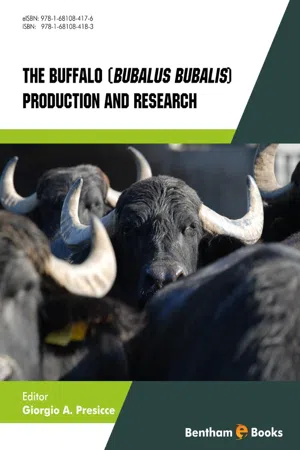
This handbook aims at focusing on the husbandry of the common water buffalo, (Bubalis bubalis). The book covers a broad range of topics such as the buffalo's genetic evolution, cytogenetics, subspecies, breed diversification, feeding and metabolic specificity, adaptable response to environmental stress factors, welfare, dairy requirements and production, reproduction and embryo technologies, cryopreservation, sperm cell sexing, somatic cell cloning and transgenesis.
Chapters presented and reviewed in this book have been by contributed by renowned scientists that have devoted years of research to the understanding of this species, and highlight the most recent advances in basic and applied science to unveil the understanding of physiological facets intrinsic to this animal species.
The depth of the selected topics makes this book especially suited for readers of all academic levels of study. Researchers, students and professionals will find this book a useful guide to breeding and farming the water buffalo.
- English
- ePUB (mobile friendly)
- Available on iOS & Android
eBook - ePub
The Buffalo Bubalus bubalis - Production and Research
About this book
Information
Topic
MedicineSubtopic
Veterinary MedicineApplied Reproductive Technologies in the Buffalo Species
Bianca Gasparrini*
Department of Veterinary Medicine and Animal Production, Federico II University, Via F. Delpino 1, 80137 Naples, Italy
Abstract
In consideration of the typically low efficiency of MOET programs in buffaloes, in the past two decades there has been a mushrooming interest in the exploitation of in vitro embryo production procedures (IVEP), employed for a more rapid and targeted improvement and propagation of superior genetics from elite animals. Procedures that had been used in cattle successfully, were also used in the very first attempts in buffaloes, although a significant improvement in the efficiency of the entire process in the buffalo species has been achieved in the course of the intervening years through novel information on oocyte and embryo culture requirements. This review aims at describing the state of the art of IVEP in the buffalo species, the results and improvements obtained together with the difficulties and limitations still to be overcome.
Keywords: Buffalo, Cryopreservation, In vitro produced embryos, Sperm sexing.
* Corresponding author Bianca Gasparrini: Department of Veterinary Medicine and Animal Production, Federico II University, Via F. Delpino 1, 80137 Naples, Italy; Tel: +39 081 2536284/461; Fax: +39 081 292981; E-mail: [email protected]
1. INTRODUCTION
Buffaloes have been playing over time an important role in countries characterized by a number of disadvantages, both in terms of climate and agricultural production systems. Interest in this species has then, for these main reasons, grown up steadily in recent years. The river buffalo can be considered a dairy producer that has no match in developing countries, characterized also by
particular environmental conditions typical of the tropics north of the equator. In those climate conditions, the buffalo is used to compensate for the lack of cattle milk in the course of the rainy season (winter to spring), enabling thus people to make use of animal proteins at competitive costs. This can happen thanks especially to the special interaction occurring between reproductive seasonality typical of this species, together with availability of forage throughout the year and external environmental conditions. A striking evidence underlining the importance of this species is given by the mushrooming increase in the total world buffalo population in the course of the last 40 years, adding up to 86% especially when compared to the cattle counterpart, with only a 34%. In Italy the Mediterranean Italian buffalo is the only livestock species that has shown a growing trend over the years; it is an important economic resource, due to the high market demand for mozzarella cheese, and its genetics is highly requested around the world due to its high milk production. The increasing demand for buffalo milk and the need to cut production costs make genetic improvement critical for successful buffalo breeding. In this scenario, programs aimed at selecting the best animals through the adoption of newly developed reproductive technologies, can be completed in shorter times than usually expected under ordinary reproductive management. In addition, developing countries require the availability of high genetic animals as quickly as possible, and in this context, reproductive biotechnologies may offer a sharp help for example in replacing the working efficiency of local swamp buffaloes with a much higher efficiency in terms of milk produced from river buffaloes. This is a possible way to enhance the availability of animal proteins for human need and consumption. In the past, one of the most applied reproductive technology in cattle, was also employed in buffaloes, in order to increase and speed up the genetic gain via the maternal lineage. In fact, attempts were made to induce multiple ovulations for in vivo embryo production in buffalo (MOET programs), although the obtained results have always been inconsistent and embryo production was always significantly reduced when compared to the cattle counterpart [1-3]. For this reason, and thanks to the encouraging results reported in cattle, interest has been shifting to the possibility to produce embryo following use of in vitro procedures (IVEP).
The first IVEP experiences were carried out on abattoir-derived oocytes mainly for research purposes and for the genetic rescue of highly valuable animals with terminal illness or characterized by reproductive inefficiency, or else for mass production of embryos. Very little impact on the genetic enhancement of animals is exerted by the use of IVEP procedures for embryo mass production, using oocytes derived from ovaries of slaughtered animals.
A boost in the spreading of IVEP procedure for the improvement of genetically important traits in production animals, has been seen thanks to the development of techniques for recovering immature oocytes from antral follicles in live animals, termed Ovum Pick Up (OPU). Indeed, the in vivo collection of immature oocytes by transvaginal ultrasound guided follicular aspiration, provided the lacking link between IVEP technologies and animal breeding. The genetic progress through the maternal lineage can be more efficiently and more quickly achieved through the combined use of IVEP procedure and OPU technique, thanks also to the repeatability of the procedure and its non invasive approach, leading to a higher number of embryos produced on a long term basis. In addition to the poor embryo output of MOET [1-3], and in comparison to MOET programs, characterized in buffaloes by a low efficiency in terms of embryos produced and recovered [1-3], the synergistic coupling of IVEP and OPU allows a consistent and wider production of embryos from animals that would have been otherwise discarded, such as in the case of acyclic females, reproductive failures due to salpingitis or infections of the genital tract, unresponsiveness to hormonal administration for superovulation. In addition, even pregnant animals within their first trimester can be used for embryo production through OPU.
The introduction of OPU in cattle dates back to the late 1980s, and became operational in the early 1990s. OPU was first adopted in 1994, in buffaloes found in deep anestrus characterized by hypotrophic ovaries [4, 5], and since then it has spread in many other countries other than Italy [6-13], like Brazil [14, 15], China ([16, 17], Argentina [18] and India [19, 20]. Therefore, in light of some of the above mentioned aspects, the coupling of IVEP and OPU techniques is the most productive and efficient approach for elite embryo production (transferable embryos) on an animal-donor basis and over long period of times. In addition, and especially in the buffalo species, this is a very competitive combined technology in terms of embryo yield when compared to MOET programs, due to the fact that these animals may be less responsive to hormonal stimulation for superovulation, less amenable to the procedure due to seasonal anestrus, and overall produce less embryos. Additionally, the procedure can be made even more efficient if, prior to its implementation, animals can be monitored and selected on the basis of their follicular dynamics and follicle count on the ovaries, bypassing thus the intrinsic variability among animals in follicular recruitment per each wave, consequent retrieval of immature oocytes and final embryo production (1 to 25 blastocysts per donor in 3.5 months) [13]. Interestingly, it was recently demonstrated that the initial number of follicles and cumulus-oocyte-complexes (COCs) might predict the blastocyst yields in a long-term period. This means that a preliminary screening, performed through a simple ultrasonic examination of the animals, allows the selection of the best oocyte donors and embryo producers [13].
Despite all the success in the exploitation of this procedure ...
Table of contents
- Welcome
- Table of Contents
- Title Page
- BENTHAM SCIENCE PUBLISHERS LTD.
- FOREWORD
- PREFACE
- List of Contributors
- DEDICATION
- River and Swamp Buffaloes: History, Distribution and their Characteristics
- The Cytogenetics of the Water Buffalo
- Molecular Genetics and Selection in Dairy Buffaloes: The Italian Situation
- Animal – Environment Interaction: Buffalo Behavior and Welfare
- Thermal Balance in the Buffalo Species
- Feed Resources, Rumen Fermentation, Manipulation and Production in Swamp Buffalo: A Review
- Protein Digestion and Metabolism in Buffalo
- Influence of Seasonality on Buffalo Production
- Buffalo Dairy Production: A Review
- Buffalo Milk Characteristics and By-Products
- Parasitological Scenario of Buffalo Farms in Central and Southern Italy: A Review
- Folliculogenesis and Ovarian Physiology Applied to Reproductive Biotechnologies in Buffaloes
- Multiple Ovulation and Embryo Transfer in the Buffalo Species
- Applied Reproductive Technologies in the Buffalo Species
- Buffalo Cloning and Transgenesis
Trusted by 375,005 students
Access to over 1.5 million titles for a fair monthly price.
Study more efficiently using our study tools.
Frequently asked questions
Yes, you can cancel anytime from the Subscription tab in your account settings on the Perlego website. Your subscription will stay active until the end of your current billing period. Learn how to cancel your subscription
No, books cannot be downloaded as external files, such as PDFs, for use outside of Perlego. However, you can download books within the Perlego app for offline reading on mobile or tablet. Learn how to download books offline
Perlego offers two plans: Essential and Complete
- Essential is ideal for learners and professionals who enjoy exploring a wide range of subjects. Access the Essential Library with 800,000+ trusted titles and best-sellers across business, personal growth, and the humanities. Includes unlimited reading time and Standard Read Aloud voice.
- Complete: Perfect for advanced learners and researchers needing full, unrestricted access. Unlock 1.5M+ books across hundreds of subjects, including academic and specialized titles. The Complete Plan also includes advanced features like Premium Read Aloud and Research Assistant.
We are an online textbook subscription service, where you can get access to an entire online library for less than the price of a single book per month. With over 1.5 million books across 990+ topics, we’ve got you covered! Learn about our mission
Look out for the read-aloud symbol on your next book to see if you can listen to it. The read-aloud tool reads text aloud for you, highlighting the text as it is being read. You can pause it, speed it up and slow it down. Learn more about Read Aloud
Yes! You can use the Perlego app on both iOS and Android devices to read anytime, anywhere — even offline. Perfect for commutes or when you’re on the go.
Please note we cannot support devices running on iOS 13 and Android 7 or earlier. Learn more about using the app
Please note we cannot support devices running on iOS 13 and Android 7 or earlier. Learn more about using the app
Yes, you can access The Buffalo Bubalus bubalis - Production and Research by Giorgio A. Presicce in PDF and/or ePUB format, as well as other popular books in Medicine & Veterinary Medicine. We have over 1.5 million books available in our catalogue for you to explore.