- English
- ePUB (mobile friendly)
- Available on iOS & Android
eBook - ePub
Dairy Production Medicine
About this book
This comprehensive book integrates new technology and concepts that have been developed in recent years to manage dairy farms in a profitable manner. The approach to the production of livestock and quality milk is multidisciplinary, involving nutrition, reproduction, clinical medicine, genetics, pathology, epidemiology, human resource management and economics. The book is structured by the production cycle of the dairy cow covering critical points in cow management. Written and edited by highly respected experts, this book provides a thoroughly modern and up-to-date resource for all those involved in the dairy industry.
Information
1
Management Considerations from Parturition to the End of the Voluntary Waiting Period to Optimize Health and Reproductive Performance
Abstract
From an animal health and well-being and performance perspective, the postpartum period is composed of an early window where health greatly impacts production and reproductive efficiency. Thus, appropriate management during this period is critical to ensure a normal state of cow health at the herd level to optimize production and reproductive performance. This chapter discusses management considerations from parturition to the end of the voluntary waiting period to optimize health and reproductive performance.
Introduction
Reproductive efficiency is vital for the economic viability of a dairy farm because it increases the likelihood of cows remaining in the herd, increases the number of cows that spend their productive life in profitable milk production, increases the number of calves born per year, and reduces involuntary culling (de Vries, 2006). However, reproductive efficiency has decreased in lactating dairy cows worldwide as evidenced by a reduction in conception rates (Macmillan et al., 1996; Royal et al., 2000; Lucy, 2001; de Vries, 2006). Although causes for this decline are multifactorial, attenuation of estrus expression in high-producing cows (Wiltbank et al., 2006), embryonic mortality (Santos et al., 2001), energy metabolism during early postpartum, and its interactions with immune function play a major role (Hammon et al., 2006). Further, the trend for larger herds coupled with labor shortage has resulted in new challenges in compliance with health and reproductive programs. Thus, opportunities abound for veterinarians to work with dairy producers to implement a sound reproductive management program to mitigate the effect of these factors on reproductive efficiency.
Pregnancy rate (PR) determines the calving to conception interval (CCI) at the end of the voluntary waiting period (VWP). As PR increases, the CCI is reduced, thereby increasing the amount of milk produced per day of herd lifetime and reducing the number of cows culled for reproductive failure, which collectively increases herd income (Risco et al., 1998; de Vries, 2006). Thus, it is clear that the challenge for both producers and veterinarians is to employ a reproductive program that attains and maintains a herd PR commensurate with a profitable production of milk.
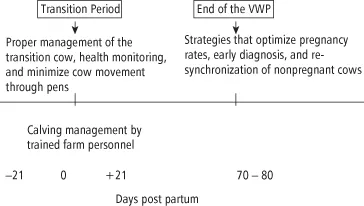
Typically, reproductive programs for dairy herds are established with the goal of increasing PR (no. of pregnant animals divided by no. of cows eligible to become pregnant in a 21-day interval) at the end of the VWP by employing estrous synchronization protocols to increase insemination rates. However, it is critical to convey to producers that events that occur during parturition have a profound effect on fertility at the end of the VWP by predisposing cows to calving-related disorders that affect uterine health and resumption of ovarian cyclicity. That is, cows that do not “transition” well from parturition to lactation have a lower risk of becoming pregnant from the application of these synchronization protocols at the end of the VWP. Therefore, reproductive management of dairy cows must integrate management strategies that optimize cow health from the time prior to parturition until the end of the VWP, as shown in Figure 1.1.
Figure 1.1. Management considerations from calving to the end of the voluntary waiting period (VWP) to optimize health and fertility.
Management of the Transition Period
The majority of diseases that affect cow health occur during the transition period (3 weeks before and after parturition) are a consequence of parturition and initiation of lactation. These diseases include dystocia, hypocalcemia, ketosis, retained fetal membranes (RFMs), uterine infections, displaced abomasum, and mastitis. Alone or together, these diseases have been shown to affect postpartum health by lowering subsequent milk production and reproductive performance (Gröhn et al., 1990)
As discussed in Chapter 2, the challenge in transition cow nutrition is to implement feeding strategies before calving to optimize immune function at calving by allowing peripartal cows to recover quickly from hypocalcemia and negative energy balance. In many dairy herds, attention to transition cow management occurs after health problems have occurred. Therefore, periodic evaluation of the management given to both pre- and postpartum cows is recommended to control the prevalence of calving-related disorders. The following checklist provides a guide to determine whether management of transition cows is appropriate.
- Is the ration balanced for energy, fiber content (including effective fiber), protein, minerals, and vitamins?
- What is the dietary cationic/anionic proportion of the ration, including the potassium percentage of the roughage source?
- Is there enough feed bunk space for prepartum cows (at least 0.60 m per cow)?
- Is there adequate shade for heat stress abatement (4.65 m2 per cow)?
- Are employees trained and supervised for proper calving assistance and treatment of postpartum diseases?
- Are urine pHs evaluated to ascertain compliance of appropriate anionic diet feeding?
- Are pre- and postpartum energy status evaluated in selected groups to determine prevalence of subclinical ketosis?
- Are body condition scores evaluated?
Calving Management
Dairy farm employees play a major role in carrying out reproductive and health programs. They do more than just inseminate and milk cows. A case in point is health monitoring to diagnose and treat diseases. In reality, to the dairy practitioner they are “health technicians,” similar to those employed by companion animal veterinarians. Consequently, training programs that define the role of the employee, the “how to,” and the “why” should be an integral component of dairy cattle production medicine.
On many dairy farms, there are inadequately trained employees who perform obstetrical procedures that result in calving trauma. Who treats, what training have they received, and when and how they treat calving-related problems are important questions that veterinarians should ask herd managers. Therefore, veterinarians should work closely with producers to design a herd health protocol that emphasizes first-aid calving assistance to discourage employees from using improper techniques for delivering calves (Chapter 3).
Moving Fresh Cows Through Pens Before and After Calving
Cow behavior and social factors can be primary risks for the development of ketosis, fatty liver, and displaced abomasum. Where poorly formulated rations and inaccurate delivery systems are considered primary risk factors for these conditions, poorly staged pen moves and overstocking are major risk factors (Nordlund et al., 2008). The mechanism appears to be a disruption of dry matter intake for vulnerable cows, leading to ketosis followed by the cascade of diseases related to ketosis.
To simplify labor, dairy farms commonly use a grouping system of cows for specialized management, which includes
- Far-off dry cows: from −60 to −21 days from calving
- Close-up dry cows: from −20 to −3 days from calving
- Maternity pen
- Fresh pen: 3–14 days after calving
- Sick pen: variable days after calving
- Various lactation and pregnant groups
In the aforementioned scenario, cows are often moved multiple times during the transition period, a time when cows are most vulnerable to develop subclinical ketosis. In general, cows resident in a pen tend to maintain their rank compared with new arrivals (Schein & Fohrman, 1955). With each movement to a new pen or group, a cow experiences stress and must establish her rank within the social order of the pen; feed intake is reduced. Early lactation cows are more affected by regrouping than mid-lactation cows, and cows that are losing weight lose social rank within a group, while those gaining weight gain dominance. These observations suggest that too many cow movements early postpartum impacts fresh cow health, as the early postpartum period is a period of significant weight loss.
Due to the daily cow entry or regrouping that occurs in the hospital pen, Cook and Nordlund (2004) have described this event as a state of constant “social turmoil” as each new cow attempts to establish her rank within the social order of the pen. In essence, this regrouping or mixing of cows decreases feed intake as well as the number of aggressive interactions in which the new cow is involved (von Keyserlingk et al., 2008). In other words, the newly moved cow is more timid and stays away from the feed bunk. We need to ask ourselves the effect of regrouping on a sick cow which is already off feed and immune compromised. Therefore, producers under the guidance of their veterinarians must use good judgment when deciding which cow to treat and if the treatment requires milk discard and thus cow movement to the hospital pen. A case in point are cows with uterine infections such as metritis that require antibiotic treatment. With the commercial availability of antibiotics labeled for treatment of metritis, where milk discard is not required, cows with metritis can be treated with these antibiotics and remain in the milk herd avoiding the negative effect of regrouping.
Postpartum Health Monitoring
A major goal for transition cow management is to maintain a dairy cow healthy during early postpartum (first 3 weeks after calving). In doing so, we must recognize that the earlier a sick animal is found and treated, the quicker her chances for returning to a normal state of health.
Postpartum health monitoring programs have become popular on dairy farms. Monitoring postpartum health involves the examination of all cows during early postpartum (first 12 days) by trained farm personnel. Parameters that can be used to evaluate health status of cows include rectal temperature, attitude, milk production, uterine discharge, and urine ketones. Veterinarians have an opportunity to expand their services to dairy producers by implementing training programs for farm employees to “look” for sick cows using time-effective techniques to identify animals in the early stages of disease and to allow for effective treatment (Chapter 4).
Strategies to Maximize PR at the End of the VWP
The VWP is the time during early lactation that producers choose not to breed cows despite their being in estrus. In a survey conducted in dairy herds participating in a progeny test program, the VWP range varied from 30 to 90 days postpartum with a mean of 56 ± 0.6 days (DeJarnette et al., 2007). In that survey, reasons for selectively altering the VWP were postpartum health issues, parity, milk production, and season.
During the VWP cows are in a negative energy balance, are anovular, and have some degree of uterine infection, which is detrimental to fertility. Recovery from these conditions can be viewed as a physiological requirement for an optimal time to pregnancy at the end of the VWP. In the author’s opinion, extending the VWP to 75 days postpartum is a sufficient time to allow cows to recover from these conditions and experience multiple estrous cycles prior to first insemination.
On many dairy farms, failure to detect cows in estrus results in a calving to first insemination interval to extend well beyond the established VWP. The application of ovulation synchronization protocols that allow for fixed time insemination with acceptable PRs has been shown to dramatically lower the interval from calving to first insemination. The economic value of the use of these ovulation synchronization protocols, such as Ovsynch, depends on the estrus detection rate of the herd. In those herds with high estrus detection rate, the value of Ovsynch is lower. This concept was illustrated in a study that reported the value of a pregnancy based on insemination at detected estrus or Ovsynch in two herds (Tenhagen et al., 2004). One-half of each herd was inseminated at detected estrus, the other half was inseminated with OvSynch. In one herd with poor estrus detection, the cost of a pregnancy was reduced significantly with the use of OvSynch compared with insemination at detected estrus. In the second herd, which had higher estrus detection rates, the cost of a pregnancy was slightly more for OvSynch, despite improved reproductive performance. The greatest costs attributed to lower PRs from insemination at ...
Table of contents
- Cover
- Title page
- Copyright page
- Dedication
- Preface
- Acknowledgments
- Contributors
- 1 Management Considerations from Parturition to the End of the Voluntary Waiting Period to Optimize Health and Reproductive Performance
- 2 Nutritional Management of the Prepartum Dairy Cow
- 3 Calving Management: A Team Approach
- 4 Monitoring Health and Looking for Sick Cows
- 5 Nutritional Management of Lactating Dairy Cows
- 6 Reproductive Management in Dairy Cows
- 7 Reproductive Management of Lactating Dairy Cows for First Postpartum Insemination
- 8 Applications of Ultrasonography in Dairy Cattle Reproductive Management
- 9 Resynchronization of Estrus, Ovulation, and Timed Insemination in Lactating Dairy Cows
- 10 Diseases that Affect the Reproductive Performance of Dairy Cattle
- 11 Infectious Reproductive Diseases
- 12 Economics of Reproductive Performance
- 13 Managing Reproduction During Heat Stress in Dairy Cows
- 14 Immunology and Vaccination of Dairy Cattle
- 15 Management of Dairy Calves from Birth to Weaning
- 16 Nutritional Management of Dairy Heifers
- 17 Management Strategies to Optimize Reproductive Efficiency in Dairy Heifers
- 18 Managing Mastitis and Producing Quality Milk
- 19 Lameness in Dairy Cattle
- 20 Management Strategies for Optimizing Forage Quality for Dairy Production
- 21 Applied Statistical Analyses for Dairy Production
- 22 Dairy Records Analysis and Evaluation of Performance
- 23 Managing People in Today’s Production Dairy Environment
- 24 Practical Genetics
- 25 Euthanasia Techniques for Dairy Cattle
- 26 Managing Herd Health in Organic Herds
- Index
Trusted by 375,005 students
Access to over 1.5 million titles for a fair monthly price.
Study more efficiently using our study tools.
Frequently asked questions
Yes, you can cancel anytime from the Subscription tab in your account settings on the Perlego website. Your subscription will stay active until the end of your current billing period. Learn how to cancel your subscription
No, books cannot be downloaded as external files, such as PDFs, for use outside of Perlego. However, you can download books within the Perlego app for offline reading on mobile or tablet. Learn how to download books offline
Perlego offers two plans: Essential and Complete
- Essential is ideal for learners and professionals who enjoy exploring a wide range of subjects. Access the Essential Library with 800,000+ trusted titles and best-sellers across business, personal growth, and the humanities. Includes unlimited reading time and Standard Read Aloud voice.
- Complete: Perfect for advanced learners and researchers needing full, unrestricted access. Unlock 1.5M+ books across hundreds of subjects, including academic and specialized titles. The Complete Plan also includes advanced features like Premium Read Aloud and Research Assistant.
We are an online textbook subscription service, where you can get access to an entire online library for less than the price of a single book per month. With over 1.5 million books across 990+ topics, we’ve got you covered! Learn about our mission
Look out for the read-aloud symbol on your next book to see if you can listen to it. The read-aloud tool reads text aloud for you, highlighting the text as it is being read. You can pause it, speed it up and slow it down. Learn more about Read Aloud
Yes! You can use the Perlego app on both iOS and Android devices to read anytime, anywhere — even offline. Perfect for commutes or when you’re on the go.
Please note we cannot support devices running on iOS 13 and Android 7 or earlier. Learn more about using the app
Please note we cannot support devices running on iOS 13 and Android 7 or earlier. Learn more about using the app
Yes, you can access Dairy Production Medicine by Carlos Risco, Pedro Melendez, Carlos Risco,Pedro Melendez in PDF and/or ePUB format, as well as other popular books in Medicine & Veterinary Medicine. We have over 1.5 million books available in our catalogue for you to explore.