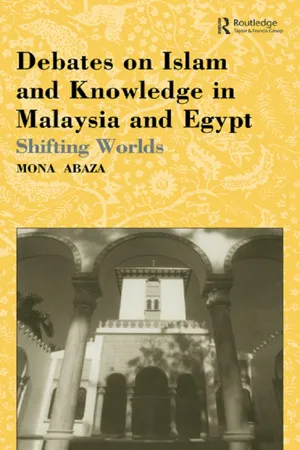
- 328 pages
- English
- ePUB (mobile friendly)
- Available on iOS & Android
eBook - ePub
About this book
This book is a comparative study of the sociological field in two different Muslim societies: Malaysia and Egypt. It analyses the process of the production of 'knowledge' through the example of the modern 'Islamization of knowledge debate' and local empirical variations.
Information
PART I
INTRODUCTORY REFLECTIONS
1
SCIENCE ISLAMIZED: LOCALITIES AND FIELDS OF KNOWLEDGE
I mistrust all systematizers and I avoid them. The will to a system is a lack of integrity.Friedrich Nietzsche
Can one Islamize knowledge? Can one Islamize (or, for that matter, Hinduize or Christianize) sociological methods, mathematics, physics or psychology? This is the rudimentary question which constantly confronted me whenever I had to publicly verbalise the state of the art of my research. This is what occurs as an initial idea to the mind of anyone who is confronted with the quantitatively abundant literature on the ‘Islamization of knowledge’ debate. The secularists’ reaction often stated: ‘We have had enough of the Islamization knowledge and science verbiage … Is it practically feasible’ So much has been written quantitatively but very little, nothing saw the light in concrete projects in sociology, anthropology or hard sciences’. I heard so often such statements from the opponents to the project. Probably, after reading this work the reader will realise that I have not answered the question of how to Islamize mathematics and will not attempt to answer it. The direct response of many Egyptian secular intellectuals (considering the ferocious power struggle they are undergoing with the Islamizers over intellectual and political credibility), has often been quite violent in expressing scepticism about me wasting my time in researching such a topic. How many times have I heard sarcastic comments from sociologists, not to mention orientalists, who looked at me with disdain and amusement. Pervez Hoodbhoy’s 1 criticism which denied the validity of those claiming to propose Islamic sciences, is pertinent. One can only consent with his concerns about the wretched management of science in the entire Muslim World and agree with his political correctness and trenchant reproach of some of the protagonists of the Islamization project. Yet his view of Islam and science and his attack against Maurice Bucaille, Seyyed Hossein Nasr, and Ziauddin Sardar, the three major exponents of Islamic sciences, although legitimate is too simplistic. Hoodbhoy remains still a positivist in praising scientism throughout his vision of modern Western sciences.
I could not help contrasting him with Ashis Nandy’s Alternative Sciences,2 a work that stimulated imagination in delineating with great subtlety and refinement the cultural milieus of two famous Indian scientists; Jagadis Chandra Bose (1858–1937) and Srivivasa Ramanujan (1887–1920). Nandy’s work is wealthy and multifaceted; combining a biting criticism of modern science through its relatedness to power. The personal contexts, lifestyles and belief systems of these two scientists, which differed from a purely European setting are so exquisitely depicted from a fascinating psychological perspective. These scientists had religious world views, they proposed ‘an integrated view of organic and inorganic worlds than the West would offer’3 (for Bose) and they made associations with magical ritualist-concepts in mathematics (for Ramanujan). They became figures of Indianized modern science. Nandy provided lively descriptions about the religiosity and psychological ambivalence between the scientific culture and the ‘extra-logical, culturally bound, inner science in India’.4 His analysis is truly engaging in deciphering what produced the ‘creative tension’ in Ramanujan. Still, as Nandy himself says, his work is far from supporting an alternative Indian model of science. He is much too conscious of the drawbacks of those promoting such an idea than ‘to be the exact reverse of what a hypothetical model of western analysis is. In such cases, even in dissent, the referent is the Occident’5 The relationship that Nandy identifies between modern science, state building and violence; and his criticism of modern science as being in itself violent, appealed to me.6 Reading him made me feel that the topic I chose was problematic. Our present is defined by the contours of globalization; it bears little resemblance to the movement of Indianization of modern science which occurred towards the beginning of this century and was related to colonial transformations. Even so, I was confronted with the poor quality of the production of the Islamizers in social and hard sciences. Their contribution left a lot to be desired. I recall wandering between the passageways of the International Islamic University of Kuala Lumpur having the sentiment that this institution was a nest breeding a tense social domination. Body language, dress, religious gestures and inflated ceremonial performances were enhanced on the front stage at the expense of genuine intellectualism. In my encounters and meetings with officials and academics in Kuala Lumpur I was struck more by the concern for habitus and ceremony than by the substance of what was said.
But what triggered my interest in the debate of Islamization was rather what stood behind discourses. Job markets, the ascending and descending status of the intellectuals, networks, variations in local cultural and political constellations seemed to be clues that rescued me from the trap of unconditionally believing in the written word. This said, the choice of such a topic was itself not without negative consequences for me; sceptical colleagues repeatedly called into question my scientific credibility. It is true that as social scientists, the involvement with our research infuses our world view and quite often blinds us with the result that we do not have the necessary distance from the subject of research. My critics nevertheless were wrong. The topic is worth research on its own for various reasons that will unfold themselves during the course of this book. In spite of the abundant literature on Islamization, no comprehensive work about the genealogy of such an ideology, the networks and counter-secular responses, has been undertaken.
This study attempts to search in the labyrinth of the process of the ‘production of knowledge’ of the Islamization of knowledge and the networks which I have followed from Malaysia to Egypt. It focuses on the competing intellectual agents and their field in two different Muslim societies experiencing modernity, each in its own distinctive way. The discourse of the search for authenticity through ‘Islamizing various fields of knowledge’ becomes here one and the same thing that resulted from the interactive encounter with the West and in particular Western academia. The majority of the protagonists of the Islamization debate were trained and have worked in the Western world. They are the incorporated product of hybridisation. As non-Marxist Third World intellectuals7 they have to dichotomise cultures into the repertoire of the we/them language, demonize the West and purify local and national traditions and religious habits, and create a cultural split in the West/East debate, instead of tracing continuities between cultures and regions. 8 In the West, these scholars learned essentialist tactics of argumentation. Now, they are constantly told in the West to reverse these arguments as a fight for representation; if they really want to have a ‘voice’ and be invited to international conferences, they have to verbalise differences. It seems that the West listens to them only when they maintain such a stance. In fact, it is a discourse that evolves from a cross-cultural interaction with the West and Western academic institutions. The present study attempts to follow the path of Aijaz Ahmad who analysed ‘the location of non-Western intelligentsia in structures of metropolitan hegemony’9 However, — and this is a crucial variance — this study will attempt to locate intellectuals in relation to the contradictory roles of post-colonial institutions. The question of either ‘the return home’ or being reduced to ‘migrant academics’ in Malaysia or elsewhere is more than ever poignant in the discourse.
The senior protagonist of the Islamization debate, the late Ismail Raji al-Faruqi was a Palestinian-American who resided in the States and married an American musicologist who converted to Islam. Certainly his notion of Islamization owes a lot to missionary ideology. It is no coincidence that al-Faruqi was specialized in comparative religions. I began this study in 1990 by looking into how a new discourse claiming to Islamize knowledge and sciences has been prospering in Malaysia. The avenues paved by my field work then drove me back to Cairo, to compare the practical implications of one and the same debate in an entirely different context. The Islamization of knowledge debate among Egyptian intellectuals seems to be strongly shaped by the contours of the secular-Islamist confrontation. This confrontation which takes the appearance of a simplistic black and white rupture by those who overlook the authoritarian discourse of the state which is wavering between an Islamization from the top to confront underground Islamists. This goes parallel with a harsh suppression of the activist Islamists. This is also connected with the tactical adoption of a caricature of a secular discourse as a defensive measure. The secular-Islamist10confrontation is itself neither a new argument nor a phenomenon; it may be observed all over the Muslim world. The present study, however, will focus on the activities of the protagonists of the debate who are already in Egypt part and parcel of the established Islamic trend in Egypt.
When I started my research I was quite antagonistic towards the protagonists of such a discourse. By the end of my study and through experiencing in the West the ascendance of right wing ideologies, the recession, the increasing power fights which are ‘third worldizing’11 and ‘provincializing’ Western academic life and parallel to the last blow that was directed towards Asian currency, I became more indulgent towards the protagonists (although hardly sharing their political agenda). I asked myself the question if one could become more sympathetic towards the policies of Malaysia's Prime Minister Mahathir Mohammad, as a Third Worldist, even though I am aware of the traps of his populism and social Darwinist ideology. Such questions were raised during my stay in Kuala Lumpur. I was attracted by the Mahathirist sense of ‘order’ and ‘control’ which I could not resist to compare with the apparent chaos of the Egyptian ruling class. Order in Malaysia, one had the impression, was equally accompanied by an extreme esprit of boredom and monotony. With the exception of the narrative S. Hussin Ali’s detention and experience in jai1,12 one could hardly trace voices of opposition or any lively intellectual atmosphere, which was in harmony with economic success. I am very much aware that my statement is only valid if one discards the fact that the Islamic oriented party is ruling in the state of Kelantan in northern Malaysia and that opposition parties have 20% of seats in parliament.
Unquestionably, my sympathies towards Mahathir decreased after Anwar’ss detention, mistreatment in confinement and the debasing sexual allegations he was confronted with, to realise again that mere Third Worldist rhetoric is no saviour of the apocalyptic future which globalisation is heading towards and which is drastically affecting the South. Mahathir’s constant simplistic bashing of the West and attacks against foreigners would not rescue him from internal contradictions of his ruling. The ill-favoured face of Mahathir’s authoritarianism came to light to remind us that one cannot circumvent the violation of the basic principles of human rights.
Ironically, Anwar is the natural outcome of Mahathir’s patronage. Anwar was promoted and encouraged in UMNO and appointed as Finance Minister by Mahathir. Obviously, antagonism was instigated by the question of power and succession.13 The recent events proved that Malay political culture disregarded the basic principles of human rights. The larger part of this study was completed before the last Asian crisis resulting in the AnwarMahathir conflict. Analysts have argued that the middle classes, which paradoxically profited most during Mahathir’s economic boom (with a growth rate reaching 8%), became the ones most affected recently. In this book, I describe an affluent situation of Malaysian intellectuals who belong to the often mentioned middle class that produced the ‘New Malay’ culture and ideology with a close alliance to power. The images conveyed of ‘think tanks’ and corporate classes, the rising consumerist attitudes, the Asian malls culture as a new form of spending leisure time have certainly been entirely shaken by the crisis. While accurate for the period of my field work, they warrant revisiting today. Anwar’s Islamic outlook in championing a futuristic Islamization surely witnessed a turn that was already problematic for Mahathir’s more secularly inclined vision. Nevertheless, my previous field observations do not contradict current events. They might provide some explanations and clues about the crisis between Mahathir and Anwar and their differing visions in administering Islam. Likewise, it is crucial to state that the two trajectories and intellectual careers of the Alatas/Attas brothers, described in chapters 6 and 8 are closely linked with Anwar’s political rise. Thanks to Anwar’s influence, we are told that Syed Hussein Alatas was app...
Table of contents
- Cover
- Half Title
- Full Title
- Copyright
- Contents
- Abbreviations/Acronyms
- A note on transliteration
- Some facts and figures about Malaysia
- Glossary
- Acknowledgements
- PART I INTRODUCTORY REFLECTIONS
- PART II BIOGRAPHIES AND TRAVELLING IDEAS
- PART III TRAJECTORIES
- Notes
- Bibliography
- Index
Trusted by 375,005 students
Access to over 1.5 million titles for a fair monthly price.
Study more efficiently using our study tools.
Frequently asked questions
Yes, you can cancel anytime from the Subscription tab in your account settings on the Perlego website. Your subscription will stay active until the end of your current billing period. Learn how to cancel your subscription
No, books cannot be downloaded as external files, such as PDFs, for use outside of Perlego. However, you can download books within the Perlego app for offline reading on mobile or tablet. Learn how to download books offline
We are an online textbook subscription service, where you can get access to an entire online library for less than the price of a single book per month. With over 1.5 million books across 990+ topics, we’ve got you covered! Learn about our mission
Look out for the read-aloud symbol on your next book to see if you can listen to it. The read-aloud tool reads text aloud for you, highlighting the text as it is being read. You can pause it, speed it up and slow it down. Learn more about Read Aloud
Yes! You can use the Perlego app on both iOS and Android devices to read anytime, anywhere — even offline. Perfect for commutes or when you’re on the go.
Please note we cannot support devices running on iOS 13 and Android 7 or earlier. Learn more about using the app
Please note we cannot support devices running on iOS 13 and Android 7 or earlier. Learn more about using the app
Yes, you can access Debates on Islam and Knowledge in Malaysia and Egypt by Mona Abaza in PDF and/or ePUB format, as well as other popular books in Théologie et religion & Théologie islamique. We have over 1.5 million books available in our catalogue for you to explore.