![]()
Part I
Assessing the significance of the high treason incident
Now and then in Japan
![]()
Ōta Masao
The high treason incident
From his prison cell, where he was interned on the charge of high treason Kōtoku Shūsui, left a sombre message for posterity:
How has it come about that I committed this grave crime? Today, my trial is closed to outside observers and I have even less liberty than previously to speak about these events. Perhaps in a hundred years' time someone will speak out about them on my behalf.
(1911)
Under the Constitution of the Japanese Empire, high treason was regarded as a felony punishable by death. Cases of high treason were heard by the Court of Cassation, which served simultaneously as trial and appeals court. The instance of high treason allegedly instigated by Kōtoku – it is therefore sometimes also called the Kōtoku incident – was not the only so-called high treason incident in modern Japanese history. In the years between 1911 and the frst shots being fred in the Fifteen-Year War in 1931,1 the authorities prosecuted three other alleged plots to assassinate members of the imperial family. These other high treason incidents are: the 1923 Toranomon incident,2 the 1925 Park Yeol incident,3 and the 1932 Sakuradamon incident.4
The incident that Kōtoku Shūsui was accused of instigating was the frst case of ‘high treason’ in modern Japanese history. What set it off was the discovery by police on 25 May 1910 that Miyashita Takichi, a socialist who worked at a timber mill in the mountainous Shinshū region (present-day Nagano prefecture), and three others were plotting to assassinate the Meiji emperor. After being found to have tested explosive devices in the mountains near a village called Akashina, they were arrested for violation of the explosives control law (Bakuhatstubutsu torishimari bassoku). This discovery was expertly used by the authorities as a pretext to intensify their campaign of political oppression against the nascent socialist movement. They conducted searches of the houses of socialists and anarchists throughout the land, and arrested many left-wing writers and activists. On 31 May 1910, Prosecutor-General Matsumuro Itasu determined that the case warranted application of Article 73 of the Criminal Code (i.e., the section that deals with high treason). Kōtoku Shūsui and Kanno Suga were arrested the following day at Yugawara, an onsen (hot-spring) resort town southwest of Tokyo, where Kōtoku was recuperating from tuberculosis.
A mass arrest of socialists and anarchists followed in the wake of the Akashina incident. Of the hundreds arrested, twenty-six people were eventually charged with plotting to assassinate the emperor. There is little doubt that those dragged in by police in this second wave of arrests were framed by the politically motivated prosecutors. Subsequently, they were hauled before the Court of Cassation and tried with unusual rapidity.
On 18 January 1911, Chief Justice Tsuru Jōichirō sentenced to death twenty-four of the accused, and ordered that the remaining two serve terms of imprisonment. However, the Imperial Household quickly intervened on behalf on the emperor, urging clemency and suggesting that the death sentences of twelve of the accused be commuted. Subsequently, on 24 January, eleven of the accused – Kōtoku Shūsui, Morichika Unpei, Miyashita Takichi, Niimura Tadao, Furukawa Rikisaku, Okunomiya Kenshi, ōishi Seinosuke, Naruishi Heishirō, Matsuo Uitta, Niimi Uichirō, and Uchiyama Gudō – were executed. They were followed to the gallows the next day by only woman in the group, Kanno Suga. Five of the accused – Takagi Kenmyō, Mineo Setsudō, Okamoto Ichirō, Miura Yasutarō, and Sasaki Dōgen – were re-sentenced to life in prison, where they died. Only seven members of the group – Sakamoto Seima, Naruishi Kanzaburō, Sakikubo Seiichi, Takeda Kuhei, Tobimatsu Yojirō, Okabayashi Toramatsu, and Komatsu Ushiji – were released on parole.
Ironically, many leading members of the left-wing movement were already in prison at the time of the alleged plot to assassinate the Emperor Meiji, and so were able to escape further criminal implication. They include ōsugi Sakae, Arahata Kanson, Sakai Toshihiko, and Yamakawa Hitoshi – all of whom had been arrested in 1908 for scuffing with police who tried to seize their red fags at a rowdy party that was being held at a cinema in the Kanda district of Tokyo to celebrate the release from prison of the journalist, Yamaguchi Koken. This was the famous red fag incident. Nonetheless, the socialist movement lost many comrades in the high treason incident. The executions and arrests hindered the movement's activities, and brought about a period of comparative inactivity known as the ‘winter years’ of the socialist movement that lasted roughly until the end of World War II.
Records relating to the high treason incident were not made public after the trials. It was not until the end of World War II that court documents were gradually uncovered and published. The picture they reveal is that only five of the twenty-four accused were remotely connected with the plot to assassinate the emperor: Miyashita Takichi, Kanno Suga, Morichika Unpei, Niimura Tadao, and Furukawa Rikisaku. In the 1960s, an association to promote clarification and public disclosure of the truth of the high treason incident was formed. It carried out considerable research, and lobbied for a retrial to restore the honour of those socialists who had been framed up. This request was dismissed by the Supreme Court in 1967.
Introducing new documents relating to Kōtoku Shūsui and Kanno Suga
A letter from Kanno Suga to Sugimura Sojinkan
On 29 January 2010, exactly 100 years after Kōtoku wrote from prison that he hoped someone would speak the truth on his behalf, one of the leading daily newspapers in Japan, the Mainichi shinbun, reported that it had discovered a letter that Kanno Suga had secretly sent to Sugimura Sojinkan (pen name Jūō), a journalist who worked for the influential Asahi shinbun. Kanno wrote to Sugimura to ask for his help in saving Kōtoku. Until it was recently discovered, the letter had remained hidden in a bookshelf in the living room of Sugimura's old house.
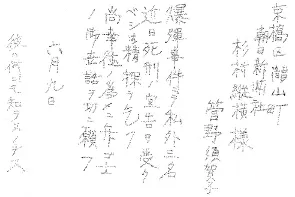
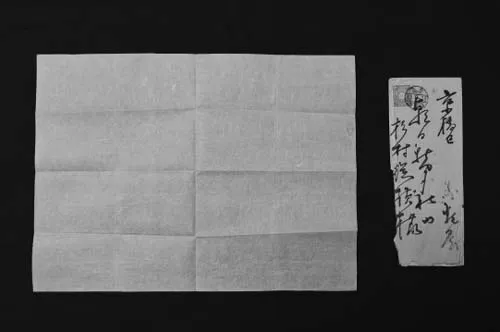
The letter is dated 9 June (1910), and was postmarked on 11 June in Ushi-gome in central Tokyo. It is unclear who actually posted it. Sugimura did not disclose anything about the letter during his lifetime, taking its details with him to the grave. What is striking is that the letter was not written with ink on paper. Rather, it was made by piercing small holes in a sheet of paper with a needle, creating a text that would only be revealed when held up to the light. Presumably Kanno did this to avoid the strict censorship of the prison authorities. Below is a translation of the text:
[To] Mr Sugimura Jūō,
The Asahi Newspaper Co.,
Takiyama village, Kyōbashi ward
[From] Kanno Sugako
In the bomb incident, three others and I will probably soon be sentenced to
death. I implore you to investigate thoroughly. In addition, I beseech you to
find a lawyer to represent Kōtoku.
The ninth of June
He knows nothing.
Figure 1.1 A letter from Kanno Suga to Sugimura Sojinkan (image presented and permission granted by the Abiko shi kyōiku iinkai, Abiko, Japan).
Figure 1.2 A letter from Kanno Suga to Sugimura Sojinkan (image presented and permission granted by the Abiko shi kyōiku iinkai, Abiko, Japan).
This letter from Kanno Suga was a desperate effort to save Kōtoku, who had been framed as a one of the ringleaders of the plot to assassinate the emperor. Curiously, the letter bears similarities to one addressed to the lawyer, Yokoyama Katsutarō, published by the Jiji shinpō newspaper in a scoop on 22 June 1910.
A letter from Kōtoku Shūsui to Oka Shigeki
Not long after I took up a position at the newly established Momoyama Gakuin Junior College in Niihama, Ehime prefecture, I started advising a research group focused on the history of Japanese political thought. This was back in 1973. We decided to put together an exhibition for the university festival, which is usually held on the weekend after the Culture Day public holiday in November. Professor Yatsunami Naonori of Kōchi University kindly introduced me to the local history research group at the Kōchi Prefectural Library, who generously sent me copies of correspondence by Kōtoku Shūsui and Kanno Suga. They included copies of a four-page letter by Kōtoku to Oka Shigeki in San Francisco and a letter of Kanno Suga to her brother Kanno Masao in Los Angeles. These documents have yet to be published, even in Japanese, and so I present them below.
Oka, like Kōtoku, was a native of the former feudal domain of Tosa, present-day Kōchi prefecture, on the island of Shikoku. He moved to Tokyo when he was seventeen, and after spending a few colourful years studying and working, joined the Yorozu chōhō (Complete Morning Report) newspaper. There, he became friends with Kōtoku as well as Sakai Toshihiko and Kinoshita Naoe. In 1902, he decided to move to America, catching a steamship from Yokohama to San Francisco. In California he managed a print shop and established an American branch of the Heiminsha, or Commoners' Society, which became a mecca for Japanese socialists on the West Coast.
Kōtoku Shūsui sent Oka Shigeki the following letter, dated 4 October 1905, before his departure for the US.
Dear Mr Oka Shigeki,
I am sorry for my lack of correspondence. I hope this letter reaches you in
good health and prosperity.
With this letter I must report to you some lamentable news. This is nothing less than the dissolution of the Heiminsha. The dissolution is a result of, on the one hand, being unable to withstand government persecution, and on the other, having exhausted our fnancial and physical capabilities.
After being released from prison, I was sorry to find that Mr Kosen5 was practically alone in managing the affairs of the Heiminsha, which was suffering from the government's insidious and moreover ruthless persecution. All over the country, police were hindering the sale of Heiminsha journals and books, making it impossible to develop a fourishing business, and therefore fnancially, we were short every month and could not make ends meet. After much deliberation, we fnally decided to reduce the scale of our operation, and publish only the journal, Chokugen (Straight Talk). I thought that we could somehow get through like this, even if we only barely got by. However, due to the recent great disturbances throughout the whole of Tokyo, publication of most newspapers has been banned.6 Publication of Chokugen was also prohibited this time. Shortly afterwards, most newspapers were allowed to resume publishing, but Chokugen, along with the Niroku shinpō (24 Hours Update) newspaper, both of which are especially detested by the Tokyo Metropolitan Police Department, did not receive such permission. Chokugen received the order to cease publication on the 10th of last month. Over a month has passed and we still have not been granted permission to resume. It appears that the government is taking these illegal measures to completely eliminate Chokugen and the Heiminsha. Faced with these conditions, and given our destitute state, we no longer have the power to keep our association going. We have fnally accepted the inevitable and on the 26th of last month the very day that Nishikawa Kōjirō was released from prison, we swallowed our resentment and wound up the association for the time being.
I do not know when we will be allowed to resume publication of Chokugen, and although I feel that we could perhaps continue once martial law is lifted, it seems impossible to publicly enjoy freedom of speech under this lawless government. Actually, on the 27th, we were slapped with a fne of over 200 yen in the Court of Appeals for publishing the Communist Manifesto.
The others are busy doing their best to put their lives in order given the above circumstances; Sakai [Toshihiko] has resolved to publish family magazines and ordinary publications for a meagre subsistence, and I am currently convalescing and preparing for my trip to the United States. After being released from prison, I tried to resume my activities. However, because the external circumstances are as I have described above and I am viciously in the bad graces of the government, taking part in the movement is extremely difficult. Moreover, my health at present does not permit it, so I have decided to travel to San Francisco, where I shall take it easy for six months or a year, while forging ties with comrades in your area. There is not even the slightest freedom of speech or association in Japan, so I think that political freedom in the United States will be much more conducive to discussions. However, as this will be my frst time out of the country, I shall probably be troubled by many unfamiliar things, so I would like to ask for your guidance in all matters.
As you know, I do not have the fnances to support my family, so I plan to entrust my mother to relatives in my hometown, my wife to relatives in Tokyo, and travel to San Francisco with one of my nephews. He is a boy of sixteen and still a middle school student, and when I leave there will be no one to care for him, so I plan to bring him along to San Francisco with me and have him find work so that he can support himself. He is in robust health, so all he needs is a job, and therefore I would like to ask for your assistance.
Although the Heiminsha has been dissolved, the world is moving in the direction of socialism. All around the world, socialist ideas are quietly four-ishing, showing no trace of decline, so there is no need for excessive concern. I am certain we will have opportunities in the not too distant future, but until then I want somehow to continue publishing Chokugen so as to remain in contact with our comrades. We are currently working hard on this matter, and I hope we can do something about it before I depart for San Francisco. For now, I plan on staying in the United States for more than six ...