
- 512 pages
- English
- ePUB (mobile friendly)
- Available on iOS & Android
eBook - ePub
About this book
NEW YORK TIMES BESTSELLER
“This is history at its most immediate and moving…A marvelous and memorable book.” —Jon Meacham
“Remarkable…A priceless civic gift…On page after page, a reader will encounter words that startle, or make him angry, or heartbroken.” —The Wall Street Journal
“Had me turning each page with my heart in my throat…There’s been a lot written about 9/11, but nothing like this. I urge you to read it.” —Katie Couric
The first comprehensive oral history of September 11, 2001—a panoramic narrative woven from voices on the front lines of an unprecedented national trauma.
Over the past eighteen years, monumental literature has been published about 9/11, from Lawrence Wright’s The Looming Tower to The 9/11 Commission Report. But one perspective has been missing up to this point—a 360-degree account of the day told through firsthand.
Now, in The Only Plane in the Sky, Garrett Graff tells the story of the day as it was lived—in the words of those who lived it. Drawing on never-before-published transcripts, declassified documents, original interviews, and oral histories from nearly five hundred government officials, first responders, witnesses, survivors, friends, and family members, he paints the most vivid and human portrait of the September 11 attacks yet.
Beginning in the predawn hours of airports in the Northeast, we meet the ticket agents who unknowingly usher terrorists onto their flights, and the flight attendants inside the hijacked planes. In New York, first responders confront a scene of unimaginable horror at the Twin Towers. From a secret bunker under the White House, officials watch for incoming planes on radar. Aboard unarmed fighter jets in the air, pilots make a pact to fly into a hijacked airliner if necessary to bring it down. In the skies above Pennsylvania, civilians aboard United 93 make the ultimate sacrifice in their place. Then, as the day moves forward and flights are grounded nationwide, Air Force One circles the country alone, its passengers isolated and afraid.
More than simply a collection of eyewitness testimonies, The Only Plane in the Sky is the historic narrative of how ordinary people grappled with extraordinary events in real time: the father and son caught on different ends of the impact zone; the firefighter searching for his wife who works at the World Trade Center; the operator of in-flight telephone calls who promises to share a passenger’s last words with his family; the beloved FDNY chaplain who bravely performs last rites for the dying, losing his own life when the Towers collapse; and the generals at the Pentagon who break down and weep when they are barred from trying to rescue their colleagues.
At once a powerful tribute to the courage of everyday Americans and an essential addition to the literature of 9/11, The Only Plane in the Sky weaves together the unforgettable personal experiences of the men and women who found themselves caught at the center of an unprecedented human drama. The result is a unique, profound, and searing exploration of humanity on a day that changed the course of history, and all of our lives.
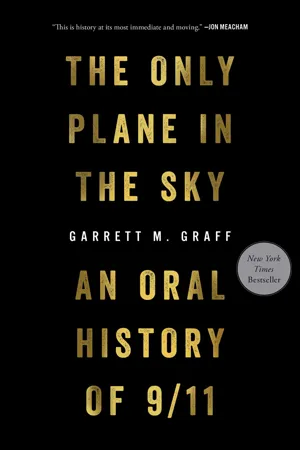
“This is history at its most immediate and moving…A marvelous and memorable book.” —Jon Meacham
“Remarkable…A priceless civic gift…On page after page, a reader will encounter words that startle, or make him angry, or heartbroken.” —The Wall Street Journal
“Had me turning each page with my heart in my throat…There’s been a lot written about 9/11, but nothing like this. I urge you to read it.” —Katie Couric
The first comprehensive oral history of September 11, 2001—a panoramic narrative woven from voices on the front lines of an unprecedented national trauma.
Over the past eighteen years, monumental literature has been published about 9/11, from Lawrence Wright’s The Looming Tower to The 9/11 Commission Report. But one perspective has been missing up to this point—a 360-degree account of the day told through firsthand.
Now, in The Only Plane in the Sky, Garrett Graff tells the story of the day as it was lived—in the words of those who lived it. Drawing on never-before-published transcripts, declassified documents, original interviews, and oral histories from nearly five hundred government officials, first responders, witnesses, survivors, friends, and family members, he paints the most vivid and human portrait of the September 11 attacks yet.
Beginning in the predawn hours of airports in the Northeast, we meet the ticket agents who unknowingly usher terrorists onto their flights, and the flight attendants inside the hijacked planes. In New York, first responders confront a scene of unimaginable horror at the Twin Towers. From a secret bunker under the White House, officials watch for incoming planes on radar. Aboard unarmed fighter jets in the air, pilots make a pact to fly into a hijacked airliner if necessary to bring it down. In the skies above Pennsylvania, civilians aboard United 93 make the ultimate sacrifice in their place. Then, as the day moves forward and flights are grounded nationwide, Air Force One circles the country alone, its passengers isolated and afraid.
More than simply a collection of eyewitness testimonies, The Only Plane in the Sky is the historic narrative of how ordinary people grappled with extraordinary events in real time: the father and son caught on different ends of the impact zone; the firefighter searching for his wife who works at the World Trade Center; the operator of in-flight telephone calls who promises to share a passenger’s last words with his family; the beloved FDNY chaplain who bravely performs last rites for the dying, losing his own life when the Towers collapse; and the generals at the Pentagon who break down and weep when they are barred from trying to rescue their colleagues.
At once a powerful tribute to the courage of everyday Americans and an essential addition to the literature of 9/11, The Only Plane in the Sky weaves together the unforgettable personal experiences of the men and women who found themselves caught at the center of an unprecedented human drama. The result is a unique, profound, and searing exploration of humanity on a day that changed the course of history, and all of our lives.
Frequently asked questions
Yes, you can cancel anytime from the Subscription tab in your account settings on the Perlego website. Your subscription will stay active until the end of your current billing period. Learn how to cancel your subscription.
At the moment all of our mobile-responsive ePub books are available to download via the app. Most of our PDFs are also available to download and we're working on making the final remaining ones downloadable now. Learn more here.
Perlego offers two plans: Essential and Complete
- Essential is ideal for learners and professionals who enjoy exploring a wide range of subjects. Access the Essential Library with 800,000+ trusted titles and best-sellers across business, personal growth, and the humanities. Includes unlimited reading time and Standard Read Aloud voice.
- Complete: Perfect for advanced learners and researchers needing full, unrestricted access. Unlock 1.4M+ books across hundreds of subjects, including academic and specialized titles. The Complete Plan also includes advanced features like Premium Read Aloud and Research Assistant.
We are an online textbook subscription service, where you can get access to an entire online library for less than the price of a single book per month. With over 1 million books across 1000+ topics, weâve got you covered! Learn more here.
Look out for the read-aloud symbol on your next book to see if you can listen to it. The read-aloud tool reads text aloud for you, highlighting the text as it is being read. You can pause it, speed it up and slow it down. Learn more here.
Yes! You can use the Perlego app on both iOS or Android devices to read anytime, anywhere â even offline. Perfect for commutes or when youâre on the go.
Please note we cannot support devices running on iOS 13 and Android 7 or earlier. Learn more about using the app.
Yes, you can access The Only Plane in the Sky by Garrett M. Graff in PDF and/or ePUB format, as well as other popular books in History & Military & Maritime History. We have over one million books available in our catalogue for you to explore.
Information
Aboard the International Space Station
On August 12, 2001, NASA astronaut Frank Culbertson arrived at the International Space Station aboard the Space Shuttle Discovery. He would live and work aboard the Space Station for 125 days. On September 11, 2001, he was the only American off the planet.
Commander Frank Culbertson, astronaut, NASA: On September the 11th, 2001, I called the ground, and my flight surgeon Steve Hart came on. I said, âHey Steve, howâs it going?â He said, âWell, Frank, weâre not having a very good day down here on Earth.â He began to describe to me what was happening in New Yorkâthe airplanes flown into the World Trade Center, another airplane flown into the Pentagon. He said, âWe just lost another airplane somewhere in Pennsylvania. We donât know where or whatâs happening.â
I looked at the laptop that has our world map on it, and I saw that we were coming across southern Canada. In a minute we were going to be over New England. I raced around, found a video camera and a window facing in the right direction.
About 400 miles away from New York City, I could clearly see the city. It was a perfect weather day all over the United States, and the only activity I could see was this big black column of smoke coming out of New York City, out over Long Island, and over the Atlantic. As I zoomed in with a video camera, I saw this big gray blob basically enveloping the southern part of Manhattan. I was seeing the second tower come down. I assumed tens of thousands of people were being hurt or killed. It was horrible to see my country under attack.
We had 90 minutes to set up for the next pass across the United States. We set up every camera we could. I said, âGuys, weâre gonna take pictures of everything we can see as we come across the U.S.â An hour and a half later, we crossed Chicago. I was looking all around for any evidence of further attacks. I could see all the way to Houston. In a few minutes, we crossed Washington, D.C., directly over the Pentagon. I could look straight down and see the gash on the side of it. I could see the lights of the rescue vehicles, the smoke of the fires. Looking north, I could clearly see New York City and the column of smoke.
Every orbit, we kept trying to see more of what was happening. One of the most startling effects was that within about two orbits, all the contrails normally crisscrossing the United States had disappeared because they had grounded all the airplanes and there was nobody else flying in U.S. airspace except for one airplane that was leaving a contrail from the central U.S. toward Washington. That was Air Force One heading back to D.C. with President Bush.
âGood days and bad daysâ
September 10th
Monday, September 10th, in New York City began with the rededication of a Bronx firehouse, home to Engine 73 and Ladder 42. Mayor Rudolph âRudyâ Giuliani, Fire Commissioner Thomas Von Essen, and Chief of Department Peter Ganci listened as Fire Department Chaplain Father Mychal Judge offered a homily for the renovated firehouse.
Father Mychal Judge, chaplain, FDNY: Good days. And bad days. Up days. Down days. Sad days. Happy days. But never a boring day on this job. You do what God has called you to do. You show up. You put one foot in front of another. You get on the rig and you go out and you do the job. Which is a mystery. And a surprise. You have no idea when you get on that rig. No matter how big the call. No matter how small. You have no idea what God is calling you to. But he needs you. He needs me. He needs all of us.
Across the country, Monday was a regular workday, the beginning of fall, the first full week after Labor Day, and for many communities the first day of school after the quiet summer doldrums of August. Reporters and news broadcasters filed back into their offices, as did government officials and business professionals, bringing cities back to life. Many anticipated a slow start to the season.
Tom Brokaw, anchor, NBC News: Iâd been off most of the summer. A friend called up to ask how it was to be back. I said, âIâm doing fine, but thereâs no news. Itâs hard to get cranked back up.â It looked like it was not going to be a terribly stimulating autumn. Social Security reform was the hot topic. The economy was winding down.
Mary Matalin, aide to Vice President Dick Cheney: There was a sense of âOkay, now back to business.â We had economic issues at the time. We were on the front end of a recession.
Matthew Waxman, staff member, National Security Council, White House: This was an administration that was interested in Great Power politics. A great deal of effort was focused on U.S.-Russian arms control and the strategic relationship questions about how to manage a rising China. These were the central questions. Two possible regional crises that week we were worried about were Burundi and Macedonia.
Monica OâLeary, Cantor Fitzgerald, North Tower, 105th floor: On September 10th, in the afternoonâmy guess is around two oâclockâI was laid off. I donât know the exact time, but I know I thought to myself, Oh, I can be home in time for General Hospital. When I got laid off, I was on the 105th floor. I was upset. I was crying. Eventually, when I calmed down, the woman for HR gave me the choice: âDo you want to go back to the desk and get your stuff, or do you want to go home?â I said, âOh, no, no, no. I want to go say good-bye to everybody.â I went around and started kissing everybody good-bye. They were all great. This guy, Joe Sacerdote, stood up in the back row, and he yelled, âItâs their loss, Monica!â
Lyzbeth Glick, wife of United Flight 93 passenger Jeremy Glick: I was on maternity leave from a teaching job at Berkley, a business college in New York. On that Monday morning, September 10, Jeremy helped me pack up the carâhe was going to California on business and was booked on a flight that night. We live in Hewitt, New Jersey, and I was going up to my parentsâ house in the Catskill Mountains while he was away. He packed me up, and then he headed down to Newark for a meeting. He called me at around five oâclock and said there had been a fire in Newark, and he didnât feel like arriving in California at two in the morning. He decided to go home, get a good nightâs sleep, and catch the first flight out Tuesday morning.
From May to October 2001, Vanessa Lawrence and Monika Bravo were supposed to be two of a total of fifteen artists in residence on the 91st and 92nd floors of the World Trade Centerâs North Tower, as part of the Studio Scape program run by the Lower Manhattan Cultural Council. Both were inspired by the Towers and had begun to incorporate them into their art.
Vanessa Lawrence, artist, North Tower, 91st floor: Because I was living in a basement where I just saw peopleâs feet, I thought it would be amazing to paint from such a high viewâseeing different weather patterns, changing skies, changing light.
Monika Bravo, artist, North Tower, 91st floor: The reason I applied was because I wanted to film. I had this image in my mindâthe Twin Towers above and only clouds underneath. The thing I missed most from my native Colombia were the clouds and the mountains. We have a lot of clouds all the time, and for me, the cloud is like home.
Vanessa Lawrence: I loved that skyline. Every morning coming in, there was something special. Again at night, seeing them lit up, just the lights on them. It was a really special skyline.
Monika Bravo: I told everybody throughout the summer, âIf you see something comingâa stormâlet me know. Iâm always going to have a camera ready.â The afternoon of September 10th, around 2:55 p.m., the storms happened.
Vanessa Lawrence: I grabbed my watercolors because I could see this storm coming. It was amazing watching it way out, looking out across Brooklyn and out on the horizon. I remember watching this dark cloud going down to the ground, and all the colors in it and everything. Thereâs one of my favorite paintings I did.
Monika Bravo: I started filming. The storm was coming from New Jersey south, through the Verrazzano Bridge and the Statue of Liberty. You see these clouds moving very fastâand thereâs a moment that is really, really incredible in the film. You see one drop hitting the window, then in a second all these water drops hitting the window. The storm is there. Itâs with you.
Vanessa Lawrence: Watching it coming, coming, coming, coming, and thenânothing. We were in this thick cloud and the rain.
Monika Bravo: The video is the witness of the last people standing, the last night before these towers cease to exist and everything and everybody that was inside. You see people in the South Tower coming in, working. You see people alive. You can see boats going. You see the city of Brooklyn lighting up. You see the movement of the bridges. Itâs alive. You see the life of the city from the last night you could see it from that perspective.
I filmed for many hours, until 9:00 or 9:30 p.m. probably. The storm was very long, the whole afternoon. I filmed in different places, in time lapse, in slow motion. It was beautiful. Then, at one point, my cell phone rang. I was married then, and this person called me: âAre you going to come home?â I said, âOh no, beautiful thunderstorm.â I said to him, âWhy donât you come over and bring me some cigarettes.â He said, âNo, Iâm not going to bring you anything. You come home.â So I said, âAll right, all right.â I actually took the tape out of the camera. I left my computer because it was raining a lot. I was looking for a place to put itâI found an old file cabinet made out of wood. I remember thinking, Is this going to be safe? And then, This is the World Trade Center. Nothing can happen to this building.
âAn easy dayâ
Tuesday Begins
Around the world, September 11th began as any other weekday. Congress was reengaging after its summer recess. In Herndon, Virginia, at the Federal Aviation Administrationâs (FAA) national command center, Ben Sliney prepared for his first day running the nationâs airspace. Nearby, in Langley, Virginia, Gina Haspel began her first day at the CIAâs counterterrorism center. In Washington, D.C., FBI Director Robert Muellerâwho had started in his new post just one week earlier, on September 4âwas scheduled to appear at 8:00 a.m. for his first briefing on the FBIâs unfolding investigation of a terror group known as al-Qaeda and its bombing of the USS Cole the previous fall. Far from Americaâs shores, the captain of the U.S. Navyâs aircraft carrier USS Enterprise was just finishing a long tour enforcing the no-fly zone over Iraq and looking forward to returning home.
In New York City it was primary day; New Yorkers would choose the candidates vying to replace the man who had run their city for eight years, Rudy Giuliani. Millions of residents, workers, schoolchildren, and commuters awoke and began preparing for the day, many boarding trains, ferries, subways, and buses to make their way into Lower Manhattan. The FDNYâs director of fire education safety was particularly excited that Tuesday: he was set to launch a new toy, modeled on a New York firefighter, and had chosen the day carefully. The date, after all, seemed perfect for firefighters: 9-1-1.
Lt. Joseph Torrillo, director of Fire Education Safety, FDNY: Fisher-Price had a line of childrenâs toys called âRescue Heroesâ that kids loved. They had a police officer called Jake Justice, a lifeguard called Wendy Waters, an ambulance attendant called Perry Medic. They wanted a New York City firefighterâthey were going to call him Billy Blazes. They would give me one dollar for every Billy Blazes sold around the world, money I would use in my public education program. They wanted to do a big press conference and introduce this new Rescue Hero to the world. I was scratching my head with the executives, and I said, â9-1-1 is the emergency phone number in New York City. Why donât we have a 9-1-1 Day in New York?â So on 9/11 at nine oâclock in the morning, every TV station in New York City was waiting for me at Rockefeller Center to introduce this new Rescue Hero.
Herb Ouida, World Trade Centers Association, North Tower, 77th floor, and father of Todd Ouida, Cantor Fitzgerald, North Tower, 105th floor: As we did every morning, my son Todd and I left our home together to travel to work, because Todd was working at the World Trade Center for Cantor Fitzgerald. When we got down to Hoboken, I said to Todd, âWhy donât you take the ferry with me, itâs a beautiful day?â He said, âNo, Dad, itâs too cold.â I told him, âHave a great day, sweetheart.â Those were my last words to Todd.
Richard Eichen, consultant, Pass Consulting Group, North Tower, 90th floor: I used to take the train every day to the Trade Center. I was sitting next to a friendâwe belonged to the same golf clubâand we were talking about how bad the food was. That was my biggest care in the world that day.
Ted Olson, solicitor general, U.S. Department of Justice: My wife, Barbara, was supposed to travel Monday, and my birthday was Tuesday. She decided that she was not going to go Monday. She did not want to be gone on the morning of my birthday, she wanted to be there when I woke up. I left for work very ear...
Table of contents
- Cover
- Dedication
- Key Moments
- Authorâs Note
- Chapter 1: Aboard the International Space Station
- Chapter 2: September 10th
- Chapter 3: Tuesday Begins
- Chapter 4: Checking In
- Chapter 5: 8:00 a.m. in New York City
- Chapter 6: The Hijackings
- Chapter 7: Inside Air Traffic Control
- Chapter 8: The First Plane
- Chapter 9: The Second Hijacking
- Chapter 10: The Military Gears Up
- Chapter 11: The Second Plane
- Chapter 12: Live, on Air
- Chapter 13: At Emma Booker Elementary School, Sarasota, Florida
- Chapter 14: First Reactions in D.C.
- Chapter 15: American Airlines Flight 77
- Chapter 16: The Third Plane
- Chapter 17: On Capitol Hill
- Chapter 18: Flight 93 in Peril
- Chapter 19: The World Trade Center Evacuation
- Chapter 20: Jumping
- Chapter 21: The FAA Makes History
- Chapter 22: The Trade Center Rescue Continues
- Chapter 23: The First Collapse
- Chapter 24: Inside the Cloud
- Chapter 25: Inside the PEOC
- Chapter 26: The Military Responds
- Chapter 27: The Fourth Crash
- Chapter 28: Fear at the Pentagon
- Chapter 29: The First Casualty
- Chapter 30: Around the Towers
- Chapter 31: After the Collapse
- Chapter 32: The Rescue at Shanksville
- Chapter 33: At School in Arlington, Virginia
- Chapter 34: Aboard Air Force One, Somewhere over the Gulf of Mexico
- Chapter 35: Among Those Who Knew
- Chapter 36: Escaping the Pentagon
- Chapter 37: In Between Collapses
- Chapter 38: The Second Collapse
- Chapter 39: Trapped in the Ruins
- Chapter 40: After the Collapse
- Chapter 41: At the Waterfront
- Chapter 42: Midmorning at the Pentagon
- Chapter 43: Midmorning at the Capitol
- Chapter 44: With the Secretary of Defense
- Chapter 45: At Barksdale Air Force Base
- Chapter 46: Midday in New York City
- Chapter 47: Midday in Washington
- Chapter 48: Airborne, Somewhere over the Plains
- Chapter 49: Afternoon in Shanksville
- Chapter 50: At Mount Weather
- Chapter 51: At Ground Zero
- Chapter 52: At the Hospitals
- Chapter 53: The 9/11 Generation
- Chapter 54: At Offutt Air Force Base
- Chapter 55: Afternoon in America
- Chapter 56: Searching
- Chapter 57: 9/11 at Sea
- Chapter 58: Afternoon at the Pentagon
- Chapter 59: Airborne, En Route to Andrews Air Force Base
- Chapter 60: Evening in Washington
- Chapter 61: In the Oval Office
- Chapter 62: The Evening of 9/11
- Chapter 63: The Day Ends
- Epilogue
- Photographs
- Acknowledgements
- Sources
- On 9/11, Luck Meant Everything
- Reading Group Guide
- About the Author
- Notes
- Index
- Image Credits
- Copyright