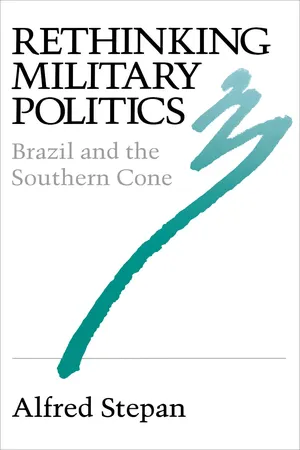
The last four years have seen a remarkable resurgence of democracy in the Southern Cone of the Americas. Military regimes have been replaced in Argentina (1983), Uruguay (1985), and Brazil (1985). Despite great interest in these new democracies, the role of the military in the process of transition has been under-theorized and under-researched. Alfred Stepan, one of the best-known analysts of the military in politics, examines some of the reasons for this neglect and takes a new look at themes raised in his earlier work on the state, the breakdown of democracy, and the military. The reader of this book will gain a fresh understanding of new democracies and democratic movements throughout the world and their attempts to understand and control the military. An earlier version of this book has been a controversial best seller in Brazil.
To examine the Brazilian case, the author uses a variety of new archival material and interviews, with comparative data from Argentina, Uruguay, Chile, and Spain. Brazilian military leaders had consolidated their hold on governmental power by strengthening the military-crafted intelligence services, but they eventually found these same intelligence systems to be a formidable threat. Professor Stepan explains how redemocratization occurred as the military reached into the civil sector for allies in its struggle against the growing influence of the intelligence community. He also explores dissension within the military and the continuing conflicts between the military and the civilian government.
- English
- ePUB (mobile friendly)
- Available on iOS & Android
eBook - ePub
About this book
Information
Publisher
Princeton University PressYear
2020Print ISBN
9780691022741
9780691077505
eBook ISBN
9780691219639
CHAPTER ONE
Military Politics in Three Polity Arenas: Civil Society, Political Society, and the State
THE TITLE of this chapter is certainly ponderous, possibly pompous, but unfortunately necessary. The focus throughout this work is on military politics in the polity. I use the word “polity” to call attention to the classic Aristotelian concern with how people organize themselves for collective life in the polis.1 For a modern polity in the midst of a democratization effort, it is conceptually and politically useful to distinguish three important arenas of the polity: civil society, political society, and the state. Obviously, in any given polity these three arenas expand and shrink at different rates, interpenetrate or even dominate each other, and constantly change.2
Very schematically, by “civil society” I mean that arena where manifold social movements (such as neighborhood associations, women’s groups, religious groupings, and intellectual currents) and civic organizations from all classes (such as lawyers, journalists, trade unions, and entrepreneurs) attempt to constitute themselves in an ensemble of arrangements so that they can express themselves and advance their interests.
By “political society” in a democratizing setting I mean that arena in which the polity specifically arranges itself for political contestation to gain control over public power and the state apparatus. At best, civil society can destroy an authoritarian regime. However, a full democratic transition must involve political society, and the composition and consolidation of a democratic polity must entail serious thought and action about those core institutions of a democratic political society—political parties, elections, electoral rules, political leadership, intraparty alliances, and legislatures—through which civil society can constitute itself politically to select and monitor democratic government.
By “the state” I mean something more than “government.” It is the continuous administrative, legal, bureaucratic, and coercive system that attempts not only to manage the state apparatus but to structure relations between civil and public power and to structure many crucial relationships within civil and political society.3
In an extreme monist (or what some would call totalitarian) polity, the state eliminates any significant autonomy in political or civil society. In a strong authoritarian regime, political society is frequently absorbed by dominant groups into the state, but civil society characteristically has at least some spheres of autonomy.
I make these distinctions knowing full well that Gramsci, Hegel, Locke, Rousseau, and in the companion volume to this study, Democratizing Brazil, Cardoso and Weffort use different definitions. I think, however, that the strongest defense of a definition is its usefulness in analysis, and these working definitions may help illuminate some frequently obscured relationships within a democratizing polity like Brazil. Let us see.
In the democratizing period in Brazil between 1974 and 1985, the most popular topics of systematic, scholarly social science concerned new movements within civil society that presented challenges to the authoritarian state, such as the church, the new unionism, the new entrepreneurs, the press, the Association of Brazilian Lawyers, women’s groups, and neighborhood associations. Because the changes in civil society were so significant, interesting, and normatively attractive, scholarly attention in more than fifty published works on these topics is quite understandable.4 As Cardoso argues,
In Brazilian political language, everything which was an organized fragment which escaped the immediate control of the authoritarian order was being designated civil society. Not rigorously, but effectively, the whole opposition . . . was being described as if it were the movement of Civil Society.5
“Civil society” became the political celebrity of the abertura. Politically the phrase had two tactical advantages in Brazilian discourse. First, because it explicitly was meant to entail opposition to the regime, the regime found it difficult to appropriate the meaning to its own advantage. Second, it created bonds between groups who in other settings were antagonists: São Paulo entrepreneurs and São Paulo metallurgical workers equally shared in the charismatic legitimacy of being part of the new “civil society.”
The intense attention given to “civil” as opposed to “political” society was not without its strategic problems for the democratizing opposition. Important segments within the church and the new labor movement—two key segments of civil society—were deeply suspicious of “intermediaries” and “negotiations.” They favored direct participation and articulation of demands, with the ideologically favored groups being “base” organizations. Partisans of this ideological current tended to be deeply suspicious of political parties. Opposition politicians in Congress—many of whom were seen as having been too tame during the pre-abertura period—were held in low esteem, and few organic links were forged between those opposition forces whose ideological and material resources were drawn from the arena of civil society and those opposition forces whose resources and style of action were associated with the arena of political society.
The military regime understood this sharp separation between the two arenas of the opposition and exploited the weakness. Again and again in the late 1970s and early 1980s the military altered the rules of the game for political society (physically and metaphorically isolated in Brasilia and surrounded by the state). In this period civil society almost never came to the defense of political society. The regime’s strategists were understandably happy with this pattern of behavior of the opposition that supported liberalization more than democratization.
This is a crucial distinction. In an authoritarian setting, “liberalization” may entail a mix of policy and social changes, such as less censorship of the media, somewhat greater working room for the organization of autonomous working-class activities, the reintroduction of some legal safeguards such as habeas corpus for individuals, the releasing of most political prisoners, the return of political exiles, possibly measures for improving the distribution of income, and, most important, the toleration of political opposition. “Democratization” entails liberalization but is a wider and more specifically political concept. Democratization requires open contestation for the right to win control of the government, and this in turn requires free elections, the results of which determine who governs. Using these definitions it is clear there can be liberalization without democratization. Liberalization refers fundamentally to civil society. Democratization involves civil society, but it refers fundamentally to political society.
There were also conceptual and analytical problems with a literature of the democratizing process that focused so heavily on civil society. Most scholars became specialists on the oppositional activity of specific fragments of civil society: base community specialists, new union specialists, specialists on lawyer associations, or the new entrepreneurs. This scholarly focus—though it produced some of the best and most exciting work on social movements anywhere in the world in the period—deflected attention from three important relationships.
First, it tended to leave understudied the immensely complex and innovative horizontal relations of civil society with itself, which helped interweave the weft and warp of civil society and give it a more variegated, more resistant fabric.6
Second, insufficient analytical attention was given to the problem of how the gap between the opposition based in the civil arena and opposition based in the political arena could be bridged.
Third, there were hundreds of scholarly and newspaper articles with titles such as “Entrepreneurs Against the State,” “The Church Against the State,” and “Metalworkers Against the State.” However, this unidirectional vertical perspective led to a serious neglect, not only of the inter- and intraclass horizontal linkages, but also of the internal contradictions within the state (especially within the military) that led fractions of the state apparatus to seek out (and to tolerate the partial empowerment of) allies within civil society. Thus, even the analysis of the growth of civil society is impoverished if the state’s downward reach for new allies in civil society is not documented descriptively and incorporated conceptually.7
Because civil society was the celebrity of the abertura and the prevailing discourse privileged the dichotomy (“Civil Society versus the State”), activists and scholars alike tended to belittle the role of parties, Congress, and elections, and “political society” was relatively neglected in the literature. Nonetheless, there were at least a score of solid books and articles in addition to a well-conceived collective longitudinal election project that focused precisely on political society in the democratizing period.8
Let us now turn to the question of the state, and specifically to the military as a part of the authoritarian state apparatus. As late as mid-1984, although the Brazilian opening was over ten years old, to my knowledge there was not even one systematic academic social science monograph or thesis in Portuguese or English, about the military in the period of distensão and abertura.9
Clearly, both for theoretical and empirical reasons, if the analytic focus is on the transition to democracy—especially a transition that is occurring within the specific context of a military-led authoritarian regime—the military component itself must be studied.
What explains this stunning neglect of the military? Part of the explanation is an understandable fear of repression and censorship. However, it should be noted that this same period saw the publication of numerous detailed accounts of torture in particular, and harshly critical books about the authoritarian regime in general. Certainly, it is also relatively difficult for scholars to do research on the military, especially if they are Brazilian citizens; however, the Brazilian military annually publishes a considerable quantity of documents that merit content analysis and many retired colonels and generals have been surprisingly willing to talk to journalists. Part of the explanation for neglect would seem therefore to be normative disdain for the military as a topic (the obverse of the normative attraction to new groups in civil society). This is a longstanding problem, often referred to as “the liberal bias.” It probably merits calling attention once again to Max Weber’s eminently sound, if neglected, dictum in his famous essay on science as a vocation, “the primary task of a useful teacher is to teach his students to recognize ‘inconvenient’ facts—I mean the facts that are inconvenient for their party opinions.”10
Finally, a significant part of the neglect of the military as a central topic of empirical research, in my judgment, has its origins in theory. The 1970s witnessed a worldwide boom in theoretical writings about the state. Probably the single most influential theorist of the state was Poulantzas, an advocate of the “relative autonomy of the state.” However, his analysis of the reasons for state autonomy has nothing to do with his analysis of empirically observed dynamics of state bureaucracies, but rather derives from his functionalist Assumption that such a degree of autonomy is a structural requirement of capital accumulation and domination in an advanced capitalist state.11 Note how little autonomous power bureaucracies are accorded in his theoretical framework; for him the state is “the site of organization of the dominant class in the relationship to the dominated classes. It is a site and a center of the exercise of power, but it possesses no power of its own.”12
Politics and political science are about power. What is particularly revealing about the Poulantzas quotation is that the theoretical logic of his form of diffuse structural determinism conceptually removes the military from the exercise of power.13 This theoretical perspective is misleading. Any military organization is of course affected by the overall balance...
Table of contents
- Cover Page
- Title Page
- Copyright Page
- Dedication
- Contents
- Lists of Tables and Figures
- Preface
- Chapter 1. Military Politics in Three Polity Arenas: Civil Society, Political Society, and the State
- Chapter 2. The Brazilian Intelligence System in Comparative Perspective
- Chapter 3. Abertura: Intra-State Conflicts and the Courtship of Civil Society
- Chapter 4. Military Discourse and Abertura
- Chapter 5. The End of the Regime: Political Society and the Military
- Chapter 6. The Military in Newly Democratic Regimes: The Dimension of Military Contestation
- Chapter 7. The Military in Newly Democratic Regimes: The Dimension of Military Prerogatives
- Chapter 8. Democratic Empowerment and the Military: The Tasks of Civil Society, Political Society, and the State
- Bibliography
- Index
Trusted by 375,005 students
Access to over 1.5 million titles for a fair monthly price.
Study more efficiently using our study tools.
Frequently asked questions
Yes, you can cancel anytime from the Subscription tab in your account settings on the Perlego website. Your subscription will stay active until the end of your current billing period. Learn how to cancel your subscription
No, books cannot be downloaded as external files, such as PDFs, for use outside of Perlego. However, you can download books within the Perlego app for offline reading on mobile or tablet. Learn how to download books offline
We are an online textbook subscription service, where you can get access to an entire online library for less than the price of a single book per month. With over 1.5 million books across 990+ topics, we’ve got you covered! Learn about our mission
Look out for the read-aloud symbol on your next book to see if you can listen to it. The read-aloud tool reads text aloud for you, highlighting the text as it is being read. You can pause it, speed it up and slow it down. Learn more about Read Aloud
Yes! You can use the Perlego app on both iOS and Android devices to read anytime, anywhere — even offline. Perfect for commutes or when you’re on the go.
Please note we cannot support devices running on iOS 13 and Android 7 or earlier. Learn more about using the app
Please note we cannot support devices running on iOS 13 and Android 7 or earlier. Learn more about using the app
Yes, you can access Rethinking Military Politics by Alfred C. Stepan in PDF and/or ePUB format, as well as other popular books in History & Latin American & Caribbean History. We have over 1.5 million books available in our catalogue for you to explore.