How the NRA became a political juggernaut by influencing the behaviors and beliefs of everyday Americans
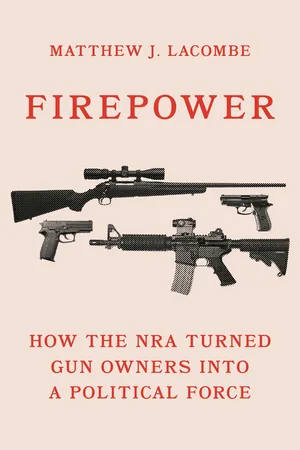
The National Rifle Association is one of the most powerful interest groups in America, and has consistently managed to defeat or weaken proposed gun regulations—even despite widespread public support for stricter laws and the prevalence of mass shootings and gun-related deaths. Firepower provides an unprecedented look at how this controversial organization built its political power and deploys it on behalf of its pro-gun agenda.
Taking readers from the 1930s to the age of Donald Trump, Matthew Lacombe traces how the NRA's immense influence on national politics arises from its ability to shape the political outlooks and actions of its followers. He draws on nearly a century of archival records and surveys to show how the organization has fashioned a distinct worldview around gun ownership and used it to mobilize its supporters. Lacombe reveals how the NRA's cultivation of a large, unified, and active base has enabled it to build a resilient alliance with the Republican Party, and examines why the NRA and its members formed an important constituency that helped fuel Trump's unlikely political rise.
Firepower sheds vital new light on how the NRA has grown powerful by mobilizing average Americans, and how it uses its GOP alliance to advance its objectives and shape the national agenda.
- English
- ePUB (mobile friendly)
- Available on iOS & Android
eBook - ePub
About this book
Information
Publisher
Princeton University PressYear
2021Print ISBN
9780691207452
9780691207445
eBook ISBN
9780691207469
1
Introduction
In April 2015, the annual meeting of the National Rifle Association brought nearly eighty thousand gun rights supporters to Nashville, Tennessee. The three-day conference offered seminars on topics ranging from home defense to doomsday survivalism planning to cooking with wild game, and a massive exhibit hall featured the latest firearms and firearms accessories (customized holsters, specialized apparel, and so on), along with live product demonstrations and a chance to meet celebrities like controversial rock star—and NRA board member—Ted Nugent. There was a prayer breakfast, a family-friendly indoor shooting range, and free country music concerts every afternoon.1
Yet the most prominent event of all was the Leadership Forum hosted by the NRA’s Institute for Legislative Action (NRA-ILA), which since 1975 has served as the organization’s primary political advocacy and lobbying branch. The forum featured speeches by more than ten Republican presidential hopefuls, including Jeb Bush, Ted Cruz, Marco Rubio, Ben Carson, and, of course, Donald Trump. Taking place long before the 2016 primaries began, the event was clearly an important part of the GOP’s so-called invisible primary—the very early, informal jockeying that occurs among each party’s presidential aspirants as they attempt to court elites, donors, activists, and the party faithful.2
Accordingly, the speakers not only touted their pro-gun credentials, but also spoke to their broader conservative beliefs across a range of issues, harshly criticized the Obama Administration, and warned of the specter of a Hillary Clinton presidency. Many took hawkish stances on terrorism and mocked President Obama’s reluctance to use the term “radical Islam”;3 Wisconsin Governor Scott Walker, for example, said that he wanted “a Commander-in-Chief who will look the American people in the eye and say that radical Islamic terrorism is a threat and we’re going to do something about it.”4 Louisiana Governor Bobby Jindal, speaking in support of businesses that refused service to same-sex couples on religious grounds, warned that if “Hollywood liberals and editorial columnists” could “conspire to crush the First Amendment, it won’t be long before they join forces again to come after the Second Amendment.”5 Criticisms of Obamacare were also common, as was support for restrictive immigration policies. Texas Senator Ted Cruz, touting his legislative record, challenged voters to ask other Republican candidates, “When have you stood up and fought to stop Obamacare? … When have you stood up and fought to stop the president’s illegal and unconstitutional executive amnesty?”6
For future President Donald Trump, the appearance previewed not just the themes but the rhetorical style that would characterize his campaign. He made populist appeals against free trade while criticizing the negotiation skills of Obama Administration officials. He opined that Vladimir Putin and ISIS had no respect for President Obama, and went on to say that Obama was “just not a good person.”7 Trump also emphasized the threat posed by illegal immigration, calling the United States’ border with Mexico “a sieve” and saying that “it’s not what the country’s all about.… Millions of people coming in illegally. We’ve gotta stop it at the border and we have to stop it fast.”
The 2015 meeting stood in stark contrast to the organization’s first annual membership convention. Held in 1948—seventy-seven years after the association was founded—the inaugural event brought around seven hundred NRA members to the Shoreham Hotel in Washington, DC, for what it described as a “4-day gunner’s get-together.” General Jacob L. Devers from the US Army kicked things off with a welcome address in which he emphasized the importance of rifle training for national defense and thanked the NRA for its assistance during World War II. In keeping with the association’s focus on marksmanship, subsequent sessions covered competitive shooting, management of local gun clubs, and recruitment of “junior riflemen.” Politics were not absent from the event—NRA Executive Director C. B. Lister led a session on “The Legislative Picture” to explain what the organization was doing to combat gun control laws and to encourage attendees to write personalized pro-gun letters to politicians and newspaper editors—but politicians were. No presidential aspirants made an appearance, and there was no mention of political parties.8
Barry Goldwater famously said that politicians should “go hunting where the ducks are” while seeking votes.9 For Republican candidates in the twenty-first century, the NRA—which reports having five million members—is unquestionably important hunting grounds. But, as the scene from its 1948 meeting suggests, this was not always the case. As we will see, NRA supporters have participated in politics at unusually high rates for a long time, consistently—and typically successfully—opposing gun regulations since as early as the 1930s. Yet, despite this durable political engagement, it has taken the NRA a long time to cultivate the powerful conservative constituency that supports its agenda today and that helped carry Donald Trump into the White House in 2016. Why are gun rights supporters so politically active—and when and how did they come to occupy such an important place in the Republican Party? How has their behavior shaped gun policy, and, crucially, what role has the NRA played in all this?
These are the questions this book seeks to answer. I contend that the NRA has played a central role in driving the political outlooks and political activity of its supporters—activity that has had both direct and indirect influence on federal gun policy in the United States.10 Even from its earliest days as a relatively small organization dedicated to marksmanship, competitive shooting, and military preparedness, the NRA cultivated a distinct worldview around guns—framing gun ownership as an identity that was tied to a broader, gun-centric political ideology—and mobilized its members into political action on behalf of its agenda. When the time was right, it joined forces with the Republican Party and eventually became the right-wing political juggernaut that it is today. How a group can construct an identity and an ideology, and what happens when it aligns these behind a single party: that’s the story of the NRA, and the story this book aims to tell.
The Power of the NRA
The focus of this book is on the political power of the NRA: What is the source of its power? How does it operate? How has it shaped gun policy and the broader political system?
Central as it is to politics, power can be difficult to pinpoint. We may have a general sense that certain groups are powerful because the observed political or economic environment seems to reflect their preferences and interests; weak gun regulations, for instance, suggest that the NRA is powerful, just as high levels of economic inequality suggest that big businesses and wealthy individuals have power. However, even when we have good reason to suspect that particular groups are powerful, the ultimate source of a group’s power isn’t always easy to determine. From where, exactly, does a group like the NRA derive influence? Similarly, it can be challenging to identify the forms a group’s power takes. How, exactly, do business groups translate their resources into preferred political outcomes (such as the election of industry-friendly politicians and the adoption of industry-friendly regulations)? This difficulty is reflected in a lacuna in the field of political science, which acknowledges the importance of power but has struggled to explain how groups can build and use it over time.11
The power of the NRA—although widely acknowledged by scholars and observers alike—is no exception to this challenge. Some politicians and commentators assert that financial resources—taking the form of outsized campaign contributions and expensive lobbying efforts—are the primary source of its influence. Others—focusing on financial resources in a different way—argue that the NRA’s true purpose is to serve as a front for firearms manufacturers who are interested in weakening gun laws in order to boost sales; these arguments typically don’t specify how, exactly, the money of gun manufacturers is translated into policy change, but they imply that financial resources play a central role. In short, the NRA—which operates in a political system that many Americans believe is dominated by large corporations and wealthy elites12—is seen by some as another example of the power of money.
Yet these financially focused arguments cannot fully—or even mostly—explain the NRA’s influence within American politics.13 NRA members are mostly working-class individuals, not financial elites.14 And although the NRA does have an ongoing relationship with manufacturers, this relationship is neither a defining characteristic of the group nor a sufficient explanation of its political power. For one thing, the NRA’s incentives are not always aligned with those of gun manufacturers. Given their interest in selling new firearms, manufacturers have no reason to oppose—and actually have good reason to support—laws that make it more difficult for individuals to sell existing guns to one another. These sorts of laws, however, are strongly opposed by the NRA. Moreover, there is evidence that the NRA can actually overpower manufacturers when disagreement exists. For example, when Smith & Wesson made an agreement with the Clinton Administration in 2000 to alter its products and sales processes to improve safety, the NRA initiated a crippling boycott against the company: its production declined by over 40 percent in just two years.15 So while manufacturers may (and do) still contribute to the NRA, this suggests that the NRA controls the relationship and is not a tool of the industry.
Moreover, the NRA’s spending does not stand out: groups that make comparable campaign contributions (e.g., environmental groups like the League of Conservation Voters and labor unions like the Service Employees International Union) do not appear to have influence comparable to the NRA’s, while groups that do appear to have comparable influence (e.g., business groups like the Chamber of Commerce) spend much more money than the NRA on lobbying. Further, despite periods when gun regulation advocates have outspent the NRA—including in the aftermath of the Sandy Hook massacre, when billionaire Michael Bloomberg put his full financial weight behind gun control—there have been no major shifts in federal gun policy (which remains, as we will see below, far more lax than in any other similarly developed nation).16 And finally, there is compelling evidence that the NRA successfully persuaded policymakers on gun policy long before it began spending substantial sums on politics. Taken together, all this suggests that other factors besides money are in play.17
In this book, I will look beyond the NRA’s use of financial resources and turn instead to what I describe as ideational resources: the identity and ideology it cultivates among its members, which have enabled it to build an active, engaged, and powerful constituency. From existing accounts of important gun control policy battles, we know that a crucial aspect of the NRA’s influence is its ability to translate the political intensity of its supporters into influence over policy. Gun rights supporters—especially NRA members and those whose status as gun owners is an important part of their personal identity—are very politically active,18 both generally and relative to individuals who support gun control: they’re more likely to write letters or donate money on behalf of their cause,19 more likely to participate in electoral campaigns,20 and more likely to join advocacy organizations like the NRA.21 Further, a remarkable 71 percent of individuals who favor less restrictive gun laws reported in 2014 that they are unwilling to ever vote for political candidates who support gun control; among those who favor stricter laws, only 34 percent said that they are unwilling to vote for candidates who do not share their gun preferences.22
As the following chapters will demonstrate, there is compelling evidence that this engagement gap has had major effects on gun control policy. As early as the 1930s, the NRA helped thwart some of the first federal attempts at gun control by leading a letter writing campaign against proposed gun regulations.23 This became a favored strategy, and an effective one; another campaign in the mid-1960s against strong gun control proposals being debated in Congres...
Table of contents
- Cover
- Series Page
- Title Page
- Copyright
- Contents
- Acknowledgments
- 1. Introduction
- 2. Explaining the NRA’s Power
- 3. The Political Weaponization of Gun Owners: The NRA and Gun Ownership as Social Identity
- 4. “America’s First Freedom”: The NRA’s Gun-Centric Political Ideology
- 5. Gun Policy during the NRA’s Quasi-Governmental Phase
- 6. The Party-Group Alignment of the NRA and the GOP
- 7. Gun Policy during the NRA’s Partisan Phase
- 8. Conclusion
- Appendix
- Notes
- Index
Trusted by 375,005 students
Access to over 1.5 million titles for a fair monthly price.
Study more efficiently using our study tools.
Frequently asked questions
Yes, you can cancel anytime from the Subscription tab in your account settings on the Perlego website. Your subscription will stay active until the end of your current billing period. Learn how to cancel your subscription
No, books cannot be downloaded as external files, such as PDFs, for use outside of Perlego. However, you can download books within the Perlego app for offline reading on mobile or tablet. Learn how to download books offline
Perlego offers two plans: Essential and Complete
- Essential is ideal for learners and professionals who enjoy exploring a wide range of subjects. Access the Essential Library with 800,000+ trusted titles and best-sellers across business, personal growth, and the humanities. Includes unlimited reading time and Standard Read Aloud voice.
- Complete: Perfect for advanced learners and researchers needing full, unrestricted access. Unlock 1.5M+ books across hundreds of subjects, including academic and specialized titles. The Complete Plan also includes advanced features like Premium Read Aloud and Research Assistant.
We are an online textbook subscription service, where you can get access to an entire online library for less than the price of a single book per month. With over 1.5 million books across 990+ topics, we’ve got you covered! Learn about our mission
Look out for the read-aloud symbol on your next book to see if you can listen to it. The read-aloud tool reads text aloud for you, highlighting the text as it is being read. You can pause it, speed it up and slow it down. Learn more about Read Aloud
Yes! You can use the Perlego app on both iOS and Android devices to read anytime, anywhere — even offline. Perfect for commutes or when you’re on the go.
Please note we cannot support devices running on iOS 13 and Android 7 or earlier. Learn more about using the app
Please note we cannot support devices running on iOS 13 and Android 7 or earlier. Learn more about using the app
Yes, you can access Firepower by Matthew J. Lacombe in PDF and/or ePUB format, as well as other popular books in Política y relaciones internacionales & Gobierno estadounidense. We have over 1.5 million books available in our catalogue for you to explore.