The transformation of the American South--from authoritarian to democratic rule--is the most important political development since World War II. It has re-sorted voters into parties, remapped presidential elections, and helped polarize Congress. Most important, it is the final step in America's democratization. Paths Out of Dixie illuminates this sea change by analyzing the democratization experiences of Georgia, Mississippi, and South Carolina.
Robert Mickey argues that Southern states, from the 1890s until the early 1970s, constituted pockets of authoritarian rule trapped within and sustained by a federal democracy. These enclaves--devoted to cheap agricultural labor and white supremacy--were established by conservative Democrats to protect their careers and clients. From the abolition of the whites-only Democratic primary in 1944 until the national party reforms of the early 1970s, enclaves were battered and destroyed by a series of democratization pressures from inside and outside their borders. Drawing on archival research, Mickey traces how Deep South rulers--dissimilar in their internal conflict and political institutions--varied in their responses to these challenges. Ultimately, enclaves differed in their degree of violence, incorporation of African Americans, and reconciliation of Democrats with the national party. These diverse paths generated political and economic legacies that continue to reverberate today.
Focusing on enclave rulers, their governance challenges, and the monumental achievements of their adversaries, Paths Out of Dixie shows how the struggles of the recent past have reshaped the South and, in so doing, America's political development.
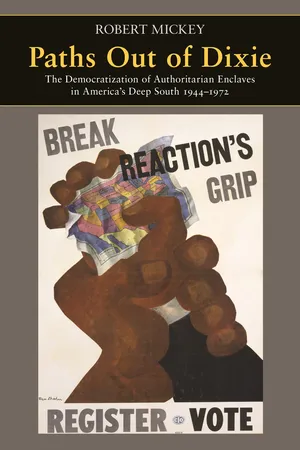
eBook - ePub
Paths Out of Dixie
The Democratization of Authoritarian Enclaves in America's Deep South, 1944-1972
- 584 pages
- English
- ePUB (mobile friendly)
- Available on iOS & Android
eBook - ePub
Paths Out of Dixie
The Democratization of Authoritarian Enclaves in America's Deep South, 1944-1972
About this book
Information
Publisher
Princeton University PressYear
2015Print ISBN
9780691149639
9780691133386
eBook ISBN
9781400838783
PART ONE
Deep South Enclaves, 1890–1940
CHAPTER ONE
Southern Political Development in Comparative Perspective
What is the State? It is the Democratic party…. Whenever there were political questions involved, … we looked to the interests of the party, because they are the interests of the State.
—Judge Thomas J. Semmes, delegate at Louisiana’s constitutional convention (1898)
The conversion of the South into a democracy in the sense that the mass of people vote and have a hand in their governance poses one of the most staggering tasks for statesmanship in the modern world.
—Valdimer Orlando Key, Jr. (1949)
ON JANUARY 11, 1961, Charlayne Hunter and Hamilton Holmes desegregated the University of Georgia in Athens. Their first afternoon of classes complete, Hunter settled in her dorm room, while Holmes returned to an off-campus residence. Much of the campus—and the state capitol in nearby Atlanta—was abuzz with talk of that night’s scheduled disturbance. Politicians from north Georgia pleaded with Governor Ernest Vandiver to dispatch the state highway patrol to ensure that the court-ordered desegregation occurred peacefully. Advisers from south Georgia disagreed; some secretly helped riot leaders in their bid to make the campus unsafe for Hunter and Holmes and safe again for white supremacy. By ten o’clock, a crowd of some two thousand students and locals set upon Hunter’s dormitory, where they hurled bricks and bottles and set fires nearby. After Athens cops fended off the crowd with tear gas and fire hoses, state troopers arrived—two hours after police requested help from the vacillating governor. National papers showed U.S. marshals rushing a distraught Hunter to safety. North Georgia politicians were chagrined by the disorder; those from south Georgia fumed at the state’s capitulation.1
On a late September morning in 1962, U.S. marshals escorted James Meredith across the University of Mississippi campus to the Lyceum—the school’s main administrative building—where a taciturn registrar awaited. Oxford’s air still stung with tear gas; stray bullets had pockmarked the statues of Confederate fallen. The group proceeded down a bloodstained corridor past exhausted U.S. marshals slumped against the walls, gas masks still strapped to their jaws. A pitched battle had just resulted in two deaths and hundreds of injuries. Alternately encouraged, discouraged, and repressed by confused state and county law enforcement, two thousand rampaging white supremacists had attacked the marshals. U.S. troops numbering 31,000—more than were stationed in South Korea—detained hundreds of civilians and restored order. Mississippi’s “occupation” had begun.2
Four months later, aspiring architect Harvey Gantt, stepping dapper out of a Buick sedan, strolled confidently across the campus of South Carolina’s Clemson College in his dark pinstripe suit, checked coat, and hat. As he did, jostling and commotion ensued. The first stirrings of a riot here in America’s last bastion of segregation? No, just shutterbugs jockeying for position. A polite meeting with the registrar, a quick press conference, a few curious onlookers…. Where was the angry white mob? Northern journalists left dejected. State politicians had foiled white supremacists’ planned disorder. The New York Times cried, “Bravo, Clemson…. What a contrast to Mississippi!” President Kennedy applauded, too, and discussed doubling South Carolina’s defense contracts.3
These confrontations among black insurgents, white crowds, state authorities, and federal officials varied greatly, ranging from the breakdown of order in Mississippi to South Carolina’s much-lauded “integration with dignity.” This book situates these crises as important moments in a much longer process—the democratization of southern authoritarian enclaves. Having begun in the 1940s, these transitions from authoritarian rule concluded by the early 1970s in the successful democratization of the eleven states of the former Confederacy. However, statesmen had converted them in sharply different ways. They differed in their ability to minimize outside interference with their dismantling of disfranchisement and “Jim Crow” social practices, to make peace with national Democrats, and to attract business investment. In part because they beat different paths out of Dixie, these states today differ in their politics and economics. Apprehending the contemporary South means coming to terms with the legacies of its democratizations.

In the 1890s leaders of the eleven states of the old Confederacy founded stable, one-party authoritarian enclaves under the “Democratic” banner. Having secured a conditional autonomy from the central state and the national party, these rulers curtailed electorates, harassed and repressed opposition parties, and created and regulated racially separate—and significantly unfree—civic spheres. State-sponsored violence enforced these elements in a system that ensured cheap agricultural labor and white supremacy. These regimes were effectively conflations of the state apparatus with those institutions regulating political ambition. The state apparatus oversaw the hegemonic Democratic party, while the party staffed, exploited, and guided local, county, and state governments. Given the strength of these regimes, their most serious challenges would emanate from without, not within. Enclaves capitalized on their influence in Congress and the national Democratic party—as well as national indifference—to shield themselves from those who might violate their “sovereignty.” For a half-century, they succeeded.
Beginning with the U.S. Supreme Court’s abolition of the “white only” Democratic primary in 1944, black insurgents, mostly in the South, inspired, compelled, and capitalized on federal judicial rulings, national legislation, and national party reforms that battered these enclaves. By the early 1970s, a variety of actors—federal authorities, domestic insurgents, and their allies “abroad”—had defeated southern authoritarians. In the process, the central state had supervised the dismantling of disfranchisement, segregation, and state repression, while national Democrats ordered southern parties to incorporate racial minorities.
But the devil, as usual, was in the details. Across the South, officeholders sought to minimize federal supervision of state compliance with civil and voting rights legislation and scores of judicial directives, ranging from school desegregation to legislative reapportionment, from electoral systems to lunch counters. In many ways, minimizing oversight could lower the costs of democratization for incumbents and their clients. How successful were these resisters in doing so? How much autonomy did they manage to preserve? Were they able to democratize on their own terms, or was the process out of their hands? Once the guarantor of southern authoritarianism, an emboldened national Democratic party had begun to interfere with the manner in which state parties treated black voters, nominated candidates, and selected presidential delegates. Did southern Democrats reform racial practices and normalize relations, or did they bicker with the national party, file for “divorce,” and then walk away?
Across the region, the eleven enclaves differed in the nature of their compliance with federal directives; the pace and scope of black incorporation into the state Democratic party; and the timing and nature of their reconciliation with the national party. Different configurations of these factors constituted distinct modes of democratization (table 1.1). In one, enclaves quickly submitted to pressures to democratize, or even preempted some of them through “indigenous” reforms. Falling into line with federal and national party directives, these enclaves—usually in the Outer South—experienced an acquiescent democratization.4 Others sought to delay change, control the pace of democratizing reforms, and minimize the consequences of black incorporation into the Democratic party.5 To do so, they needed to walk a tight wire from angry defiance to lawful compliance without inducing disorder (and the breaches of “sovereignty” that might follow). Some successfully implemented this strategic accommodation, and thereby secured a harnessed democratization. Others failed, triggering enclave intransigence, massive interventions, and fractured national party relations, and experienced a protracted democratization.
Surprisingly, this variation existed even within the Deep South—a region that remains relatively undifferentiated in the popular imagination and academic mind. As the transitions began in the 1940s, these enclaves featured similar demographics, political economies, modes of governance, partisan dynamics, and commitments to white supremacy. Over time, rulers’ responses to democratization pressures propelled these states onto different paths. South Carolina managed a harnessed democratization, Mississippi stumbled through a protracted democratization, and Georgia experienced a bifurcated democratization, in which sectional conflict led north and south Georgia to come to different terms with the feds and the national party.
These different paths generated important legacies that still shape the present. Those enclaves that accommodated democratization pressures garnered greater success in capital accumulation and accelerated their state’s economic growth. Conversely, those enclaves unable to do so suffered greatly on this score. Ironically, however, by managing to incorporate blacks and reconcile with the national party smoothly, enclave rulers doomed state Democrats over the long run. Where rulers failed to accommodate strategically to democratization pressures, they unintentionally benefited state Democrats over the coming decades.
Southern regime change has never been examined. This study—a comparative historical analysis of democratization in Georgia, Mississippi, and South Carolina—seeks to explain one important element of this change: the processes of democratization undergone by Deep South states. It argues that elite cohesion, and the institutions of party and state that equipped and constrained these elites, help account for differences in modes of democratization across the Deep South. (Regime elites are discussed further in chapter 2. For now, by elites I mean powerful authorities in party or state institutions, and other important resource-holders within the regime.) Elite cohesion refers to the degree to which regime politicians and other resource-holders agree that the party remains the best vehicle for pursuing political careers and policy goals, and agree broadly on a strategy to resist democratization pressures. Party-state capacity refers to the degree of fit between, on the one hand, the institutions regulating political ambition and those of the state apparatus, and, on the other, elites’ efforts to undertake various governance tasks—especially those necessary for maintaining enclave rule.6 By the early 1960s, enclaves differed on these two dimensions, and thus varied in how they navigated mounting democratization pressures.
TABLE 1.1
Modes of Democratization
Outer South | South Carolina | Mississippi | Georgia | |
State compliance with federal directives | Preemptive | Superficial and tranquil | Delayed and violent | Split by region |
Black incorporation into state party | Early and extensive | Early and managed | Late and divisive | Split by region |
Reconciliation with national party | Earliest and preemptive | Early 1960s and smooth | Late (mid-1970s) and turbulent | Split by region (early 1970s) |
Type of democratization process | Acquiescent | Harnessed | Protracted | Bifurcated |
The South’s democratization—a complex macrohistorical process occurring amid great social, cultural, and economic change—is the most important development in American politics since World War II. It has contributed to the ideological and racial polarization of the national parties, altered the dimensions on which the parties compete, redrawn the map of presidential elections, and transformed Congress. Moreover, today millions of Americans now practice an entirely different mode of politics. Whereas blacks were once shut out of electoral politics, some six thousand black elected officials now serve southern constituencies. More than 73 million southern adults, native-born and newly arrived, may participate freely in a competitive, two-party system. Whereas Democrats once occupied about 95 percent of all elective offices, Republicans now claim more than one-half of the region’s federal and state offices.7 Thus, understanding how the recent past shapes contemporary U.S. politics requires illuminating the political development of the American South.
This study offers an optic for focusing on the region, and on the United States, in cross-national perspective. The remainder of this chapter describes some of the principal approaches to southern political change, outlines the one used here, describes th...
Table of contents
- Cover Page
- Title Page
- Copyright Page
- Dedication Page
- Contents
- List of Illustrations and Tables
- Preface and Acknowledgments
- Part One: Deep South Enclaves, 1890–1940
- Part Two: The Transition Begins, 1944–48
- Part Three: The Clouds Darken, 1950–63
- Part Four: Modes of Democratization and Their Legacies since 1964
- Notes
- Index
Trusted by 375,005 students
Access to over 1.5 million titles for a fair monthly price.
Study more efficiently using our study tools.
Frequently asked questions
Yes, you can cancel anytime from the Subscription tab in your account settings on the Perlego website. Your subscription will stay active until the end of your current billing period. Learn how to cancel your subscription
No, books cannot be downloaded as external files, such as PDFs, for use outside of Perlego. However, you can download books within the Perlego app for offline reading on mobile or tablet. Learn how to download books offline
Perlego offers two plans: Essential and Complete
- Essential is ideal for learners and professionals who enjoy exploring a wide range of subjects. Access the Essential Library with 800,000+ trusted titles and best-sellers across business, personal growth, and the humanities. Includes unlimited reading time and Standard Read Aloud voice.
- Complete: Perfect for advanced learners and researchers needing full, unrestricted access. Unlock 1.5M+ books across hundreds of subjects, including academic and specialized titles. The Complete Plan also includes advanced features like Premium Read Aloud and Research Assistant.
We are an online textbook subscription service, where you can get access to an entire online library for less than the price of a single book per month. With over 1.5 million books across 990+ topics, we’ve got you covered! Learn about our mission
Look out for the read-aloud symbol on your next book to see if you can listen to it. The read-aloud tool reads text aloud for you, highlighting the text as it is being read. You can pause it, speed it up and slow it down. Learn more about Read Aloud
Yes! You can use the Perlego app on both iOS and Android devices to read anytime, anywhere — even offline. Perfect for commutes or when you’re on the go.
Please note we cannot support devices running on iOS 13 and Android 7 or earlier. Learn more about using the app
Please note we cannot support devices running on iOS 13 and Android 7 or earlier. Learn more about using the app
Yes, you can access Paths Out of Dixie by Robert Mickey in PDF and/or ePUB format, as well as other popular books in Politics & International Relations & North American History. We have over 1.5 million books available in our catalogue for you to explore.