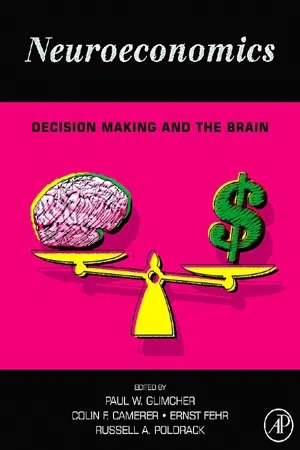
eBook - ePub
Neuroeconomics
Decision Making and the Brain
- 556 pages
- English
- ePUB (mobile friendly)
- Available on iOS & Android
eBook - ePub
Neuroeconomics
Decision Making and the Brain
About this book
Neuroeconomics is a new highly promising approach to understanding the neurobiology of decision making and how it affects cognitive social interactions between humans and societies/economies. This book is the first edited reference to examine the science behind neuroeconomics, including how it influences human behavior and societal decision making from a behavioral economics point of view. Presenting a truly interdisciplinary approach, Neuroeconomics presents research from neuroscience, psychology, and behavioral economics, and includes chapters by all the major figures in the field, including two Economics Nobel laureates.
- An authoritative reference written and edited by acknowledged experts and founders of the field
- Presents an interdisciplinary view of the approaches, concepts, and results of the emerging field of neuroeconomics relevant for anyone interested in this area of research
- Full-color presentation throughout with carefully selected illustrations to highlight key concepts
Information
Subtopic
Economic TheoryIndex
Biological SciencesChapter 1 Introduction
A Brief History of Neuroeconomics
Over the first decade of its existence, neuroeconomics has engendered raucous debates of two kinds. First, scholars within each of its parent disciplines have argued over whether this synthetic fineld offers benefits to their particular parent discipline. Second, scholars within the emerging field itself have argued over what form neuroeconomics should take. To understand these debates, however, a reader must understand both the intellectual sources of neuroeconomics and the backgrounds and methods of practicing neuroeconomists.
Neuroeconomics has its origins in two places; in events following the neoclassical economic revolution of the 1930s, and in the birth of cognitive neuroscience during the 1990s. We therefore begin this brief history with a review of the neoclassical revolution and the birth of cognitive neuroscience.
Neoclassical Economics
The birth of economics is often traced to Adam Smith's publication of The Wealth of Nations in 1776. With this publication began the classical period of economic theory. Smith described a number of phenomena critical for understanding choice behavior and the aggregation of choices into market activity. These were, in essence, psychological insights. They were relatively ad hoc rules that explained how features of the environment influenced the behavior of a nation of consumers and producers.
What followed the classical period was an interval during which economic theory became very heterogenous. A number of competing schools with different approaches developed. Many economists of the time (Edgeworth, Ramsey, Fisher) dreamed about tools to infer value from physical signals, through a “hedonimeter” for example, but these early neuroeconomists did not have such tools (Colander, 2008).
One school of thought, due to John Maynard Keynes, was that regularities in consumer behavior could (among other things) provide a basis for fiscal policy to manage economic fluctuations. Many elements in Keynes’ theory, such as the “propensity to consume” or entrepreneurs’ “animal spirits” that influence their investment decisions, were based on psychological concepts. This framework dominated United States’ fiscal policy until the 1960s.
Beginning in the 1930s, a group of economists – most famously, Samuelson, Arrow, and Debreu – began to investigate the mathematical structure of consumer choice and behavior in markets (see, for example, Samuelson, 1938). Rather than simply building models that incorporated a set of parameters that might, on a priori psychological grounds, be predictive of choice behavior, this group of theorists began to investigate what mathematical structure of choices might result from simple, more “primitive,” assumptions on preferences. Many of these models (and the style of modeling that followed) had a strong normative flavor, in the sense that attention was most immediately focused on idealized choices and efficient allocation of resources; as opposed to necessarily seeking to describe how people choose (as psychologists do) and how markets work.
To better understand this approach, consider what is probably the first and most important of these simple models: the Weak Axiom of Revealed Preference (WARP). WARP was developed in the 1930s by Paul Samuelson, who founded the revealed preference approach that was the heart of the neoclassical revolution. Samuelson proposed that if a consumer making a choice between an apple and an orange selects an apple, he reveals a preference for apples. If we assume only that this means he prefers (preference is here a stable internal property that economists did not hope to measure directly) apples to oranges, what can we say about his future behavior? Can we say anything at all?
What Samuelson and later authors showed mathematically was that even simple assumptions about binary choices, revealing stable (weak) preferences, could have powerful implications. An extension of the WARP axiom called GARP (the “generalized” axiom of revealed preference, Houthakker, 1950) posits that if apples are revealed preferred to oranges, and oranges are revealed preferred to peaches, then apples are “indirectly” revealed preferred to peaches (and similarly for longer chains of indirect revelation). If GARP holds for binary choices among pairs of objects, then some choices can be used to make predictions about the relative desirability of pairs of objects that have never been directly compared by the consumer. Consider a situation in which a consumer chooses an apple over an orange and then an orange over a peach. If the assumption of GARP is correct, then this consumer must not choose a peach over an apple even if this is a behavior we have never observed before.
The revealed preference approach thus starts from a set of assumptions called axioms which encapsulate a theory of some kind (often a very limited one) in formal language. The theory tells us what a series of observed choices implies about intermediate variables such as utilities (and, in more developed versions of the theory, subjective beliefs about random events). The poetry in the approach (what distinguishes a beautiful theory from an ugly one) is embodied in the simplicity of the axioms, and the degree to which surprisingly simple axioms make sharp predictions about what kind of choice patterns should and should not be observed. Finally, it is critical to note that what the theory predicts is which new choices could possibly follow from an observed set of previous choices (including choices that respond to policy and other changes in the environment, such as responses to changes in prices, taxes, or incomes). The theories do not predict intermediate variables; they use them as tools. What revealed preference theories predict is choice. It is the only goal, the only reason for being, for these theories.
What followed the development of WARP were a series of additional theorems of this type which extended the scope of revealed-preference theory to choices with uncertain outcomes whose likelihoods are known (von Neumann and Morgenstern's expected utility theory, EU) or subjective (or “personal,” in Savage's subjective EU theory), and in which outcomes may be spread over time (discounted utility theory) (see Chapter 3 for more details). What is most interesting about these theories is that they demonstrate, amongst other things, that a chooser who obeys these axioms must behave both “as if” he has a continuous utility function that relates the subjective value of any gain to its objective value and “as if” his actions were aimed at maximizing total obtained utility. In their seminal book von Neumann and Morgenstern also laid the foundations for much of game theory, which they saw as a special problem in utility theory, in which outcomes are generated by the choices of many players (von Neumann and Morgenstern, 1944).
At the end of this period, neoclassical economics seemed incredibly powerful. Starting with as few as one and as many as four simple assumptions which fully described a new theory the neoclassicists developed a framework for thinking about and predicting choice. These theories of consumer choice would later form the basis for the demand part of the Arrow-Debreu theory of competitive “general” equilibrium, a system in which prices and quantities of all goods were determined simultaneously by matching supply and demand. This is an important tool because it enables the modeler to anticipate all consequences of a policy change – for example, imposing a luxury tax on yachts might increase crime in a shipbuilding town because of a rise in unemployment there. This sort of analysis is unique to economics, and partly explains the broad influence of economics in regulation and policy-making.
It cannot be emphasized enough how much the revealed-preference view suppressed interest in the psychological nature of preference, because clever axiomatic systems could be used to infer properties of unobservable preference from observable choice (Bruni and Sugden, 2007). Before the neoclassical revolution, Pareto noted in 1897 that
It is an empirical fact that the natural sciences have progressed only when they have taken secondary principles as their point of departure, instead of trying to discover the essence of things. … Pure political economy has therefore a great interest in relying as little as possible on the domain of psychology.
(Quoted in Busino, 1964: xxiv)
Later, in the 1950s, Milton Friedman wrote an influential book, The Methodology of Positive Economics. Friedman argued that assumptions underlying a prediction about market behavior could be wrong, but the prediction could be approximately true. For example, even if a monopolist seller does not sit down with a piece of paper and figure out what price maximizes total profit, monopoly prices might evolve “as if” such a calculation has been made (perhaps due to selection pressures within or between firms). Friedman's argument licensed economists to ignore evidence of when economic agents violate rational-choice principles (evidence that typically comes from experiments that test the individual choice principles most clearly), a prejudice that is still widespread in economics.
What happened next is critical for understanding where neuroeconomics arose. In 1953, the French economist Maurice Allais designed a series of pairwise choices which led to reliable patterns of revealed preference that violated the central “independence” axiom of expected utility theory. Allais unveiled his pattern, later called the “Allais paradox,” at a conference in France at which many participants, including Savage, made choices which violated their own theories during an informal lunch. (Savage allegedly blamed the lunchtime wine.)
A few years after Allais’ example, Daniel Ellsberg (1961) presented a famous paradox suggesting that the “ambiguity” (Ellsberg's term) or “weight of evidence” (Keynes’ term) supporting a judgment of event likelihood could influence choices, violating one of Savage's key axioms. The Allais and Ellsberg paradoxes raised the possibility that the specific functional forms of EU and subjective EU implied by simple axioms of preference were generally wrong. More importantly, the paradoxes invited mathematical exploration (which only came to fruition in the 1980s) about how weaker systems of axioms might generalize EU and SEU. The goal of these new theories was to accommodate the paradoxical behavior in a way that is both psychologically plausible and formally sharp (i.e., which does not predict that any pattern of choices is possible, and could therefore conceivably be falsified by new paradoxes).
One immediate response to this set of observations was to argue that the neoclassical models worked, but only under some limited circumstances – a fact which many of the neoclassicists were happy to concede (for example, Morgenstern said “the probabilities used must be within certain plausible ranges and not go to .01 or even less to .001”). Surely axioms might also be violated if the details of the options being analyzed were too complicated for the chooser to understand, or if the chooser was overwhelmed with too many choices. Observed violations could then be seen as a way to map out boundary conditions – a specification of the kinds of problems that lay outside the limits of the neoclassical framework's range of applicability.
Another approach was Herbert Simon's suggestion that rationality is computationally bounded, and that much could be learned by understanding “procedural rationality.” As a major contributor to cognitive science, Simon clearly had in mind theories of choice which posited particular procedures, and suggested that the way forward was to understand choice procedures empirically, perhaps in the form of algorithms (of which “always choose the object with the highest utility” is one extreme and computationally demanding procedure).
A sweeping and constructive view emerged from the work of Daniel Kahneman and Amos Tversky (1979) in the late 1970s and 1980s, and other psychologists interested in judgment and decision making whose interests intersected with choice theory. What Kahneman, Tversky, and others showed in a series of remarkable experimental examples was that the range of phenomena that fell outside classical expected utility theory was even broader than Allais’ and Ellsb...
Table of contents
- Cover
- Title Page
- Copyright Page
- Table of Contents
- Contributors
- Preface
- Chapter 1: Introduction
- Chapter 2: Introduction
- Chapter 3: Axiomatic Neuroeconomics
- Chapter 4: Neuroeconomics:
- Chapter 5: Experimental Neuroeconomics and Non-cooperative Games
- Chapter 6: Games in Humans and Non-human Primates: Scanners to Single Units
- Chapter 7: The Evolution of Rational and Irrational Economic Behavior
- Chapter 8: The Expected Utility of Movement
- Chapter 9: The Psychology and Neurobiology of Judgment and Decision Making
- Chapter 10: Decisions Under Uncertainty
- Chapter 11: Prospect Theory and the Brain
- Chapter 12: Values and Actions in Aversion
- Chapter 13: Behavioral Game Theory and the Neural Basis of Strategic Choice
- Chapter 14: Neuroscience and the Emergence of Neuroeconomics
- Chapter 15: Social Preferences and the Brain
- Chapter 16: The Study of Emotion in Neuroeconomics
- Chapter 17: Understanding Others
- Chapter 18: Social Preferences in Primates
- Chapter 19: Responses to Inequity in Non-human Primates
- Chapter 20: Neuroeconomics of Charitable Giving and Philanthropy
- Chapter 21: Midbrain Dopamine Neurons
- Chapter 22: Theoretical and Empirical Studies of Learning
- Chapter 23: The Neurobiological Foundations of Valuation in Human Decision Making Under Uncertainty
- Chapter 24: Multiple Forms of Value Learning and the Function of Dopamine
- Chapter 25: Representation of Subjective Value in the Striatum
- Chapter 26: The Basal Ganglia and the Encoding of Value
- Chapter 27: The Neural Mechanisms that Underlie Decision Making
- Chapter 28: The Computation and Comparison of Value in Goal-directed Choice
- Chapter 29: Neuronal Representations of Value
- Chapter 30: The Trouble with Choice: Studying Decision Variables in the Brain
- Chapter 31: Mechanisms for Stochastic Decision Making in the Primate Frontal Cortex
- Chapter 32: Choice
- Chapter 33: Remarks on Neuroeconomics
- Index
Trusted by 375,005 students
Access to over 1.5 million titles for a fair monthly price.
Study more efficiently using our study tools.
Frequently asked questions
Yes, you can cancel anytime from the Subscription tab in your account settings on the Perlego website. Your subscription will stay active until the end of your current billing period. Learn how to cancel your subscription
No, books cannot be downloaded as external files, such as PDFs, for use outside of Perlego. However, you can download books within the Perlego app for offline reading on mobile or tablet. Learn how to download books offline
We are an online textbook subscription service, where you can get access to an entire online library for less than the price of a single book per month. With over 1.5 million books across 990+ topics, we’ve got you covered! Learn about our mission
Look out for the read-aloud symbol on your next book to see if you can listen to it. The read-aloud tool reads text aloud for you, highlighting the text as it is being read. You can pause it, speed it up and slow it down. Learn more about Read Aloud
Yes! You can use the Perlego app on both iOS and Android devices to read anytime, anywhere — even offline. Perfect for commutes or when you’re on the go.
Please note we cannot support devices running on iOS 13 and Android 7 or earlier. Learn more about using the app
Please note we cannot support devices running on iOS 13 and Android 7 or earlier. Learn more about using the app
Yes, you can access Neuroeconomics by Paul W. Glimcher,Ernst Fehr,Colin Camerer,Russell Alan Poldrack in PDF and/or ePUB format, as well as other popular books in Biological Sciences & Economic Theory. We have over 1.5 million books available in our catalogue for you to explore.