- 538 pages
- English
- ePUB (mobile friendly)
- Available on iOS & Android
eBook - ePub
About this book
Nanotechnology is considered the next big revolution in medicine and biology. For the past 20 years, research groups have been involved in the development of new applications of novel nanomaterials for biotechnological applications. Nanomaterials are also becoming increasingly important in medical applications, with new drugs and diagnostic tools based on nanotechnology. Every year, hundreds of new ideas using nanomaterials are applied in the development of biosensors. An increasing number of new enterprises are also searching for market opportunities using these technologies.Nanomaterials for biotechnological applications is a very complex field. Thousands of different nanoparticles could potentially be used for these purposes. Some of them are very different; their synthesis, characterization and potentiality are very diverse. This book aims to establish a route guide for non-erudite researchers in the field, showing the advantages and disadvantages of the different kind of nanomaterials. Particular attention is given to the differences, advantages and disadvantages of inorganic nanoparticles versus organic nanoparticles when used for biotechnological applications. A tutorial introduction provides the basis for understanding the subsequent specialized chapters.
- Provides an overview of the main advantages and disadvantages of the use of organic and inorganic nanoparticles for use in biotechnology and nanomedicine
- Provides an excellent starting point for research groups looking for solutions in nanotechnology who do not know which kind of materials will best suit their needs
- Includes a tutorial introduction that provides a basis for understanding the subsequent specialized chapters
Information
Topic
Ciencias biológicasSubtopic
BiotecnologíaFrontiers of Nanoscience,, Vol. 4, No. suppl (C), 2012
ISSN: 1876-2778
doi: 10.1016/B978-0-12-415769-9.00001-7
Chapter 1 Synthesis Applications of Gold Nanoparticles
Abstract
The technological development of nanoscience (nanotechnology) has revolutionized the impact of Au in the scientific community and, more recently, in our society in the form of very beneficial technological applications in fields such as materials science, energy, or medicine. Currently, the development of new synthetic routes to obtain Au colloids, complex multicomponent materials embedding Au colloids, and following novel applications based on these materials are the subjects of work for many scientists; consequently, reports related to gold colloids, also referred to as Au nanoparticles or nanocrystals, have become very prolific in literature. As the degree of control to fabricate such structures evolves, new applications based on these materials can be explored. Photothermal therapy, photoacoustic imaging, and surface enhanced resonance spectroscopy are examples of applications where NPs such as nanorods, hollow nanospheres, and nanostars, among others, can act as transducers..
Keywords
Optical properties Surface plasmons Anisotropic shapes Biocompatibility Thiolated surfactants
1 Introduction
As bulk materials, the noble metal gold (Au) has been for centuries a very popular subject of study in science. However, the technological development of nanoscience (nanotechnology) has revolutionized the impact of Au in the scientific community and, more recently, in our society in the form of very beneficial technological applications in fields such as materials science, energy, and medicine. Currently, the development of new synthetic routes to obtain Au colloids, complex multicomponent materials embedding Au colloids, and the following novel applications based on these materials are the subjects of work for many scientists; consequently, reports related to gold colloids, also referred to as Au nanoparticles or nanocrystals (GNPs), have become very prolific in the literature. Furthermore, the popularity of synthetic methods yielding GNPs with on-demand size, shape, structure (solid or hollow), coating, etc., continues growing exponentially; as the degree of control to fabricate such structures evolves, new applications based on these materials can be explored. Photothermal therapy (PTT), photoacoustic (PA) imaging, and surface-enhanced resonance spectroscopy (SERS) are examples of applications where NPs such as nanorods, hollow nanospheres, and nanostars, among others, can act as transducers.
Among material scientists, the interesting optical features of GNPs are their key to success; in general, photons can couple to the plasma resonance of the conduction electrons at the surface of metallic NPs to produce their collective oscillation, in a phenomenon usually referred as localized surface plasmon resonance (LSPR). Indeed, the optical properties of metallic NPs are mainly dictated by surface plasmons. For NPs made of Au (noble metals in general), the LSPR band lies in the visible-NIR part of the spectrum; the position of the LSPR band is determined by a combination of NP attributes such as composition, size, and shape, and also by the dielectric environment. The interaction of light with surface plasmons at very confined volumes like that of Au colloids is currently being explored in fields such as optics and energy.1-3
The ability for tuning the color of colloidal solutions of GNPs by changing their size has been known for long time. However, in the past decade, a consistent body of work has highlighted the fact that shape plays also a crucial role in determining the optical properties of nanomaterials. Ultimately, the energy confinement of electrons, holes, excitons, phonons, and plasmons with respect to the NPs shape is the reason for this observation. Colors can be attributed to changes in surface plasmon resonance, energy at which light couples to the surface plasmons of NPs (Figure 1.1).
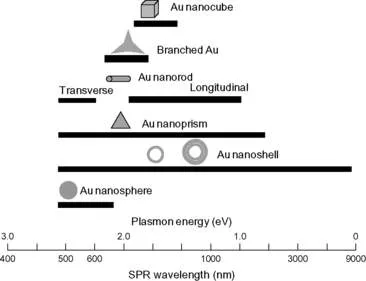
Figure 1.1 Range of surface plasmon resonances of GNPs as a function of their shape
(reproduced from Treguer-Delapierre).4
In the context of biology and medicine, in addition to the widely explored optical properties, GNPs exhibit two extra value properties which make them the “stars” among a wide variety of NPs for bioapplications, that is, biocompatibility and ease of surface modification by a wide range of thiolated molecules. In summary, GNPs represent an ideal platform for many applications in very different areas. The interest on Au is reflected by the increasing number of publications related to GNPs in the past years (Figure 1.2A); the most recent interest on anisotropic GNPs such as nanorods, nanoplates, branched nanostructures, nanoprisms, or nanoshells can also be seen in Figure 1.2B.
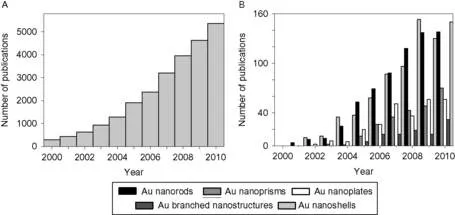
Figure 1.2 Publication during the past decade related to (A) GNPs and (B) different types of anisotropic GNPs
(Source Isi Web of Knowledge, June 2011).
2 Ancient Uses of GNPs
Throughout human history, gold has been valued for its beauty and for its resistivity against corrosion; also, it was hammered into articles of jewelry. Gold extraction started in the fifth millennium BC However, in contrast to the long history of gold, the development of its chemistry was delayed because of its noble character. Gold can be only dissolved in oxidizing media such as aqua regia or by complexing species such as cyanides under air.5 Long before the development of modern gold chemistry, the unique “golden” appearance of gold was highly appreciated. Probably, “soluble” gold appeared around the fifth or fourth century BC in Egypt and China; colloidal gold was used then to make ruby glass and for coloring ceramics, applications which continue nowadays. In the Middle Ages, gold was greatly valued due to the belief of its curative powers for various diseases. All these aspects were compiled in which is considered the first book on colloidal gold wrote by F. Antonii in 1618.6 Communications regarding the curative properties and optical featur...
Table of contents
- Cover image
- Table of Contents
- Series Page
- Copyright
- Contributors
- Preface
- Chapter 1 Synthesis Applications of Gold Nanoparticles
- Chapter 2 Synthesis of Inorganic Nanoparticles
- Chapter 3 Synthesis of Inorganic Nanocrystals for Biological Fluorescence Imaging
- Chapter 4 Synthesis of Organic Nanoparticles
- Chapter 5 Synthetic Strategies to Create Dendrimers
- Chapter 6 Applications of Inorganic Nanoparticles for Biotechnology
- Chapter 7 Investigating Nanoparticle Internalization Patterns by Quantitative Correlation Analysis of Microscopy Imaging Data
- Chapter 8 Organic Nanoparticles
- Chapter 9 Application of Inorganic Nanoparticles for Diagnosis Based on MRI
- Chapter 10 Biosensors Based on Nanoparticles and Electrochemical Detection
- Chapter 11 Magnetic Nanoparticles for Application in Biomedical Sensing
- Chapter 12 Quantum Dot Nanoparticles for In Vitro Sensing
- Chapter 13 Hyperthermia Using Inorganic Nanoparticles
- Chapter 14 Nanocarriers as Nanomedicines
- Chapter 15 Nanotoxicology
- Chapter 16 Overview of Nanomedicines Regulation in the European Union
- Index
Trusted by 375,005 students
Access to over 1.5 million titles for a fair monthly price.
Study more efficiently using our study tools.
Frequently asked questions
Yes, you can cancel anytime from the Subscription tab in your account settings on the Perlego website. Your subscription will stay active until the end of your current billing period. Learn how to cancel your subscription
No, books cannot be downloaded as external files, such as PDFs, for use outside of Perlego. However, you can download books within the Perlego app for offline reading on mobile or tablet. Learn how to download books offline
Perlego offers two plans: Essential and Complete
- Essential is ideal for learners and professionals who enjoy exploring a wide range of subjects. Access the Essential Library with 800,000+ trusted titles and best-sellers across business, personal growth, and the humanities. Includes unlimited reading time and Standard Read Aloud voice.
- Complete: Perfect for advanced learners and researchers needing full, unrestricted access. Unlock 1.5M+ books across hundreds of subjects, including academic and specialized titles. The Complete Plan also includes advanced features like Premium Read Aloud and Research Assistant.
We are an online textbook subscription service, where you can get access to an entire online library for less than the price of a single book per month. With over 1.5 million books across 990+ topics, we’ve got you covered! Learn about our mission
Look out for the read-aloud symbol on your next book to see if you can listen to it. The read-aloud tool reads text aloud for you, highlighting the text as it is being read. You can pause it, speed it up and slow it down. Learn more about Read Aloud
Yes! You can use the Perlego app on both iOS and Android devices to read anytime, anywhere — even offline. Perfect for commutes or when you’re on the go.
Please note we cannot support devices running on iOS 13 and Android 7 or earlier. Learn more about using the app
Please note we cannot support devices running on iOS 13 and Android 7 or earlier. Learn more about using the app
Yes, you can access Nanobiotechnology by in PDF and/or ePUB format, as well as other popular books in Ciencias biológicas & Biotecnología. We have over 1.5 million books available in our catalogue for you to explore.