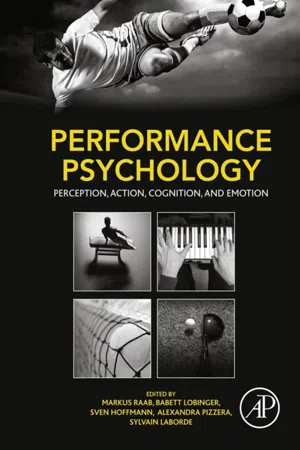
eBook - ePub
Performance Psychology
Perception, Action, Cognition, and Emotion
- 366 pages
- English
- ePUB (mobile friendly)
- Available on iOS & Android
eBook - ePub
Performance Psychology
Perception, Action, Cognition, and Emotion
About this book
This book integrates findings from across domains in performance psychology to focus on core research on what influences peak and non-peak performance. The book explores basic and applied research identifying cognition-action interactions, perception-cognition interactions, emotion-cognition interactions, and perception-action interactions. The book explores performance in sports, music, and the arts both for individuals and teams/groups, looking at the influence of cognition, perception, personality, motivation and drive, attention, stress, coaching, and age. This comprehensive work includes contributions from the US, UK, Canada, Germany, and Australia.
- Integrates research findings found across domains in performance psychology
- Includes research from sports, music, the arts, and other applied settings
- Identifies conflicts between cognition, action, perception, and emotion
- Explores influences on both individual and group/team performance
- Investigates what impacts peak performance and error production
Information
Section E
Performance under Pressure of Individuals or Teams and Other Performance Phenomena of Emotion–Cognition Interactions
Introduction
17. Bridging the Gap between Emotion and Cognition: An Overview (Sylvain Laborde) 275
18. Performing under Pressure: Influence of Personality-Trait–Like Individual Differences (Emma Mosley and Sylvain Laborde) 291
19. The Influence of Hormonal Stress on Performance (Franziska Lautenbach and Sylvain Laborde) 315
20. Performing under Pressure: High-Level Cognition in High-Pressure Environments (K. Werner) 329
Overview
This section aims to address how emotions and cognition are affected by pressure and how they influence performance under pressure (Chapter 17). Chapter 18 starts by delineating the influence of stable and enduring characteristics of individuals, referred to as personality trait–like individual differences, on aspects related to how individuals deal with pressure (e.g., decision-making, coping). Pressure will induce physiological and hormonal changes in individuals, and getting a grip on those changes through specific interventions should help to improve performance under pressure, as introduced in Chapter 19. The way high-level cognition processes function under pressure, such as creativity and problem solving, will be addressed in Chapter 20.
Chapter 17
Bridging the Gap between Emotion and Cognition
An Overview
Sylvain Laborde1,2 1Department of Performance Psychology, Institute of Psychology, German Sport University, Cologne, Germany 2UFR STAPS, EA 4260, University of Caen, Caen, France
Abstract
This section aims to address how emotions and cognition are affected by pressure, and how they influence performance under pressure (Laborde, Chapter 17). Mosley and Laborde (Chapter 18) start by delineating the influence of stable and enduring characteristics of individuals, referred to as personality-trait-like individual differences, on aspects related to how individuals differently deal with pressure (e.g., decision-making, coping). Pressure will induce physiological and hormonal changes in individuals, and getting a grip on those changes through specific interventions should help to improve performance under pressure, as introduced by Lautenbach and Laborde (Chapter 19). The way high-level cognition processes function under pressure, such as creativity and problem-solving, will be addressed by Werner (Chapter 20).
Keywords
Cognition; Decision-making; Emotion; Pressure; Psychophysiology; StressWhy do some people struggle to find the words during a public presentation, though the speech was flowing while rehearsing? Why do musicians who practice their instrument flawlessly all day long still experience stage fright and make mistakes when giving a concert? Why do students, who studied extremely hard for their final examination, get very anxious when taking the test and just cannot structure their thoughts? How can it happen that James Lebron, one of the best NBA players, regularly misses crucial free throws during competitions, though this is a closed skill that one can extensively train?
When there is something at stake, the pressure to perform comes immediately into play. Pressure represents “any factor or combination of factors that increases the importance of performing well on a particular occasion” (Baumeister, 1984, p. 610). Pressure usually triggers stress (e.g., Laborde, Raab, & Kinrade, 2014) and emotions, in particular anxiety (e.g., Laborde, Lautenbach, Allen, Herbert, & Achtzehn, 2014). Hence, pressure has the potential to influence cognitive processes, for example, evidenced in a recent special issue on emotion and decision-making (Laborde, Dosseville, & Raab, 2013). Complementary to this account, neuroscientists made clear that cognition and emotion are embedded (Damasio, 1994), in the sense that effective cognition can only happen with a working functional connection to emotions, which ultimately motivates the investigation of the emotion–cognition dyad in Section E. This introductory chapter to Section E provides the reader with the basics to understand the relevant theories attempting to bridge the gap between emotion and cognition in performance contexts. In it, we will point out the current challenges of the field and offer a critical view on the theories. Finally, we will show how theory development and the pertinent combination of different research methods can help both basic research and the applied field with the development of specific interventions.
Emotions and Other Affective Phenomena
For the longest time, stress has been the focus in research on affective phenomena and cognition (Lazarus, 2000). This is no longer the case: in the last few years, there has been a shift toward emotions. Stress is considered as a unidimensional concept representing the degrees of external pressure or disturbed reactions and can be indexed in terms of arousal or activation (Lazarus, 2000). Emotions, in contrast, offer a richer, multidimensional view.
Given the fact that within the realm of affective states these concepts are often used interchangeably, I first want to define them shortly to get a better grip on them. Affects are acknowledged to represent the whole diversity of the phenomena experienced by an individual. They are associated with a hedonic tone and include preferences, attitudes, feelings, moods, and emotions. They can be considered as encompassing all these affective terms (Scherer, 2005). Mood and emotions differ in that emotions are shorter in duration, lasting from a few seconds to a couple of minutes, and they are triggered by a specific event. Mood can last longer (one or several days) and are not related, in particular, to one event or situation, such as the recurrent experience of negative moods during depression (Feldman–Barrett, 1998; Lench, Flores, & Bench, 2011; Scherer, 2005).
The focus here is on emotions because of their adaptive role, which will be decisive to achieve peak performance. The changes provoked by an emotion are supposedly facilitative to an adequate response to the environmental changes that triggered that emotion in the first place (Lench et al., 2011). According to Scherer (2005), emotions have five main components: the cognitive component (appraisal), the neurophysiological component (bodily symptoms), the motivational component (action tendencies), the motor expression component (facial and vocal expression), and the subjective feeling component (emotional experience). Two main perspectives have been taken to conceptualize emotions, the discrete approach and the dimensional approach. The discrete approach describes each emotion as having a specific cognitive content as well as specific appraisal properties (Scherer, 2005). This is, for example, the case for the cognitive-motivational-relational theory of Lazarus (2000). It identifies each emotion through specific cognitive content and appraisal properties referred to as “core relational theme.” The dimensional approach considers that any emotion can be defined along a continuum of two main dimensions: valence and arousal. Valence or hedonic tone refers to experiences ranging from negative/unpleasant to positive/pleasant. Arousal, also called activation or intensity, refers to a sense of mobilization and ranges from low arousal to high arousal (Feldman–Barrett, 1998). Both valence and arousal play an important evolutionary role. First, valence indicates whether things are going well or badly regarding the existence of the individual. Second, arousal, which is close to the idea of action readiness, illustrates that emotions help us to respond to environmental stimulation or reach a goal (Frijda, 1986). High levels of arousal may, therefore, motivate actions more than low levels of arousal.
Both approaches, discrete and dimensional, are relevant for performance. We can potentially derive similar emotion regulation strategies from both approaches; however, the underlying reasons might differ. For the discrete approach, the focus would be on identifying those specific emotions that can either help or hinder the individual to perform in a specific setting. Subsequently, we can select the strategies to act on emotion-specific appraisal to elicit/control the targeted emotions. For the dimensional approach, the goal would be to identify the appropriate levels of valence and intensity required for the task and use specific strategies to reach them.
Albeit this chapter is entitled emotion and cognition, we might refer below to research based on affect or moods, because, as we have already mentioned, terms are still used interchangeably in the literature, and our could benefit from integrating those works to get a more complete overview on the topic.
Cognition: A Necessary Distinction Between Executive and Non-Executive Functions
Cognition (see also Raab, Chapter 1) has been divided between executive and non-e...
Table of contents
- Cover image
- Title page
- Table of Contents
- Copyright
- Contributors
- Preface
- Section A. What is Performance Psychology?
- Section B. Performance Phenomena of Cognitive–Action Interaction
- Section C. Dysfunctional Learning, Errors, and Other Performance Phenomena of Perception–Cognition Interactions
- Section D. Self-Other Perceptions and Other Performance Phenomena of Perception- Action Interactions
- Section E. Performance under Pressure of Individuals or Teams and Other Performance Phenomena of Emotion–Cognition Interactions
- Index
Trusted by 375,005 students
Access to over 1.5 million titles for a fair monthly price.
Study more efficiently using our study tools.
Frequently asked questions
Yes, you can cancel anytime from the Subscription tab in your account settings on the Perlego website. Your subscription will stay active until the end of your current billing period. Learn how to cancel your subscription
No, books cannot be downloaded as external files, such as PDFs, for use outside of Perlego. However, you can download books within the Perlego app for offline reading on mobile or tablet. Learn how to download books offline
Perlego offers two plans: Essential and Complete
- Essential is ideal for learners and professionals who enjoy exploring a wide range of subjects. Access the Essential Library with 800,000+ trusted titles and best-sellers across business, personal growth, and the humanities. Includes unlimited reading time and Standard Read Aloud voice.
- Complete: Perfect for advanced learners and researchers needing full, unrestricted access. Unlock 1.5M+ books across hundreds of subjects, including academic and specialized titles. The Complete Plan also includes advanced features like Premium Read Aloud and Research Assistant.
We are an online textbook subscription service, where you can get access to an entire online library for less than the price of a single book per month. With over 1.5 million books across 990+ topics, we’ve got you covered! Learn about our mission
Look out for the read-aloud symbol on your next book to see if you can listen to it. The read-aloud tool reads text aloud for you, highlighting the text as it is being read. You can pause it, speed it up and slow it down. Learn more about Read Aloud
Yes! You can use the Perlego app on both iOS and Android devices to read anytime, anywhere — even offline. Perfect for commutes or when you’re on the go.
Please note we cannot support devices running on iOS 13 and Android 7 or earlier. Learn more about using the app
Please note we cannot support devices running on iOS 13 and Android 7 or earlier. Learn more about using the app
Yes, you can access Performance Psychology by Markus Raab,Babett Lobinger,Sven Hoffmann,Alexandra Pizzera,Sylvain Laborde in PDF and/or ePUB format, as well as other popular books in Psychology & Cognitive Psychology & Cognition. We have over 1.5 million books available in our catalogue for you to explore.