eBook - ePub
Coastal Risk Management in a Changing Climate
- 670 pages
- English
- ePUB (mobile friendly)
- Available on iOS & Android
eBook - ePub
Coastal Risk Management in a Changing Climate
About this book
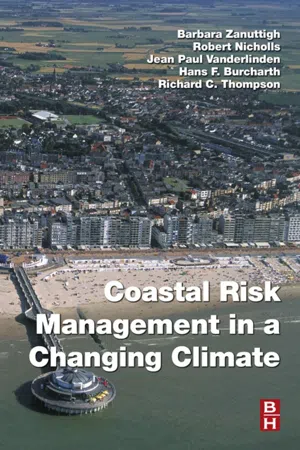
Existing coastal management and defense approaches are not well suited to meet the challenges of climate change and related uncertanities. Professionals in this field need a more dynamic, systematic and multidisciplinary approach. Written by an international group of experts, Coastal Risk Management in a Changing Climate provides innovative, multidisciplinary best practices for mitigating the effects of climate change on coastal structures. Based on the Theseus program, the book includes eight study sites across Europe, with specific attention to the most vulnerable coastal environments such as deltas, estuaries and wetlands, where many large cities and industrial areas are located.
- Integrated risk assessment tools for considering the effects of climate change and related uncertainties
- Presents latest insights on coastal engineering defenses
- Provides integrated guidelines for setting up optimal mitigation measures
- Provides directly applicable tools for the design of mitigation measures
- Highlights socio-economic perspectives in coastal mitigation
Information
Subtopic
Science environnementaleChapter 1
Introduction
Barbara Zanuttigh1, Robert Nicholls2, and Susan Hanson2 1Department of Civil, Chemicals, Environmental and Materials Engineering, University of Bologna (UniBo), Bologna, Italy 2Faculty of Engineering and the Environment, University of Southampton (Soton), Southampton, BJ, UK
Abstract
Coastal areas are important settlement zones and play a vital role in the wealth of many nations. Nearly 25% of the world's population lives within 62 miles (100 km) of a shoreline. Roughly 600 million people live in coastal regions that are less than 10 m above sea level, and this figure is likely to increase more rapidly (up to 50% over the next 25 years) than global population projections, reflecting coastal urbanization. Many of the world's largest cities are located at the coast (e.g., Tokyo, Guangzhou, Bangkok, Istanbul, London, Lagos, New York, Buenos Aires), and of course include critical infrastructures such as energy facilities, ports, and airports. Coasts are also home to important and productive ecosystems that are increasingly valued by society.
Keywords
Climate change; Coastal areas; Erosion; Risk assessment1.1. Background
Coastal areas are important settlement zones and play a vital role in the wealth of many nations. Nearly 25% of the world's population lives within 62 miles (100 km) of a shoreline. Roughly 600 million people live in coastal regions that are less than 10 m above sea level, and this figure is likely to increase more rapidly (up to 50% over the next 25 years) than global population projections, reflecting coastal urbanization (Lichter, Vafeidis, Nicholls, & Kaiser, 2011; McGranahan, Balk, & Anderson, 2007). Many of the world's largest cities are located at the coast (e.g., Tokyo, Guangzhou, Bangkok, Istanbul, London, Lagos, New York, Buenos Aires) (Hanson et al., 2011), and of course include critical infrastructures such as energy facilities, ports, and airports. Coasts are also home to important and productive ecosystems that are increasingly valued by society.
Large coastal stretches are exposed to erosion and flooding worldwide (Hinkel et al., 2013; Hinkel, van Vuuren, Nicholls, & Klein, 2013). Coastal flooding has caused more than 3 million deaths since 1700, with a strong concentration around the Bay of Bengal (see Doocy, Daniels, Murray, & Kirsch, 2013; Nicholls, 2006). During the worst sea surge recorded in modern European history, in the North Sea Surge in 1953, more than 2000 people lost their lives in England and the Netherlands, whereas 300 people died in Germany in 1962, which highlights the large areas in Europe that are also below normal high tide level. Most recent storms have been very economically disruptive because of flooding, for example, Hurricanes Katrina (2005) and Sandy (2012) in the United States and Typhoon Haiyan (2013) in the Philippines.
All the available assessments up to the Intergovernmental Panel on Climate Change Fourth Assessment show that world's coasts are threatened by sea-level rise and climate change in a variety of ways (Nicholls et al., 2007). Deltas, low-lying coastal plains, islands and barrier islands, beaches, coastal wetlands, and estuaries appear most affected by the acceleration in sea-level rise, although the local response will depend on the total sediment budget, for example, the Nile (Marriner, Flaux, Morhange, & Stanley, 2013) and in Bangladesh (Sarwar & Woodroffe, 2013). For erosion, this includes the indirect influence of sea-level rise on the beach sediment budget via infilling of coastal embayments or basins. As the sea level rises, estuaries and lagoons attempt to maintain equilibrium by raising their bed elevation and hence potentially act as a major sink of sand that is often derived from adjacent coasts, aggravating their erosion. For flooding, local subsidence has often been important, and this is likely to remain an issue in the future in susceptible areas, particularly for the extensive deltaic areas in Southern and Eastern Asia (e.g., Ericson, Vorosmarty, Dingman, Ward, & Meybeck, 2006; Syvitski et al., 2009).
These changes also have consequences for coastal habitats and ecosystems that have generated a societal response in the form of global, regional, and local conservation efforts (e.g., Ramsar Convention, European Directives). Climate change combines with and amplifies nonclimate stressors on coastal ecosystems (e.g., Jackson, Nordstrom, Feagin, & Smith, 2013; Jennerjahn & Mitchell, 2013). Intense development and overpopulation, poverty, internal conflict, fragmentation and loss of habitat, overfishing, pollution, and spread of invasive species will impair the resilience of ecosystems (i.e., the ability of the ecosystem to maintain its integrity and to continue to provide critical goods and services to coastal communities, such as fisheries, storm protection, erosion control, water storage, groundwater recharge, pollution abatement, and retention and cycling of nutrients and sediments) (e.g., van Slobbe et al., 2013; UK NEA, 2011). Healthy coastal habitats such as mangroves, coral reefs, estuaries, seagrass beds, and dune communities function as self-repairing “natural infrastructure” for flood mitigation, in contrast to human-built infrastructure, thus minimizing maintenance costs. When these critical resources are compromised, coastal ecosystems can deteriorate—and weakened, unhealthy coastal ecosystems are less resilient to climate change and variability and coastal flood risk may rise.
The application of risk assessment and management is one of the most important environmental policy developments of the past few decades. Modern societies recognize that their activities both depend upon and have consequences for the environment, and risk assessment can be used as a method for determining how and where to intervene for maximum benefit. Effects of human activity have an impact on sociopolitical institutions and environmentally dependent systems, such as the economy, human health, and natural ecosystems at different spatial and temporal scales. To be effective, flood risk management strategies therefore need to be developed with a multidisciplinary, long-term (many decades) perspective to include factors such as climate change, especially sea-level rise, coastal development pressures, and habitat implications. This is challenging because this is often beyond typical financial, political, and management decision timescales. The most comprehensive responses are seen in wealthy countries that have experienced significant coastal flooding (e.g., Japan, UK, The Netherlands).
Although in the media and the public mind, coastal floods and erosion are often seen as unnatural and nonallowable, they are natural occurrences, and no amount of investment can reduce risks to zero; the residual risk will always remain and society needs to define the acceptable level of this residual.
Traditional technical flood and erosion defenses have shown their limits. First, traditional coastal defenses have had an impact on their environment: in recent years, greater attention had been paid to the design and selection of coastal defense structures and technologies based on an integrated analysis of their performance and on their environmental and socioeconomic implications. Then, of course, they are facing their sensitivity to climate change: because of the expected sea-level rise and possible increase of storminess, thousands of kilometers of coastal dikes will be exposed to waves with heights exceeding the design value and will need to be improved or a higher risk accepted. Finally, what society expects from defenses is changing (e.g., widespread moves from hard to soft defenses to “hold the line” and maintain valuable breaches), and these needs will continue to evolve (e.g., the potential for widespread application of multipurpose structures such as surf reefs or marine renewable energy devices).
A more systems-based view of the coast, which is implied earlier in the chapter, suggests the possibility of enhancing overall coastal resilience rather than relying on single management measures. The management of risk levels also requires understanding the flood system as it responds to a range of internal and external drivers as well as the implementation of different risk mitigation options. In this way, more appropriate and locally acceptable decisions can be made that address local problems, while recognizing wider or more distant implications (Dawson et al., 2009; Jongman, Ward, & Aerts, 2012; Kok & Grossmann, 2010). Recent studies (e.g., Resilient Coasts Initiative, 2009) recommend six principles to enhance coastal resilience: (1) require risk-based land use planning; (2) design adaptable infrastructure and building code standards to meet future risk; (3) strengthen ecosystems as part of a risk mitigation strategy; (4) develop flexible adaptation plans; (5) maintain a viable private property and casualty insurance market; and (6) integrate climate change impacts into due diligence for investment and lending. Although these ideas and concepts are well known, there is less practical experience of their application, especially applying a combination of different approaches together.
The effective management of coastal flooding therefore requires the active involvement and cooperation of multiple actors (national/regional governments, the private sector, research bodies, civil society, and community-based organizati...
Table of contents
- Cover image
- Title page
- Table of Contents
- Copyright
- Acknowledgments
- List of Contributors
- Chapter 1. Introduction
- Chapter 2. Developing a Holistic Approach to Assessing and Managing Coastal Flood Risk
- Chapter 3. Innovative Engineering Solutions and Best Practices to Mitigate Coastal Risk
- Chapter 4. Ecological Approaches to Coastal Risk Mitigation
- Chapter 5. Nonstructural Approaches to Coastal Risk Mitigations
- Chapter 6. Toward Sustainable Decision Making
- Chapter 7. Case Studies Worldwide
- Index
Trusted by 375,005 students
Access to over 1.5 million titles for a fair monthly price.
Study more efficiently using our study tools.
Frequently asked questions
Yes, you can cancel anytime from the Subscription tab in your account settings on the Perlego website. Your subscription will stay active until the end of your current billing period. Learn how to cancel your subscription
No, books cannot be downloaded as external files, such as PDFs, for use outside of Perlego. However, you can download books within the Perlego app for offline reading on mobile or tablet. Learn how to download books offline
Perlego offers two plans: Essential and Complete
- Essential is ideal for learners and professionals who enjoy exploring a wide range of subjects. Access the Essential Library with 800,000+ trusted titles and best-sellers across business, personal growth, and the humanities. Includes unlimited reading time and Standard Read Aloud voice.
- Complete: Perfect for advanced learners and researchers needing full, unrestricted access. Unlock 1.5M+ books across hundreds of subjects, including academic and specialized titles. The Complete Plan also includes advanced features like Premium Read Aloud and Research Assistant.
We are an online textbook subscription service, where you can get access to an entire online library for less than the price of a single book per month. With over 1.5 million books across 990+ topics, we’ve got you covered! Learn about our mission
Look out for the read-aloud symbol on your next book to see if you can listen to it. The read-aloud tool reads text aloud for you, highlighting the text as it is being read. You can pause it, speed it up and slow it down. Learn more about Read Aloud
Yes! You can use the Perlego app on both iOS and Android devices to read anytime, anywhere — even offline. Perfect for commutes or when you’re on the go.
Please note we cannot support devices running on iOS 13 and Android 7 or earlier. Learn more about using the app
Please note we cannot support devices running on iOS 13 and Android 7 or earlier. Learn more about using the app
Yes, you can access Coastal Risk Management in a Changing Climate by Barbara Zanuttigh,Robert J. Nicholls,Jean-Paul Vanderlinden,Richard C. Thompson,Hans Falk Burcharth in PDF and/or ePUB format, as well as other popular books in Technologie et ingénierie & Science environnementale. We have over 1.5 million books available in our catalogue for you to explore.