- strikes a balance between theory and practical applications for an introductory course in soil mechanics
- keeps mechanics to a minimum for the students to appreciate the background, assumptions and limitations of the theories
- discusses implications of the key ideas to provide students with an understanding of the context for their application
- gives a modern explanation of soil behaviour is presented particularly in soil settlement and soil strength
- offers substantial on-line resources to support teaching and learning
- English
- ePUB (mobile friendly)
- Available on iOS & Android
eBook - ePub
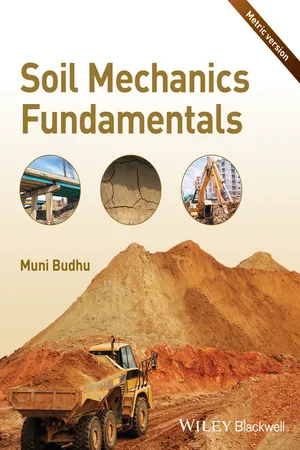
Soil Mechanics Fundamentals
About this book
An accessible, clear, concise, and contemporary course in geotechnical engineering, this key text:
Information
Chapter 1
Composition and Particle Sizes of Soils
1.1 Introduction
The purpose of this chapter is to introduce you to the composition and particle sizes of soils. Soils are complex, natural materials, and soils vary widely. The composition and particle sizes of soils influence the load-bearing and settlement characteristics of soils.
Learning Outcomes
When you complete this chapter, you should be able to do the following:
- Understand and describe the formation of soils.
- Understand and describe the composition of soils.
- Determine particle size distribution of a soil mass.
- Interpret grading curves.
1.2 Definitions of Key Terms
- Minerals are chemical elements that constitute rocks.
- Rocks are the aggregation of minerals into a hard mass.
- Soils are materials that are derived from the weathering of rocks.
- Effective particle size (D10) is the average particle diameter of the soil at the 10th percentile; that is, 10% of the particles are smaller than this size (diameter).
- Average particle diameter (D50) is the average particle diameter of the soil.
- Uniformity coefficient (Cu) is a numerical measure of uniformity (majority of grains are approximately the same size).
- Coefficient of curvature (CC) is a measure of the shape of the particle distribution curve (other terms used are the coefficient of gradation and the coefficient of concavity).
1.3 Composition of Soils
1.3.1 Soil Formation
Engineering soils are formed from the physical and chemical weathering of rocks. Soils may also contain organic matter from the decomposition of plants and animals. In this textbook, we will focus on soils that have insignificant amounts of organic content. Physical weathering involves reduction of size without any change in the original composition of the parent rock. The main agents responsible for this process are exfoliation, unloading, erosion, freezing, and thawing. Chemical weathering causes both reductions in size and chemical alteration of the original parent rock. The main agents responsible for chemical weathering are hydration, carbonation, and oxidation. Often chemical and physical weathering takes place in concert.
Soils that remain at the site of weathering are called residual soils. These soils retain many of the elements that comprise the parent rock. Alluvial soils, also called fluvial soils, are soils that were transported by rivers and streams. The composition of these soils depends on the environment under which they were transported and is often different from the parent rock. The profile of alluvial soils usually consists of layers of different soils. Much of our construction activity has been and is occurring in and on alluvial soils.
1.3.2 Soil Types
Gravels, sands, silts, and clays are used to identify specific textures in soils. We will refer to these soil textures as soil types; that is, sand is one soil type, clay is another. Texture refers to the appearance or feel of a soil. Sands and gravels are grouped together as coarse-grained soils. Clays and silts are fine-grained soils. Coarse-grained soils feel gritty and hard. Fine-grained soils feel smooth. The coarseness of soils is determined from knowing the distribution of particle sizes, which is the primary means of classifying coarse-grained soils. To characterize fine-grained soils, we need further information on the types of minerals present and their contents. The response of fine-grained soils to loads, known as the mechanical behavior, depends on the type of predominant minerals present.
Currently, many soil descriptions and soil types are in usage. A few of these are listed below.
- Alluvial soils are fine sediments that have been eroded from rock and transported by water, and have settled on river- and streambeds.
- Calcareous soil contains calcium carbonate and effervesces when treated with hydrochloric acid.
- Caliche consists of gravel, sand, and clay cemented together by calcium carbonate.
- Collovial soils (collovium) are soils found at the base of mountains that have been eroded by the combination of water and gravity.
- Eolian soils are sand-sized particles deposited by wind.
- Expansive soils are clays tha...
Table of contents
- Cover
- Title page
- Copyright page
- About the Author
- Other Books by this Author
- Preface
- Acknowledgments
- Notes for Students and Instructors
- Notation, Abbreviations, Unit Notation, and Conversion Factors
- Chapter 1: Composition and Particle Sizes of Soils
- Chapter 2: Phase Relationships, Physical Soil States, and Soil Classification
- Chapter 3: Soils Investigation
- Chapter 4: One- and Two-Dimensional Flows of Water through Soils
- Chapter 5: Soil Compaction
- Chapter 6: Stresses from Surface Loads and the Principle of Effective Stress
- Chapter 7: Soil Settlement
- Chapter 8: Soil Strength
- Appendix A: Derivation of the One-Dimensional Consolidation Theory
- Appendix B: Mohr's Circle for Finding Stress States
- Appendix C: Frequently Used Tables of Soil Parameters and Correlations
- Appendix D: Collection of Equations
- References
- Index
- End User License Agreement
Trusted by 375,005 students
Access to over 1.5 million titles for a fair monthly price.
Study more efficiently using our study tools.
Frequently asked questions
Yes, you can cancel anytime from the Subscription tab in your account settings on the Perlego website. Your subscription will stay active until the end of your current billing period. Learn how to cancel your subscription
No, books cannot be downloaded as external files, such as PDFs, for use outside of Perlego. However, you can download books within the Perlego app for offline reading on mobile or tablet. Learn how to download books offline
Perlego offers two plans: Essential and Complete
- Essential is ideal for learners and professionals who enjoy exploring a wide range of subjects. Access the Essential Library with 800,000+ trusted titles and best-sellers across business, personal growth, and the humanities. Includes unlimited reading time and Standard Read Aloud voice.
- Complete: Perfect for advanced learners and researchers needing full, unrestricted access. Unlock 1.5M+ books across hundreds of subjects, including academic and specialized titles. The Complete Plan also includes advanced features like Premium Read Aloud and Research Assistant.
We are an online textbook subscription service, where you can get access to an entire online library for less than the price of a single book per month. With over 1.5 million books across 990+ topics, we’ve got you covered! Learn about our mission
Look out for the read-aloud symbol on your next book to see if you can listen to it. The read-aloud tool reads text aloud for you, highlighting the text as it is being read. You can pause it, speed it up and slow it down. Learn more about Read Aloud
Yes! You can use the Perlego app on both iOS and Android devices to read anytime, anywhere — even offline. Perfect for commutes or when you’re on the go.
Please note we cannot support devices running on iOS 13 and Android 7 or earlier. Learn more about using the app
Please note we cannot support devices running on iOS 13 and Android 7 or earlier. Learn more about using the app
Yes, you can access Soil Mechanics Fundamentals by Muni Budhu,Muniram Budhu in PDF and/or ePUB format, as well as other popular books in Tecnología e ingeniería & Ingeniería civil. We have over 1.5 million books available in our catalogue for you to explore.