- 720 pages
- English
- ePUB (mobile friendly)
- Available on iOS & Android
eBook - ePub
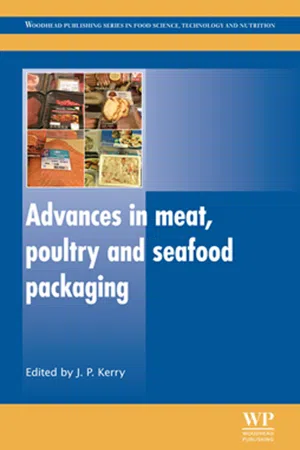
Advances in Meat, Poultry and Seafood Packaging
About this book
Packaging plays an essential role in limiting undesired microbial growth and sensory deterioration. Advances in meat, poultry and seafood packaging provides a comprehensive review of both current and emerging technologies for the effective packaging of muscle foods.Part one provides a comprehensive overview of key issues concerning the safety and quality of packaged meat, poultry and seafood. Part two goes on to investigate developments in vacuum and modified atmosphere packaging for both fresh and processed muscle foods, including advances in bulk packaging and soluble carbon dioxide use. Other packaging methods are the focus of part three, with the packaging of processed, frozen, ready-to-serve and retail-ready meat, seafood and poultry products all reviewed, alongside advances in sausage casings and in-package pasteurization. Finally, part four explores emerging labelling and packaging techniques. Environmentally-compatible, antimicrobial and antioxidant active packaging for meat and poultry are investigated, along with edible films, smart packaging systems, and issues regarding traceability and regulation.With its distinguished editor and international team of expert contributors, Advances in meat, poultry and seafood packaging is a key text for those involved with the research, development and production of packaged meat, poultry and seafood products. It also provides an essential overview for post-graduate students and academic researchers with an interest in the packaging of muscle foods.
- Provides a comprehensive review of current and emerging technologies for the effective and safe packaging of muscle foods
- Investigates developments in vacuum and modified atmosphere packaging for fresh and processed muscle foods, including advances in bulk packaging and soluble carbon dioxide use
- Explores environmentally-compatible, antimicrobial and antioxidant active packaging for meat and poultry, along with edible films, smart packaging systems, and issues regarding traceability and regulation
Information
Part I
Safety and quality of packaged meat, poultry and seafood
1
Major microbiological hazards associated with packaged fresh and processed meat and poultry
C.N. Cutter, R.N. Senevirathne, V.P. Chang, R.B. Cutaia, K.A. Fabrizio, A.M. Geiger, A.M. Valadez and S.F. Yoder, Pennsylvania State University, USA
Abstract:
This chapter discusses major microbiological hazards associated with packaged fresh and processed meat and poultry, including survival and growth of microorganisms in meat and poultry products, as well as the role of product composition and intrinsic and extrinsic factors (water activity, pH, oxidation-reduction potential, atmosphere, temperature, etc.) affecting microbial growth in these products. Additional information addresses foodborne outbreaks related to packaged fresh and further processed meat and poultry caused by pathogenic E. coli, Campylobacter spp., Listeria monocytogenes, Salmonella spp., Yersinia spp., Clostridium spp., Staphylococcus aureus and Aeromonas spp. and novel packaging techniques that may be employed to control these pathogens.
Key words
foodborne pathogens
pathogenic E. coli
Campylobacter spp.
Listeria monocytogenes
Salmonella spp.
Yersinia spp.
Clostridium spp.
Staphylococcus aureus
Aeromonas spp
1.1 Introduction: survival and growth of microorganisms in meat and poultry products
The many properties of meat and poultry, including intrinsic, as well as extrinsic variables, will determine the survivability of pathogenic and spoilage microorganisms. Microorganisms require plentiful sources of water; adequate carbon sources (sugars, alcohols) for energy, nitrogen (amino acids), B vitamins, related growth factors and various minerals, in order to survive. Other factors, such as water activity (aw) and oxidation-reduction potential (ORP) of meat and poultry products can influence significantly the growth and proliferation of organisms. Additionally, extrinsic parameters of meat and poultry, including pH, relative humidity, temperature and gaseous atmosphere affect microbial growth as well as survivability (Cutter, 2002).
1.1.1 Product composition
The composition of meat and poultry products can affect the growth of pathogenic bacteria. Generally speaking, fresh meat or poultry that has undergone rigor is composed of macromolecules such as protein, fat, as well as trace minerals. Compositionally speaking, most meat and poultry is made up of 18% protein, on average, but can range from 12% to 20%, depending upon the type of meat or animal source. Meat products are typically low in carbohydrates (0–6%), except those that have been supplemented for fermentation purposes, for flavor or purely for the creation of specific appearances. For fat content, meat and meat products average 3% fat (w/w), but fat levels can vary widely and can range from 3% to 45% (Jay et al., 2005), depending upon the product and how it is processed. Low molecular weight soluble components, including creatine phosphate to glycogen to amino acids and dipeptides, minerals and vitamins, also contribute to the composition of these food products (~ 3.5%; Jay et al., 2005). Additionally, the presence of water in muscle tissue also affords microorganisms with another necessary component to support microbial growth. In fact, muscle is composed of approximately 75.5% water, but again, levels can range from 42% to 80% (Jay et al., 2005).
As described above, water is an important component of meat and poultry and, consequently, its presence supports microbial growth. Moisture content, or water activity (aw), are terms used interchangeably when describing the amount of water in a food product or system. However, aw is defined as ‘the energy status of the water in the system. It is equal to the relative humidity of the air in equilibrium with a sample in a sealed chamber. It is defined as the vapor pressure of water in a sample divided by the vapor pressure of pure water held at the sample temperature … therefore, water activity and moisture content together provide a complete moisture analysis’ (Decagon, 2010). aw measurements range from 0 to 1.0, with moisture-laden products having an aw of 0.90 or greater, while products with an aw of < 0.50 are intermediate moisture products, typically described as dry, and are relatively shelf stable.
From a microbiological perspective, the aw of meat and poultry is an important intrinsic property that will influence the growth of pathogenic microorganisms. Fresh meats and poultry typically exhibit aw values of > 0.95 (Jay et al., 2005). Processing can also influence significantly the ultimate aw depending upon the type of parameters (heating, cooling, drying, etc.) or compounds (marinades, salt concentrations, carbohydrates, etc.) employed.
Various microorganisms have varying aw requirements. For example, Gramnegative organisms (such as E. coli O157:H7, Salmonella spp., Campylobacter spp., etc.) have a minimum aw requirement of 0.96 to 0.93 for growth, whereas Gram-positive, non-spore-formers (Listeria monocytogenes, Staphylococcus aureus, etc.) can grow to a lower aw of 0.90 to 0.94 (Farkas, 1997). By lowering the aw of a muscle food, one can increase the lag phase of bacterial growth and, ultimately, decrease the growth rate (Farkas, 1997). Additionally, factors such as pH, temperature, nutrient content, presence of antimicrobials or oxidation-reduction potential, work synergistically with aw (Jay et al., 2005). For example, when stored at a specific temperature, the ability of microbes to grow on meat and poultry is reduced as the aw is lowered. Similarly, addition of salts or solutes in a marinade to a muscle food and storage under refrigeration will hamper the ability of the pathogenic organism to grow. The difference in aw limits for microbial growth may be reflected in osomoregulatory capacities since mechanisms of tolerance to low aw are different in bacteria and fungi (Farkas, 1997). The strategy employed by microorganisms to protect against osmotic stress under extreme conditions of low aw appears to be the intracellular accumulation of salts, polyols, amino acids or compatible solutes such as potassium ions or amino acids in bacteria (Cutter, 2002; Farkas, 1997; Jay et al., 2005). In conjunction with aw, the relative humidity of the storage environment is also important in determining the growth of microorganisms in foods (Jay et al., 2005). Careful consideration should be given when storing low aw foods in environments where the relative humidity is high since moisture will transfer from the environment to the food. The change in the aw of the muscle food has the potential to affect the growth of microbes. Conversely, high aw foods held in packaged environments with low relative humidity tend to lose moisture in the transfer of moisture from the food to the environment. In this case, microbial growth may be slowed by the loss of available water, but undesirable quality changes in the food may occur. It is possible that by altering the gaseous environment, microbial growth can be minimized without lowering the relative humidity (Jay et al., 2005).
1.1.2 Storage temperature and oxidation-reduction potential
Another property that influences the growth of microorganisms is storage temperature. While microorganisms grow over a wide range of temperatures, the general temperature ranges for microbial growth are: psychrophiles (− 15°C to 20°C with an optimum of 10°C); psychrotrophs (− 5°C to 35°C with optimum of 20°C to 30°C); mesophiles (10°C to 35°C with optimum of 30°C to 40°C); and ther-mophiles (40°C to 90°C with optimum of 55°C to 65°C) (Cousin and Rodriguez, 1987). Above the optimal growth temperature, the growth rates decrease precipitously; below the optimum, growth rates also decrease, but do so gradually (Montville and Matthews, 2008).
The influence of temperature on microbial growth and physiology is obvious; yet the influence of temperature on gene expression is equally important (Montville and Matthews, 2008). For example, psychrophilic organisms not only grow slower under refrigerated conditions, but they also express different genes and are physiologically different than mesophilic organisms (Montville and Matthew...
Table of contents
- Cover image
- Title page
- Table of Contents
- Copyright
- Contributor contact details
- Woodhead Publishing Series in Food Science, Technology and Nutrition
- Preface
- Part I: Safety and quality of packaged meat, poultry and seafood
- Part II: Developments in vacuum and modified atmosphere packaging of meat, poultry and seafood
- Part III: Other packaging methods for meat, poultry and seafood products
- Part IV: Emerging packaging techniques and labelling
- Index
Trusted by 375,005 students
Access to over 1.5 million titles for a fair monthly price.
Study more efficiently using our study tools.
Frequently asked questions
Yes, you can cancel anytime from the Subscription tab in your account settings on the Perlego website. Your subscription will stay active until the end of your current billing period. Learn how to cancel your subscription
No, books cannot be downloaded as external files, such as PDFs, for use outside of Perlego. However, you can download books within the Perlego app for offline reading on mobile or tablet. Learn how to download books offline
Perlego offers two plans: Essential and Complete
- Essential is ideal for learners and professionals who enjoy exploring a wide range of subjects. Access the Essential Library with 800,000+ trusted titles and best-sellers across business, personal growth, and the humanities. Includes unlimited reading time and Standard Read Aloud voice.
- Complete: Perfect for advanced learners and researchers needing full, unrestricted access. Unlock 1.5M+ books across hundreds of subjects, including academic and specialized titles. The Complete Plan also includes advanced features like Premium Read Aloud and Research Assistant.
We are an online textbook subscription service, where you can get access to an entire online library for less than the price of a single book per month. With over 1.5 million books across 990+ topics, we’ve got you covered! Learn about our mission
Look out for the read-aloud symbol on your next book to see if you can listen to it. The read-aloud tool reads text aloud for you, highlighting the text as it is being read. You can pause it, speed it up and slow it down. Learn more about Read Aloud
Yes! You can use the Perlego app on both iOS and Android devices to read anytime, anywhere — even offline. Perfect for commutes or when you’re on the go.
Please note we cannot support devices running on iOS 13 and Android 7 or earlier. Learn more about using the app
Please note we cannot support devices running on iOS 13 and Android 7 or earlier. Learn more about using the app
Yes, you can access Advances in Meat, Poultry and Seafood Packaging by Joseph P. Kerry in PDF and/or ePUB format, as well as other popular books in Technology & Engineering & Food Science. We have over 1.5 million books available in our catalogue for you to explore.