eBook - ePub
Clinical Biochemistry of Domestic Animals
- 928 pages
- English
- ePUB (mobile friendly)
- Available on iOS & Android
eBook - ePub
Clinical Biochemistry of Domestic Animals
About this book
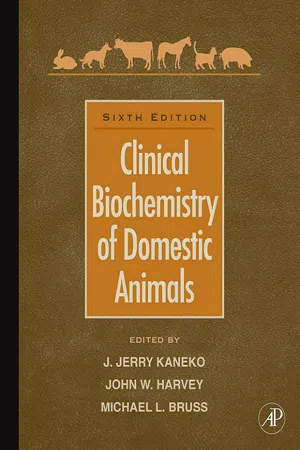
The 6th edition of a well-known and much used standard text in the field. This book covers all aspects of the biochemical abnormalities caused by various diseases and how they relate to the biochemical changes in the blood, urine, cerebrospinal fluid, joint fluids, other body fluids and in cells. The purpose is to provide the fundamental bases for understanding the biochemical changes that occur in disease processes and in turn to provide the rationale for applying this understanding to the diagnosis of the disease process. A substantial appendix is provided so that the user can quickly identify the reference ranges for a large number of animal species.
- An appendix is provided in the book so that the user can quickly identify the reference ranges for a large number of animal species
- Explains what biochemical changes occur in disease processes and provides the rationale for applying this understanding to the diagnosis of the disease process
Information
Table of contents
- Cover
- Copyright
- Contributors
- Preface
- Chapter 1: Concepts of Normality in Clinical Biochemistry
- Chapter 2: Comparative Medical Genetics
- Chapter 3: Carbohydrate Metabolism and Its Diseases
- Chapter 4: Lipids and Ketones
- Chapter 5: Proteins, Proteomics, and the Dysproteinemias
- Chapter 6: Clinical Veterinary Immunology
- Chapter 7: The Erythrocyte Physiology, Metabolism, and Biochemical Disorders
- Chapter 8: Porphyrins and the Porphyrias
- Chapter 9: Iron Metabolism and Its Disorders
- Chapter 10: Hemostasis
- Chapter 11: Neutrophil Function
- Chapter 12: Diagnostic Enzymology of DomesticAnimals
- Chapter 13: Hepatic Function
- Chapter 14: Gastrointestinal Function
- Chapter 15: Skeletal Muscle Function
- Chapter 16: Kidney Function and Damage
- Chapter 17: Fluid, Electrolyte, and Acid-Base Balance
- Chapter 18: Pituitary Function
- Chapter 19: Adrenocortical Function
- Chapter 20: Thyroid Function
- Chapter 21: Clinical Reproductive Endocrinology
- Chapter 22: Trace Minerals
- Chapter 23: Vitamins
- Chapter 24: Lysosomal Storage Diseases
- Chapter 25: Tumor Markers
- Chapter 26: Cerebrospinal Fluid
- Chapter 27: Clinical Biochemistry in Toxicology
- Chapter 28: Avian Clinical Biochemistry
- Appendix I: SI Units
- Appendix II: Conversion Factor of Some Non-SI Serum Enzym Units to SI Internation Enzyme Unitsa
- Appendix III: Temperature Correction Factor (Tf) for Some Common Enzymes
- Appendix IV: Stability of Serum Enzymes under Various Storage Conditionsa
- Appendix V: Temperature Conversions among Degrees Celsius, Degrees Fahrenheit, and Degrees Kelvin
- APPENDIX VI: Nomogram for Computing Relative Centrifugal Forces (RCF)
- Appendix VII: Conversions of Body Weight to Square Meters of Body Surface Area for Dogs and Catsa
- Index
Trusted by 375,005 students
Access to over 1.5 million titles for a fair monthly price.
Study more efficiently using our study tools.
Frequently asked questions
Yes, you can cancel anytime from the Subscription tab in your account settings on the Perlego website. Your subscription will stay active until the end of your current billing period. Learn how to cancel your subscription
No, books cannot be downloaded as external files, such as PDFs, for use outside of Perlego. However, you can download books within the Perlego app for offline reading on mobile or tablet. Learn how to download books offline
Perlego offers two plans: Essential and Complete
- Essential is ideal for learners and professionals who enjoy exploring a wide range of subjects. Access the Essential Library with 800,000+ trusted titles and best-sellers across business, personal growth, and the humanities. Includes unlimited reading time and Standard Read Aloud voice.
- Complete: Perfect for advanced learners and researchers needing full, unrestricted access. Unlock 1.5M+ books across hundreds of subjects, including academic and specialized titles. The Complete Plan also includes advanced features like Premium Read Aloud and Research Assistant.
We are an online textbook subscription service, where you can get access to an entire online library for less than the price of a single book per month. With over 1.5 million books across 990+ topics, we’ve got you covered! Learn about our mission
Look out for the read-aloud symbol on your next book to see if you can listen to it. The read-aloud tool reads text aloud for you, highlighting the text as it is being read. You can pause it, speed it up and slow it down. Learn more about Read Aloud
Yes! You can use the Perlego app on both iOS and Android devices to read anytime, anywhere — even offline. Perfect for commutes or when you’re on the go.
Please note we cannot support devices running on iOS 13 and Android 7 or earlier. Learn more about using the app
Please note we cannot support devices running on iOS 13 and Android 7 or earlier. Learn more about using the app
Yes, you can access Clinical Biochemistry of Domestic Animals by Jiro Jerry Kaneko,John W. Harvey,Michael L. Bruss in PDF and/or ePUB format, as well as other popular books in Technology & Engineering & Veterinary Medicine. We have over 1.5 million books available in our catalogue for you to explore.