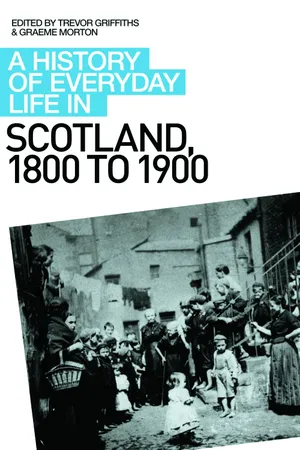
The nineteenth century was a period of profound change in Scottish history. Industrialisation, improved communications, agricultural transformation, country to town migration, upheavals in the church, increased trade, and imperialism – all these affected the pace and rhythm of everyday life across the country. At the same time increased literacy helped to generate new patterns of identity, extending beyond the local to encompass the nation, which challenged certainties of how the world was viewed. With new styles of living came new dangers to the physical and moral health of the population, and increased apprehension of crime and disorder. Industrialisation created opportunities for consumption and recreation but with tangible environmental and economic costs. Rural Scotland adjusted to changes in farming practice and the traumas of population loss and began to look to the opportunities presented by recreation and tourism. The large-scale creation and survival of documentary evidence and records make the study of everyday life during this period practicable in depth for the first time. This volume presents a vivid account that includes the experiences of all the people of Scotland. It draws on every kind of available evidence and on work in social and cultural history, sociology and anthropology.The series will be complete in four volumes. x and x are already available. x is forthcoming.
eBook - PDF
A History of Everyday Life in Scotland, 1800 to 1900
- 345 pages
- English
- PDF
- Available on iOS & Android
eBook - PDF
A History of Everyday Life in Scotland, 1800 to 1900
About this book
Information
Topic
StoriaSubtopic
Storia britannicaTable of contents
- Cover
- Title page
- Copyright page
- Contents
- List of figures
- Acknowledgements
- Series editors' foreword
- Introduction
- Chapter 1
- Chapter 2
- Chapter 3
- Chapter 4
- Chapter 5
- Chapter 6
- Chapter 7
- Chapter 8
- Chapter 9
- Bibliography
- Notes on contributors
- Index
Trusted by 375,005 students
Access to over 1.5 million titles for a fair monthly price.
Study more efficiently using our study tools.
Frequently asked questions
Yes, you can cancel anytime from the Subscription tab in your account settings on the Perlego website. Your subscription will stay active until the end of your current billing period. Learn how to cancel your subscription
No, books cannot be downloaded as external files, such as PDFs, for use outside of Perlego. However, you can download books within the Perlego app for offline reading on mobile or tablet. Learn how to download books offline
We are an online textbook subscription service, where you can get access to an entire online library for less than the price of a single book per month. With over 1.5 million books across 990+ topics, we’ve got you covered! Learn about our mission
Look out for the read-aloud symbol on your next book to see if you can listen to it. The read-aloud tool reads text aloud for you, highlighting the text as it is being read. You can pause it, speed it up and slow it down. Learn more about Read Aloud
Yes! You can use the Perlego app on both iOS and Android devices to read anytime, anywhere — even offline. Perfect for commutes or when you’re on the go.
Please note we cannot support devices running on iOS 13 and Android 7 or earlier. Learn more about using the app
Please note we cannot support devices running on iOS 13 and Android 7 or earlier. Learn more about using the app
Yes, you can access A History of Everyday Life in Scotland, 1800 to 1900 by Graeme Morton,Trevor Griffiths, Graeme Morton, Trevor Griffiths in PDF and/or ePUB format, as well as other popular books in Storia & Storia britannica. We have over 1.5 million books available in our catalogue for you to explore.