![]()
CHAPTER 1
Daniel and His Friends Taken to Babylon
Daniel 1:1-21
Daniel 1:81
About twenty years ago I heard a sermon in which the preacher focused on Daniel’s refusing the royal rations of food and wine. He encouraged the young people: “Like Daniel, you should avoid rich food; like Daniel you should avoid alcohol; and like Daniel you should avoid sex.”2 On the bright side, I remember this sermon — even after twenty years! On the down side, the enthusiastic preacher missed the good news God had for us in this passage. Such direct transference applications usually miss the author’s intended meaning; they clutter up the sermon; and, in the context of the New Testament, they may be unbiblical.3 The Israelites in exile were not told this story about Daniel in order to imitate him in avoiding rich food and wine — royal rations of food and wine were not even on their menu. Unfortunately, busy pastors may look for applications before they have taken the time to understand the author’s message for Israel and his goal (purpose) in sending this message to them.
The book of Daniel was addressed to God’s people suffering in exile. This first narrative is a good preaching text for people who are deeply disturbed about the persecution of Christians around the world. According to the latest estimates, one hundred million Christians are persecuted worldwide.4 Where is God in all this? Is he powerless to stop the oppression of his people? Many people, especially in Europe, have given up their faith in a sovereign, loving God and have adopted a secular lifestyle. Others are wondering, How will we react when persecution comes our way? Will we give up our Christian faith or stand firm?
Text and Context
In preaching this narrative we must not only avoid moralizing5 but also cutting up this single narrative into smaller, more manageable preaching texts. For example, a well-known preaching guide on Daniel recommends that “the conquering king’s call for qualified Jewish youths to be educated in the Chaldean language and literature (vv. 3-4)” can be developed into two different sermons: “(1) the importance and limits of education and (2) alternative attitudes which religious/Christian communities may take toward secular culture.”6 But surely one cannot base a sermon on “the requirements and cost of a secular education” on the narrative detail that the Jewish youths “were to be taught the literature and language of the Chaldeans” (v. 4). This preaching guide offers other sermon proposals on segments of this narrative,7 but not one of them comes even close to capturing the point (theme) of Daniel’s narrative. Biblical authors communicate their messages not in a few words or phrases but in literary units. In order to do justice to the biblical author and pass on his inspired message, we need to first determine the literary unit that will function as the preaching text and next the point (theme) he makes with this entire unit. We shall begin, therefore, with establishing the parameters of the literary unit that will function as the preaching text, and next work toward the point this unit seeks to communicate to Israel in exile.
In contrast to the difficulty of discerning the major literary units in a book such as Ecclesiastes, it is easy to spot the textual units in Daniel. Daniel 1:1 begins with a chronological marker, “In the third year of the reign of King Jehoiakim of Judah, King Nebuchadnezzar of Babylon came to Jerusalem and besieged it.” Verse 21 concludes the unit with another chronological marker, “And Daniel continued there until the first year of King Cyrus.” Daniel 2:1 begins a new literary unit with another chronological marker: “In the second year of Nebuchadnezzar’s reign, Nebuchadnezzar dreamed. . . .” The preaching text, therefore, is Daniel 1:1-21.
In its Old Testament context, Daniel 1 links up with 2 Chronicles 36:6-7, “Against him [Jehoiakim] King Nebuchadnezzar of Babylon came up, and bound him with fetters to take him to Babylon. Nebuchadnezzar also carried some of the vessels of the house of the LORD to Babylon and put them in his palace in Babylon.” In Daniel 1:2 the narrator relates that the king brought these vessels to “the land of Shinar” — a reminder of the people who, in defiance of God, settled in “the land of Shinar” (Gen 11:2) and built the tower of Babel. This echo of the Babel narrative tips off the reader that Babylon is a place that is opposed to God and God’s kingdom.
The description of Daniel as a young man, handsome (v. 4), who was forcibly taken into exile (v. 6), given a foreign name (v. 7), to whom God gave “favor and compassion from the palace master” (v. 9), to whom God gave “insight into all visions and dreams” (v. 17), and who became “ruler” of Babylon (2:48) evokes the story of Joseph, who was also described as a young man, handsome (Gen 39:6b), who was forcibly taken into exile (Egypt; Gen 37:36), given a foreign name (Gen 41:45), “found favor” in the sight of his master (Gen 39:4; 41:37), to whom God gave the ability to interpret dreams (Gen 41:39), and who became ruler of Egypt (Gen 41:41-45). The narrator portrays Daniel as another Joseph, a child of God whom God will use to advance the cause of his kingdom even in a foreign land.8
Since this first chapter serves as an introduction to the book of Daniel, it also has many links with the following chapters. Verse 1 introduces Nebuchadnezzar, the king of Babylon, who will play a major role in the first four chapters. Verse 2 notes that Nebuchadnezzar took “some of the vessels of the house of God . . . and placed the vessels in the treasury of his gods.” This information prepares us for chapter 5:3, where we read that Belshazzar desecrated these vessels by drinking from them at his feast. Verse 6 introduces us to Daniel’s three friends who join Daniel in his resistance (v. 11). These friends will play a major role in chapter 3 when they refuse to bow down to the king’s statue and are thrown into the fiery furnace. Verse 17 states, “To these four young men God gave knowledge and skill in every aspect of literature and wisdom,” which qualified Daniel’s three friends for high office in Babylon (2:49). Verse 17 continues, “Daniel also had insight into all visions and dreams,” which prepares us for chapters 2 and 4 where he interprets the dreams of Nebuchadnezzar, chapter 5 where he interprets the writing on the wall, and the visions of chapters 7–12.
Literary Features
The narrator uses hyperbole when he writes that the king found Daniel and his friends “ten times better than all the magicians and enchanters in his whole kingdom” (v. 20). Since “ten” is the number of fullness, they were far superior (cf. the “seven times more” in 3:19). The major literary features we shall explore in order to better understand this narrative and its point are narrative structure, the plot line, character description, and repetition.
Narrative Structure
This narrative consists of three scenes:9
Scene 1: Jerusalem, in “the third year of the reign of Jehoiakim” | (1:1-2) |
A. The Lord allows Nebuchadnezzar to capture Jerusalem | (1:2a) |
B. Nebuchadnezzar brings vessels of the house of God to Babylon | (1:2b) |
Characters: Nebuchadnezzar and the Lord |
Scene 2: Babylon: Daniel and his friends reeducated | (1:3-17) |
A. Daniel and his friends are brought to Babylon | (1:3-7) |
B. Daniel resolves not to defile himself with the royal food | (1:8) |
C. Daniel raises the issue with the palace master, who is afraid | (1:9-10) |
D. The guard agrees to withhold royal food for ten days | (1:11-14) |
E. The guard agrees to continue to withhold the royal food | (1:15-16) |
F. God gives the four young men wisdom | (1:17) |
Characters: Daniel/friends and the palace master; |
when the palace master leaves the stage, he is replaced by the guard |
Scene 3: Three years later in the king’s palace: examination time | (1:18-21) |
A. The king interviews Daniel and his friends | (1:18-19) |
B. The king stations Daniel and his friends at his court | (1:19-21) |
Characters: Daniel/friends and the king |
The Plot Line
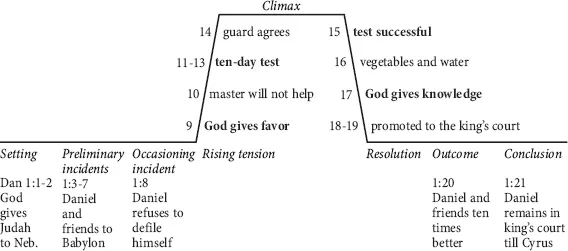
For understanding the narrative, catching its main point (theme), and retelling the story in the sermon, it is crucial to discern the plot line. The literary setting of this narrative is that the Lord gives Jehoiakim of Judah into the power of Nebuchadnezzar and allows the latter to take some of the vessels of God’s temple back to Babylon (vv. 1-2). Preliminary incidents are the king’s order to bring some bright young men to Babylon for reeducation and eventual service in the king’s palace. The king assigns them daily portions of the royal rations of food and wine. Daniel and his three friends are among the young men. The palace master replaces their Hebrew names with Babylonian names (vv. 3-7).
The occasioning incident is Daniel’s resolve to disobey the king’s order of eating the royal rations of food and wine in order not to defile himself (v. 8). The pace of the story slows down at this important junction. Also, “the subject of the action words shifts from that of the government to the resolute action of a captive. Now the story becomes shaped by the captive’s decision.”10 The tension rises when the palace master, who likes Daniel but fears the king, refuses Daniel’s request not to defile himself with the royal food and wine (vv. 9-10). The narrator slows the pace even more in verses 10-13 by using direct discourse instead of indirect, thus adding to the suspense. The tension rises further when Daniel approaches a lower official, the guard of Daniel and his friends, with the proposal that instead of the royal food and wine they be given vegetables and water for ten days (vv. 11-13). The guard agrees to try this test (v. 14).
The tension begins to resolve when after the ten days Daniel and his friends appear “better and fatter” than the other young men and the guard continues to withdraw their royal rations and wine (vv. 15-16). The tension resolves still further when the narrator relates that in addition to their physical well-being God gives these four young men knowledge, skill, and wisdom (v. 17). The tension is fully resolved when at the end of three years the king examines all the young men, concludes that Daniel and his friends are far superior, and places them in his court (vv. 18-19).
The outcome is that the king finds Daniel and his friends “ten times better than all the magicians and enchanters in his whole kingdom” (v. 20). The narrative concludes with the information that Daniel continues in the king’s court, outliving all Babylonian kings, until the first year of Cyrus, king of Persia (v. 21).
We can sketch the narrative as a single plot:
Character Description
The narrator tells this story in the third person. He characterizes Daniel and his friends as “Israelites of the royal family and of the nobility, young men without physical defect and handsome, versed in every branch of wisdom, endowed with knowledge and insight, and competent to serve in the king’s palace” (vv. 3-4). All four are “from the tribe of Judah” (v. 6). After the ten-day trial, they appeared “better and fatter” than the other young men (v. 15). Moreover, God gave them “knowledge and skill in every aspect of literature and wisdom; Daniel also had insight into ...