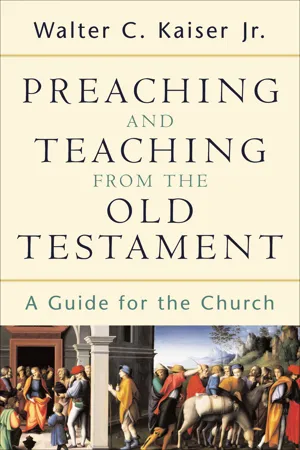
Viewed as antiquated and remote, the Old Testament is frequently neglected in the preaching and teaching ministry of the church. But contrary to the prevailing attitude, might the Old Testament contain relevant and meaningful application for today? Renowned author and scholar Walter Kaiser shows why the Old Testament deserves equal attention with the New Testament and offers a helpful guide on how preachers and teachers can give it the full attention it deserves.
Growing out of his teaching material from the last decade, Preaching and Teaching from the Old Testament demonstrates Kaiser's celebrated straightforward exposition. Offering an apologetic for the Christian use of the Old Testament, the opening chapters deal with the value, problem, and task of preaching from it. Following a discussion of the role of expository preaching, Kaiser provides a practical focus by examining preaching and teaching from the texts of various genres. A final chapter explores the relevance of the Old Testament in speaking to a contemporary audience.
Bible teachers, pastors, seminary students, and professors will appreciate Kaiser's practical focus and relevant applications. Additional helps include a glossary and suggested outlines and worksheets for expository preaching.
- 222 pages
- English
- ePUB (mobile friendly)
- Available on iOS & Android
eBook - ePub
About this book
Information
Topic
Teologia e religioneSubtopic
Ministro del culto cristiano
1
The Value of the Old Testament for Today
Quite often when I have the opportunity to speak or preach at a church or Christian institution, I am asked: “You are not going to speak from the Old Testament, are you?” Obviously the expected answer is that no one who is thinking correctly, or even as a Christian, would venture to do such a bizarre thing as address contemporary issues and the needs of our day by going back to something as antique and remote as the Old Testament.
But that is indeed what I have done time and again, for I have been impressed with how relevant and powerful a message that portion of the biblical text shares with the New Testament. The time has come for a whole new evaluation of our reasons for avoiding this section of the Bible. Along with the argument for turning to the Old Testament for answers to contemporary issues must also come some practical helps on how this task can be carried out without doing an injustice either to the older text or to the needs of the waiting church.
The Old Testament needs about as much defending as a lion! Yet it clearly is overlooked and frequently neglected in the preaching and teaching ministry of the church. This neglect is all the more baffling when its claims and right to be received as the powerful Word of God are just as strong as those of the New Testament. Therefore, it is incumbent that we hear the Old Testament’s own case for itself once again. This case can be set forth in four major theses.
It Is the Powerful Word of God
The earlier testament is light years away from being a mere word from mortals written to humanity about themselves! Instead, it presents itself as possessing divine authority with a sufficiency that transcends what mere mortals can create or expound for their contemporaries or for later generations.
True, God employed the distinctive personalities, literary skills, vocabulary, and unique ways each writer had of expressing himself, as anyone who has read the Bible in the original languages has noticed. But God’s revelation was not thereby hampered or distorted like a sunbeam that is refracted when it passes through a stained glass window. If this analogy must be used, then let it be noted that the architect that built the sun, from which the sunbeam originated, is the same architect who built the stained glass window, which in this case would be analogous to the writers of the Old Testament. God prepared both the writers, with all the uniqueness and particularity that each brings to the task of writing Scripture, and the revelation itself.
The point is this: the preparation of the authors was just as significant a work of God as was the revelation that came from God. Thus, each writer was given experiences, cultural settings, a range of vocabulary, and special idiosyncrasies so that they would express themselves in styles absolutely their own but with the end result being precisely what God wanted for each section of his revelation.
This preparation of the writer began as early as the day he was born. The prophet Jeremiah knew he was called while he was still in his mother’s womb (Jer. 1:4–5), while Isaiah’s call to minister on behalf of God’s word came out of his sense of need, apparently later in life (Isa. 1–5). If Jeremiah illustrates what an internal call of God is like, then Isaiah shows us what God’s external call is like.
How, then, can each writer be so uniquely himself and yet so true to the disclosure God wanted to get across to humanity? Must we sacrifice either human originality or divine authority? We cannot have it both ways—or can we?
It is evident to any student beginning to read in the original languages of the Old Testament (Hebrew and Aramaic) that there are very clear differences in the levels of difficulty, grammar, vocabulary, and styles in the thirty-nine books of the Old Testament. This certainly makes the case for the individuality of each of the writers. But instead of this being a mere word of mortals, the repeated claim of the writers themselves is that what they wrote was a disclosure from God that was to be distinguished from their own words. For example, Jeremiah 23:28–29 enjoined:
“Let the prophet who has a dream tell his dream, but let the one who has my word speak it faithfully. For what has straw to do with grain,” declares the LORD. “Is not my word like fire,” declares the LORD, “and like a hammer that breaks a rock in pieces?”
To confuse the prophet’s own words and dreams with God’s word and vision was as silly as confusing straw and chaff with real grain on that straw stem!
The apostle Paul would have no part in a diminution of the Old Testament, for he instructed his youthful friend Timothy in 2 Timothy 3:16 that,
All Scripture is God-breathed and is useful for
teaching,
rebuking,
correcting
and training in righteousness.
One must recall that the “Scripture” (Greek: graphe, “writing”) that was available to Timothy when Paul wrote was the Old Testament. All of it, the whole of the Old Testament, was “God-breathed.” It came as a product of God. Therefore, if we are to have a balanced and full presentation of all of God’s truth, it is absolutely essential that we include the Old Testament in our teaching and preaching.
Moreover, the Old Testament is useful for it has at least four functions: (1) teaching, (2) rebuking, (3) correcting, and (4) training us in righteousness. To this Paul also adds in 2 Timothy 3:15 that the Old Testament is “able to make [us] wise for salvation through faith in Christ Jesus.” Few think that such a good result as one’s own personal salvation through faith in Jesus Christ could come from teaching and preaching from the Old Testament, but the apostle Paul taught that it could—and he taught that under the inspiration of the sovereign Lord.[1]
Our day is not the only time when the Word of God has been scarce, hard to find, out of vogue, or seemingly lacking in power or effectiveness in those cases where it is exposed to the people. One could cite a similar situation when young Samuel was growing up in the sanctuary under the tutelage of the priest Eli. Accordingly, the story began on the note that “in those days the word of the LORD was rare; there were not many visions” (1 Sam. 3:1). Without the light of revelation, the whole fabric of society was put at risk. That point was also made in the Book of Proverbs, which warned, “Where there is no revelation [Hebrew: ḥazôn, “vision” or “disclosure” from God], the people perish” (Prov. 29:18, my translation). The Hebrew term used for “perish” is the same one that appears in the golden calf episode in Exodus 32:25, where the people “cast off all restraint” and “ran wild” in acts of sacred prostitution in front of the calf they had just created. That was exactly what was happening in the days of young Samuel, for the high priest’s sons were imitating the same reckless path of destroying themselves even while they presided as priests at the altar of God. Meanwhile, the word of God remained scarce and was rarely announced or taught to the people.
Possession of a word from God was no small favor or treasure, for it continues to be second in importance only to the gift of God’s Son. But mere possession of that word alone will not be enough to fortify the community in times of need. In fact, continual neglect of that word can lead to God himself making that word scarce so that few can find it and thus profit from applying its message. In that case, mortals cannot manufacture it, duplicate it, or replace it with an alleged alternative.
Such a scarcity of God’s word would be a sign of God’s judgment on his people and their leaders who had helped to create this barrenness. It would represent a setting similar to those horrible words found in Amos 8:11–12:
“The days are coming,” declares the Sovereign LORD, “when I will send a famine through the land—not a famine of food or a thirst for water, but a famine of hearing the words of the LORD. Men will stagger from sea to sea and wander from north to east, searching for the word of the LORD, but they will not find it.”
Sometimes God gives us what we want (when we refuse to hear his word), but he also sends a leanness to our souls as a result (Ps. 106:15). In these instances, God grows silent and the darkness of our day thickens as an unbearable sadness and gloom sets in over us.
The only known cure for this is the cry that was heard in the Reformation: post tenebras lux, “After darkness, light!” That is why Calvin and his successors reasoned that the only way light was going to come to God’s people and to the city of Geneva, Switzerland, would be through the preaching of the Scriptures. Hence, six sermons a week were prescribed according to the Ordinances of the Church of Geneva in A.D. 1541. There was to be a sermon at dawn on Sunday, and another at the usual hour of 9 A.M. Catechism for the children was to take place at noon, followed by a sermon at 3 P.M. and three more sermons on Monday, Wednesday, and Friday. Only in this manner would light return and the darkness be invaded, they reasoned. Should we not follow these Genevans in establishing, as they did, something more than the twenty-five-minute homily or one ten- to fifteen-minute topical sermon given each Sunday morning as the total source for our Christian maturation for the whole week? And should not a portion of that expanded repertoire of biblical texts include a distinctive preaching and teaching mission from Old Testament texts?
That word from God can startle us just as it shocked the priest Eli (1 Sam. 3:2–14). It was startling in its call, for repeatedly God called to the young boy Samuel (vv. 2–10). The words “call” or “called” appear no less than eleven times in verses 4–10 of 1 Samuel 3. Nevertheless, God does not rebuke Samuel for being dim-witted or slow to respond; he merely “came and stood there, calling as at the other times” (v. 10). The patience and tenderness of our Lord is in itself amazing.
But just as amazing and startling is the content of that word. In this case it was the word that the Lord had Samuel deliver to Eli. The sovereign God was “about to do something in Israel that [would] make the ears of everyone who hear[d] of it tingle” (v. 11). Because Eli failed to restrain his sons, God would judge his family and the guilt of their household would never be atoned for by sacrifice or offering (vv. 12–14). Hence, the word of God would involve a blessed call on one man for service to God but a visitation of judgment on another for failure to act in accordance with the published Word.
In so doing God demonstrated that he was sovereign over all (1 Sam. 3:15–18). He was sovereign over the speaker (vv. 15–17) and sovereign over the audience (v. 18). Thus we are taught in Scripture to say “Amen,” not only to the blessings of God, but also to the judgments of God.
The story of Samuel ends with the word of God accrediting his servant Samuel (1 Sam. 3:19–4:1a). As a matter of fact, God “let none of his words fall to the ground” (v. 19). Herein lay the validation, confirmation, and security of Samuel’s proclamation of the divine revelation. And that is what will validate the preaching of the Old Testament in our day as well: the sovereign validation of the Lord himself.[2]
It Leads Us to Jesus the Messiah
One of the tragic results of separating the Old Testament from the New is that the believing community fails to see that Jesus’ life, ministry, death, and resurrection were clearly anticipated long before the events occurred. By viewing the older testament as a message that is non-Christian, the expectation is set in advance for some that there is nothing Christological or messianic to be gained from studying, much less reading, teaching, and preaching, the Old Testament. But such a view flies in the face of the evidence from the text itself.
The Messiah is at the heart of the message of that neglected portion of the Bible. For example, according to rabbinical calculations, there are some 456 Old Testament texts that refer either directly to the Messiah or to the messianic times.[3] Even though this number is inflated by the particular standards of scholarship used in some communities, what remains when the list is reduced is still extremely impressive.[4]
Sadly, a significant portion of modern scholarship shares a skeptical attitude toward the messianic consciousness of the Old Testament writers. Typical of such judgments is the conclusion of Joachim Becker: “There is no evidence for true messianism until the second century B.C.”[5] Becker would have us believe that it was only on the threshold of the New Testament that we begin to see any evidence for a Messiah! The amazing thing is that Becker himself realized that such a conclusion would run counter to some pretty strong evidence from those early believers in the first Christian century who were still without a New Testament in any of its sections or parts. He allowed: “Such a conclusion [that he had just made above] would contradict one of the most central concerns of the New Testament, which insists with unprecedented frequency, intensity, and unanimity that Christ was proclaimed in advance in the Old Testament. Historical-critical scholarship can never set aside this assertion of the New Testament.”[6] Becker will go to even greater lengths in destroying his own conclusions. He wrote, “To find Christ at every step on our way through the history of Israel and the Old Testament is not only no deception but also a duty imposed on us by the inspired testimony of the New Testament, the meaning of which we must strive to understand.”[7]
Indeed, there is an organic system of messianic prophecy that can be found in the Old Testament, which is in full accord with the fulfillments of the New Testament. All too few have noticed the organic unity of the total argument, often settling for much less by picking up a verse here or there in an abstract and random manner.
The interpreter need not resort to settling for a double set of meanings in order to squeeze out of the Old Testament some messianic possibilities. On the contrary, one must be able to show that the Old Testament writers were aware of a very decided nexus between the temporal/historical events in many ...
Table of contents
- Cover
- Title Page
- Copyright Page
- Endorsements
- Dedication
- Contents
- Introduction
- Part 1: The Need to Preach and Teach from the Old Testament
- Part 2: How to Preach and Teach from the Old Testament
- Conclusion: Changing the World with the Word of God
- Appendix A: Suggested Worksheet for Doing Syntactical-Theological Exegesis
- Appendix B: Biblical Integrity in an Age of Theological Pluralism
- Notes
- Glossary
- Subject Index
- Author Index
- Scripture Index
Trusted by 375,005 students
Access to over 1.5 million titles for a fair monthly price.
Study more efficiently using our study tools.
Frequently asked questions
Yes, you can cancel anytime from the Subscription tab in your account settings on the Perlego website. Your subscription will stay active until the end of your current billing period. Learn how to cancel your subscription
No, books cannot be downloaded as external files, such as PDFs, for use outside of Perlego. However, you can download books within the Perlego app for offline reading on mobile or tablet. Learn how to download books offline
Perlego offers two plans: Essential and Complete
- Essential is ideal for learners and professionals who enjoy exploring a wide range of subjects. Access the Essential Library with 800,000+ trusted titles and best-sellers across business, personal growth, and the humanities. Includes unlimited reading time and Standard Read Aloud voice.
- Complete: Perfect for advanced learners and researchers needing full, unrestricted access. Unlock 1.5M+ books across hundreds of subjects, including academic and specialized titles. The Complete Plan also includes advanced features like Premium Read Aloud and Research Assistant.
We are an online textbook subscription service, where you can get access to an entire online library for less than the price of a single book per month. With over 1.5 million books across 990+ topics, we’ve got you covered! Learn about our mission
Look out for the read-aloud symbol on your next book to see if you can listen to it. The read-aloud tool reads text aloud for you, highlighting the text as it is being read. You can pause it, speed it up and slow it down. Learn more about Read Aloud
Yes! You can use the Perlego app on both iOS and Android devices to read anytime, anywhere — even offline. Perfect for commutes or when you’re on the go.
Please note we cannot support devices running on iOS 13 and Android 7 or earlier. Learn more about using the app
Please note we cannot support devices running on iOS 13 and Android 7 or earlier. Learn more about using the app
Yes, you can access Preaching and Teaching from the Old Testament by Walter C. Kaiser in PDF and/or ePUB format, as well as other popular books in Teologia e religione & Ministro del culto cristiano. We have over 1.5 million books available in our catalogue for you to explore.