- 208 pages
- English
- ePUB (mobile friendly)
- Available on iOS & Android
eBook - ePub
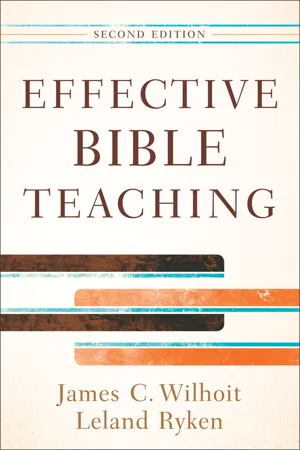
Effective Bible Teaching
About this book
Why does Bible study flourish in some churches and small groups and not in others? In this updated edition of a trusted classic, two Christian education specialists provide readers with the knowledge and methods needed to effectively communicate the message of the Bible. The book offers concrete guidance for mastering a biblical text, interpreting it, and applying its relevance to life. Its methods, which have been field-tested for twenty-five years, help pastors, teachers, and ministry students improve their classroom skills. Readers will learn how to develop the "big idea" of a passage and allow the text itself to suggest creative teaching methods. This new edition has been updated throughout and explores the changed landscape of Bible study over the past two decades. Readable and interdisciplinary in approach, this book will help a new generation of Bible students teach in a purposeful and unified way.
Information
Topic
Teología y religiónSubtopic
Ministerio cristiano
1
The Changing Landscape of Bible Study
A quarter of a century has elapsed since the first appearance of this book. There has been no need for a revision of the content of the book. We are still as convinced now as we were at its writing that what we said about the nature of the Bible, as well as the methods of studying and teaching it, provides useful and field-tested practices. We have not updated the principles of Bible study for purposes of this new edition of Effective Bible Teaching.
However, the context or landscape of Bible study has changed significantly in the past two decades. The purpose of this introductory chapter is to paint a picture of the changed landscape of Bible study. In the remainder of the book we have added and subtracted on a small scale to adapt our tried-and-true material to the changed landscape that we delineate in this newly added chapter.
We will survey a number of new developments in this chapter, but the underlying theme is the diminished stature of the Bible and its study in the spheres that we still hope to influence. A sense of buoyancy and expectation surrounded the first appearance of this book in 1988. We remember the enthusiasm that permeated workshops we conducted at professional meetings and in churches. It seemed possible that a golden age of Bible study was just around the corner. As spokesmen for our approach, we have lost no confidence whatsoever in the correctness of what we advocate, but we are no longer able to assume that our readers and the people they influence begin with a commitment to the study of the Bible, whether in inductive studies or more formal teaching situations. Twenty-five years ago we wrote in an attempt to keep a good thing going and give it added momentum; today we write as people trying to revive a worthwhile practice.
The Eclipse of the Bible in the Evangelical Church
A former theology professor at Yale University, George Lindbeck, wrote an essay that illustrates the problematic status of the Bible in the contemporary church. Lindbeck paints a descriptive picture of how, for fifteen centuries, Christendom lived within the intellectual and imaginative universe created by the Bible. The “text above all texts was the Bible,” writes Lindbeck; “Its stories, images, conceptual patterns, and turns of phrase permeated the culture from top to bottom,” even among non-Christians and nonchurchgoers.[1]
Lindbeck’s picture of the pervasive presence of the Bible appears, however, in an essay devoted to discussing biblical illiteracy in the modern world. In fact, Lindbeck clinches his point by claiming that when he first came to Yale “even those who came from nonreligious backgrounds knew the Bible better than most of those now who come from churchgoing families.”[2]
We have no reason to be surprised by this. The number of evangelical pulpits from which the sermon consists of an exposition of a biblical text is very small. As recently as two decades ago, most young people growing up in evangelical churches would identify the small-group, inductive Bible study as a major ingredient of their high school experience. Today only a handful of Christian young people would make that claim; the chief input into teenagers’ church experience now is a charismatic speaker with a microphone in hand or (more likely) a worship leader or praise band with an amplifying system behind them.
Lack of Models for Bible Study
When the downward slide of people’s contact with the Bible began, the ordinary layperson still had reliable models for how to study the Bible. Potentially the best model of how to study a biblical text inductively is provided by ministers preaching on Sunday morning. This is true because most congregants handle the Bible as they see it handled from the pulpit. Expository preaching can provide the right model, but unfortunately, preachers have largely abandoned the exposition of Scripture as their basic mode of preaching.
There also has been a feminization of Bible study in the past quarter century. This is well illustrated by a remark made at a men’s retreat by a leader whose wife was the director of women’s ministry at a large evangelical church: “I realize you guys don’t know the Bible like your wives do.” The statement was made in a matter-of-fact way and not as a challenge to men to improve the quality of their interaction with the Bible. This kind of gender stereotyping has had three negative effects. One is that it lowers the bar for what we should expect from men in regard to studying the Bible. We believe that it is inappropriate to expect less from one gender than the other. Second, gender stereotyping incorrectly fosters the idea that Bible study is different for men and women, whereas the methods of Bible study are the same for both genders and for all adult ages.
The third negative effect of gender stereotyping requires more detailed analysis. In some evangelical churches, the women’s Bible-study program is the most vibrant arm of the church’s Bible-study or small-group ministry. That women should have succeeded so splendidly is commendable. However, success does not eliminate the need to practice the right methods of Bible study. From the beginning of our venture in teaching the methods of Bible study and putting our ideas into published form, a leading emphasis in our approach has been the need for teachers to understand the principles of inductive Bible study—the methods for turning an analysis of a biblical text into a series of questions that lead a group to discover the nuances of meaning that the text stands ready to reveal. Fueled by success, some highly visible women’s programs have substituted a topical and experience-oriented approach for Bible study. Personal story-sharing and emotional support have replaced a careful probing of the biblical text as the main ingredient of a Bible study. Most evangelical churches would rightly hesitate to use these procedures for a general church audience. As college professors, we see our female students do brilliant work. The slanting of women’s materials away from a study of the Bible and toward a small-group relational experience incorrectly implies that women are less intellectually capable or that they are more interested in discussing their lives than in exploring the Bible. By our standard, Bible-study resources should help a class go through a biblical text, savor its beauty, understand its message, and live out its teaching.
In a related phenomenon, recent years have brought a rediscovery of lectio divina as a means of studying Scripture. In large part this emphasis came through the effects of Vatican II and the desire in Roman Catholicism for the laity to read the Bible more. Even though one of us has written on lectio divina and is a strong proponent of its proper use, it is important to understand that this method arose in a particular context and is not a method to be grabbed off the shelf and used just anywhere.[3] It is a method of devotional Bible study that arose in the Western monasteries where the monks were praying through the entire Psalter each week and lived in submission to the ecumenical creeds of the church. Today it is often used as a “Bible-study light” method of devotional reading. But its proper use is not as a replacement for Bible study. Instead it is a method of contemplative prayer that complements the thoughtful study of Scripture.
In addition to advocating the need to understand principles of inductive Bible study, our approach also emphasizes a literary analysis of Bible passages. A literary text—like a story, poem, or letter—needs to be approached in terms of the kind of writing it is. It is impossible to relive a Bible story adequately without interacting with the characters, settings, and plot. A poem is not adequately experienced if the images and figures of speech are not unpacked. It is no wonder that most published Bible-study materials have not taken people inside a biblical text: the materials do not provide sufficient literary analysis to do so.
The Seductive Appeal of Technology
When we first wrote this book, we could not foresee how widely available Bible-study resources would become. The good news is that maps, pictures, and illustrative videos are now just a click away. For a long time both of us have projected images in our classes to help make the stories come alive in our students’ imaginations and to illustrate the images used in the poetic parts of the Bible. We welcome the availability of high-quality, accessible images. Bible software has made a host of resources readily available to the lay Bible teacher.
However, simply having ready access to a variety of computer resources doesn’t guarantee effective results. For example, the presence of a wide variety of Bible translations on one’s computer has actually encouraged the practice of picking and choosing among translations. One local youth worker will often use four or more translations in his PowerPoint presentations, selecting the translations that contain the words he needs to make a given point. This is actually a form of computer-assisted Scripture twisting. Another downside is that commentary resources of somewhat marginal quality have become mainstream because they are bundled free with widely distributed software.
One of us was an early adopter and remains a dedicated user of PowerPoint, but he is the first to admit that there is no clear research to support its supposed educational benefits. On the whole, we suspect that the introduction of PowerPoint into our churches has had a slightly negative effect. We believe that learning needs to be active. Students need to wrestle with material, formulate their own perspectives, try out their understandings by talking in class, and generally get involved. Though PowerPoint need not be stultifying for teaching, it often is. It supports one-directional communication and can force the presenter to mindlessly adhere to a rigid order such that the happy serendipities that mark good teaching are virtually eliminated. What seems like a potentially great tool for showing maps, images, and video clips has often resulted in death by bullet points. Both of us have witnessed teaching that consisted of little more than the presenter reading bullet points off the screen. Good teaching has an artistry and aesthetic appeal that can never come through that type of presentation.
Why Biblical Scholarship Has Not Helped Bible Study
We are supportive of studious and careful approaches to the study of the Bible by biblical scholars. However, we also affirm the great Reformation belief in the clarity of Scripture. This ideal is captured in the Westminster Confession’s statement that “those things which are necessary to be known, believed, and observed for salvation, are so clearly propounded, and opened in some place of Scripture or other, that not only the learned, but the unlearned, in a due use of the ordinary means, may attain unto a sufficient understanding of them” (1.VII). This doctrine has set the Bible free and has encouraged generations to read the Bible in their homes and adopt Bible-oriented devotional practices of meditation and praying the Scriptures.
The data that biblical scholarship provides as a context for a biblical passage is potentially a welcome source of information. The problem is that biblical scholarship can readily become a substitute for the biblical text. Sometimes Bible-study members who carry the largest study Bibles show more confidence and interest in reading the notes than in carefully looking at the text. We need to get the balance right. We can celebrate the place for scholarship in understanding the Bible and at the same time announce that the central message and moral teachings of the Bible are so clear that ordinary people can discover them on their own. We have found that virtually any Bible passage contains within itself the data needed to unpack most of its meanings.
Many Bible-study leaders resort naturally to Bible commentaries when faced with the task of leading or teaching a group. This is generally not a helpful move. Bible commentaries are too atomistic in format, consisting of a mass of individual details that do not readily yield a coherent picture. Bible commentaries are reference books. They do not provide a methodology for systematically working one’s way through a Bible passage and then packaging it for an inductive or directed Bible study.
Some tools for Bible study have appeared in recent years. The Life Application Bible was a unique product that included maps and graphics throughout to provide information on the setting and context. The editors had good literary intuitions and provided guidance for actually living out the text. In a similar fashion, the NIV Application Commentary series by Zondervan has provided careful, accessible scholarship and a model of respecting the literary units of a text in their analysis.
The limitation of Bible commentaries as models for successful Bible studies is related to recent trends in academic biblical scholarship. A quarter of a century ago, the trend toward literary methods of analysis in biblical scholarship looked promising. Unfortunately, the promise remains largely unfulfilled, for at least three reasons.
First, the appeal of reducing the multiplicity of the Bible to a single overriding paradigm has proved irresistible. The paradigm is variously known as salvation history or redemption history. That the Bible possesses such a superstructure is obvious, but the tendency in many circles is to reduce virtually every passage in the Bible to a chapter in the overriding story of redemption. Inductive and directed Bible study thrives on the particularity of a given biblical text. Such study dies when every Bible passage is reduced to a single, predetermined message.
Second, much biblical scholarship is more interested in the context of Bible passages than in the text. Context includes historical information gleaned from beyond the Bible itself and the placing of a specific Bible passage in relationship to other Bible passages. An example of the latter might be the claim that we cannot adequately experience the opening chapter of the book of Jonah without taking an excursion into Genesis 10:11–12 (for information on the origin of Nineveh) and 2 Kings 14:23–27 (for information on the king under whom Jonah prophesied). The result of this focus on context has been to divert people from the text itself and to discourage laypeople from believing they can interpret the Bible for themselves.
Third, the characteristic way of handling the Bible among biblical scholars and the preachers they produce is to reduce a biblical text to a series of theological abstractions. The effect of this, likewise, is to put something in the place of actually reliving a biblical text, as the conceptual structure short-circuits interaction with the text itself. What a person carries away from such an approach is a collection of ideas—information about the Bible and theological ideas based on the Bible instead of an experiential encounter with the text of the Bible.
We are strong proponents of expository preaching, but that does not mean that all expository preaching provides the correct model for a Bible study. For one thing, expository sermons are orchestrated by a single person—the preacher. When transferred to a small-group Bible study, this model yields a one-directional process of...
Table of contents
- Cover
- Title Page
- Copyright Page
- Dedication
- Contents
- Preface
- Part 1: Effective Teaching
- Part 2: The Methods of Effective Bible Teaching
- Part 3: The Bible We Teach Page
- Notes
- Subject Index
- Author Index
- Back Cover
Trusted by 375,005 students
Access to over 1.5 million titles for a fair monthly price.
Study more efficiently using our study tools.
Frequently asked questions
Yes, you can cancel anytime from the Subscription tab in your account settings on the Perlego website. Your subscription will stay active until the end of your current billing period. Learn how to cancel your subscription
No, books cannot be downloaded as external files, such as PDFs, for use outside of Perlego. However, you can download books within the Perlego app for offline reading on mobile or tablet. Learn how to download books offline
Perlego offers two plans: Essential and Complete
- Essential is ideal for learners and professionals who enjoy exploring a wide range of subjects. Access the Essential Library with 800,000+ trusted titles and best-sellers across business, personal growth, and the humanities. Includes unlimited reading time and Standard Read Aloud voice.
- Complete: Perfect for advanced learners and researchers needing full, unrestricted access. Unlock 1.5M+ books across hundreds of subjects, including academic and specialized titles. The Complete Plan also includes advanced features like Premium Read Aloud and Research Assistant.
We are an online textbook subscription service, where you can get access to an entire online library for less than the price of a single book per month. With over 1.5 million books across 990+ topics, we’ve got you covered! Learn about our mission
Look out for the read-aloud symbol on your next book to see if you can listen to it. The read-aloud tool reads text aloud for you, highlighting the text as it is being read. You can pause it, speed it up and slow it down. Learn more about Read Aloud
Yes! You can use the Perlego app on both iOS and Android devices to read anytime, anywhere — even offline. Perfect for commutes or when you’re on the go.
Please note we cannot support devices running on iOS 13 and Android 7 or earlier. Learn more about using the app
Please note we cannot support devices running on iOS 13 and Android 7 or earlier. Learn more about using the app
Yes, you can access Effective Bible Teaching by James C. Wilhoit,Leland Ryken in PDF and/or ePUB format, as well as other popular books in Teología y religión & Ministerio cristiano. We have over 1.5 million books available in our catalogue for you to explore.