Do you ever wonder why Jeffrey talks all of the time?
Or why Toni can't sit still? Or why Alex loves work sheets?
Or why Jordan is always trying something new? Each chapter is fun to read, stimulating, and immensely practical. This book is valuable to teachers, and for preachers, too. DAVID R. MAINS
DIRECTOR, CHAPEL OF THE AIR
It's about time. Creative Teaching Methods is not just another book on the theory of creativity (which we don't need). Rather, it is a book on the practice of creativity in the classroom (which we desperately need). This is a book you will use over and over again.
Creative Teaching Methods is loaded with practical and usable ideas that will make creative teaching a reality in your classroom. Without hesitation, I would recommend this book to anyone who teaches young people or adults. MIKE YACONELLI
PRESIDENT, YOUTH SPECIALTIES
Marlene LeFever makes the principle of learning through creative participation come alive for Christian education. Creative methods are vividly and invitingly explored for their potential for deepening the spiritual life through new ways of hearing the Word of God and using heretofore untapped personal resources in responding to it. Unique in its assumption that in Christian education creativity is just as essential in work with youth and adults as it is in work with children. D. CAMPBELL WYCKOFF
PROFESSOR OF CHRISTIAN EDUCATION EMERITUS, PRINCETON THEOLOGICAL SEMINARY
Marlene D. LeFever is Manager of Ministry Relations for David C. Cook Church Ministries, holds a master of Christian education and is a frequent speaker at Sunday School conventions, writers' conferences, and professional organizations. Editor of Teacher Touch, a quarterly letter of affirmation for Sunday School teachers, Marlene has authored over ten books, including Creative Teaching Methods (Cook), Creative Hospitality (Tyndale), and Is Your To Do List About To Do You In? (NavPress).
- 312 pages
- English
- ePUB (mobile friendly)
- Available on iOS & Android
eBook - ePub
Creative Teaching Methods
About this book
Information
Topic
Teología y religiónSubtopic
Religión1
THE CREATIVE DARE
I celebrate the times when we are teachers,
When we are living, loving, sharing, believing teachers.
Where did we get the idea that God loves sh-h-h and drab and anything will do?
I think it’s blasphemy not to bring our joy into His church.
—adapted from Balloons Belong in Church by Ann Weems
When we are living, loving, sharing, believing teachers.
Where did we get the idea that God loves sh-h-h and drab and anything will do?
I think it’s blasphemy not to bring our joy into His church.
—adapted from Balloons Belong in Church by Ann Weems
Barbara had taken the dare and joined an experimental adult Sunday school class. The prerequisite for joining: no student had ever been in a class where a method other than lecture was used. These older adult students were very good at sitting and listening and occasionally responding to questions about biblical facts and theology. Now they were agreeing to participate in role-play, work in small, inductive Bible study groups, and write personal psalms using the same forms the psalmist had used.
“I had never approached a teaching assignment with more trepidation,” the teacher said. “The first week I lost two couples, and I had no way of knowing if they were the only people who would leave. I was depressed, but then, God gave me Barbara. She was to be my affirmation that new growth in this forty-years-plus group was taking place.”
At the end of one session, the group shared acrostics built around the key word it had identified in the Bible study—LOVE. In this acrostic, the first letter of each line helped spell the identified word vertically. For example:
Lord, I often fail You.
Over and over, I’m amazed by Your patience.
Very often I forget to tell You that
Every part of me praises You.
The next week Barbara didn’t wait for the class to begin before she announced, “I spent the week writing a poem to God. Do you want to hear it? I went through the whole alphabet twice, and each line tells God something I love about Him. I never felt so close to Him before in my life.”
“For me, the teacher, it was the breakthrough I needed. It was as if God was patting me on the back. Barbara’s response broke the barriers the other students had built through the years. They began talking about their relationship with Christ and the new ways they were experiencing Him. I know some of these people had never dared to share a current testimony with their peers.”
God used a simple and creative method to help Barbara discover a bit more about Himself and the enthusiasm He had placed within her. And God used a teacher who dared to try something new, something that could have failed and made her look silly.
As teachers, we all too often act as our own police. “I couldn’t try that,” we tell ourselves. “My students wouldn’t respond.” Sometimes that’s true; they won’t. But sometimes we’re wrong, and God takes our creative teaching efforts and turns them into wonderful learning experiences. Adult students feel the presence of God as they never have before. Teenagers realize that the principles in the Bible can be applied in the hallways and locker rooms of their schools. When children and adults participate in the learning process, truth becomes real in their lives.
The potential within a creative teacher is like a dare—a dare to think new thoughts and try new things, not because newness in itself is something to be coveted, but because he or she is following the Master Teacher who used interactive methods to prepare His small band of students to change history.
Jesus used lecture and storytelling. People listened as He told simple stories filled with eternal truths. He used object lessons. The fig tree withered, and His disciples understood. He used small groups to get His twelve involved in the realities of service. Out they went, two by two, to share what they had learned, to experience rejection and success. He used inductive study. He didn’t just announce to His disciples, “Fellows, I am the Son of God. That’s it—pure truth, and now let’s get on with the miracle of salvation.” No, He let them hear and watch and come to the right conclusion for themselves.
Am I right to assume that Jesus, were He among us in human form today, would use all the methods available—role-play, lecture, storytelling, drama, questions, and on and on—to bring people closer to Him? As student teachers for the Master Teacher, we must seek to reflect His every attribute—not just love and truth and mercy, which commonly form the basis for sermon topics, but also creativity. The Creator is our model. We must be creative teachers.1
People used to think of creativity as a rare gift given to a few. It’s true that in each century only a few incredibly gifted people appear and change a fundamental assumption about some aspect of life Few of us will be Albert Einsteins, Ben Franklins, or C. S. Lewises. Yet each of us can be more creative than we now are. We can use our adequate amounts of the stuff of geniuses to put life into our teaching and, with the Holy Spirit’s help, to change the lives of those students who are learning with us.
What’s unique about creative teachers? They have the ability to make the most of every situation. They have a receptivity to change that allows them to greet new opportunities with glee rather than panic. They are curious.
“When I first started teaching junior high students, I never veered from my lesson plan,” a teacher said. “My students were from secular families, most with no exposure to spiritual things. I got very good at telling Bible stories, and they were always enthusiastically received. For most of the teens, the stories were new. In the discussion period that followed the stories, I’d get some difficult questions, questions well-churched kids would rarely think to ask. I’d try to answer, but I’d always leave class feeling as if there were more questions than those that had surfaced.
“Finally I did what for me was a very daring thing. I decided that for one Sunday I would leave the teacher’s guide at home. That Sunday would be totally given over to students’ questions. My preparation was prayer: ‘Lord, don’t let the blank spaces be too long, and help me to come up with some answers.’ He answered! This was for me the most daring, most creative thing I’ve ever done.”
When you, the teacher, are creative, you are willing to take that step into the unknown. “What would happen in my class if I asked students to develop a mime on salvation?” “How could I use color and form to take advantage of the artistic gifts of some of my students?” A creative teacher is willing to break out of the mold and risk failure because he or she believes that God can use a new idea.
Creativity is part of the Christian’s life, part of our journey with the “wild energies of God. . . . At times in my life . . . the numinous Greatest-than-Self whammed me. Awakened previously untapped energies in me. Set me on a ‘wild journey’ through uncharted wilderness.”2
Breaking Patterns
“But we’ve always done it this way” may be the ultimate creativity squelcher. To infuse our teaching ministries with excitement and perhaps to grow our own share of creativity, we need to be willing to look beyond the “always done.” We can get so used to the way things are that we forget there may be new ways that are more effective. It’s also easier to stick to old patterns and make them better and better rather than to try anything new.
Long before the century of Columbus, man had developed the skills of seamanship and sail craft. When the sailors of that time looked out upon the seas, what they saw was a flat surface and not surprisingly, when cartographers ran out of known world before they ran out of parchment, they inscribed the words “Here Be Dragons” on the ominous blankness. Then came Columbus. As he watched sailing ships disappear over the horizon, he noticed that they didn’t just “disappear,” but that the hull always disappeared first, then the sails and finally the tip of the mast. In very pragmatic, operational terms, Columbus saw the oceans differently.3
His vision of what might be redefined the world. Your vision of what might be in your Sunday school teaching might, with the Holy Spirit’s help, change lives. Start by challenging your assumptions. If the lecture has been your teaching horizon, try a simulation. If you’re an excellent discussion leader, try a lecture illustrated with transparencies. If somewhere within your identity you hear the whisper, “I’m not creative,” try writing a prayer patterned after one of David’s, and encourage your students to follow your lead.
Try breaking patterns. Help yourself and your students learn to see differently. Suppose you’re teaching a lesson on communion to senior high students in a class Sunday afternoon in your home. List three things you might do in your teaching process that you’ve never done before:
1.
2.
3.
Hard, isn’t it? Breaking any kind of pattern that we’re used to and trying to come up with a new pattern is difficult. Consider what happens when you unexpectedly lock eyes with someone across the congregation. Even if you had no intention of doing so, you’ll find your eyes returning and locking again and again. It can be embarrassing. It takes a conscious effort to break an eye pattern.
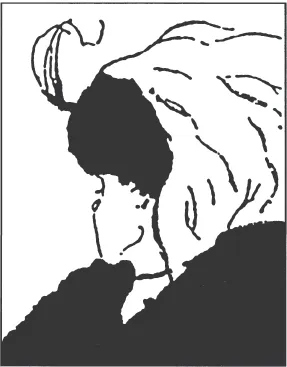
Try this experiment. Look at the picture on the next page until you are able to see both the old woman and the young woman in it. When you have seen both, force your eyes to focus on one and then the other and back again every three seconds. What an effort! If it’s that hard to break an eye pattern, consider how hard it is to break a teaching pattern you’ve been working on for years. Hard, but certainly not impossible, and worth the effort.
Assignment: Make a list of your teaching patterns. For example: “I always begin with prayer because it settles my ninth graders down.” “I always take a student out to lunch after Sunday’s class.” “My students almost always find that Bible study is the dullest part of my lesson.”
When you’ve finished the list, check those things that you consider excellent patterns that you wouldn’t want to break. For those unchecked things on your list, come up with alternatives. Really stretch.
Where do you look for ideas that might be alternatives to weak or overused teaching patterns? One place is in the other patterns of your life. What would happen if you mixed what you do on Tuesday with what you do on Sunday? For example, how might your visit to the Museum of Science and Industry provide ideas that stimulate your teaching?
“I had just finished looking at the exhibits,” a high school teacher said. “In the museum store, I was intrigued by some unusual puzzles. One was a wooden, Chinese tangram, a square that had been cut into seven geometric pieces. Those pieces could be arranged in numerous ways to form patterns and symbolic pictures. In my class some of the students are interested in architecture, and I thought they might enjoy using tangram pieces to illustrate some concept in an upcoming lesson. I traced the design and have been using it ever since. I often find myself looking for ideas that can be used in teaching, even when I’m not primarily thinking about lesson preparation.”
Jesus was that kind of teacher, too. When He saw a sower, He told the story that illustrated the different ways people respond to His message. He was able to mix the different patterns of His life so they contributed to His teaching.
For us, this is hard work. We don’t easily take an idea from the experience part of our lives and insert it into the teaching part, yet that mixing will make our teaching more creative. We also have to be open to things that aren’t immediately familiar to us, if we are to be creative teachers. The old patterns seem so much more right. Yet, they might not be; they might be just mo...
Table of contents
- Cover
- Title Page
- Dedication
- Contents
- Introduction
- 1. The Creative Dare
- 2. The Creative Process
- 3. The Creative Person
- 4. Acting Up—Drama in the Classroom
- 5. Roleplay: Do-It-Yourself Drama
- 6. Mime—Miracle of Motion
- 7. Simulation Games
- 8. Never Too Old for “Tell Me a Story”
- 9. Discussion: A Learning Imperative
- 10. Case Study: Chunk of Reality in the Classroom
- 11. Creative Writing: Helping Students Save Their Thoughts
- 12. Joyful Noises
- 13. Art: What Colors Are in God?
- 14. Teaching Without Walls
- About the Author
- Copyright Page
Trusted by 375,005 students
Access to over 1.5 million titles for a fair monthly price.
Study more efficiently using our study tools.
Frequently asked questions
Yes, you can cancel anytime from the Subscription tab in your account settings on the Perlego website. Your subscription will stay active until the end of your current billing period. Learn how to cancel your subscription
No, books cannot be downloaded as external files, such as PDFs, for use outside of Perlego. However, you can download books within the Perlego app for offline reading on mobile or tablet. Learn how to download books offline
Perlego offers two plans: Essential and Complete
- Essential is ideal for learners and professionals who enjoy exploring a wide range of subjects. Access the Essential Library with 800,000+ trusted titles and best-sellers across business, personal growth, and the humanities. Includes unlimited reading time and Standard Read Aloud voice.
- Complete: Perfect for advanced learners and researchers needing full, unrestricted access. Unlock 1.5M+ books across hundreds of subjects, including academic and specialized titles. The Complete Plan also includes advanced features like Premium Read Aloud and Research Assistant.
We are an online textbook subscription service, where you can get access to an entire online library for less than the price of a single book per month. With over 1.5 million books across 990+ topics, we’ve got you covered! Learn about our mission
Look out for the read-aloud symbol on your next book to see if you can listen to it. The read-aloud tool reads text aloud for you, highlighting the text as it is being read. You can pause it, speed it up and slow it down. Learn more about Read Aloud
Yes! You can use the Perlego app on both iOS and Android devices to read anytime, anywhere — even offline. Perfect for commutes or when you’re on the go.
Please note we cannot support devices running on iOS 13 and Android 7 or earlier. Learn more about using the app
Please note we cannot support devices running on iOS 13 and Android 7 or earlier. Learn more about using the app
Yes, you can access Creative Teaching Methods by Marlene LeFever in PDF and/or ePUB format, as well as other popular books in Teología y religión & Religión. We have over 1.5 million books available in our catalogue for you to explore.