Worldwide Destinations: The Geography of Travel and Tourism is a unique text that explores tourism demand, supply, organisation and resources for a comprehensive range of destinations and every country worldwide. The seventh edition is brought up to date with features such as:
An exploration of current issues such as climate change, sustainability, mobilities, emerging markets, demographic changes and the social impacts of tourism.
New and updated case studies throughout
More emphasis on emerging countries in Africa and Asia.
Improved full colour presentation, packed with useful learning resources such as location maps, discussion questions and assignments to aid understanding.
Online resources for lecturers and students including: multiple choice questions per chapter, power points, web links and video links
The first part of the book comprises thematic chapters which detail the geographic knowledge and principles required to analyse the tourism appeal of destinations. The subsequent division of the book into regional chapters enables the student to carry out a systematic analysis of a particular destination, by providing insights on cultural characteristics as well as information on specific places.
Worldwide Destinations is an invaluable resource for studying every destination in the world, by explaining tourism demand, evaluating the many types of tourist attractions and examining the trends that may shape the future geography of tourism. This thorough guide is a must-have for any student undertaking a course in travel and tourism.
Part I The geographical principles of travel and tourism
1 An introduction to the geography of travel and tourism
2 The geography of demand for tourism
3 The geography of resources for tourism
4 Climate and tourism
5 The geography of transport for travel and tourism
An introduction to the geography of travel and tourism
DOI: 10.4324/9781315697666-1
Learning objectives
After reading this chapter, you should be able to:
Define and use the terms leisure, recreation and tourism and understand their interrelationships
Distinguish between tourism, migration and other types of mobility
Distinguish between the different forms of tourism and the relationship of different types of tourist with the environment
Appreciate the importance of scale in explaining patterns of tourism
Identify the three major components of the tourism system
Explain the push and pull factors that give rise to tourist flows
Appreciate the methods used to measure tourist flows and be aware of their shortcomings
Leisure, recreation and tourism
What exactly is meant by the terms leisure, recreation and tourism, and how are they related? Leisure is often seen as a measure of time, and usually means the time left over after work, sleep, household chores and personal obligations have been completed (Figure 1.1). In other words, leisure is free time for individuals to spend as they please. This does, however, introduce the problem of whether all free time is leisure. A good example of this dilemma is whether the unemployed feel that their free time is in fact ‘enforced’ leisure, or whether volunteers at a sporting event see their activity as ‘serious leisure’. This has led to the view that leisure is as much an attitude of mind as a measure of time, and that an element of ‘choice’ has to be involved. In fact the relationships between work and leisure have changed over the last two centuries in most of the world; the Industrial Revolution brought about a sharp contrast between the home, the workplace and the leisure environment, which became more widely separated as transport facilities improved. In pre-industrial societies the pace of life is attuned to the rhythm of the seasons rather than being governed by the clock, and personal mobility is limited. In post-industrial countries such as Britain and the USA, one aspect of the so-called ‘24/7 culture’ is the blurring of the boundaries between work and leisure, and the work–life balance is increasingly under threat as a result. Highly paid executives are expected to be in contact with the office during their vacations, while some corporate employers provide leisure opportunities based at the workplace.
Figure1.1 Leisure, recreation and tourism
Recreation is normally taken to mean the variety of activities undertaken during leisure time (Figure 1.1). Basically recreation refreshes a person’s strength and spirit and can include activities as diverse as watching television at home and holidaying abroad. We can make a useful distinction between leisure pursuits that involve the arts, cultural activities and entertainment, and physical activities. We can further distinguish sports from other types of physical recreation, as they involve competition and participants must follow rules laid down by a recognised authority.
If we accept that leisure is a measure of time and that recreation embraces the activities undertaken during that time, then tourism is simply one type of recreation activity. It is, however, more difficult to disentangle the meaning of the terms recreation and tourism in practice. Perhaps the most helpful way to think about the difference is to envisage a spectrum, with at one end recreation based at home or the local area, and at the opposite end recreational travel where some distance is involved and overnight accommodation may be needed. This is based on the time required for the activity and the distance travelled, and it places tourism firmly at one extreme of the recreational activity spectrum (Figure 1.1). The spectrum also allows us to consider the role of same-day visitors or excursionists. These travellers are increasingly a consideration in the geography of tourism – they visit for less than 24 hours and do not stay overnight. In other words, they utilise all tourism facilities except accommodation, and put pressure on the host community and the environment.
Clearly tourism is a distinctive form of recreation and demands separate consideration. In particular, from the geographical point of view, tourism is just one form of temporary or leisure mobility, recognising that technology and changes in society have given people the capacity to travel extensively. In other words we can think of tourism as a form of voluntary, temporary mobility in relation to where people live.
Discussion point
Geography is rediscovering tourism as an area for research by combining social and spatial elements in a new ‘mobilities’ approach. This views tourism as but one form of ‘mobility’, located within a spectrum ranging from permanent migration to daily shopping, where tourism is re-examined as a form of ‘voluntary temporary mobility in relation to home’. In other words the mobilities approach views tourism as one dimension of our ‘connections’ with the world, ranging across many different localities. The key message from the idea of tourism ‘as a form of mobility’ is that tourism is no longer treated as a distinct and special activity, but simply one that is a part of a range of other activities in society. The mobilities approach creates a number of issues for tourism, however:
First, the approach puts movement centre-stage and increases our understanding of the underlying processes driving patterns of tourism movement. The key question is to understand and explain what influences these movements, from micro personal resources, to macro geo-politics.
Second, mobilities blur the distinction between home, work and tourist destinations; and between differing types of traveller – whether they are commuters, shoppers or migrants. This makes reconciling the ‘mobilities’ approach with drawing up ‘definitions’ of tourism problematic – particularly when we go back to the definitions of tourism designed by the UNWTO, which we deal with below.
Not everyone can be part of this world of movement. To travel involves mustering the personal resources needed, and yet some argue that the mobilities approach ignores these inequalities. Only two or three per cent of the world’s population engage in international tourism, and some who do are ‘hypermobile’, engaging in many trips in any one year.
Is tourism still a ‘special’ activity or does the mobilities approach devalue it to a being a part of everyday life and expectations?
The mobilities approach brings into focus the international debate as to the definition of tourism. There are two ways to investigate the problem:
First we can define tourism from the demand side, i.e. the person who is the tourist. This approach is well developed and the United Nations Statistical Commission now accepts the following definition of tourism: ‘The activities of persons travelling to and staying in places outside their usual environment for not more than one consecutive year for leisure, business and other purposes’. This definition raises a number of issues:
What is a person’s usual environment?
The inclusion of ‘business’ and ‘other’ purposes of visit demands that we conceive of tourism more widely than simply as a recreational pursuit.
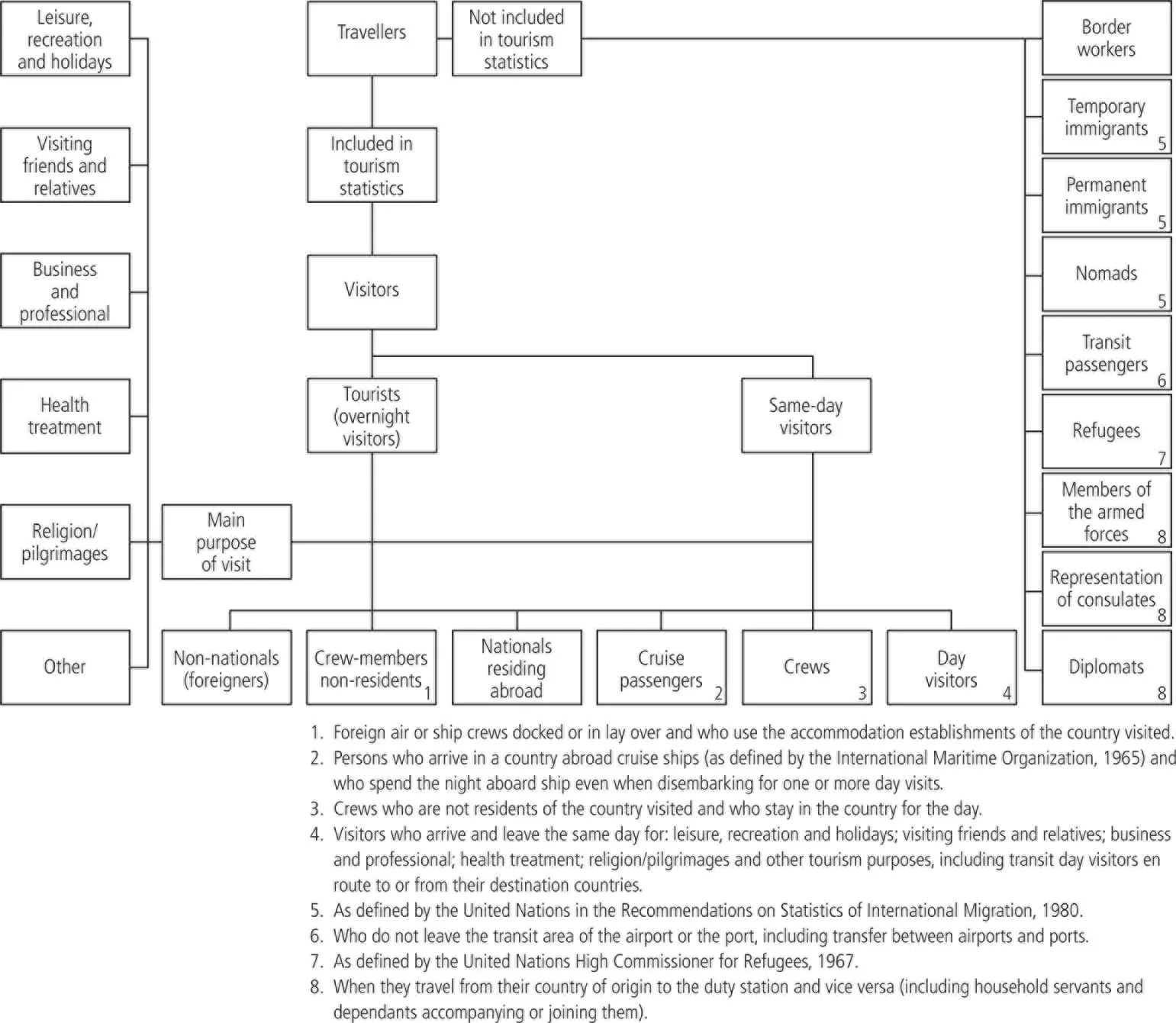
Certain types of traveller are excluded from the definition. Tourism is only one part of the spectrum of travel, which ranges from the daily journey to work, or for shopping, to migration, where the traveller intends to take up permanent or long-term residence in another area (see Figure 1.2).
Figure1.2 Classification of travellers Source: World Tourism Organization
We can also define the tourism sector from the supply-side point of view. Here the difficulty lies in disentangling tourism businesses and jobs from the rest of the economy. After years of debate, the accepted approach is the tourism satellite account (TSA), adopted by the United Nations in 2000. The TSA measures the demand for goods and services generated by visitors to a destination. It allows tourism to be compared with other sectors of the economy by calculating its contribution to investment, consumption, employment, gross domestic product (GDP) and taxation.
Discussion point
Traditional definitions of tourism fail to incorporate the idea of tourism as an ‘experience’, yet experiences now define what many tourists are seeking. In fact, the tourist is as much a creator of the experience as the tourism industry itself. This is known as ‘co-creation’ of the tourism experience and has been enabled in part by technology whereby tourists construct their own product. Can you devise a new definition of tourism that takes this idea into account?
Geography and tourism
When we study the geography of travel and tourism, three key concepts need to be considered:
spatial scale;
the geographical components of the tourism system; and
spatial interaction between the components of the tourism system: tourist flows.
Spatial scale
Geographers study the spatial expression of tourism as a human activity, focusing on both tourist-generating and tourist-receiving areas as well as the links between them. We can undertake this study at a variety of scales, namely:
the global or continental scale – the distribution of major climate zones and ecosystems, air and shipping routes and patterns of migration;
the national scale – the identification of a country’s transport networks and tourist regions and population distribution;
the regional scale – the assessment of tourism resources in part of a country; and
the local scale – the location of particular attractions and the configuration of holiday resorts.
This issue of scale has become important in the global versus local debate. As the tourism sector embraces the tools of globalisation, such as the forging of global airline alliances, we must never forget that the tourism product is delivered at the local scale, often by local people and within a local cultural context.
We have used the idea of scale to organise the material presented in this book because at each scale we can gain a distinctive perspective and insight on tourism. In other words, as a more detailed explanation is required, attention is drawn to increasingly smaller parts of the problem. This idea of scale, or geographical magnitude, keeps in focus the area being dealt with, and can be likened to increasing or decreasing the magnification on a microscope, or the area covered by a map. Flows of leisure tourism in Europe provide a good example of the importance of scale. At the international scale the dominant flow of tourists is from north to...
Table of contents
Cover Page
Half Title Page
Title Page
Copyright Page
Contents
List of figures
List of tables
List of photos
List of case studies
Preface
PART I The geographical principles of travel and tourism
PART II The regional geography of travel and tourism
PART III Useful sources
Selective place name index
Subject index
Trusted by 375,005 students
Access to over 1.5 million titles for a fair monthly price.
Study more efficiently using our study tools.
Frequently asked questions
Yes, you can cancel anytime from the Subscription tab in your account settings on the Perlego website. Your subscription will stay active until the end of your current billing period. Learn how to cancel your subscription
No, books cannot be downloaded as external files, such as PDFs, for use outside of Perlego. However, you can download books within the Perlego app for offline reading on mobile or tablet. Learn how to download books offline
Perlego offers two plans: Essential and Complete
Essential is ideal for learners and professionals who enjoy exploring a wide range of subjects. Access the Essential Library with 800,000+ trusted titles and best-sellers across business, personal growth, and the humanities. Includes unlimited reading time and Standard Read Aloud voice.
Complete: Perfect for advanced learners and researchers needing full, unrestricted access. Unlock 1.5M+ books across hundreds of subjects, including academic and specialized titles. The Complete Plan also includes advanced features like Premium Read Aloud and Research Assistant.
Both plans are available with monthly, semester, or annual billing cycles.
We are an online textbook subscription service, where you can get access to an entire online library for less than the price of a single book per month. With over 1.5 million books across 990+ topics, we’ve got you covered! Learn about our mission
Look out for the read-aloud symbol on your next book to see if you can listen to it. The read-aloud tool reads text aloud for you, highlighting the text as it is being read. You can pause it, speed it up and slow it down. Learn more about Read Aloud
Yes! You can use the Perlego app on both iOS and Android devices to read anytime, anywhere — even offline. Perfect for commutes or when you’re on the go. Please note we cannot support devices running on iOS 13 and Android 7 or earlier. Learn more about using the app
Yes, you can access Worldwide Destinations by Brian Boniface,Robyn Cooper,Chris Cooper in PDF and/or ePUB format, as well as other popular books in Business & Management. We have over 1.5 million books available in our catalogue for you to explore.