Making a vital contribution to our understanding of North American borderlands history through its examination of the northernmost stretches of the U.S.-Canada border, Andrea Geiger highlights the role that the North Pacific borderlands played in the construction of race and citizenship on both sides of the international border from 1867, when the United States acquired Russia’s interests in Alaska, through the end of World War II. Imperial, national, provincial, territorial, reserve, and municipal borders worked together to create a dynamic legal landscape that both Indigenous and non-Indigenous people negotiated in myriad ways as they traversed these borderlands. Adventurers, prospectors, laborers, and settlers from Europe, Canada, the United States, Latin America, and Asia made and remade themselves as they crossed from one jurisdiction to another.
Within this broader framework, Geiger pays particular attention to the ways in which Japanese migrants and the Indigenous people who had made this borderlands region their home for millennia—Tlingit, Haida, and Tsimshian among others—negotiated the web of intersecting boundaries that emerged over time, charting the ways in which they infused these reconfigured national, provincial, and territorial spaces with new meanings.
eBook - ePub
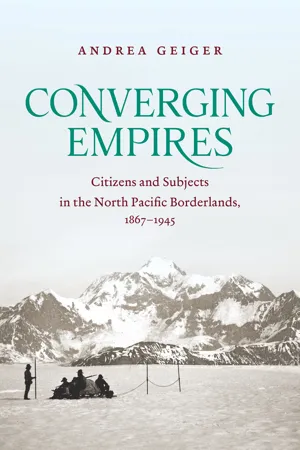
Converging Empires
Citizens and Subjects in the North Pacific Borderlands, 1867–1945
- 352 pages
- English
- ePUB (mobile friendly)
- Available on iOS & Android
eBook - ePub
About this book
Information
CHAPTER ONE The Shifting Borderlands of the North Pacific Coast
The northwestern coast of the continent of North America, long deemed terra incognita by European explorers and mapmakers, is a creation of both land and ocean, its contours carved out by glaciers that, along some parts of the coast, still connect land and sea. Often shrouded in mist and battered by Pacific storms in winter, it is also a borderland region rich in resources that had long sustained human life. While the turbulent waves of the North Pacific obscured European knowledge of this coastline for many decades after Europeans first set foot on the eastern shores of the continent, a growing demand for whale oil increasingly lured European sailors into parts of the North Pacific they had not previously explored. In time, they developed a more complete understanding of the contours of the north Pacific coast. Where the rough waters of the Pacific had once posed a barrier to access to the northwesternmost regions of North America, the open ocean would also become in turn a ready access route for ships from around the world.1
By the end of the eighteenth century, Russian hunters had followed the chain of islands that stretches across the northern reaches of the Pacific Ocean from the Kuril Islands that link Hokkaido to the Kamchatka Peninsula and then the Commander and Aleutian Islands. An archipelago that itself extends a thousand miles, the Aleutian chain bisects the North Pacific and the Bering Sea, before it connects to the western tip of the long, narrow Alaskan peninsula. In contrast to the densely forested islands that lie further south along both the eastern and western coasts of the Pacific Ocean, the far more barren shores of the Aleutian Islands, like the Pribilof Islands that lie to their north, were once home to great herds of fur seals and sea lions. Further east along the southern coast of Alaska, the deep fjords and glaciers that surround the Gulf of Alaska give way to cedar-, fir-, and pine-covered archipelagos that extend another thousand miles along the Alaska panhandle and the B.C. coast to the Strait of Georgia and Puget Sound, both a part of what is also known as the Salish Sea.2 Together, the islands that lie along the western edge of the North American continent, including Haida Gwaii and Vancouver Island, create a series of saltwater channels largely sheltered from the broad swells of the open ocean that have long facilitated travel along that coast.3

Portion of Oranda shinyaku chikyu zenzu (The complete map of the whole world, newly translated from Dutch sources), depicting the Western Hemisphere based on information obtained from the Dutch. Created by Hashimoto Sōkichi, 1796 (woodblock or engraved copperplate). Stanford University, Glen McLaughlin Map Collection: California as an Island.
Three major rivers flow down into the easternmost waters of the North Pacific from the coastal mountain range that now divides Alaska and British Columbia—the Skeena, the Nass, and the Stikine. The Skeena and the Nass flow into Hecate Strait just north and south of Prince Rupert, while the Stikine cuts across the Alaska panhandle just north of the town of Wrangell.4 Together, these rivers link the north Pacific coast to the interior of the continent. Like the Fraser and Columbia Rivers to the south, the Skeena, Stikine, and Nass Rivers served as ready routes to the plateaus and mountain valleys that lie east of the coastal range, facilitating the movement of goods and people both before and after the arrival of Europeans. Railroads would follow many of the same river valleys to tie the Pacific coast to eastern Canada and the United States, including cities like St. Louis, where many a seal or sea lion hide would be processed over the years.5 The fact that the major rivers along the northwestern coast of North America flow directly into the Pacific Ocean distinguishes it from Siberia’s eastern coast, where the major rivers of the eastern half of the Eurasian continent, with the exception of the Amur, empty into not the Pacific but the Arctic Ocean. The lack of direct access to the Pacific Ocean, the editors of The Trans-Pacific, an English-language journal published in Japan, observed in 1921, explained why it was not Siberia but the northwestern coast of North America that was the primary focus of resource extraction, whether of timber or of animal pelts, around the North Pacific Rim.6
Another feature that distinguishes the north Pacific coast of Eurasia from that of North America is the fact that far fewer harbors remain ice free in winter along Eurasia’s eastern coast. Mariners understood early on that given the direction of the prevailing winds in the earth’s Northern Hemisphere, the eastern coasts of its northern continents are invariably colder than their western coasts. They also recognized that this had important strategic consequences. As the Russian explorer Dmitry Zavalishin explained as early as 1824, the absence of ice-free ports in winter meant that neither the Amur River nor Sakhalin could serve as a base that would enable any power that controlled them to dominate any part of the Pacific Ocean, even its northernmost reaches. Instead, Zavalishin declared, “The key to sway over the Pacific [was] to be sought not on its Asiatic coast but on the western coast of North America. Only on this coast, even far to the north, could there be found harbors that never froze and that permitted unrestricted coming and going at all times.” Harbors located as far north as latitude 57° north along the northwestern coast of North America never froze in winter, he reported, but even harbors as far south as latitude 40° north along Eurasia’s eastern coast were often clogged with ice in winter.7
The presence of sheltered and largely ice-free inland channels along the northwest coast of North America, together with the access that the Skeena, the Nass, and the Stikine provide to the interior—all factors attractive to Europeans interested in securing access to its resources—had supported Indigenous trading networks that extended not just along the coast but deep into the interior of the continent long before the first Europeans arrived.8 Traveling up the same river systems along the western coast of the continent, the life-sustaining salmon central to Indigenous cultures around the North Pacific Rim also linked territories as far inland as those of the Tahltan, Gitxsan, Wet’suwet’en, and Sekani peoples, among others, to the ocean,9 as they did those of the Ainu who lived on Ainu Moshir, renamed Hokkaido by the Japanese, as well as on the island of Sakhalin and the Kamchatka Peninsula.10 Other resources that abound around the North Pacific Rim, and that had long sustained the Indigenous peoples of the coastal region who had made it their home over many centuries—Tlingit, Tsimshian, Haida, Haisla, Heiltsuk, Nisga’a, Eyak, Alutiiq, Unangan, and others—include sea urchins, abalone, shellfish, starfish, crab, and the kelp beds favored by sea otters.11 These were all maritime peoples whose deep ties to coastal waters were reflected in long-standing cultural traditions and sophisticated technologies of knowledge grounded in many centuries of experience with the marine environment at the center of both the spiritual and the material worlds in which they lived.12 These knowledge systems, together with their long-honed expertise in hunting marine mammals and the building and navigating of small boats adapted to local conditions, were among the skills Indigenous peoples had developed that non-Indigenous invaders sought to use to their advantage. The boundaries that these newcomers would establish over time to differentiate their own claims to exclusive access to certain parts of northwestern North America from those of other European powers, in short, cut across what was already a rich and complex social and cultural landscape.
Colonial Contexts
As the eighteenth century unfolded, the same resources that had sustained the Indigenous peoples of the North Pacific Rim for millennia attracted the attention first of Russian and then of Spanish, British, and American colonizers. The contests that ensued among these imperial powers during the colonial period set the stage for the eventual division of these territories between the nation-states that later replaced them. Japan’s own colonization of Hokkaido and its increasing presence in the Kuril Islands was also a factor that caused Russia to look east across the North Pacific rather than south along the Eurasian coast for new resources. Indigenous resistance to colonial intrusion, in turn, played a key role in inhibiting the advance of Russian traders into the heart of the North American continent and, in so doing, determining where the boundaries of the territories claimed by European powers were eventually drawn.
The practical incorporation of any new land area within the boundaries of empire or a nation-state occurs in stages and may assume different forms depending on its purpose. As John R. Bockstoce notes, the rivalry among European powers in northwestern North America was initially structured around a quest for the knowledge on which material access to commodifiable resources depended.13 “Territory had to be known before it could be controlled,” Jeffers Lennox explains, “and the methods by which that knowledge was created and implemented reflected the technological, political, and ideological realities of the time.”14 Early explorations of the north Pacific coast were driven in large part by a demand for the dense pelts of sea otters highly valued in China—one of the few commodities Chinese traders were willing to accept in exchange for the tea, teak, ivory, sugar, porcelain, lacquerware, rhubarb, silk, and cotton Europeans and Americans sought to acquire.15 The mercantile economic framework within which European nations operated made it desirable to assert exclusive control over a given area, even if there was no interest in settlement, in order to maximize the profits that could be derived from the wholesale extraction of its resources for the benefit of the mother country.16 For that reason, contests among European powers initially centered on the “discoveries” that were key to their ability to assert territorial claims as against other European powers to areas unknown to them, based on the tenets of European international law at the time.17
Marine mammals, and particularly sea otters and fur seals, bore the brunt of a quest for furs that came to an end only when their populations were all but annihilated around the North Pacific Rim, much as beavers were in many parts of North America as Europeans expanded across the continent during the colonial period.18 As Bockstoce notes, the wealth gleaned from furs and hides harvested on the North American continent and in Siberia during the seventeenth and eighteenth centuries remade the economies of Britain, France, and Russia and repositioned Europe as a power that would make itself felt around the world.19 Mirroring the westward march of British and American colonial interests across the North American continent during the eighteenth and nineteenth centuries, the Russian empire extended its reach eastward across Siberia to Sakhalin, the Kuril Islands, and the Kamchatka Peninsula and then to the Aleutian Islands in a parallel quest for fur during the same period.20
The home of extensive sea otter populations of commercial interest to both Russian and Japanese traders, the Kuril Islands were also of strategic interest to the imperial governments of Russia and Japan because they linked the Kamchatka Peninsula to Hokkaido and thus controlled access to the Sea of Okhotsk. Although powerful currents, stormy winter weather, and the dense fogs that shrouded them even in summer obscured knowledge of their coasts for many centuries, both Japan and Russia were aware of their existence by the mid-seventeenth century, as were the Dutch. Both Russian and Japanese maps of the period depict the Kurils as lying just beyond the edge of empire, although historians generally agree that neither Russian nor Japanese authorities had a clear understanding of their geographical contours.21 As John J. Stephan notes, the fact that the Kuril Islands—known as Chishima Retto (Chishima Archipelago) in Japanese—were an Ainu homeland is reflected in the names still used for the islands in Russian and Japanese today, most of which derive from those first used by the Ainu.22 As commercial activity in the vicinity of the Kuril Islands increased during the early decades of the eighteenth century, both Russia and Japan began to acquire greater knowledge of them. An edict first issued by the Tokugawa shogunate in 1639 forbade travel outside Japan’s coastal waters and imposed harsh penalties on those who violated it, making Japanese explorers more reluctant than their Russian counterparts to document their contacts with the Kuril Islands, although there were some traders who...
Table of contents
- Cover
- Series Page
- Title Page
- Copyright
- Dedication
- Contents
- Illustrations and Maps
- Acknowledgments
- Note on Terminology
- Introduction
- Chapter One: The Shifting Borderlands of the North Pacific Coast
- Chapter Two: Immigrant and Indigene
- Chapter Three: Encounters with Law and Lawless Encounters
- Chapter Four: Borders at Sea
- Chapter Five: The Pacific Borderlands in Wartime
- Afterword
- Notes
- Index
Trusted by 375,005 students
Access to over 1.5 million titles for a fair monthly price.
Study more efficiently using our study tools.
Frequently asked questions
Yes, you can cancel anytime from the Subscription tab in your account settings on the Perlego website. Your subscription will stay active until the end of your current billing period. Learn how to cancel your subscription
No, books cannot be downloaded as external files, such as PDFs, for use outside of Perlego. However, you can download books within the Perlego app for offline reading on mobile or tablet. Learn how to download books offline
Perlego offers two plans: Essential and Complete
- Essential is ideal for learners and professionals who enjoy exploring a wide range of subjects. Access the Essential Library with 800,000+ trusted titles and best-sellers across business, personal growth, and the humanities. Includes unlimited reading time and Standard Read Aloud voice.
- Complete: Perfect for advanced learners and researchers needing full, unrestricted access. Unlock 1.5M+ books across hundreds of subjects, including academic and specialized titles. The Complete Plan also includes advanced features like Premium Read Aloud and Research Assistant.
We are an online textbook subscription service, where you can get access to an entire online library for less than the price of a single book per month. With over 1.5 million books across 990+ topics, we’ve got you covered! Learn about our mission
Look out for the read-aloud symbol on your next book to see if you can listen to it. The read-aloud tool reads text aloud for you, highlighting the text as it is being read. You can pause it, speed it up and slow it down. Learn more about Read Aloud
Yes! You can use the Perlego app on both iOS and Android devices to read anytime, anywhere — even offline. Perfect for commutes or when you’re on the go.
Please note we cannot support devices running on iOS 13 and Android 7 or earlier. Learn more about using the app
Please note we cannot support devices running on iOS 13 and Android 7 or earlier. Learn more about using the app
Yes, you can access Converging Empires by Andrea Geiger in PDF and/or ePUB format, as well as other popular books in History & North American History. We have over 1.5 million books available in our catalogue for you to explore.