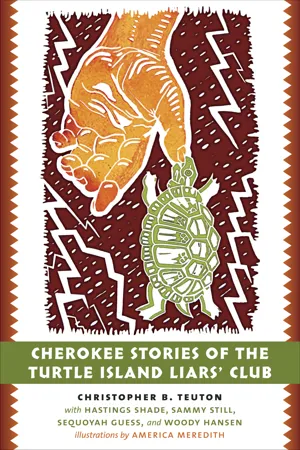
Cherokee Stories of the Turtle Island Liars' Club paints a vivid, fascinating portrait of a community deeply grounded in tradition and dynamically engaged in the present. A collection of forty interwoven stories, conversations, and teachings about Western Cherokee life, beliefs, and the art of storytelling, the book orchestrates a multilayered conversation between a group of honored Cherokee elders, storytellers, and knowledge-keepers and the communities their stories touch. Collaborating with Hastings Shade, Sammy Still, Sequoyah Guess, and Woody Hansen, Cherokee scholar Christopher B. Teuton has assembled the first collection of traditional and contemporary Western Cherokee stories published in over forty years.
Not simply a compilation, Cherokee Stories of the Turtle Island Liars' Club explores the art of Cherokee storytelling, or as it is known in the Cherokee language, gagoga (gah-goh-gá), literally translated as “he or she is lying.” The book reveals how the members of the Liars' Club understand the power and purposes of oral traditional stories and how these stories articulate Cherokee tradition, or “teachings,” which the storytellers claim are fundamental to a construction of Cherokee selfhood and cultural belonging. Four of the stories are presented in both English and Cherokee.
eBook - ePub
Cherokee Stories of the Turtle Island Liars’ Club
- 264 pages
- English
- ePUB (mobile friendly)
- Available on iOS & Android
eBook - ePub
Cherokee Stories of the Turtle Island Liars’ Club
About this book
Information
Joi (Three)
Dideyohvsdi (Teachings)
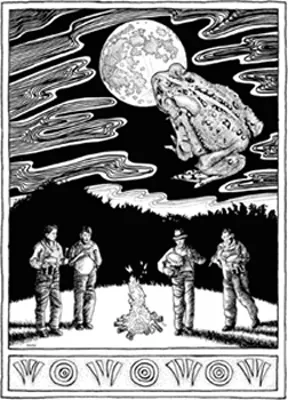
Toad swallowing Moon
“Most of the traditional stories are teaching tools,” Hastings said. “They’re not stories, per se, that kids would really, really prefer to listen to when they find out what they are,” he said and laughed. “But they’re actually teaching tools. They teach a value, some kind of value. I guess that’s how we were taught our values, without actually come out and say, ‘Hey, this is what you gonna do.’”
“Mmhm,” I said.
“‘You goin’ do it like this,’ or, you know, they would tell you in a story. And that way, it wasn’t saying, ‘You . . . do . . . this.’ It kind of brought it real . . .”
“Subtle,” Sequoyah said.
“Yeah. Subtle. ’Cause a lot of times you tell somebody, ‘You goin’ do this,’ it just puts a wall.” We all laughed at the truth of that. “And we were no different than ordinary kids, you know. I mean, when we were told, ‘Don’t do this,’ a lot of times we done it anyway,” Hastings said, and we laughed again.
“But these right here are something that you can live with every day,” Hastings continued. “Like the walk. How you present yourself, you know? My grandpa used to say, ‘When somebody’s coming towards you, don’t ever look where he’s been. Look at that person. Let him prove who he is. ’Cause if you look past him, you may not like him. And he may be the best man around.’ He said, ‘Don’t look at his past ’cause if people looked at our pasts they wouldn’t want us around neither.’ So, that’s another good teaching. Always look at the man, or the person. And let them prove to you who they are.”
“Mmhm,” I said.
“I think what I’d like to see in this book is, like Hastings was saying, you know we’ve lost that, we’ve lost that where we sit and speak with kids, with our young ones, and tell our teachings,” Sammy said. “We lost it to TV, to video games, to other things that’s out there. And maybe if this is done in a book, maybe if someone can pick it up and read this and read the teachings, they’ll get interested and say, ‘Hey,’ and pass this along to others and show ’em. Maybe this will be another tool that we can use to teach our kids again the teachings they should know. And like I said earlier about the story about the bear making full circle. Well, maybe this will be what happens to them. Maybe they know who they are, they realize where they come from. Maybe as they grow older and read this book with the teachings in it, they’ll come back to it and say, ‘Hey, maybe it’s time I come back and start teaching my kids.’”
“It’s gonna happen to ’em. I mean, it’s not ‘if,’” Hastings said. “And they may not move as far. They may move within a mile away from where they grew up. And they may move a thousand miles.”
“Or in their own head . . . ,” I said.
“Yeah. Yeah,” Hastings and Sammy both said.
“So I think that would be good to do that,” Sammy said.
“That time we talked about the ice storm,” Hastings said, after a moment. “Our electricity . . . We were lucky. I think we lost about eight hours. But the community around there, just houses right around us. For two or three weeks we had kids, we had neighbors over at the house. I enjoyed it, ’cause they’d come around and say, ‘Tell stories. Tell some more stories.’ We’d sit around there and put a cot up, put a pot of beans on and coffee, and we’d sit there until, shoot, two or three o’clock in the morning. Telling stories. They was wanting to hear stories. That was something that they really wanted to hear.
“And it lasted for two or three weeks, even after the electricity come on and they got back into their routine. Their video games and stuff like that, when they knew the electricity was going to stay on,” he said and laughed.
“The thing about it is . . . ,” Hastings paused for a moment and looked away. “Our kids . . . I think if we could do it somewhere once or twice a week. If we could just sit down together and talk. We don’t raise them anymore. We don’t talk to them.
“I think it’s the influence of different cultures. And the modern technology that we have has influenced a lot of the things that we do, even how we teach our kids anymore. We used to sit around like this a long time ago and this was our classroom. Listen to the elders speak and tell us these things. Anymore, they can go inside and click the computer on and all the knowledge is right there, or the knowledge they think is true. But I always said, the computer is only as smart as the man that designed it.”
“That’s true,” I said.
Hearing versus Seeing
“Hey, I was put here to like everybody,” Hastings told me once. “You can be the worst person in the world. I still like you as a person, I just don’t like what you do. And that’s the thing about it. I always say, ‘I’m not the most honest man in the world, but I won’t cheat you or lie to you.’ But, a lot of people will look right at you and say this, with all intention of not doing it. That’s how come Indians will not look at you in the eye, because he wants to take you at your word, not what he sees. Somebody say, ‘He didn’t look at me.’ Well, he didn’t want to see you. ’Cause a lot of times, you know, especially the elders. We’ve learned anymore to look at people. Our elders, they look down when they talk to you. And it’s not, it’s not disrespectful to who you are. It’s they want to hear what you are going to say. They didn’t want to see the truth, ’cause they could look at your eye and see the truth. But they wanted to hear it from you. They want to hear it from your mouth. And what you were going to do. Until this day, a lot of our elders, they’ll talk to you like they’re not paying attention to you. And, modern society says, ‘If you’re not looking at me, you’re not listening.’
“Like that little boy says, ‘Teacher says, “Look at me when I’m talking to you!”’ He says, ‘Teacher I hear with my ears, not my eyes.’ And that’s basically what we do. And a lot of kids . . . I know this when I’m teaching. Kids are playing around, but a lot of them, no. Because they’re listening. A lot of times, you know, they’ll say, ‘What’d you say?’” Hastings laughed and then paused.
“Even in school, especially with little ones, you know? I’ll be talking about something. Kid’ll be there and a teacher will get on ’em and I’ll say, ‘Leave him alone.’ ’Cause they’re listening. And I’ll get through and he’ll say, ‘What’d you say about this word?’ And that tells me then they’re listening. At least I was reaching ’em, you know? And if I’d have got on to ’em or the teacher’d got on to ’em, they would have cut ’em off. And teacher said, ‘I don’t see how you could talk with all that noise.’ I said, ‘What noise?’ Kids is not noise,” Hastings said and laughed again. “To me. They’re kids. I enjoy kids. I mean, I just like to be around ’em.”
HOW THE TERRAPIN LOST HIS WHISTLE!
By Hastings Shade
One day while Quail was walking around in a field, he heard a whistle. He wondered, “Who can be whistling?”
He thought he knew all the ones that whistled. So he started to look for the whistling. As he got closer, the whistling got louder. Soon he came to a small clearing in the field. This is where he found the source of the whistle. And it surprised him to see who it was! It was Terrapin.
“I didn’t know who was wh...
Table of contents
- Cover Page
- Cherokee Stories of The Turtle Island Liars’ Club
- Copyright Page
- Dedication
- Contents
- Note on Pronunciation of Cherokee
- Introduction: Opening the Door
- Sagwu (One): Alenihv (Beginnings)
- Tali (Two): Adanvsgvi (Movements)
- Joi (Three): Dideyohvsdi (Teachings)
- Nvgi (Four): Ulvsgedi (The Wondrous)
- Afterword: Standing in the Middle
- Acknowledgments
- Works Cited
Trusted by 375,005 students
Access to over 1.5 million titles for a fair monthly price.
Study more efficiently using our study tools.
Frequently asked questions
Yes, you can cancel anytime from the Subscription tab in your account settings on the Perlego website. Your subscription will stay active until the end of your current billing period. Learn how to cancel your subscription
No, books cannot be downloaded as external files, such as PDFs, for use outside of Perlego. However, you can download books within the Perlego app for offline reading on mobile or tablet. Learn how to download books offline
Perlego offers two plans: Essential and Complete
- Essential is ideal for learners and professionals who enjoy exploring a wide range of subjects. Access the Essential Library with 800,000+ trusted titles and best-sellers across business, personal growth, and the humanities. Includes unlimited reading time and Standard Read Aloud voice.
- Complete: Perfect for advanced learners and researchers needing full, unrestricted access. Unlock 1.5M+ books across hundreds of subjects, including academic and specialized titles. The Complete Plan also includes advanced features like Premium Read Aloud and Research Assistant.
We are an online textbook subscription service, where you can get access to an entire online library for less than the price of a single book per month. With over 1.5 million books across 990+ topics, we’ve got you covered! Learn about our mission
Look out for the read-aloud symbol on your next book to see if you can listen to it. The read-aloud tool reads text aloud for you, highlighting the text as it is being read. You can pause it, speed it up and slow it down. Learn more about Read Aloud
Yes! You can use the Perlego app on both iOS and Android devices to read anytime, anywhere — even offline. Perfect for commutes or when you’re on the go.
Please note we cannot support devices running on iOS 13 and Android 7 or earlier. Learn more about using the app
Please note we cannot support devices running on iOS 13 and Android 7 or earlier. Learn more about using the app
Yes, you can access Cherokee Stories of the Turtle Island Liars’ Club by Christopher B. Teuton,America Meredith in PDF and/or ePUB format, as well as other popular books in Literature & North American Literary Collections. We have over 1.5 million books available in our catalogue for you to explore.