This is an integrated textbook on the endocrine system, covering the anatomy, physiology and biochemistry of the system, all presented in a clinically relevant context appropriate for the first two years of the medical student course.- One of the seven volumes in the Systems of the Body series.- Concise text covers the core anatomy, physiology and biochemistry in an integrated manner as required by system- and problem-based medical courses.- The basic science is presented in the clinical context in a way appropriate for the early part of the medical course.- There is a linked website providing self-assessment material ideal for examination preparation.
eBook - ePub
The Endocrine System
Systems of the Body Series
- 192 pages
- English
- ePUB (mobile friendly)
- Available on iOS & Android
eBook - ePub
The Endocrine System
Systems of the Body Series
About this book
Information
1
INTRODUCTION
What is endocrinology?
Endocrinology is the study of hormones and their actions. Hormones are chemical messengers, released into the blood, that act through receptors to cause a change in the target cell. The glands that release hormones are ductless, giving the term ‘endocrine’ from the Greek for ‘internal secretion’. The thyroid gland is an example of a classical endocrine gland. Its only function is to synthesize and release hormones into the bloodstream. Some organs, such as the pancreas, have endocrine as well as other functions. So the hormones released by the pancreas are released directly into the blood, whereas the other (exocrine) secretions of the pancreas are released into a duct.
The major, or ‘classical’, endocrine glands are shown in Figure 1.1 and the hormones they secrete are listed in Table 1.1. It has been suggested that the vascular endothelium, the whole gastrointestinal tract, and even the skin, should also be considered to be endocrine organs as they all release hormones or their precursors into the blood. Such tissues form the extensive ‘diffuse endocrine system’, which is located throughout the body. This system consists of scattered endocrine cells, located in various different tissues, that secrete hormones but do not form a discrete endocrine gland.
Table 1.1
Major endocrine glands and the hormones they secrete
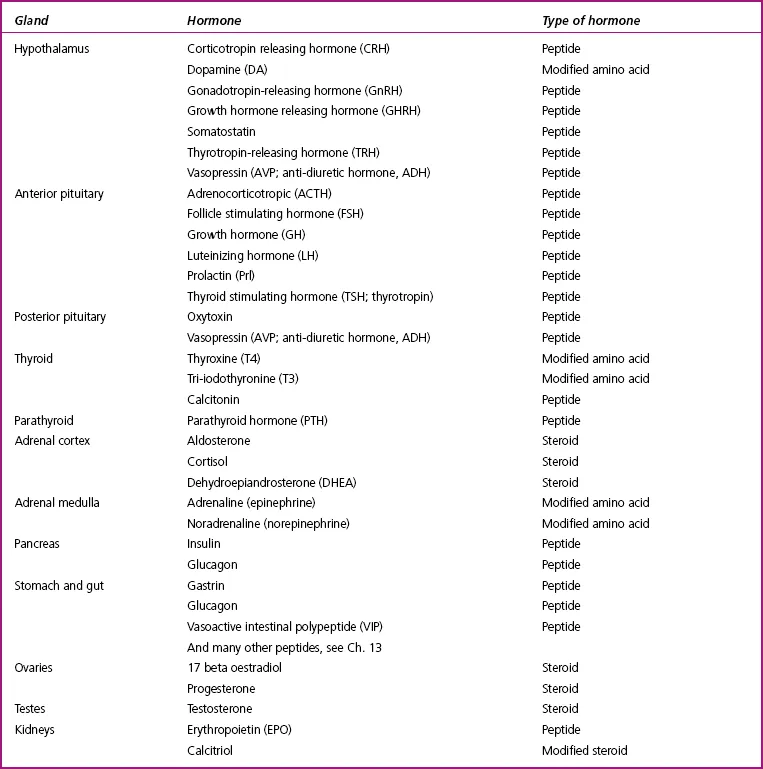
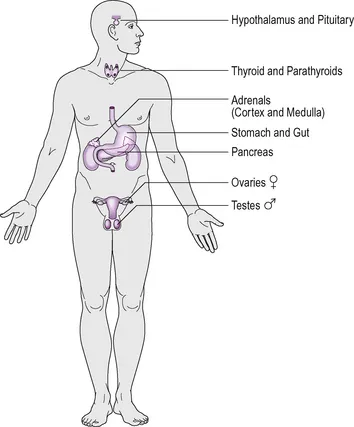
Figure 1.1 Major endocrine glands of the body. In addition, the gut, heart and skin have all been shown to produce hormones.
Endocrinology is a relatively young branch of medical science and is, by definition, exciting. The term ‘hormone’ was coined by Starling in the early 1900s. It derives from the Greek hormon, meaning ‘exciting’ or ‘setting in motion’. Ernest Starling (1866–1927) is perhaps best known for his eponymous law of the cardiovascular system, but is also regarded as the founder of endocrinology. Working at University College, London, with Sir William Bayliss, he isolated and described the actions of secretin, the first known hormone. Starling built on the theoretical work of Edward Schafer and developed the concept of ‘an endocrine system’ in 1905, in a series of lectures called ‘On the chemical correlations of the functions of the body’.
Endocrine disorders are very common in Western society and it has been estimated that more than half the population will suffer from an endocrine disease during their lifetime. There are several examples of common endocrine diseases: osteoporosis, the bone-weakening disease, affects one-third of older women. Around one in six women has polycystic ovarian disease. In addition, an increasing number of the population has type 2 diabetes, a disease of insulin resistance, as a result of obesity.
Interesting fact
The year 2005 saw the centenary of ‘Endocrinology’ as a recognized science and branch of medicine. Learned societies, such as the Society for Endocrinology, celebrated this with a series of special published articles, papers, lectures, events and poster campaigns (Fig. 1.2). To put this into perspective, surgery and pharmacology have been around for thousands of years.

Figure 1.2 In 2005, The Society for Endocrinology celebrated the centenary of Endocrinology as a recognized science.
What do hormones do?
There are two major regulatory systems in the body: the neural system and the endocrine system. Although both use chemical messengers, they are set up very differently and have quite different functions. Neural regulation is very rapid, while endocrine control is generally slower and acts over a longer period of time. These differences arise because the neural system is designed to deliver its messenger directly to the surface of its target cell, while the endocrine system puts its messengers into the blood and allows for diffusion from the blood to the target cell. Thus, the endocrine system is not designed for the same speed of communication as the neural system, but instead has the ability to deliver its messengers to a wider range of targets throughout the body.
Hormones usually control regulatory systems in the body, including homeostasis, metabolism and reproduction. Homeostasis means ‘keeping the same’ and is a term used to describe the regulation of any of the large physiological systems in the body, including levels of glucose in blood and body temperature. Hormones are particularly important in making sure that blood levels of sodium, potassium, calcium and glucose stay within set limits.
The boundaries between the endocrine system and the neural system are quite fuzzy (Fig. 1.3), because some hormones are released from nerve endings, ‘neuro-hormones’, while other hormones, such as adrenaline, are perhaps better known as neurotransmitters.
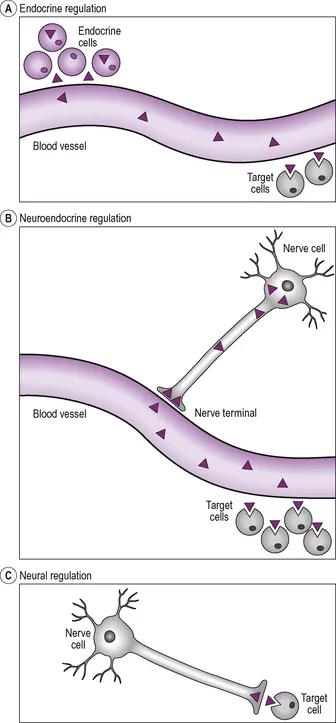
Figure 1.3 Comparison of (A) endocrine, (B) neuroendocrine and (C) neural regulation. In endocrine regulation, the hormone is released from the cells of an endocrine or ‘ductless’ gland into the bloodstream where the hormones travel to target cells often at some distance from the endocrine gland. In neural regulation, the neurotransmitter is released, in response to an action potential, from a nerve ending into the synaptic cleft, directly onto the surface of the target cell. In neuroendocrine regulation, the hormone is secreted by a nerve cell in response to an action potential, but is released into the bloodstream, not a synaptic cleft, and then acts as a hormone.
Types of hormone: their synthesis and secretion
In terms of their chemical structure, hormones are a varied group of substances. There are, however, three major basic types. The first and most numerous are the peptide hormones, made of chains of amino acids. Some of these are very small indeed: the hypothalamic hormone thyrotropin releasing hormone (TRH) is only three amino acids long, whereas the pituitary hormone whose release it stimulates (thyroid stimulating hormone, TSH) is a large glycoprotein with a molecular weight of around 30 000 Daltons. Usually, peptide hormones are pre-formed and stored in granules within the endocrine cell, ready for release in response to the appropriate signal. The synthesis and secretion of peptide hormones is shown in Figure 1.4A.
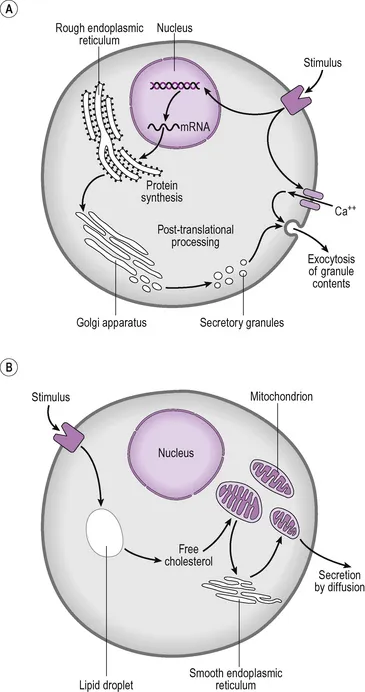
Figure 1.4 Synthesis and secretion of (A) peptide hormones and (B) steroid hormones. The cells that synthesize peptide hormones have abundant rough endoplasmic reticulum and Golgi apparatus. Secretory granules are often visible. Peptides require a specific secretory mechanism, exocytosis, which is usually triggered by an increase in intracellular calcium levels, or depolarization of the cell. The entire contents of the secretory granule are released. Steroid-secreting cells, on the other hand, have lipid droplets visible in the cytoplasm. They have abundant mitochondria and smooth endoplasmic reticulum. The steroid hormones, once made, simply diffuse out of the cell and do not require a specific secretory mechanism.
Many peptide hormones, particularly the larger ones, undergo modification of the basic peptide sequence before being secreted. This post-translational processing, which occurs in the Golgi apparatus and the secretory granules, can include the linking of peptide chains by disulphide bridges, and the addition of carbohydrate residues (glycosylation). Peptide hormone-secreting cells are distinguished by the large amounts of rough endoplasmic reticulum, prominent Golgi apparatus and by the presence of secretory granules, containing the finished hormone ready for secretion.
The second major group of hormones consists of the steroids. These are all made from cholesterol (Fig. 1.4B) and...
Table of contents
- Cover image
- Title page
- Table of Contents
- DEDICATION
- Copyright
- PREFACE
- ACKNOWLEDGEMENTS
- Chapter 1: INTRODUCTION
- Chapter 2: RECEPTORS AND HORMONE ACTION
- Chapter 3: THE HYPOTHALAMUS AND PITUITARY PART I: THE HYPOTHALAMUS AND POSTERIOR PITUITARY
- Chapter 4: THE HYPOTHALAMUS AND PITUITARY PART II: THE ANTERIOR PITUITARY
- Chapter 5: THE ADRENAL GLANDS PART I: THE ADRENAL MEDULLA
- Chapter 6: THE ADRENAL GLANDS PART II: THE ADRENAL CORTEX
- Chapter 7: THE THYROID GLAND
- Chapter 8: HORMONAL CONTROL OF REPRODUCTION PART I: MALE REPRODUCTIVE SYSTEM
- Chapter 9: HORMONAL CONTROL OF REPRODUCTION PART II: FEMALE REPRODUCTIVE SYSTEM
- Chapter 10: HORMONAL CONTROL OF REPRODUCTION PART III: DEVELOPMENT AND FERTILITY
- Chapter 11: INSULIN AND THE REGULATION OF PLASMA GLUCOSE
- Chapter 12: HORMONAL REGULATION OF PLASMA CALCIUM AND CALCIUM METABOLISM
- Chapter 13: MISCELLANEOUS HORMONES
- Glossary
- Index
Trusted by 375,005 students
Access to over 1.5 million titles for a fair monthly price.
Study more efficiently using our study tools.
Frequently asked questions
Yes, you can cancel anytime from the Subscription tab in your account settings on the Perlego website. Your subscription will stay active until the end of your current billing period. Learn how to cancel your subscription
No, books cannot be downloaded as external files, such as PDFs, for use outside of Perlego. However, you can download books within the Perlego app for offline reading on mobile or tablet. Learn how to download books offline
Perlego offers two plans: Essential and Complete
- Essential is ideal for learners and professionals who enjoy exploring a wide range of subjects. Access the Essential Library with 800,000+ trusted titles and best-sellers across business, personal growth, and the humanities. Includes unlimited reading time and Standard Read Aloud voice.
- Complete: Perfect for advanced learners and researchers needing full, unrestricted access. Unlock 1.5M+ books across hundreds of subjects, including academic and specialized titles. The Complete Plan also includes advanced features like Premium Read Aloud and Research Assistant.
We are an online textbook subscription service, where you can get access to an entire online library for less than the price of a single book per month. With over 1.5 million books across 990+ topics, we’ve got you covered! Learn about our mission
Look out for the read-aloud symbol on your next book to see if you can listen to it. The read-aloud tool reads text aloud for you, highlighting the text as it is being read. You can pause it, speed it up and slow it down. Learn more about Read Aloud
Yes! You can use the Perlego app on both iOS and Android devices to read anytime, anywhere — even offline. Perfect for commutes or when you’re on the go.
Please note we cannot support devices running on iOS 13 and Android 7 or earlier. Learn more about using the app
Please note we cannot support devices running on iOS 13 and Android 7 or earlier. Learn more about using the app
Yes, you can access The Endocrine System by Joy P. Hinson Raven,Peter Raven,Shern L. Chew,Joy P. Hinson in PDF and/or ePUB format, as well as other popular books in Medicine & Medical Theory, Practice & Reference. We have over 1.5 million books available in our catalogue for you to explore.