- 211 pages
- English
- ePUB (mobile friendly)
- Available on iOS & Android
eBook - ePub
About this book
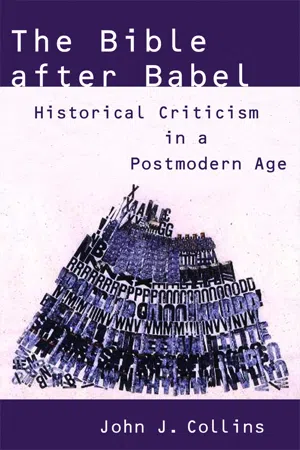
Biblical scholars today often sound as if they are caught in the aftermath of Babel -- a clamor of voices unable to reach common agreement. Yet is this confusion necessarily a bad thing? Many postmodern critics see the recent profusion of critical approaches as a welcome opportunity for the emergence of diverse new techniques. In
The Bible after Babel noted biblical scholar John J. Collins considers the effect of the postmodern situation on biblical, primarily Old Testament, criticism over the last three decades. Engaging and even-handed, Collins examines the quest of historical criticism to objectively establish a text's basic meaning. Accepting that the Bible may no longer provide secure "foundations" for faith, Collins still highlights its ethical challenge to be concerned for "the other" -- a challenge central both to Old Testament ethics and to the teaching of Jesus.
Information
Historical Criticism and Its Postmodern Critics
The story of the tower of Babel is told briefly and enigmatically in Gen 11:1–9, at the end of the Primeval History in the J (Yahwist) source. In the beginning, people had one language and the same words throughout the earth. They attracted the attention of the Lord, however, by building a city and a tower, with its top in the heavens, to make a name for themselves. The Lord figured that this was only the beginning of what they would do and, since they were one people with one language, nothing would be impossible to them. To prevent further developments, the Lord went down and confused their language and scattered them abroad over the face of the earth. Therefore the city was called “Babel,” because there the Lord confused the language of all the earth.
This intriguing little story has received more than its share of scholarly attention.1 Commentators have noted that there seem to be two distinct themes in the story: the attempt to build the city and tower and the confusion of language, and, inevitably, source critics have tried to separate the two. On one level, at least, the story is an etiology for the diversity of languages. On another level, it recapitulates a recurring theme in the primeval history—the futile attempts to bridge heaven and earth, whether by human beings becoming like God or by “sons of God” becoming human. As the story stands, the confusion of languages seems to be a punishment for human hybris, or at least an attempt by a defensive God to protect his realm from human encroachment. Neither the building nor the confusion of languages is viewed positively. Rather, the story seems to be a final episode in the gradual fall of humanity from the pristine glory of Eden to the postlapsarian condition of human history.
In recent years, this story has received new attention, even attracting notice from one of the icons of postmodernism, Jacques Derrida.2 The distinctive postmodern take on the story, however, reverses the traditional evaluation. The enterprise of building the tower is still viewed negatively, but the confusion of languages is celebrated as liberation. On the one hand, some critics, especially from the Third World, see the city and tower as symbols of dominion and oppression.3 This reading acquires credibility from the historical relation between Babylon and Israel and the obvious taunting of Babel in the perverse explanation of the name,4 even if there is nothing explicit about oppression in the biblical text.5 The confusion of languages, then, bespeaks political liberation, insofar as each people is freed to pursue its own identity. On the other hand, from a more philosophical perspective, the tower has been taken as a symbol of the aspiration to total, comprehensive, and unitary interpretation, and the confusion of languages has come to symbolize the celebration of diversity. In the context of biblical studies, historical criticism, or the dominant mode of biblical criticism for the last two centuries or so, has been cast as the tower, and the confusion of languages is taken as the joyful eruption of a chatter of new approaches. The issue, of course, is not what the biblical text of Genesis 11 “really meant.” Some postmodern critics would deny that a text has any “real meaning” at all. The story simply provides familiar imagery that can serve to visualize the situation in which biblical criticism, and perhaps academia in general, finds itself at the beginning of the 21st century.6
It is not the case that the postmodernists have captured the field. Far from it. Diversity of approaches is at best a mixed blessing, and sometimes threatens to become a curse. But neither is traditional historical criticism accurately described as the totalitarian monolith that some of its critics make it out to be. I will begin by reflecting on the character of historical criticism as I understand it. I will then consider some of the distinctive features of postmodern approaches and consider the application of some of them in biblical studies.
I should say at the outset that by training and temperament I am on the modern side of the modern/postmodern debate. My brain has not incubated in the languages of Jacques Derrida, Michel Foucault, or Stanley Fish (if indeed incubation is what happens to a brain in these environments). But it also seems to me that there are some valid concerns and significant insights in the welter of new approaches. Historical criticism has always been a process rather than a technical method, and if it can be said to construct a tower, it has always been a work in progress, whose design and orientation are constantly subject to change. I do not think it either likely or desirable that God’s gym and God’s beauty parlor will become the twin towers of biblical interpretation in the coming century,7 but it would be naive to think that scholarship a century from now will look much like it does today, whatever form it may take.
The Character of Historical Criticism
“Historical Criticism” is the label usually applied to what might be termed “mainline” biblical scholarship over the last two centuries or so. As James Barr has insisted, historical criticism is not strictly a method, but a loose umbrella that covers a range of methods (source criticism, form criticism, sociological criticism, etc.) that may sometimes be at odds with each other.8 In fact, it is not unusual to narrate the history of biblical scholarship as a succession of methods, each of which initially exhibited its anxiety of influence by attempting to kill its father, and whose fathers sometimes disowned the offspring.9 What these methods have in common is a general agreement that texts should be interpreted in their historical contexts, in light of the literary and cultural conventions of their time. There is also a general assumption that the meaning of a text can be established in an objective manner, but this assumption is more complicated than it may seem. The meaning intended by an ancient author can, at best, only be reconstructed tentatively, and few historical critics would deny that a text may take on new meanings in changing circumstances. (This is in fact the raison d’être of redaction criticism.) But historical critics usually assume a hierarchy of meanings and regard the historical context as basic or primary.
Historical criticism of the Bible developed primarily as an enterprise of Protestant Christianity, within the context of the Christian churches.10 While the Reformation encouraged Christians to read the Bible for themselves, and used it as a counterweight to Catholic tradition, it was not until the 18th century and the Enlightenment that biblical criticism began to emerge in its modern form, and it developed hand in hand with critical historiography in the 19th.11 The principles that guided this criticism were articulated most insightfully by the German theologian and sociologist of religion Ernst Troeltsch, whose views were later reformulated lucidly by Van Harvey.12
These principles included the autonomy of the historian. This principle is associated with the Enlightenment and especially with Immanuel Kant, although he certainly was not the first to conceive of it.13 As Harvey has well described it, autonomy represented a change in what may be called the morality of knowledge. Where medieval culture had celebrated belief as a virtue and regarded doubt as sin, the modern critical mentality regards doubt as a necessary step in the testing of knowledge and the will to believe as a threat to rational thought. In the context of biblical studies, autonomy meant first of all freedom from ecclesiastical authorities and heresy trials. In that narrow sense, the need for autonomy can hardly be questioned. But it also represented an ideal of judgment. In the words of the historian R. G. Collingwood, “so far from relying on an authority other than himself, to whose statements his thought must conform, the historian is his own authority.”14 In this sense, autonomy is opposed not only to ecclesiastical interference but also to undue deference to received opinion. Biblical scholarship has not always been characterized by autonomy in the latter sense, although I doubt that many historical critics would dispute the principle!
A second principle of historical criticism is the principle of analogy.15 To understand the ancient context of a text requires some sympathetic analogy between ancient and modern situations. Indeed, one of the assumptions of historical criticism is that texts are human products and that human nature has not changed beyond recognition over the centuries. We can assess what is plausible in an ancient situation because we know what human beings are capable of. This principle gave rise to problems with regard to the miraculous aspects of the biblical stories, but it also provided a way of bringing the text to life by analogy with modern experiences.
A third principle of historical criticism is the principle of criticism.16 Scholarship is an ongoing process; its results are always provisional and never final. This is perhaps especially obvious in historical scholarship, where new evidence is constantly coming to light. The historian tries to establish the most probable account of the past, but absolute certainty is never available. Today’s results may be overturned by tomorrow’s excavation. This element of uncertainty in biblical scholarship has always been especially unsettling for church authorities and for traditional theologians, more so even than heretical conclusions, because it implies that anything we believe may be subject to revision in light of new evidence and undercuts any idea of unchangeable revealed truth.17
The original impact of historical criticism in the predominantly Christian contexts of Europe and North America was revolutionary. Robert Morgan has referred to “the death of Scripture” in this context, although the death throes continue to the present day.18 The impact was felt mainly in connection with the historical reliability of the biblical text. For many Christians, the belief that the text is inspired entailed a belief in its historical accuracy, and that belief is so deeply ingrained that the debate lingers on in various forms after two hundred years of historical criticism. Julius Wellhausen felt obliged to resign from a theological faculty.19 Scholars like W. Robertson Smith and Charles A. Briggs were subjected to heresy trials.20 In the United States, the Fundamentalist movement was in large part a reaction against historical criticism and the relativism that it implied.21 In the Roman Catholic Church, the Modernist movement embraced historical criticism but was condemned by the papacy.22 Nonetheless, by the early 20th century the point had been made, at least in the so-called mainline churches, that biblical texts did not necessarily always report historical events, or do so in ways that would satisfy modern criteria. The growing appreciation of literary genre and the publication of cognate literature from the ancient Near East were crucial factors in this development.23 Christian theology, at least in its more liberal forms, reached an accommodation with historical criticism that acknowledged its validity, even if only within certain limits.
Conversely, biblical scholars often sought to reconcile their findings with traditional faith. This tendency was most obvious in the subfield of biblical theology and especially in the so-called biblical theology movement.24 In the arena of history, this tendency can be seen in the enormously influential A History of Israel by John Bright, which scarcely questions the reliability of the biblical record, while buttressing it with a richly informative account of ancient Near Eastern history.25 There were, of course, profound differences between the Am...
Table of contents
- Cover
- Title Page
- Copyright
- Contents
- Preface
- Abbreviations
- 1. Historical Criticism and Its Postmodern Critics
- 2. The Crisis in Historiography
- 3. Exodus and Liberation in Postcolonial Perspective
- 4. The Impact of Feminist and Gender Studies
- 5. Israelite Religion: The Return of the Goddess
- 6. Is a Postmodern Biblical Theology Possible?
- Bibliography
Trusted by 375,005 students
Access to over 1.5 million titles for a fair monthly price.
Study more efficiently using our study tools.
Frequently asked questions
Yes, you can cancel anytime from the Subscription tab in your account settings on the Perlego website. Your subscription will stay active until the end of your current billing period. Learn how to cancel your subscription
No, books cannot be downloaded as external files, such as PDFs, for use outside of Perlego. However, you can download books within the Perlego app for offline reading on mobile or tablet. Learn how to download books offline
Perlego offers two plans: Essential and Complete
- Essential is ideal for learners and professionals who enjoy exploring a wide range of subjects. Access the Essential Library with 800,000+ trusted titles and best-sellers across business, personal growth, and the humanities. Includes unlimited reading time and Standard Read Aloud voice.
- Complete: Perfect for advanced learners and researchers needing full, unrestricted access. Unlock 1.5M+ books across hundreds of subjects, including academic and specialized titles. The Complete Plan also includes advanced features like Premium Read Aloud and Research Assistant.
We are an online textbook subscription service, where you can get access to an entire online library for less than the price of a single book per month. With over 1.5 million books across 990+ topics, we’ve got you covered! Learn about our mission
Look out for the read-aloud symbol on your next book to see if you can listen to it. The read-aloud tool reads text aloud for you, highlighting the text as it is being read. You can pause it, speed it up and slow it down. Learn more about Read Aloud
Yes! You can use the Perlego app on both iOS and Android devices to read anytime, anywhere — even offline. Perfect for commutes or when you’re on the go.
Please note we cannot support devices running on iOS 13 and Android 7 or earlier. Learn more about using the app
Please note we cannot support devices running on iOS 13 and Android 7 or earlier. Learn more about using the app
Yes, you can access The Bible after Babel by John J. Collins in PDF and/or ePUB format, as well as other popular books in Theology & Religion & Biblical Criticism & Interpretation. We have over 1.5 million books available in our catalogue for you to explore.