From the everyday and unnoticed to the newsworthy and cutting edge, technology is undoubtedly a fundamental element of our daily lives. While saving us time and effort, it can also shape our environment, mediate our relationships, and simultaneously solve problems and create new ones. In studying technology we gain an insight into how society
is constructed, maintained and transformed.
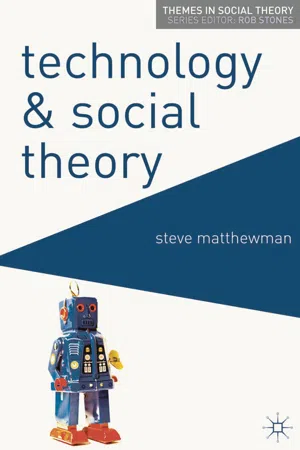
Unravelling and explaining the complex connections between technology and the social contexts in which it is used, Technology and Social Theory guides the reader through 150 years of thinking in this ever evolving field. The chapters critically evaluate a broad range of theorists, from Marx to Foucault, Orwell to Elias, alongside empirical examples which show theory in action. The significance of technology is assessed within both public spheres and intimate spaces, shedding light on its integral role in society.
Showing how theory maps the way for further research, and in turn how new advances in research can inform theory, this book is invaluable reading for students and researchers in Sociology, Social theory, Science and Technology Studies and the Media.
- 219 pages
- English
- PDF
- Available on iOS & Android
eBook - PDF
Technology and Social Theory
About this book
Information
Table of contents
- Cover
- Title
- Copyright
- Dedication
- Contents
- Series Foreword
- Acknowledgements
- Introduction
- 1 Theorizing Technology
- 2 Marx, Modernity and the Machine
- 3 Constructing the Modern: Human-Built World
- 4 The Politics of Artifacts
- 5 The Social Construction of Technology
- 6 The Sociotechnical Construction of Society: Actor-Network Theory
- 7 Left to Our Own Devices: Subjective Machines
- 8 Objective Life: Things and Social Theory
- Conclusion: We Have Always Been Posthuman
- Bibliography
- Index
Trusted by 375,005 students
Access to over 1.5 million titles for a fair monthly price.
Study more efficiently using our study tools.
Frequently asked questions
Yes, you can cancel anytime from the Subscription tab in your account settings on the Perlego website. Your subscription will stay active until the end of your current billing period. Learn how to cancel your subscription
No, books cannot be downloaded as external files, such as PDFs, for use outside of Perlego. However, you can download books within the Perlego app for offline reading on mobile or tablet. Learn how to download books offline
We are an online textbook subscription service, where you can get access to an entire online library for less than the price of a single book per month. With over 1.5 million books across 990+ topics, we’ve got you covered! Learn about our mission
Look out for the read-aloud symbol on your next book to see if you can listen to it. The read-aloud tool reads text aloud for you, highlighting the text as it is being read. You can pause it, speed it up and slow it down. Learn more about Read Aloud
Yes! You can use the Perlego app on both iOS and Android devices to read anytime, anywhere — even offline. Perfect for commutes or when you’re on the go.
Please note we cannot support devices running on iOS 13 and Android 7 or earlier. Learn more about using the app
Please note we cannot support devices running on iOS 13 and Android 7 or earlier. Learn more about using the app
Yes, you can access Technology and Social Theory by Steve Matthewman in PDF and/or ePUB format, as well as other popular books in Social Sciences & Sociology. We have over 1.5 million books available in our catalogue for you to explore.