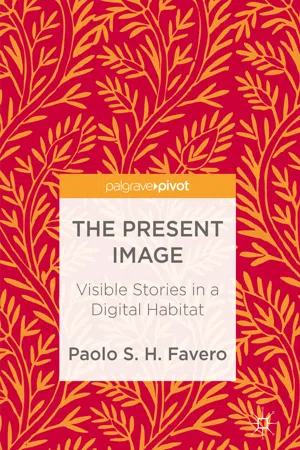
The Present Image explores the world of images in the contemporary, increasingly digitized, habitats of the world. Moving across a theoretical spectrum that brings visual and digital culture in touch with anthropology, political theory, phenomenology and art-history, and based on the author's practice-based involvement with images, the book argues against the idea of the digital as a revolution in the world of images. "Present images" are the result of a dialectic between the material and the immaterial, the manual and the mechanical, the visible and the audible, the old and the new. Offering an analysis containing simultaneously elements of timeliness and timelessness, the book addressed practices such as VR and 360 degrees, iDocs and action cameras in a dialogue with classical art, religious iconography, early photography and contemporary art. In the final chapter the book explores the significance of images and image-making in the context of dying, mourning and living.
- English
- ePUB (mobile friendly)
- Available on iOS & Android
eBook - ePub
About this book
Information
© The Author(s) 2018
Paolo S. H. FaveroThe Present Imagehttps://doi.org/10.1007/978-3-319-69499-3_11. Introduction: Present Images
Paolo S. H. Favero1
(1)
Visual and Digital Cultures Research Center (ViDi), University of Antwerp, Antwerp, Belgium
Abstract
Introducing readers to the notion of “present image” (the core contribution of the book), this chapter offers insights into the key theoretical tools on which the book builds. Starting with a discussion of the manifold ways in which images creep into everyday human life, the chapter addresses a number of theoretical pillars. It explores the idea of images as being a constitutive part of the lived world of human beings (they are in and of the world); it introduces the need to rethink dichotomic distinctions between the digital and the analog; and finally it looks into the politics of “present images”. The chapter ends with a brief overview of the structure of the book.
Keywords
Present imagesDigital versus analogPolitics of imagesPresenceThe soul never thinks without an image.
—Aristotle
Images come to us in many ways. They decorate our houses and offices, the streets of cities and villages. They pop up in the most unexpected moments in our wallets and smartphones, books and computers. They inaugurate the drafting of a life-story at the moment of our birth and often end up closing the circle of that story at the moment of our death. We live most of our lives, to quote Melinda Hinkson (2017) “in the company of images”.1 Images are a constitutive part of our manifold ways of “being in the world” (Merleau-Ponty 1962). It is through them that, paraphrasing Paul Stoller (1984: 93), we allow the world to penetrate us.
There is, however, a great diversity with regard to the type of images that human beings accompany themselves with. Images carry, indeed, significantly different meanings across space and time (see Pinney and Thomas 2001; Edwards 2006). And they can also be significantly different from a material and technical point of view. For many citizens of today’s “wired” parts of the world, for instance, images are the result of a particular “mash” born out of the encounter between things visual and digital technologies. Within this dialectic, the “actual” and the “virtual”, the material and the immaterial, the manual and the mechanically produced, the visible and the audible, meet and merge giving birth to things, practices, and tokens that are, at once, new and old.
This generative dialectic has given new life into the pervasive debates regarding the supposed “visual hypertrophy” (Jay 1994; Taylor 1994) of late modernity. More than ever, images are today considered to permeate all aspects of our lives. Tapping onto social actors’ growing capacity not only to “consume” but also to “produce” their own depictions of the world they live in, images are transforming us, we could say by paraphrasing John Peters (1997), into “bifocal” creatures. Incorporating, as McLuhan (McLuhan and Fiore 1967) suggested long ago, technology as a “natural” prolongation of our bodies and minds, we have learned to trespass the boundary that separates mediated and unmediated experiences.
The specific confluence of digital and visual technologies and practices that characterizes the historical moment and cultural context within which this book is being written has a number of important implications. Politically, we are today asked, as scholars and practitioners in the field, to provide a critical and nuanced understanding of the dialectic between liberating and oppressive forces in the context of contemporary digital/visual technologies and practices. Epistemologically and ontologically, we must dare to renew the terms of our debates, moving away from simplistic dualisms and toward a perspective that integrates the digital with the material (analog) world. Most people living in the digital habitats of the world have today abundantly overcome the naive fears regarding the death of photography (see Ritchin 1990) and the supplanting of reality by mechanically produced representations (see Baudrillard 1994; Der Derian 1994). They are aware of the possible deceptions and mystifications that images can generate and have abandoned simplistic notions of the image as a “transparent window on the world” (Mitchell 1984, p. 504). Slowly living up to Howard Becker’s (1986) invitation, they have also stopped looking for an ultimate truth in images, but they have not lost that sense of wonder that has accompanied human beings’ engagement with images across space and time. Images, as materializations of the visible and invisible, still charm us, excite us, “enchant” us (Gell 1998). As John Searle (2015) beautifully phrased it: “Along with sex and great food and drink, visual experience is one of the major forms of pleasure and happiness in life” (p. 18). Images help us moving beyond the limits of our awareness; they are our “optical unconscious” (Benjamin 2015 [1931]).
This book takes off from Crary’s and Mitchell’s famous observations, dating from the early 1990s, that the arrival of the digital was igniting a proper revolution in visual culture. Crary (1990) notably stated that this entailed “a transformation in the nature of visuality probably more profound than the break that separates medieval imagery from Renaissance perspective” (p. 1). Mitchell (1992) spoke about the introduction of a “new model of vision”. “New images” were, for him, “a new kind of token, made to yield new forms of understanding […] to disturb and disorientate by blurring comfortable boundaries and encouraging transgression of rules on which we have come to rely” (Mitchell 1992: p. 223). Questioning such stances, this book seeks to rethink and overcome some of the established (and often simplistic) dualisms and polarizations that have characterized the terrain of “new images”. The dualistic thinking embedded in the very notion of “new images” (where “new” indeed stands in opposition to an alleged “old”) has led me to opt for a different term, “present images”, that I will explain into further depth in this chapter. Under the mantle of this notion I attempt to critically address the images that circulate in the world’s contemporary digital habitats as, at once, producers of actions (agents) and carriers of meaning (representations); as material and immaterial; as new and old, known and unknown. My position resonates with what Manovich said in 1995 when he spoke about digital photographs as “paradoxical…radically breaking with other modes of visual representation while at the same time reinforcing these modes” (1995: p. 240). It also carries echoes of Latour’s (1993) argument that “[w]e have never been modern”.2
Before I go any further, it is important for me to stress that this book, despite dealing extensively with digital images and technologies, is not about digital images or digital technologies. It is about images in digital habitats—that is, in those environments where the digital is an important actor for putting images in motion, for producing, distributing, and circulating them. The images involved in digital circulation are not necessarily digital ones. I wish to reposition images along a continuum (images can be simultaneously analog and digital, mechanical and manual, new and old) rather than within conventional sets of dualistic oppositions. In an era of separation such as the one in which I live as I am writing this book (I am referring indeed to the political transformations taking place at the present moment, when walls are being built and new wars are being fought), we are more than ever in need of tools capable of bridging gaps, of covering distances and creating dialogue. Images, I suggest, are valuable tools for doing this. This is what they have always done and this is probably also what they will always do. Echoing Kandinsky’s (1989) observations on art, we can say that images do not merely “reflect” and “echo”; they also function as a “prophecy” (p. 20).
In the following pages, I will share the conceptual platform on which this book has been built, hoping in this way to facilitate the reading of the chapters to come. I will finish this introduction with a brief outline of the chapters that compose the book.
Images in and of the World
As hinted at earlier, in this book I engage with images along a continuum that goes from the analog to the digital, from the manually to the mechanically produced, the still and the moving, the visible, the acoustic, and the verbal. Despite addressing a number of emerging practices (that therefore foreground the digital), it is not my aim to address the digital image away from the broader visual, sensory, and communicative field in which such images are immersed. Quite the opposite; looking on them as “co-actants” (to borrow from Latour 2005) in the world in which we live, I consider images as objects that act, do, and, to quote Mitchell (2006), want. They do not only mean, narrate, and represent. Images are “living” things, capable of acting upon us. They have, to cite Belting (2011), a capacity to “colonize our bodies” and take control upon us: “Images both affect and reflect the changing course of human history” (p. 10).
My attempt is in a way a response to Baker’s (2005) call for a new notion of “the photographic”, one, to quote Hoelzl and Marie (2015), capable of moving “beyond the analog and digital, print and projection, still and moving divide” (11). It also mirrors Mitchell’s and Belting’s reminder that images are not a mere matter of visibility. They are a point of conjunction between “mental frames” (Belting 2011) and the physical, material world out there. An image, Belting reminds us, is always both internal and external, personal and collective (p. 9). And if we are to follow Mitchell (2015, 1984), it can also be verbal and acoustic. “Media are always mixtures of sensory and semiotic elements…mixed or hybrid formations combining sound and sight, text and image” (Mitchell 2015, p. 14).
Ingold (2010) too has extensively tapped into this question. In Ways of Mind Walking, he shows, by bringing the work of Mary Carruthers to bear on the writings of Richart de Fournival (canon of Amiens Cathedral in the mid-thirteenth century) and other examples gathered from Aboriginal Australia and classic Chinese painting, how images often contain an element of what the Greeks called ekphrasis, that is, the translation of words (and sounds, I would say) into images. The core ingredient in the stitching together of these separate sensory areas is imagination. Ingold (2010) says that:
we must recognise in the power of the imagination the creative impulse of life itself in continually bringing fort...
Table of contents
- Cover
- Frontmatter
- 1. Introduction: Present Images
- 2. Participated Images
- 3. Immersive Images
- 4. Material Images
- 5. Images of Living and Dying
- Backmatter
Trusted by 375,005 students
Access to over 1.5 million titles for a fair monthly price.
Study more efficiently using our study tools.
Frequently asked questions
Yes, you can cancel anytime from the Subscription tab in your account settings on the Perlego website. Your subscription will stay active until the end of your current billing period. Learn how to cancel your subscription
No, books cannot be downloaded as external files, such as PDFs, for use outside of Perlego. However, you can download books within the Perlego app for offline reading on mobile or tablet. Learn how to download books offline
We are an online textbook subscription service, where you can get access to an entire online library for less than the price of a single book per month. With over 1.5 million books across 990+ topics, we’ve got you covered! Learn about our mission
Look out for the read-aloud symbol on your next book to see if you can listen to it. The read-aloud tool reads text aloud for you, highlighting the text as it is being read. You can pause it, speed it up and slow it down. Learn more about Read Aloud
Yes! You can use the Perlego app on both iOS and Android devices to read anytime, anywhere — even offline. Perfect for commutes or when you’re on the go.
Please note we cannot support devices running on iOS 13 and Android 7 or earlier. Learn more about using the app
Please note we cannot support devices running on iOS 13 and Android 7 or earlier. Learn more about using the app
Yes, you can access The Present Image by Paolo S. H. Favero in PDF and/or ePUB format, as well as other popular books in Social Sciences & Anthropology. We have over 1.5 million books available in our catalogue for you to explore.