Climate Change and Human History provides a concise introduction to the relationship between human beings and climate change throughout history. Starting hundreds of thousands of years ago and going up to the present day, this book illustrates how natural climate variability affected early human societies and how human activity is now leading to drastic changes to our climate. Taking a chronological approach the authors explain how climate change created opportunities and challenges for human societies in each major time period, covering themes such as phases of climate and history, climate shocks, the rise and fall of civilizations, industrialization, accelerating climate change and our future outlook. This 2nd edition includes a new chapter on the explosion of social movements, protest groups and key individuals since 2017 and the implications this has had on the history of climate change, an improved introduction to the Anthropocene and extra content on the basic dynamics of the climate system alongside updated historiography. With more case studies, images and individuals throughout the text, the second edition also includes a glossary of terms and further reading to aid students in understanding this interdisciplinary subject. An ideal companion for all students of environmental history, Climate Change and Human History clearly demonstrates the critical role of climate in shaping human history and of the experience of humans in both adapting to and shaping climate change.
eBook - ePub
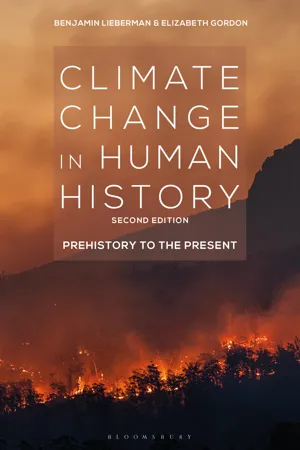
Climate Change in Human History
Prehistory to the Present
- 336 pages
- English
- ePUB (mobile friendly)
- Available on iOS & Android
eBook - ePub
About this book
Information
CHAPTER ONE
A fragile start
• Global cooling
• Forest habitats
• From woodlands to savannas
• Hunter-gatherers and dispersal
• Climate change and Homo sapiens
• Neanderthals and Homo sapiens
• The last glacial maximum and Homo sapiens
• Summary
Long before it influenced the history of modern humans, climate change over hundreds of thousands and even millions of years helped shape the evolution of our species. Multiple factors influenced human evolution and, indeed, all of human prehistory and history. Just as neither politics, nor economics, nor culture, nor religion by itself determines history, neither does climate change by itself make a particular historical outcome inevitable. However, climate change was a pivotal driving force for human evolution.
Climate change took several forms during the period of human evolution. Human ancestors evolved during a period of general cooling. Within Africa, the opening of the Great Rift Valley led to increasing aridity in East Africa, where most hominin species originated. Cycles of glaciation, often termed ice ages, sharply affected habitats starting 2.58 million years ago during the period called the Quaternary. These cycles of glaciation periodically shifted or moved the habitats in which our human ancestors lived. All of these climate trends affected the evolution of human ancestors, and the cycles of glaciation were key factors that led to the dispersals of human ancestors and eventually to that of humans.
Global cooling
An overall cooling trend prevailed during the millions of years when the ancestors of gorillas, chimpanzees, and humans diverged from their common ancestor and began to evolve on their own. Evidence of a long-term global cooling for at least the past 50 million years comes from remains of microscopic marine organisms (fossilized plankton) buried as sediment on the ocean floor. Fossil vegetation also suggests a warmer climate prior to 50 million years. Our largest ice-covered continent, Antarctica, was ice-free until about 35 million years ago, while the formation of large ice sheets in the Northern Hemisphere came later, around 3 million years ago. Embedded within this long-term cooling trend are shorter-term variations in temperature, but the overall trend has been toward a cooler climate.
Several ideas have been proposed to explain the growth of ice sheets on Antarctica and later those in the Northern Hemisphere. On these long timescales—millions of years—the shifting of continents plays an important role in climate change. The isolation of Antarctica is one example: Australia became separated from Antarctica around 35 million years ago, followed by the opening of the Drake Passage between South America and Antarctica 25 to 20 million years ago. This continental rearrangement allowed for the formation and strengthening of an ocean current that encircles Antarctica and isolates it from the warming effects of tropical currents. Some climate modeling efforts indicate that the opening of the Drake Passage could have led to cooling in the southern high latitudes, initiating ice-sheet growth on the polar continent.1
Global cooling associated with a decrease in atmospheric carbon dioxide (CO2)—the chemical effects produced by the rise of the Himalayan mountains—provides an alternative explanation for Antarctic glaciation.2 Proxies for atmospheric CO2 buried in deep-sea sediments, including carbon isotopes of organic molecules3 and boron isotopes used to infer ocean pH4 , indicate a decline in CO2. The decrease in atmospheric CO2 at this time was most likely the result of enhanced chemical weathering associated with the uplift of the Himalayas and the Tibetan plateau, which began around 50 million years ago.5 The overall drawdown of CO2 since then helps explain the long-term global cooling trend that continued into the Quaternary, influencing the formation of ice sheets in the Northern Hemisphere around 3 million years ago (mya) and subsequent changes that drove human evolution.
Further shifts in the alignment of continents may have contributed to the Northern Hemisphere glaciation around 3 million years ago with the formation of the Isthmus of Panama and the closure of the Central American seaway.6 Closure of the seaway enhanced the delivery of warm salty water to the North Atlantic via the Gulf Stream, which in turn strengthened deep-water formation in the North Atlantic. An intensified overturning circulation increased moisture supply to the atmosphere and, along with the cooler temperatures, set the stage for glaciation. Cooler Northern Hemisphere summers brought on by changes in Earth’s tilt may have provided the ultimate trigger for ice-sheet formation.7 As in the case for Antarctic glaciation, climate feedbacks then helped sustain ice-sheet growth.
The expansion of Northern Hemisphere ice sheets coincided with a major transition in Earth’s climate, from a relatively warm period characterized by an ice-free Arctic before 3 million years ago, to one characterized by the cyclical expansion and retreat of ice sheets governed by changes in Earth’s orbit. Temperatures just before this transition were, on average, 3°C warmer than today. This also represents the most recent time in Earth’s history when CO2 levels matched our current level around 400 ppm. With the cooling that followed, many regions became drier, particularly in Africa, and this drying of the continent led to a shift in vegetation that influenced human evolution.
Within Africa, the shifting of tectonic plates further altered the climate, in particular in East Africa along a series of rifts where the Earth is spreading apart. Although the development of the East African Rift System may have begun as early as 45 million years ago, uplift and notable landscape changes accelerated around 10 million years ago. The formation of the rift valley transformed the region from a relatively flat tropical forest biome to one with varied topography and vegetation. The terrain is now composed of deep rift valleys as well as tall mountains—the most famous are Mount Kilimanjaro and Mount Kenya—and lake basins. The mountains of the rift system intensified the overall drying trend as the high peaks blocked moisture from the Indian Ocean, creating a rain shadow desert in this region. The increasing aridity may have led to the expansion of grasslands and savannas, and may have created an environment increasingly sensitive to hydrological changes. The overall decline in atmospheric CO2 during this time period may also have contributed to the expansion of savanna vegetation. Recent research indicates that savanna grasses became more abundant beginning 10 million years ago, but before the onset of drier conditions around 7 million years ago. Because the grasses are adapted to low CO2 conditions, this vegetation shift may have been triggered by the global decrease in CO2.8
Forest habitats
The cooling and drying trend brought significant changes in the habitat in which human ancestors lived—the rain forests of Africa. We are Homo sapiens, also described as anatomically modern humans, or AMH for short, and we are the last survivors of a host of related species. Homo sapiens are the only living species of hominins. Chimpanzees and anatomically modern humans shared a last common ancestor approximately 6 to 7 million years ago. In comparison to any other species, chimpanzees are the closest living relatives to Homo sapiens—we share more than 98 percent of our DNA. Gorillas, the second most closely related species to humans, share some 98 percent of their DNA with us. Gorillas and modern humans shared a common ancestor approximately 9 to 12 million years ago, though these dates are more open to debate.
Although we are more similar to chimpanzees than to any other living species, the differences between humans and chimpanzees stand out today. Homo sapiens have colonized most of the globe and have pushed into regions where they were once unknown. In contrast, chimpanzees and gorillas persist in often-shrinking habitats in Africa. Some subspecies such as the mountain gorilla currently survive in small zones in East Africa. Population attests to the current dominance of humans. As of 2020, total human population exceeded 7.7 billion people. In contrast, the chimpanzee population in the wild in Africa has been estimated at somewhere between 150,000 and 250,000, and estimates of the gorilla population in the wild range from 100,000 to 150,000, mostly western lowland gorillas. We also use incomparably more energy than do our closest relatives. The average carbon footprint, the amount of CO2 emitted per year by the activity of an individual, is about four tons per person per year for humans, with an average three to five times that for residents of comparatively wealthy countries. Chimpanzees and gorillas have essentially no carbon footprint.
How and why did the ancestors of modern humans evolve on a different path from their most closely related species? Humans in no way descended directly from either chimpanzees or gorillas, or indeed, from any other living animal. For that matter, chimpanzees did not descend directly from gorillas. However, we do share a common ancestor. The study of chimpanzees, in particular, provides vital clues for reconstructing where and how our shared common ancestor lived and for how climate change affected the emergence of human ancestors. Chimpanzees live in the greatest density and numbers in the rain forests of tropical Africa. They also survive in woodland forests, and a few populations make excursions into grasslands, but chimpanzees generally stick to areas dominated by trees with fruit. Their preferred habitat is very closely linked to their diet. More than 90 percent of their diet consists of fruit, and they fall back on other plants for the rest. Male chimpanzees eat very small amounts of meat. Even more than chimpanzees, gorillas are restricted to forested areas. They are split up into several subspecies in the rain forests of Africa. By far the largest number of gorillas live in the western lowland areas of Africa in a range that crosses through countries including Cameroon, Gabon, the Central African Republic and the Republic of the Congo, and the Democratic Republic of the Congo. Gorillas obtain their nutrition almost entirely from plants. Like chimpanzees, they prefer fruit.
Observation of our closest relatives among all other species helps shape a picture of our common ancestors. The common ancestors of Homo sapiens, chimpanzees, and gorillas lived millions of years ago in the forests of Africa, and in particular in the tropics. These rain forests provided the copious quantities of fruit that sustained them. We should imagine an animal more closely resembling the apes than us living in or near trees and foraging for fruit. If the diet preferred by chimpanzees and gorillas is a guide, they ate massive quantities of wild figs. This kind of habitat, then as now, required a high constant temperature with abundant rainfall.
Given their adaptation to life in the rain forest and to eating a diet heavy in fruit, why did an ancestral species to h umans evolve along a separate path that led far beyond the rain forest? Chimpanzees and gorillas, after all, did not, so it was still certainly possible to survive and thrive as a species by maintaining the same basic way of life. What, then, propelled the ancestors of humans to begin the process of leaving the rain forests of Africa and moving to a much wider range of habitats? Tracking changes in climate helps answer that question. A shift in climate that led to the expansion of the rain forest would provide a greater range with abundant food, but a shift that reduced the area of the rainforest would diminish food supply. Climate change over millions of years that broke up the edges of rainforest therefore helped drive the evolution of human forebears as distinct and separate from their closest relatives.
From woodlands to savannas
The next group of hominin species, which emerged about 4 million years ago, have been dubbed the australopiths. The australopiths, if we could meet them, would not closely resemble modern humans, but would instead look more like bipedal chimpanzees. The most famous of all the australopiths, discovered in 1974 and given the name Lucy, lived 3.2 million years ago. She stood about 3 1/2 feet tall and weighed about 65 pounds. The males were larger, standing a little under 5 feet tall on average and weighing about 110 pounds or more. Lucy’s species, Australopithecus afarensis, existed between around 3 to 4 million years ago. We might not find them well suited to life in our modern society, but they were better adapted to walking than their ancestors who had once dwelled in the rain forest, though with much shorter legs they had a far shorter stride than humans.
A shift in climate was likely a key factor in the emergence of australopiths. In a cooling climate, forests broke up and areas of woodland and savannas grew, reducing the supply of the preferred food: fruit. This shift in habitat created selective pressure to consume fallback foods, including tubers, harder and tougher than fruit. Australopiths were able to walk and to dig in search of additional calories. They developed large teeth and jaws that better enabled them to chew hard foods for long periods of time.
Continuing climate change was most likely a pivotal factor in a second key phase in human evolution long before the emergence of Homo sapiens. To obtain food in a cooling Africa, human ancestors continued to diversify their die...
Table of contents
- Cover
- Half-Title
- Title
- Contents
- List of figures
- Acknowledgments
- List of acronyms
- Introduction
- 1 A fragile start
- 2 The rise of farming
- 3 The rise and fall of civilizations
- 4 Climate and civilizations of the Middle Ages
- 5 The Little Ice Age
- 6 Humans take over
- 7 The future is now
- 8 Projections and uncertainties
- 9 Responses to climate change
- Glossary
- Notes
- Further Reading
- Index
- Copyright
Trusted by 375,005 students
Access to over 1.5 million titles for a fair monthly price.
Study more efficiently using our study tools.
Frequently asked questions
Yes, you can cancel anytime from the Subscription tab in your account settings on the Perlego website. Your subscription will stay active until the end of your current billing period. Learn how to cancel your subscription
No, books cannot be downloaded as external files, such as PDFs, for use outside of Perlego. However, you can download books within the Perlego app for offline reading on mobile or tablet. Learn how to download books offline
Perlego offers two plans: Essential and Complete
- Essential is ideal for learners and professionals who enjoy exploring a wide range of subjects. Access the Essential Library with 800,000+ trusted titles and best-sellers across business, personal growth, and the humanities. Includes unlimited reading time and Standard Read Aloud voice.
- Complete: Perfect for advanced learners and researchers needing full, unrestricted access. Unlock 1.5M+ books across hundreds of subjects, including academic and specialized titles. The Complete Plan also includes advanced features like Premium Read Aloud and Research Assistant.
We are an online textbook subscription service, where you can get access to an entire online library for less than the price of a single book per month. With over 1.5 million books across 990+ topics, we’ve got you covered! Learn about our mission
Look out for the read-aloud symbol on your next book to see if you can listen to it. The read-aloud tool reads text aloud for you, highlighting the text as it is being read. You can pause it, speed it up and slow it down. Learn more about Read Aloud
Yes! You can use the Perlego app on both iOS and Android devices to read anytime, anywhere — even offline. Perfect for commutes or when you’re on the go.
Please note we cannot support devices running on iOS 13 and Android 7 or earlier. Learn more about using the app
Please note we cannot support devices running on iOS 13 and Android 7 or earlier. Learn more about using the app
Yes, you can access Climate Change in Human History by Benjamin Lieberman,Elizabeth Gordon in PDF and/or ePUB format, as well as other popular books in History & Historical Geography. We have over 1.5 million books available in our catalogue for you to explore.