This sweeping history of New York's millions of immigrants, both famous and forgotten, is "told brilliantly [and] unforgettably" (
The Boston Globe).
Written by an acclaimed historian and including maps and photos, this is the story of the peoples who have come to New York for four centuries: an American story of millions of immigrants, hundreds of languages, and one great city.
Growing from Peter Minuit's tiny settlement of 1626 to a clamorous metropolis with more than three million immigrants today, the city has always been a magnet for transplants from around the globe. City of Dreams is the long-overdue, inspiring, and defining account of the young man from the Caribbean who relocated to New York and became a founding father; Russian-born Emma Goldman, who condoned the murder of American industrialists as a means of aiding downtrodden workers; Dominican immigrant Oscar de la Renta, who dressed first ladies from Jackie Kennedy to Michelle Obama; and so many more. Over ten years in the making, Tyler Anbinder's story is one of innovators and artists, revolutionaries and rioters, staggering deprivation and soaring triumphs. In so many ways, today's immigrants are just like those who came to America in centuries past—and their stories have never before been told with such breadth of scope, lavish research, and resounding spirit.
"Anbinder is a master at taking a history with which many readers will be familiar—tenement houses, temperance societies, slums—and making it new, strange, and heartbreakingly vivid. The stories of individuals, including those of the entrepreneurial Steinway brothers and the tragic poet Pasquale D'Angelo, are undeniably compelling, but it's Anbinder's stunning image of New York as a true city of immigrants that captures the imagination." —
Publishers Weekly (starred review)
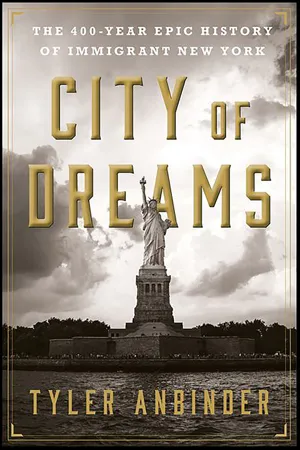
eBook - ePub
City of Dreams
The 400-Year Epic History of Immigrant New York
- 768 pages
- English
- ePUB (mobile friendly)
- Available on iOS & Android
eBook - ePub
About this book
Information
Notes
Prologue
1. “The New Year Welcomed,” Times, January 1, 1892, 2. In the notes that follow, all cited newspapers were published in New York unless otherwise noted. I have provided page numbers for newspaper and magazine articles published before 1990 but not for those that appeared thereafter. Because most people access old newspapers online these days, page numbers might seem unnecessary. But these papers are typically scanned from decaying microfilm copies, and as a result, optical scanning often fails to properly read not only the text but also sometimes even the article titles. Consequently, I have provided titles and page numbers to make it easy for readers to find my original sources. By the 1990s, when I began collecting newspaper articles for this book, newspaper content was being uploaded online digitally, so knowing page numbers became less important for finding an article if one knew the title. In fact, because newspapers began producing so many different editions, the number on the page in the edition I consulted might not be the one provided in the online version. For the New York Times, the newspaper cited most often in these notes, the page number given for an article at nytimes.com sometimes differs from that given at timesmachine.nytimes.com, and often varies from that given at proquest.com, the most-used source in academia for searching major American newspapers of the past. So I have opted not to provide page numbers for newspaper articles published in 1990 or later. One may also find slight variations between the newspaper dates given in these notes and those found for the same article at a newspaper’s website because in some cases newspaper websites give as the date of an article the date it was first posted online rather than the date it appeared in print. Whenever I was aware of such discrepancies, I have provided the date an article appeared in print. Finally, the websites of major magazines such as newyorker.com do not typically provide the page numbers on which the print versions of their articles originally appeared, so in those instances as well I have not given page numbers. But in all such cases, these articles can easily be accessed online with the information provided in the notes.
[back]
2. Entries for Moore family, manifest of the Nevada, January 2, 1892, “New York Passenger Lists,” Record Group 36, National Archives, accessed via ancestry.com; birth dates for the Moore children are from Cork baptismal records found at familysearch.org. Mary was born December 10, 1870; Cornelius, May 28, 1872; Anne, May 30, 1874; Anthony, December 5, 1876; and Philip, December 17, 1879. Unless otherwise specified, all ship manifest citations are drawn from the collections of the National Archives and were accessed via ancestry.com.
[back]
3. “Sunk by the Nevada,” Times, May 7, 1884, 1; “The Nevada’s Disaster,” Times, May 8, 1884, 8; Nevada data from norwayheritage.com; number of passengers on previous Nevada voyages from “New York Passenger Lists.”
[back]
4. Manifest of the Nevada, January 2, 1892, ancestry.com.
[back]
5. Even on a normal day, immigrants waiting on their ships to land could distinctly hear the sounds on Manhattan Island. See Jocelyn Cohen and Daniel Soyer, eds., My Future Is in America: Autobiographies of Eastern European Jewish Immigrants (New York, 2006), 141.
[back]
6. John B. Weber, The Autobiography of John B. Weber (Buffalo, 1924), 13–29, 87–96; “Platt’s Man Chosen,” Times, March 13, 1890, 1.
[back]
7. “Unfit for Their Work,” Times, January 14, 1890, 3; “Biglin Gets a Scoring,” Times, April 12, 1890, 8.
[back]
8. Weber, Autobiography, 89; “Farewell Castle Garden,” Times, April 19, 1890, 5.
[back]
9. “The Weather Report,” Tribune, January 2, 1892, 5.
[back]
10. Guion Line dock location from 1890 New York City Directory, accessed via ancestry.com.
[back]
11. “An Irish Lass’s New Year’s Gift,” Tribune, January 2, 1892, 3; “Landed on Ellis Island,” Times, January 2, 1892, 2; “First Immigrant on Ellis Island,” Herald, January 2, 1892, 2; “Ellis Island Opened,” Press, January 2, 1892, 10; “Annie’s Golden Greeting,” World, January 2, 1892, 12; “The New Immigrant Depot,” Irish World, January 9, 1892, 8.
[back]
12. “Annie’s Golden Greeting,” World, January 2, 1892, 12 (“little”); “The New Immigrant Depot,” Irish World, January 9, 1892, 8 (other quotations).
[back]
13. “Reports from the Nation,” Times, May 16, 1965, sec. 4, 4; “About New York,” Times, June 21, 1977, 25.
[back]
14. Alex Haley, Roots (Garden City, N.Y., 1976); Matthew Jacobson, Roots Too: White Ethnic Revival in Post–Civil Rights America (Cambridge, Mass., 2006), 1–388.
[back]
15. “Mrs. O’Connell Killed,” Clovis (N.M.) News Journal, August 30, 1923, 1; http://www.honoringourancestors.com/wrong-annie/index.html.
[back]
16. “Historical Focus at Ellis Island” Oswego (N.Y.) Palladium Times, June 10, 1988, 3 (Associated Press report on Middleton being honored at Ellis Island); “Statues with Limitations,” Times, May 23, 1993.
[back]
17. “First Through Gates of Ellis I., She Was Lost. Now She’s Found,” Times, September 14, 2006 (Smolenyak quotation); Jesse Green, “Immigrant Number One,” New York, May 9, 2010.
[back]
18. Death certificates of Winifred Schayer, August 10, 1905; Walter Schayer, May 14, 1909; Edward Raymond Schayer, March 17, 1912; Harry Philip Schayer, October 4, 1919, New York County death records, New York Municipal Archives. Annie had lost another child earlier in her marriage, a fact recorded in the 1900 census, though the child’s name is not listed. See entry for Annie Schayer, dwelling 8, enumeration district 22, New York County, manuscript population schedules, 1900 U.S. census, National Archives, accessed via ancestry.com. Unless otherwise specified, all census information refers to New York County (Manhattan), is drawn from the manuscript U.S. census population schedules, is in the collections of the National Archives, and was accessed via ancestry.com. New York State census population schedules were also accessed via ancestry.com unless otherwise noted.
[back]
19. “First Through Gates of Ellis I., She Was Lost. Now She’s Found,” Times, September 14, 2006; New York City Almshouse Admission Card for Julia Moore, January 6, 1909, death certificates of Matthew Moore, August 28, 1907, and Julia Moore, April 20, 1927 (“senile”), accessed via ancestry.com.
[back]
20. Green, “Immigrant Number One.”
[back]
21. New York Telephone Company, Manhattan telephone directory for winter–spring 1944, 929. The value of the inheritance was calculated at http://www.measuringworth.com, a site created by economic historians.
[back]
22. Green, “Immigrant Number One.”
[back]
23. Konrad Bercovici, Around the World in New York (New York, 1924), 3.
[back]
1. Settlement
1. Russell Shorto, The Island at the Center of the World: The Epic Story of Dutch Manhattan and the Forgotten Colony That Shaped America (New York, 2004), 73–74, 153 (wilden). Historians debate the name of the Indian tribe or subtribe that “sold” Manhattan to Minuit; I have relied on Reginald Bolton, New York City in Indian Possession, 2nd ed. (New York, 1975), 14–15; but also see Paul Otto, The Dutch-Munsee Encounter in America: The Struggle for Sovereignty in the Hudson Valley (New York, 2006), 4–20.
[back]
2. C. A. Weslager, A Man and His Ship: Peter Minuit and the Kalmar Nyckel (Wilmington, Del., 1989), 14; Bertrand van Ruymbeke, “The Walloon and Huguenot Elements in New Netherland and Seventeenth-Century New York: Identity, History, and Memory,” in Revisiting Ne...
Table of contents
- Cover
- Title Page
- Contents
- Copyright
- Dedication
- Maps
- Prologue
- Settlement
- Rebellion
- Anglicization
- Americanization
- Revolution
- Republic
- Famine
- Irish Metropolis
- Kleindeutschland
- Politics
- War
- Uprising
- Transition
- Liberty
- Ellis Island
- The Lower East Side
- Little Italys
- Reform
- Restriction
- Refuge
- Renaissance
- Today
- Appendix
- Acknowledgments
- Notes
- Select Bibliography
- Illustration Credits
- Index
- About the Author
- Connect with HMH
- Footnotes
Trusted by 375,005 students
Access to over 1.5 million titles for a fair monthly price.
Study more efficiently using our study tools.
Frequently asked questions
Yes, you can cancel anytime from the Subscription tab in your account settings on the Perlego website. Your subscription will stay active until the end of your current billing period. Learn how to cancel your subscription
No, books cannot be downloaded as external files, such as PDFs, for use outside of Perlego. However, you can download books within the Perlego app for offline reading on mobile or tablet. Learn how to download books offline
We are an online textbook subscription service, where you can get access to an entire online library for less than the price of a single book per month. With over 1.5 million books across 990+ topics, we’ve got you covered! Learn about our mission
Look out for the read-aloud symbol on your next book to see if you can listen to it. The read-aloud tool reads text aloud for you, highlighting the text as it is being read. You can pause it, speed it up and slow it down. Learn more about Read Aloud
Yes! You can use the Perlego app on both iOS and Android devices to read anytime, anywhere — even offline. Perfect for commutes or when you’re on the go.
Please note we cannot support devices running on iOS 13 and Android 7 or earlier. Learn more about using the app
Please note we cannot support devices running on iOS 13 and Android 7 or earlier. Learn more about using the app
Yes, you can access City of Dreams by Tyler Anbinder,Anbinder, Tyler in PDF and/or ePUB format, as well as other popular books in History & North American History. We have over 1.5 million books available in our catalogue for you to explore.