Key Account Management Excellence in Pharma & Medtech is designed to help life sciences practitioners develop and execute innovative and effective key account management (KAM) strategies and capabilities. Pharmaceutical and medtech companies are increasingly pursuing KAM in response to the rapid rise of large, sophisticated and complex healthcare provider and payer systems and groups. Those that invest the time to get KAM right will protect their business and grow with these rising customers.
This book is groundbreaking in both its scope and its tailoring of leading KAM practices specifically for life sciences. The central theme is that "key account management is an organization-wide business strategy, not just a role or a sales-specific initiative." KAM is a strategy focused on providing unique offerings and value through an orchestrated, cross-functional, go-to-market model designed specifically to address the needs and engagement preferences of a unique segment of customers. The insights and practices shared in this book are designed to be a valuable reference at every stage of the KAM journey.
The book has been designed to facilitate a common language and deep understanding of KAM issues and leading practices organization-wide—particularly for life sciences leaders, account managers and cross-functional team members responsible for building, transforming and supporting their organization's KAM strategies and capabilities.
Chapter one KAM is a business strategy, not a role
Mike Moorman and Namita Powers
DOI: 10.4324/9781003226512-1
Key account management (KAM) has become a major priority for most pharmaceutical and medtech companies for a simple reason: Organized customers such as IDNs, IPPNs, national payers, regional payers, large group practices and a host of other account types have become increasingly large, powerful and complex. Furthermore, continued horizontal and vertical integration, growing centralization of decision-making and control, less sales representative access to physicians, and more interest among organized customers in partnering with life sciences will elevate the importance of KAM even further. Life sciences companies that invest the time to get it right will protect their business and grow with these rising customers.
In this chapter, we introduce three fundamental KAM principles that stand out as particularly important considerations for life sciences leaders and that are foundational to this book:
KAM is a business strategy, not a role
KAM is an organization-wide initiative, not just a “sales” or “managed markets” initiative
KAM is a journey, not a one-time project
These core principles are central to the success of every organization that has excelled in KAM. In introducing these principles, we set the stage for the chapters to come.
Principle no. 1: KAM is a business strategy, not a role
KAM (key account management) often is mistakenly viewed as a field role (key account manager), which is a narrow view that fundamentally misses the point. KAM in life sciences is a strategy focused on providing unique offerings and value through an orchestrated, cross-functional, go-to-market model designed specifically to address the needs and engagement preferences of a defined segment of large, complex and strategically important systems and groups. KAM is dramatically different from the brand-centric and doctor-focused one-to-one engagement models that have served life sciences so well for many years and that will continue to be important in segments of the market. KAM is a many-to-many business-to-business (B2B) engagement model and requires life sciences organizations to work in new ways across their customer-facing roles and within internal functions. Creating new internal support functions and reengineering cross-functional operating models and metrics are part of the KAM equation.
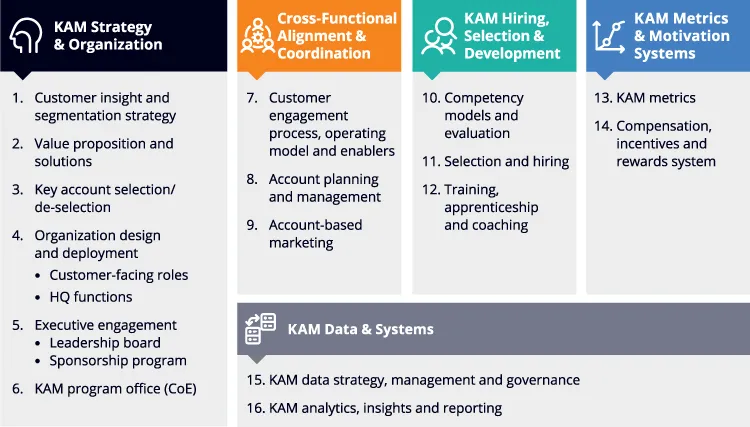
To design and implement effective KAM strategies, companies should address the five core areas defined in ZS’s KAM360™ framework: strategy and organization; cross-functional alignment and coordination; hiring, selection and development; metrics and motivation systems; and data and systems (Figure 1.1).
Figure1.1 ZS’s KAM360™ framework.
Organizations that excel in KAM approach the KAM360™ building blocks as a “recipe” and not as a “pick-and-choose menu.” While not all elements are equal priorities at any one point in time, none can be ignored.
The comprehensive KAM360™ framework underscores the notion that KAM is a business strategy—not simply a role—and is the perfect lead-in to the next principle: approaching KAM as an organization-wide capability.
Principle no. 2: KAM is an organization-wide initiative, not just a “sales” or “managed markets” initiative
KAM requires a degree of cross-functional coordination, collaboration, commitment and agility that is new to most life sciences organizations. In fact, internal silos are identified as one of the biggest barriers to KAM time and again. In other words, the real challenge is often from within.
KAM requires a diverse array of commercial and medical field roles to operate as tightly orchestrated customer-facing teams. These roles may include enterprise KAMs, business unit KAMs, hospital sales reps, HCP sales reps, HEOR liaisons, medical science liaisons, clinical specialists and many others. These field roles touch overlapping decision makers spanning a network of facilities and locations, report to different leaders, have different objectives and metrics, and often have a long history of working in silos.
The degree to which these roles can operate as close-knit teams will ultimately dictate the value and business impact that will be realized. To get there, life sciences companies will require new team-based B2B customer engagement processes, operating models, tools and motivation systems—and strong leadership alignment.
KAM also requires new and different types of internal cross-functional support spanning marketing, sales, medical, analytics, IT, human resources, training, and legal and regulatory. Many life sciences companies will need to revamp their headquarters-based functions to succeed at KAM. Take, for example, the deeply entrenched brand- and product-centric approaches that have been so successful in traditional markets and customers. KAM is about customer centricity, not brand or product centricity. Business approaches for key accounts will need to evolve from “inside out” to “outside in.” KAM often requires implementing account strategy and planning, above-the-brand marketing, account-based marketing, solution support, implementation support, and specific data and tools that currently might not exist. To truly succeed at KAM, life sciences companies need to evolve their people, processes and systems organizationwide. The challenge will be “living in two worlds at once,” characterized by traditional healthcare systems in some situations and rapidly evolving systems in others.
This brings us to our third core principle.
Principle no. 3: KAM is a journey, not a one-time project
KAM has the potential to transform and improve relationships with large organized customers, but there are no shortcuts or silver bullets. Effective KAM requires many people across the organization to work in new ways, and that takes systematic effort and time. A “big bang” approach to KAM nearly always fails. The history of KAM is littered with organizations that sought to go “too big, too fast” or that thought they could excel at KAM through training and compensation alone.
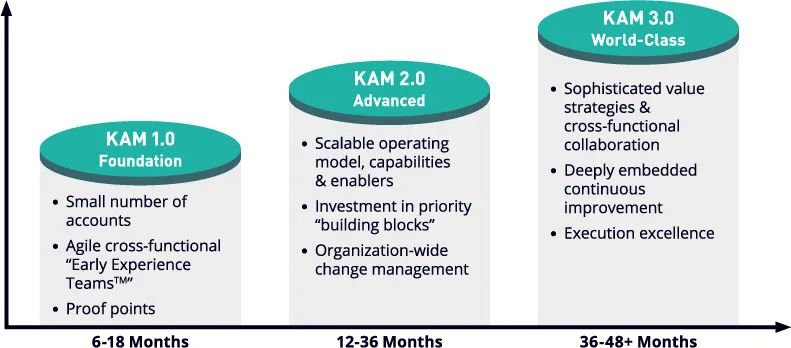
Most organizations go through at least three stages on the journey to improve KAM’s effectiveness, with each stage lasting about 6–18 months (Figure 1.2). In a nutshell, companies on the KAM journey begin by starting small and building a foundational capability before moving to a more advanced model and finally, building to a world-class capability.
Figure1.2 Stages of the KAM journey.
Staging the journey doesn’t preclude early wins and business impact. In fact, quite the opposite is true. By reducing complexity and focusing talent and resources, staged approaches are typically the best means to accelerate impact while simultaneously reducing risk. The successes and impact achieved at each stage of the journey create the momentum to pursue the next wave of investment and advancement.
Staging requires leaders to be highly adept at assessing where their organization is on the journey—and at defining tailored roadmaps and supporting business cases and expectations. No matter where an organization finds itself along the journey, the key is to meet the organization “where it is” and customize the path forward given the specific context and business impact opportunities.
Ultimately, KAM effectiveness and impact are all about organization-wide execution and agility. Most life sciences companies are now pursuing KAM, with many focused on advancing from KAM 1.0 to KAM 2.0, and a smaller number beginning the journey to KAM 3.0.
Concluding thoughts
While KAM is relatively new in the life sciences industry, many B2B industries have been pursuing KAM since the late 1980s. Life sciences leaders can learn important insights and lessons about KAM—and the KAM journey—from the successes and struggles of other industries, as well as from the substantial KAM experience that has rapidly accrued within the life sciences space itself. At the same time, some cross-industry KAM approaches won’t work for life sciences companies. For example, regulatory and compliance requirements in the pharmaceutical industry demand a unique approach to value proposition and customer engagement strategies. KAM simply can’t be a “plug-and-play” approach from one industry, company or business unit (BU) to the next; each iteration needs to be uniquely designed with the customer and specific company or BU in mind.
In this chapter, we have introduced three core principles for achieving KAM excellence. These principles set the stage for the remainder of this book and are worth repeating:
KAM is a business strategy, not a role
KAM is an organization-wide initiative, not just a “sales” or “managed markets” initiative
KAM is a journey, not a one-time project
In the chapters to come, we provide insights on how leading organizations apply these principles in practice. We explore the rise of the organized customer and KAM in life sciences, discuss in detail the components of the KAM360™ framework and review the current and future state of KAM in the industry. Our intention is to provide insights that can be leveraged at any stage of the journey, whether that is building a new KAM program or advancing an existing program to world-class status.
Chapter two The rise of the organized customer and KAM in healthcare
Brian Chapman and Pratap Khedkar
DOI: 10.4324/9781003226512-2
For life sciences companies, the clinician—predominantly the physician writing a drug script or the surgeon doing a procedure—was traditionally the most significant decision-maker within the healthcare ecosystem. Given the freedom that clinicians had to make individual choices on behalf of patients as they saw fit, they were consequently the center of pharma and medtech company sales and marketing efforts. In a clinician-centric world, healthcare institutions operated largely in the background, relatively insensitive to price and inclined to treat life sciences as innovation suppliers.
But this model has shifted dramatically. No longer are individual doctors the primary decision-makers when it comes to many life sciences products. Institutions—or large “organized customers”—have assumed a far greater role in actively managing these purchasing decisions to drive greater clinical, financial, patient-experience and healthcare provider work-life outcomes. And this shift has had significant implications for how life sciences companies broadly promote and sell their offerings, as well as for the role key account management (KAM) plays in engaging these entities more specifically.
In this chapter, we discuss the emergence and rise of the organized customer and how life sciences companies can overcome these customers’ heterogeneity to successfully implement KAM strategies and provide value.
What is an organized customer?
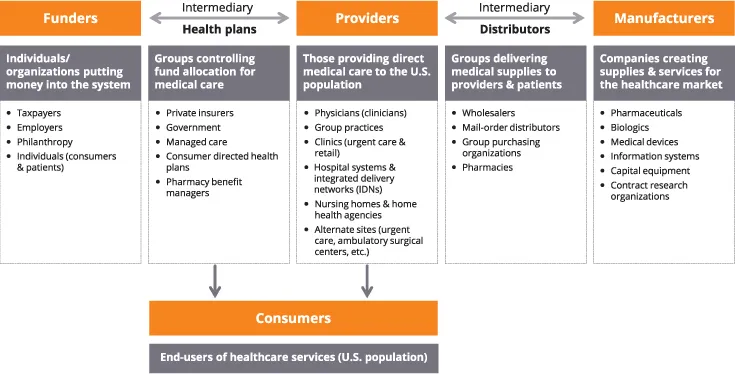
To understand the rise of organized customers, it’s helpful to first look at the healthcare ecosystem, which includes an array of players interacting across the value chain to provide healthcare to the patient. In this ecosystem, funding, management, service delivery and product manufacturing are split across entire industry sub-verticals (Figure 2.1).
Figure2.1 The U.S. healthcare system at a glance.
Each of these groups includes a bewildering variety of players with different focus areas and characteristics. For example, funding comes not only from large government agencies, but also from employers and patients themselves via their co-pays. Health plans moreover may bear risk or simply concentrate on utilization management on behalf of employers. And providers can work independently or as parts of highly complicated integrated delivery networks.
For our purposes, organized customers are any institutional entities in the healthcare ecosystem that make consolidated decisions beyon...
Table of contents
Cover
Half Title
Title Page
Copyright Page
Dedication Page
Table of Contents
List of figures and tables
Foreword—A message from the CEO of SAMA
Preface—Important information about this book
Chapter 1 KAM is a business strategy, not a role
Chapter 2 The rise of the organized customer and KAM in healthcare
Chapter 3 Where to play: Key account segmentation and selection
Chapter 4 Value strategy: Evolving from basic offerings to advanced solutions
Chapter 5 KAM organization design: Form follows function
Chapter 6 Executive alignment and engagement: It’s make or break for life sciences KAM programs
Chapter 7 KAM Program Office: Marshalling the internal support required for results
Chapter 8 The long and short of KAM metrics
Chapter 9 Customer engagement process: The secret to agile execution
Chapter 10 Bringing value to account planning and management
Chapter 11 Context is king: Laying the foundation for a comprehensive KAM talent strategy
Chapter 12 The unique learning journey required for KAM
Chapter 14 Why technology is critical for breathing life into KAM
Chapter 15 KAM in the United States versus Europe: Are we headed to the same place?
Chapter 16 The future of KAM in life sciences
Acknowledgments
Index
Trusted by 375,005 students
Access to over 1.5 million titles for a fair monthly price.
Study more efficiently using our study tools.
Frequently asked questions
Yes, you can cancel anytime from the Subscription tab in your account settings on the Perlego website. Your subscription will stay active until the end of your current billing period. Learn how to cancel your subscription
No, books cannot be downloaded as external files, such as PDFs, for use outside of Perlego. However, you can download books within the Perlego app for offline reading on mobile or tablet. Learn how to download books offline
Perlego offers two plans: Essential and Complete
Essential is ideal for learners and professionals who enjoy exploring a wide range of subjects. Access the Essential Library with 800,000+ trusted titles and best-sellers across business, personal growth, and the humanities. Includes unlimited reading time and Standard Read Aloud voice.
Complete: Perfect for advanced learners and researchers needing full, unrestricted access. Unlock 1.5M+ books across hundreds of subjects, including academic and specialized titles. The Complete Plan also includes advanced features like Premium Read Aloud and Research Assistant.
Both plans are available with monthly, semester, or annual billing cycles.
We are an online textbook subscription service, where you can get access to an entire online library for less than the price of a single book per month. With over 1.5 million books across 990+ topics, we’ve got you covered! Learn about our mission
Look out for the read-aloud symbol on your next book to see if you can listen to it. The read-aloud tool reads text aloud for you, highlighting the text as it is being read. You can pause it, speed it up and slow it down. Learn more about Read Aloud
Yes! You can use the Perlego app on both iOS and Android devices to read anytime, anywhere — even offline. Perfect for commutes or when you’re on the go. Please note we cannot support devices running on iOS 13 and Android 7 or earlier. Learn more about using the app
Yes, you can access Key Account Management Excellence in Pharma & Medtech by Mike Moorman in PDF and/or ePUB format, as well as other popular books in Business & Business General. We have over 1.5 million books available in our catalogue for you to explore.