Now in its fourth edition, the bestselling, seminal book by James Flaherty, Coaching: Evoking Excellence in Others, is an insightful, thought-provoking, pragmatic guide that dissects the art and science of coaching.
This fourth edition includes two brand new chapters: the first is on finding one's inner guidance and purpose in traversing the world of work, especially in more uncertain working environments; and the second is on the topic of somatic intelligence. As in earlier editions, this foundational book in coaching clearly presents the theories, concepts, and models, and then moves on to consider rigorous methods of practice and self-observation in a relationship of mutual trust, respect, and freedom of expression. It will probe you to rethink how you relate to your clients and your staff, how you produce long-term excellent performance in yourself, and how you can become more effective in helping others to achieve their goals.
Coaching, Fourth Edition is a rich learning resource guide for new and experienced coaches who want to challenge their methods of partnering with clients. It is also an inspiring guide for training managers and leaders, human resource development managers, and general managers who want to develop their teams.
Here are the basics, the building blocks for everything that follows-the fundamentals of coaching. They’re presented simply, directly, and concisely with few examples or elaborations. The presentation gives you maximum room for your own thinking and creativity. This book doesn’t tell you what to do. Instead, it gives you distinctions, ideas, models, and principles from which you can design your own actions. Some readers will be annoyed by this, others will feel informed and liberated. In either case, regardless of initial response, the question remains-what will leave you, the reader, with the greatest chance to be an excellent coach who can self-correct and self-generate your own innovations? The following is my response to that question.
Our chief want in life is someone who will make us do what we can.
—Emerson
Why Coaching Now?
Maybe as you select a book about coaching you already have in mind the situation in which you want to use coaching. Perhaps you’re a manager in some kind of organization who is trying to improve the performance of someone who works for you, or maybe you are someone attempting to mentor a young promising person. Alternatively, you might be a team leader on a software development task force attempting to build the proficiency of your team. You could also be a parent who wants to provide the best possible upbringing for your child. The possible scenarios could go on and on, and it’s the purpose of this book to give you an introduction to coaching in a way that allows you to apply it to the wide range of situations we find ourselves in these days.
The common thread running through these circumstances is the intention of the coach to leave the person being coached, whom we’ll call the client, more competent in an activity that is of mutual interest to coach and client. Since many of the people reading this book are probably interested in how coaching applies to business, here are some reasons why coaching is important in the world of commerce today:
The need for innovation is endless. Businesses must keep reinventing not only their products and ways of delighting their customers, but also the way they organize themselves; communicate so as to coordinate activities; and stay current with changes in technology, demographics, politics, government regulations, and so on.
Because of relentless downsizing and reengineering efforts, the traditional relationship between organization and employee has been changed in a way that is probably irreparable. Consequently, even outstanding performers do not anticipate staying with one organization for their entire career and are always working with the knowledge, at least in the background, that their current position is temporary. Organizations have to find a way to retain such people as long as possible by providing both attractive compensation and a chance to continuously learn.
Organizations by necessity are having to work in multicultural environments. This happens when organizations recruit or market in other nations as well as within the United States, as our demographics evolve from the historic Eurocentrality.
It is one of the central tenets of this book that command-and-control organizations cannot bring about the conditions and competencies necessary to successfully meet the challenges holistically. For the most part, organizations know this and have attempted to reorganize themselves using the principles of total quality management and reengineering. The usual problem with these interventions is that they are implemented by and end up reinforcing the command-and-control structure. Here’s my objection to that: command-and-control organizations are based on the premise that a power and knowledge hierarchy is the most effective way of structuring an organization. People at the top make the decisions and people further down implement those decisions, changing them as little as possible. The process is slow, expensive, and has as its core belief that people cannot be trusted and must be closely monitored. As long as those beliefs are in place any organization will have tremendous difficulty flourishing in today’s world. Of course, what I’m saying here is not a new statement. What I’m offering in this book is an alternative to working in a command-and-control environment by beginning with new premises. It’s been my experience that organizations must be dedicated to allowing people to be both effective and fulfilled. Organizations are the ongoing creations of the people who work in them. Treating organizations as if they were huge machines, as is done with command and control, badly misunderstands the nature of the phenomenon. To sum up and simplify what I’m saying, coaching is a way of working with people that leaves them more competent and more fulfilled so that they are more able to contribute to their organizations and find meaning in what they are doing. I hope that reading this book will convince you that this is possible and that you will experiment with the ideas presented here. That is the only way you can find out for yourself that what I’m saying here is worthwhile.
What Is Coaching?
Perhaps one of the most powerful ways of understanding coaching is from the end. If we know what we are intending to accomplish, we can correct ourselves as we go along and be able to evaluate our success at the end. These products are meant to distinguish what we mean about coaching from other interpretations. We present coaching as more than being an accountability partner that supports someone in reaching her goals or as a disciplinarian who changes someone’s unwanted actions. Instead we claim that coaching occurs in a bigger frame that sometimes includes these two modalities but goes well beyond that.
The Products of Coaching
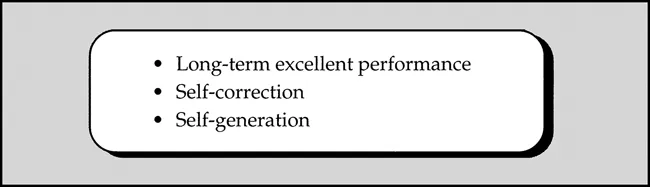
Long-Term Excellent Performance
This means that the client meets the high objective standards of the discipline in which coaching is occurring. Standards are objective when they can be observed by any competent person. For example, hitting a home run in baseball is an objective standard, as is a checkmate in chess; however, we must know something about each game to be able to observe these outcomes as favorable.
Self-Correction
Well-coached clients can observe when they are performing well and when they are not and will make any necessary adjustments independently of the coach. By keeping this criterion in mind, coaches can avoid the big temptation of becoming indispensable and, instead, work to build the competence of their client.
Self-Generation
We can always improve, and well-coached people know this and will continually find ways on their own to do so. They’ll practice more, or they’ll watch others perform, or they’ll learn an activity that will strengthen them in a new way that improves their competence (see Figure 1.1).
FIGURE1.1 The Products of Coaching.
Let me give you an example that will illustrate what I’m saying and will perhaps make these ideas more clear. I coached a man named Bob at a major oil company in California. Bob was referred to me by my friend Nancy, who worked as an internal human resources consultant. He was a competent and well-regarded accountant who traveled to various sites worldwide and audited drilling operations. But Bob had greater ambitions. He felt as if he were trapped by his own success, that management would never let him move on because he was doing such good work. At least that is what he told me.
As I got to know Bob better I saw that he was missing a whole set of competencies to move ahead in a large organization with powerful political forces at play. Bob’s initial assumption was that by doing good work he would get noticed and promoted. When this didn’t happen he blamed management for their shortsightedness and selfishness. This explanation left Bob powerless; there was nothing he could do to change the thinking of his managers.
Of course, this is where a coach comes in. A coach is someone who builds a respectful relationship with a client and then researches the situations the client finds himself in, with particular emphasis on the client’s interpretation of the events. When I did that, I saw that Bob would be captured in the vicious circle of his thinking until he saw the situation in a new way, developed new competencies, and created a new identity for himself in the organization.
I’ll continue to tell you the story of Bob as the book continues, but for now I want to talk about the products of coaching in terms of this scenario. For Bob to be a long-term excellent performer, he had to be known as someone who could deal effectively with the bigger issues facing executives in the company and not merely skillful dealing with problems at his level. He had to know how decisions were made and power was brokered. He needed to learn to build alliances, share concerns, and present himself as executive material.
To be self-correcting, Bob had to be able to alter in midconversation or midmeeting what he was doing to bring about the outcomes he intended. He had to learn about his own habits and how they might get him in trouble, about the subtle communications clues he had been oblivious to in his environment, and he had to be able to keep learning without either being too harsh on himself or too lax.
To be self-generating, Bob had to have more than a list of tasks he was going to accomplish during his coaching program. He had to locate the resourcesin himself, in his relationships at work, and in the wider community that would allow him to continuously improve. He had to develop the capacity to renew himself, question his premises, let go of assumptions when they no longer were helpful, and do all this while maintaining his well-being, family life, and closely held personal values.
Perhaps from this example you can see that coaches have to address both a short- and a long-term view. Short term in the sense that they must support their clients in reaching their goals, but long term in the sense that the client will always have more challenges later and must be left competent to deal with these situations as they arise, while simultaneously conducting a fulfilling life.
An Alternative Model of Coaching
The hundreds of times I’ve described the products of coaching in classes or with individual clients I’ve always had people agree that they were terrific, worthwhile, and desirable. After all, who wouldn’t want to leave people as long-term excellent performers who were self-correcting and self-generating? I found that nearly everyone agrees with the products. Problems arise though, when people attempting to coach work to bring them about.
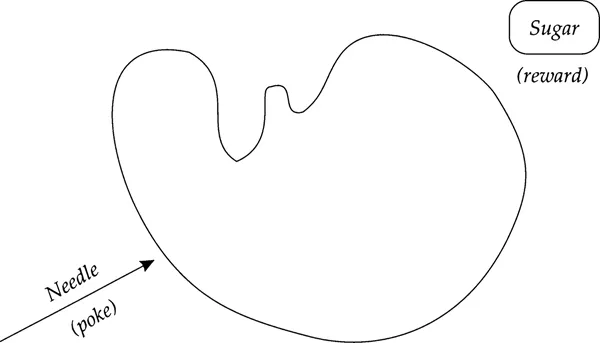
The heart of these problems is the assumptions coaches make about people. When attempting to bring about changes in others, many of us employ what I call the amoeba theory (see Figure 1.2).
FIGURE1.2 The Amoeba Theory of Management.
You may recall that amoebas are single-cell protozoa. Perhaps you studied them in high school biology. It’s easy to change the behavior of an amoeba. We can either poke it to get it to move away or entice it to move in the desired direction by giving it sugar. Poking and sugar work very well for amoebas, who never wake up and say, “Today I will ignore the sugar.” Day after day they predictably respond to the stimuli presented. All of this was useful and powerful learning that was brought to the world through Pavlov, Watson, and Skinner. The only problem, as far as we’re concerned in this book, is that the amoeba theory becomes management theory. For the most part, managers and coaches attempt to bring about changes in others by figuring out how to poke them or give them sugar.
The vast majority of psychologists have abandoned the amoeba theory, which is more properly called behaviorism, because they made an amazing discovery: human beings are more complicated than amoebas. It’s unfortunate that many managers and many coaches act as if they haven’t made a similar discovery. In fact, one of the most well-known coaching books by Fournies proposes that the only way to coach is to use behaviorism in its most blunt and stark form.
I can assure you that using the amoeba theory will never bring about the products of coaching. Here’s why:
Nothing long term can come from the amoeba theory; as soon as the stimulus ends, the behavior ends.
People are more clever than amoebas and we learn to get the reward without doing the action. Many of us have learned, for example, how to get top grades in college without really learning much, and organizations are full of people who have mastered looking good, while not accomplishing anything of use.
The amoeba theory eliminates the possibility of people being self-correcting because they are merely responding to stimuli and not correcting according to principles, desired outcomes, or values.
The amoeba theory weakens people every time it’s applied because it habituates people to taking actions only when someone else provides the stimulus. This is terrific when we want passive, nonthinking drones, but deadly when we expect initiative, innovation, risk-taking, and creativity.
The amoeba theory eliminates the chance for people to be self-generating because their ambition and curiosity are crushed, since any unauthorized initiatives or unsanctioned relationships are thwarted. All attention must be on only those actions that lead to the immediate cessation of the pain or the immediate acquisition of the reward. The immediate is worshipped. The building of long-term competence is thwarted.
These reasons could go on and on, and probably you can come up with plenty of them yourself. Everyone I know resents being manipulated either overtly or covertly and that is what the amoeba theory is—manipulation. The amoeba theory is also a theory underlying command-and-control practices in organizations. Since this theory wo...
Table of contents
Cover
Half Title
Title Page
Copyright Page
Table of Contents
List of figures
List of tables
Foreword
Preface to the Fourth Edition
Preface
Acknowledgments
Orientation
Introduction
1. The Foundation for Coaching
2. Basic Principles
3. The Flow of Coaching
4. The Coaching Relationship
5. Openings
6. Assessment Models
7. How Things Really Get Done
8. Enrollment
9. Coaching Conversations
10. Stuck
11. Midlife Drift
12. Somatic Intelligence: The Missing Piece in Adult Development
13. Getting in Condition for Change
14. Track Two: Working with Ourselves
Conclusion
Appendix A: Self-Observations
Appendix B: Practices
Bibliography
About the Author
Index
Trusted by 375,005 students
Access to over 1.5 million titles for a fair monthly price.
Study more efficiently using our study tools.
Frequently asked questions
Yes, you can cancel anytime from the Subscription tab in your account settings on the Perlego website. Your subscription will stay active until the end of your current billing period. Learn how to cancel your subscription
No, books cannot be downloaded as external files, such as PDFs, for use outside of Perlego. However, you can download books within the Perlego app for offline reading on mobile or tablet. Learn how to download books offline
Perlego offers two plans: Essential and Complete
Essential is ideal for learners and professionals who enjoy exploring a wide range of subjects. Access the Essential Library with 800,000+ trusted titles and best-sellers across business, personal growth, and the humanities. Includes unlimited reading time and Standard Read Aloud voice.
Complete: Perfect for advanced learners and researchers needing full, unrestricted access. Unlock 1.5M+ books across hundreds of subjects, including academic and specialized titles. The Complete Plan also includes advanced features like Premium Read Aloud and Research Assistant.
Both plans are available with monthly, semester, or annual billing cycles.
We are an online textbook subscription service, where you can get access to an entire online library for less than the price of a single book per month. With over 1.5 million books across 990+ topics, we’ve got you covered! Learn about our mission
Look out for the read-aloud symbol on your next book to see if you can listen to it. The read-aloud tool reads text aloud for you, highlighting the text as it is being read. You can pause it, speed it up and slow it down. Learn more about Read Aloud
Yes! You can use the Perlego app on both iOS and Android devices to read anytime, anywhere — even offline. Perfect for commutes or when you’re on the go. Please note we cannot support devices running on iOS 13 and Android 7 or earlier. Learn more about using the app
Yes, you can access Coaching by James Flaherty in PDF and/or ePUB format, as well as other popular books in Business & Business General. We have over 1.5 million books available in our catalogue for you to explore.