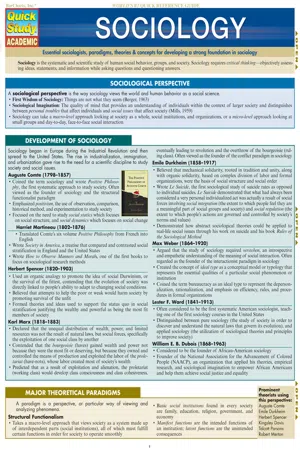
The essentials of the systematic and scientific study of human social behavior, groups and society. Extremely easy to access, study by, and reference for students in college courses or students of the world around them.
- 4 pages
- English
- ePUB (mobile friendly)
- Available on iOS & Android
eBook - ePub
About this book
Information

SOCIAL INSTITUTIONS
Institutions are relatively stable and patterned ways of carrying out social activities that are vital to society.
Families 
- Family: Two or more people related by blood, law, marriage, or adoption and are in a committed relationship
- Family of Orientation (Family of Origin): Family into which a person is born or adopted
- Family of Procreation (Family of Marriage): Family formed by marriage
- Family Patterns: Nature of family structure
- Nuclear Family: Parents and children living apart from other kin
- Extended Family: Parents and children living with other kin such as grandparents, aunts, uncles, and cousins
- Descent Patterns: How families trace kinship and inheritance
- Patrilineal Descent: Family lineage is traced through the male side of the family
- Matrilineal Descent: Family lineage is traced through the female side of the family
- Bilineal Descent: Family lineage is traced through both sides of the family
- Authority Patterns: Nature of authority in family structure
- Patriarchal: Oldest male is ultimate authority
- Matriarchal: Oldest female is ultimate authority
- Egalitarian: Shared authority among male and female head of household
- Marriage norms: Guidelines governing who can and should marry
- Monogamy: One person married to one other person at one time
- Serial monogamy: One person married to one person at a time, but divorces and remarries one or more times
- Polygamy: One person married to more than one other person at a time
- Polygyny: One man with more than one wife
- Polyandry: One woman with more than one husband
- Divorce: Legal recognition and termination of a marriage
- Divorce Rate: Number of divorces per 1,000 marriages in a year
- Annulment: Legal dissolution of marriage as if it did not take place
- Education: The institutionalized life-long process of teaching cognitive skills and knowledge as well as transmitting culture from one generation to the next
- Schooling: Education that takes place within the formal setting of a school
- Cognitive Skills: In the U.S., often referred to as the Three R’s— ‘readin,’ ‘ritin,’ and ‘rithmetic. Usually includes a somewhat standardized curriculum containing the subjects widely considered mandatory to be an educated person (e.g., English, mathematics, history, government, sciences, etc.)
- Cultural values: Schools attempt to reinforce basic American cultural values emphasizing freedom, democracy, honesty, good citizenship, etc.
- Hidden Curriculum: In addition to published cognitive and valueoriented curricula, schools also tend to teach conformity to dominant values and ideologies, maintenance of the status quo, and reinforcement of existing stratification and inequalities
- Credentialism: Increased emphasis on academic credentials (i.e., test scores, diplomas, certificates, degrees) as opposed to accumulation of knowledge and/or acquisition of marketable skills and expertise
- Tracking: Placing students with similar intelligence, skills, and academic abilities in the same classroom. May also involve grouping students with similar behavioral patterns
- Mainstreaming: Trend in schools to place students that once were taken out of the traditional classroom to address educational special needs back into traditional classrooms
- Pygmalion Effect: A form of self-fulfilling prophecy in which teachers label students as gifted and talented and expect them to excel academically. Teachers work with them and give them special attention in order to ensure that they do, sometimes ignoring students they expect to fail, which may lead to them achieving the anticipated academic outcome
- Charter Schools: Schools created as an alternative to public education by a charter (contract) between those starting the schools and a governing body that allows the schools to receive local, state, and federal monies
- School Vouchers: Provide funds to parents to offset some of the costs of transporting their children to public schools outside their district, or to help supplement some of the costs of attending a private school
- Homeschooling: Children are not sent to public or private schools, but are educated at home by one or both parents. May be motivated by personal, religious, and/or political reasons
- Religion: Institutionalized system of shared beliefs, symbols, and rituals that signify the sacred and address the ultimate meaning of life
- Sacred: Uncommon extraordinary aspects of life that inspire believers with awe, reverence, and respect
- Profane: Ordinary, commonly understood, and routine activities of ordinary life that people take for granted
- Animatism: A belief that supernatural forces rather than beings are the dominant power in the universe
- Animism: A belief in spirit beings that inhabit the same world as humans but on a different plane of existence
- Agnosticism: The existence of supreme beings or gods that have the power to influence human behavior and deserve to be worshiped is ultimately unknown and probably unknowable
- Atheism: A disbelief or lack of belief in supreme beings or gods that have the power to influence human b...
Table of contents
- Sociological Perspective
- Development Of Sociology
- Major Theoretical Paradigms
- Research Process & Theory Development
- Social Structure
- Social Differentiation & Inequality
- Social Institutions
- Population & Demography
- Collective Behavior & Social Change
Trusted by 375,005 students
Access to over 1.5 million titles for a fair monthly price.
Study more efficiently using our study tools.
Frequently asked questions
Yes, you can cancel anytime from the Subscription tab in your account settings on the Perlego website. Your subscription will stay active until the end of your current billing period. Learn how to cancel your subscription
No, books cannot be downloaded as external files, such as PDFs, for use outside of Perlego. However, you can download books within the Perlego app for offline reading on mobile or tablet. Learn how to download books offline
Perlego offers two plans: Essential and Complete
- Essential is ideal for learners and professionals who enjoy exploring a wide range of subjects. Access the Essential Library with 800,000+ trusted titles and best-sellers across business, personal growth, and the humanities. Includes unlimited reading time and Standard Read Aloud voice.
- Complete: Perfect for advanced learners and researchers needing full, unrestricted access. Unlock 1.5M+ books across hundreds of subjects, including academic and specialized titles. The Complete Plan also includes advanced features like Premium Read Aloud and Research Assistant.
We are an online textbook subscription service, where you can get access to an entire online library for less than the price of a single book per month. With over 1.5 million books across 990+ topics, we’ve got you covered! Learn about our mission
Look out for the read-aloud symbol on your next book to see if you can listen to it. The read-aloud tool reads text aloud for you, highlighting the text as it is being read. You can pause it, speed it up and slow it down. Learn more about Read Aloud
Yes! You can use the Perlego app on both iOS and Android devices to read anytime, anywhere — even offline. Perfect for commutes or when you’re on the go.
Please note we cannot support devices running on iOS 13 and Android 7 or earlier. Learn more about using the app
Please note we cannot support devices running on iOS 13 and Android 7 or earlier. Learn more about using the app
Yes, you can access Sociology by in PDF and/or ePUB format, as well as other popular books in Social Sciences & Sociology. We have over 1.5 million books available in our catalogue for you to explore.