![]()
Chapter 1
Teacher Persistence
. . . . . . . . . . . . . . . . . . . .
Persistence is reflected in an endless search for what works best with each student. Indeed, Star Teachers define their jobs as asking themselves constantly, "How might this activity have been better—for the class or for a particular individual?"
Learning Outcomes
Upon completion of this chapter, you will be able to
- Define teacher persistence.
- Explain why teacher persistence is the key disposition of Star Teachers.
- Analyze the ways in which Star Teachers think about their commitment to learners and their efficacy as teachers.
- Explore the classroom environments and problem-solving approaches of Star Teachers.
Interstate New Teacher Assessment and Support Consortium (InTASC) Standards
Standard #2: Learning Differences
The teacher uses understanding of individual differences and diverse cultures and communities to ensure inclusive learning environments that enable each learner to meet high standards.
Standard #4: Content Knowledge
The teacher understands the central concepts, tools of inquiry, and structures of the discipline(s) he or she teaches and creates learning experiences that make the discipline accessible and meaningful for learners to assure mastery of the content.
Standard #5: Application of Content
The teacher understands how to connect concepts and use differing perspectives to engage learners in critical thinking, creativity, and collaborative problem solving related to authentic local and global issues.
Standard #6: Assessment
The teacher understands and uses multiple methods of assessment to engage learners in their own growth, to monitor learner progress, and to guide the teacher's and learner's decision making.
Standard #8: Instructional Strategies
The teacher understands and uses a variety of instructional strategies to encourage learners to develop deep understanding of content areas and their connections, and to build skills to apply knowledge in meaningful ways.
★ ★ ★ ★ ★ ★
Defining
What pushes some people to keep trying, to never give up, even when the conditions suggest defeat? Persistence, also known as tenacity or grit, is defined as continuing to strive toward a goal in the face of challenges. It is perseverance with a passion for attaining long-term goals. Persistence is a noncognitive dimension of a person's character, a disposition or a habit of mind operationalized through problem solving.
Though the terms resilience and persistence are often used interchangeably, they in fact have different meanings. As Grotberg explains, resilience is the "human capacity to face, overcome, and even be strengthened by experiences of adversity."1 Highly resilient individuals are reactive to setbacks in their personal or everyday life, but come out of them as more efficacious people. By contrast, persistence is a proactive personal attribute linked to professional action and goal setting. (We will delve more into teacher resilience in Chapter 6: Surviving in a Bureaucracy.)
We need only look at the inspirational quotes plastered on so many office walls—"Patience, persistence, and perspiration make an unbeatable combination for success" (Napoleon Hill); "Success is the result of perfection, hard work, learning from failure, loyalty, and persistence" (Colin Powell)—to understand how desirable a quality persistence is. Most of us can point to instances in our everyday lives of skilled individuals who seem to have an especially high level of stick-with-it-ness in their chosen field, exercising persistence to achieve goals despite extraordinary odds.
Persistence has long been tied to success in the workplace. Business literature with titles like Executive Toughness and Stick with It highlight persistence as key to professional success. It takes persistence to evolve, acquire competencies, and explore opportunities that develop over time. In comparison with individuals who give up easily when they face hardships, people who persist at any effort further refine their skills and develop expertise.
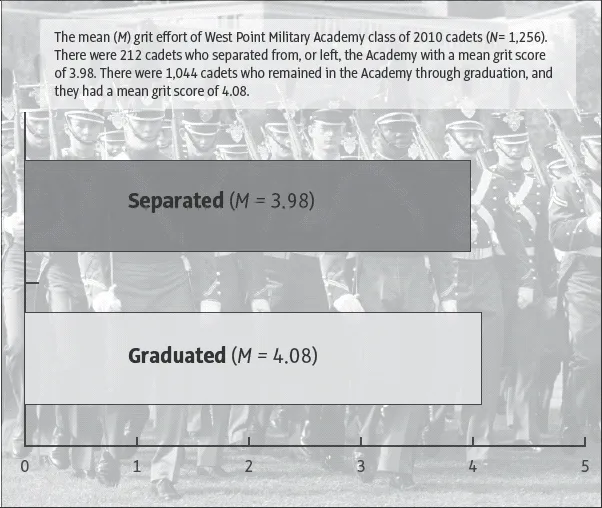
Kelley, Matthews, and Bartone examined the predictive power of grit and hardiness among a cohort of 1,558 West Point cadets, finding these noncognitive characteristics to be major factors in attrition: the less gritty and hardy the cadets, the likelier they were to drop out. Specifically, the authors found grit to be a differentiating factor between cadets who left West Point early (M = 3.98) and those who persisted through graduation (M = 4.08) (see Figure 1.1). "Conceptually, grit has an obvious link with the demands required for successful performance at West Point," they wrote. "Grit, or 'firmness of character,' is synonymous with fortitude or courage and is the essence of what the Academy sustains and builds in its cadets and graduates."2 These findings suggest that cadet officers, who develop as professionals through trial and error, may be readily identified by their grit scores.
Figure 1.1. Grit as a Predictor of Graduation Among West Point Cadets
Teacher Persistence
An online search of the phrase teacher persistence leads to innumerable studies on teacher attrition, teacher retention, and job satisfaction—but few studies on teacher persistence. We define teacher persistence as a disposition manifested in the day-to-day actions of a teacher pursuing an outcome directly related to improving student achievement. This is in line with Haberman's definition of persistence in teaching as the mindset and behavior of a teacher who continues to support learners in a committed way through creative problem solving.3 For Haberman, persistence is at the heart of the seven dispositions of Star Teachers, helping to maintain and actualize the other six (see Figure 1.2). Persistence determines whether the teacher can sustain fallibility and be vulnerable with students; protect student learning regardless of cost; retain practices that reflect sound theory; preserve a healthy approach to students identified as being at risk; maintain a professional orientation toward student-teacher relationships; and avoid burnout. If learners are to achieve their full potential, teachers must exhibit persistence even in the face of repeated instructional failures, never giving up on their learners.
Figure 1.2. Haberman's 7 Dispositions of Star Teachers
Persistence
Fallibility
Protecting Students' Learning
Putting Theory into Practice
Approach to At-Risk Students
Professional vs. Personal Orientation
Bureaucracy
Persistence and Teacher Quality
According to the Every Student Succeeds Act (ESSA),4 all children in the United States are to be taught in the core academic subjects by "effective" teachers. Among many others, Wheatley suggests that persistence is crucial to teacher effectiveness because it "may promote high expectations for students, development of teaching skills, teachers' reflectiveness, responsiveness to diversity, teaching efficacy, effective responses to setbacks, and successful use of reformed teaching methods."5
Substituting grit for persistence, Robertson-Kraft and Duckworth6 analyzed two longitudinal studies of nearly 500 novice teachers assigned to elementary, middle, and high schools in low-income districts, measuring factors such as grit, leadership, academic credentials, and teacher performance. Their findings show that novices who demonstrated sustained passion and perseverance in activities prior to becoming teachers were more likely to stay in the profession and prove effective during their first year on the job. The authors defined effective teachers as those who make, on average, "a year's worth of progress according to published norms" and less effective teachers as those for whom "student progress falls short of the target."7 In their study, the mean grade-point average (GPA) of students with effective teachers (3.59) was nearly identical to that of students with less effective teachers (3.60). Scholastic Aptitude Test (SAT) scores were also close to equivalent, with an average of 1332.78 for students of effective teachers compared to 1327.65 for those with less effective teachers. Similar variables such as "interview ratings of leadership potential and demographics failed to predict retention or effectiveness."8
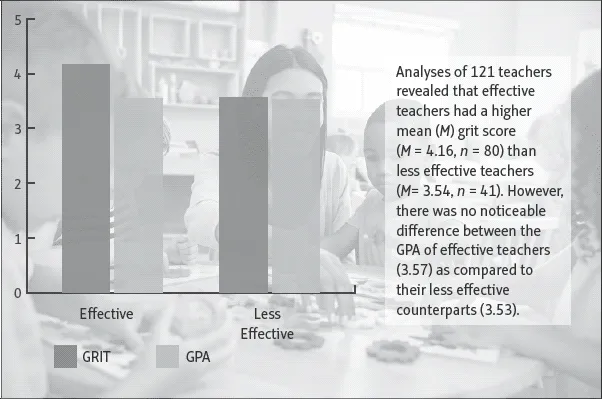
The effective teachers in this study were most readily identified by their grit ratings rather than by the GPA or SAT scores of students. Effective middle school teachers (i.e., those most likely to stay in their jobs) possessed a significantly higher mean grit rating (3.98) than their less effective counterparts (2.79). As Figure 1.3 shows, differences between effective and less effective teachers are more evident when noncognitive characteristics are evaluated.
Figure 1.3. Grit and GPA as Predictors of Teacher Effectiveness
Source: Data from "True Grit: Trait-Level Perseverance and Passion for Long-Term Goals Predicts Effectiveness and Retention Among Novice Teachers," by C. Robertson-Kraft and A. L. Duckworth, 2014, Teachers College Record, 116(3), pp. 1–27.
In another study, Duckworth, Quinn, and Seligman9 asked 390 novice teachers in low-income districts to complete questionnaires assessing their grit, optimism, and satisfaction with life prior to the first day of school. All three of these characteristics individually predicted some measure of teacher effectiveness for student academic gains over the school year. Further, when the three characteristics were measured collectively, only the combination of grit and life satisfaction was determined to be highly predictive of teacher effectiveness. For this reason, Haberman10 advises administrators to examine observable and measurable personality factors like persistence among teacher candidates—before they are hired as teachers.
The Mindset of Persistent Star Teachers
We can best understand Star Teachers by appreciating how they (1) perceive the nature of the learner and (2) comprehend their personal sense of efficacy. Haberman notes that Star Teachers express deep and abiding beliefs about the potential of diverse learners, the nature of the teaching role, and the reasons they and their students are in school. They are relentless in their efforts to ensure that every learner, re...