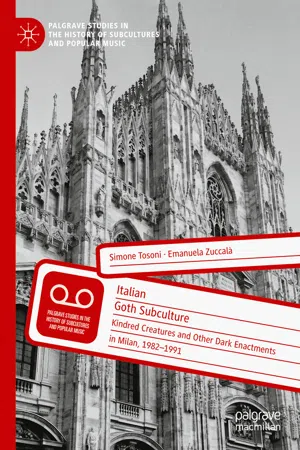
eBook - ePub
Italian Goth Subculture
Kindred Creatures and Other Dark Enactments in Milan, 1982-1991
- English
- ePUB (mobile friendly)
- Available on iOS & Android
eBook - ePub
Italian Goth Subculture
Kindred Creatures and Other Dark Enactments in Milan, 1982-1991
About this book
This book is the first in-depth investigation of the Goth subculture in Italy, focusing in particular on the city of Milan. It grows out of a three year research project - the first in Italy of this scope on the topic - based on the life histories of two dozen participants. In light of this, Simone Tosoni and Emanuela Zuccalà propose an innovative approach to the study of spectacular subcultures: contrarily to the most common accounts of the spectacular subcultures of the 80s, this book describes the experience of subcultural belonging as plural and internally diversified. In particular, three different variations - or 'enactments' - of goth are described in-depth: the politically engaged one; the one typical of the scene of the alternative music clubs spread all over northern Italy; and the one, common in the little towns surrounding Milan (but not limited to it), where participants used to 'enact' the dark subculture alone or in small groups. Their book argues that while these three different variations of goth shared the same canon of subcultural resources (music, style, patterns of cultural consumptions), they differed under relevant points of view, like forms of socialization, stance toward political activism, identity construction processes, and even their relationship with urban space. Yet, contrarily to the stress on individual differences in 'subcultural' belonging typical of post-subcultural theorists, the Milanese variations of goth appear to have been socially shared, as socially shared were the different 'practices of enactment' of the subculture that characterized each of them.
Information
Topic
StoriaSubtopic
Storia europea© The Author(s) 2020
S. Tosoni, E. ZuccalàItalian Goth Subculture Palgrave Studies in the History of Subcultures and Popular Musichttps://doi.org/10.1007/978-3-030-39811-8_11. Introduction: Enacting Goth in Milan in the 1980s
Simone Tosoni1 and Emanuela Zuccalà2
(1)
Università Cattolica del Sacro Cuore, Milan, Italy
(2)
Freelance Journalist, Milan, Italy
Emanuela Zuccalà
1.1 Dark Enactments in Milan
The 4th of April 1984, Milan: the provincial government building Palazzo Isimbardi, a ten minutes’ walk from the Duomo, is hosting the conference titled Youth Gangs: A Reality in the Metropolis of the ‘80s. A team of sociologists is expected to present the preliminary results of a research study1 (Caioli et al. 1986) on the new forms of youth aggregation—mods, rockabillies, punks—that at the time were gaining visibility in the city and in the media (Frascangeli 2010). The symposium is part of a week of debates, press conferences, exhibitions and concerts organised by the Province of Milan, and dedicated to “spectacular youth gangs” (De Sario 2009). Yet, “as it may happen even in the best homes, at the very last moment an unexpected—and probably unwanted—guest shows up” (Punx Anarchici2 1984: 11). It is a small group of protesters: some of them are anarcho-punks, or ‘punx’—spelled with an x, the way they sign their leaflets and graffiti to mark their distance from non-politicised forms of punk—from the Virus squat3; others hang out at the Virus, but they do not consider themselves properly punks: they prefer to be called Creature Simili (Kindred Creatures), to underline their affinity and, at the same time, their distinction from punx. A few months later, the political reputation Creature Simili had acquired with what remained of the radical left in the city will earn them a permanent space at the Leoncavallo, at that time the most important squat run by Autonomia Operaia (Autonomism) still in activity in Milan (De Sario 2012). It will be called Helter Skelter, and it will soon become a reference point for the goth scene in Northern Italy.
As soon as the sociologists begin their speeches, the small group stages its protest, shouting and yelling: “We are not guinea pigs! (…) I am a person, not a phenomenon!” Three of the demonstrators take their shirts off and start to scratch their chests with razor blades. Someone is videotaping them while they hand out blood splattered leaflets in which they accuse the researchers of being accessories to the repression of the anarcho-punk movement.4 “This is my blood: analyse that! Maybe you will find what my real needs are”, the leaflet starts (Punx Anarchici 1984: 11). It doesn’t matter if “the approach [of the research is] undoubtedly innovative, at least for the Italian context of those years, [as it draws on] the conceptual framework elaborated during the ‘60s and early ‘70s by the Centre for Contemporary Cultural Studies of Birmingham, and formalized in 1976 with the publication of a key volume in the study of post-war British youth subcultures: Resistance Through Rituals [(Hall and Jefferson 1986)]” (De Sario 2009: 107). What punx and Creature Simili can’t really accept is the word ‘gangs’, because they feel it criminalises them, along with all the other Milanese spectacular subcultures, from the very title of the research. For the same reason, they further dislike the fact that the research was commissioned by the provincial government’s CSERDE, Centro Studi e Ricerche sulla Devianza e l’Emarginazione (Research and Study Centre on Deviancy and Social Exclusion).5 The conference is interrupted. Three days later, when the media buzz about the protest is still high, the Virusians (a name for the punx of the Virus) temporarily occupy the Porta Romana theatre. In a leaflet, they proclaim “the night of anarchy” (Punx Anarchici 1984: 11), as a response to the conference, as well as a way to raise awareness against the lack of non-commercial social venues in the city. Together with the Virus and many other collectives, the leaflet is also signed by Amen darkzine, the first and most important Italian goth fanzine of the 1980s.
In those years, in fact, the collective that edited the fanzine (‘Quelli di Amen’—The People of Amen), and some of the Creature Simili, adopted a surprising appropriation of goth,6 or dark—as the subculture was, and is still known in Italy—centred on political engagement and activism. While goth in the UK and in other contexts has been described as involving, “no external political objectives” (Hodkinson 2002: 76), and characterised by a “self-reflexive, introspective, subjectivist rather than an activist, confrontational stance” (Brill 2008: 10), they organised concerts and cultural initiatives, but also political rallies, occupations and sit-ins, occasionally confronting the police. They also experimented with what they called ‘mental attacks’: sort of situationist demonstrative actions, usually staged during Saturday afternoons in Via Torino, one of the main shopping streets in Milan.
Yet, this strongly politicised way of living the experience of subcultural belonging was not the only one in the city and its hinterland. Indeed, being dark in Milan in the 1980s took a plurality of forms. The subculture was experienced as an aesthetic phenomenon, but also as an attempt to publicly refuse the new hedonistic values of the historical phase known in Italy as ‘riflusso’ (the ebb, or the resignation) (Ginsborg 1990; Mudu and Piazza 2016): the years of the end of political engagement under the harsh repression of the state, in favour of a general retreat to the private sphere. And furthermore: dark was a solitary and imaginary escape from the city’s hinterlands ravaged by the spread of heroin, as well as a strategy to construct non-conformed identities and to experiment with gender and non-heteronormative forms of sexuality. For some, it was a retreat from politics, while for others it was exactly the opposite: a way to enrich and relaunch the experience of activist anarcho-punk. It is not possible to properly understand Milanese dark without accounting for this heterogeneous, and sometimes contradictory, complexity. As Hodkinson put it regarding the UK Goth in the mid- and late 1990s, “The functions, meanings and symbols of subcultural involvement [were] liable to vary between participants and to reflect complex processes of cultural choice and coincidence rather than an automatic shared reaction to circumstances” (Hodkinson 2002: 30). Yet, as we will show, Milanese dark resists postmodernist interpretations of subcultures as ‘free floating’ signifiers (Redhead 1993) “that enhance differentiation of individual experience” (Blackman 2005: 9). Its internal variations cannot be, in fact, attributed exclusively to the individual understandings of the participants, and cannot be reduced “to individual distinction, of tweaking a singular shared meaning so as to stand out as unique” (Hannerz 2015: 16). On the contrary, in the 1980s, internal heterogeneities were “structured and structuring” (ibidem) Milanese dark in a number of distinct and stabilised forms. In particular, the activist variation of the subculture, typical of Quelli di Amen and of the dark wing of Creature Simili, coexisted with two other discernible ones: the one typical of the alternative music club scene spread throughout northern Italy and beyond, that had its centre at the Hysterika club, in Milan; and a third one, where participants lived the experience of dark on their own, or in small, isolated groups, not rarely made up of members of different subcultures.
These variations of dark had in common the same canon of subcultural symbolic resources (music, style, specific material artefacts, patterns of cultural consumption), usually—but not exclusively—tapped from the UK through mainstream and independent media and relational networks, defining “their relatively consistent adherence to an identifiable range of shared tastes” (Hodkinson 2002: 7). Nonetheless, they differed not only for their stance on activism or for having s...
Table of contents
- Cover
- Front Matter
- 1. Introduction: Enacting Goth in Milan in the 1980s
- 2. The Research: Methods and Methodology
- 3. Der Himmel Über Milan: The City of Milan in the Early 1980s
- 4. Another No Future: From Anarcho-Punk to the Activist Enactment of Dark
- 5. A Batcave in Via Redi: The Music Club Enactment of Dark
- 6. Siberia: The Loner Enactment of Dark
- 7. Dark Canon
- 8. Conclusions: An Enactment Approach to Subcultures and Post-Subcultures
- Back Matter
Trusted by 375,005 students
Access to over 1.5 million titles for a fair monthly price.
Study more efficiently using our study tools.
Frequently asked questions
Yes, you can cancel anytime from the Subscription tab in your account settings on the Perlego website. Your subscription will stay active until the end of your current billing period. Learn how to cancel your subscription
No, books cannot be downloaded as external files, such as PDFs, for use outside of Perlego. However, you can download books within the Perlego app for offline reading on mobile or tablet. Learn how to download books offline
Perlego offers two plans: Essential and Complete
- Essential is ideal for learners and professionals who enjoy exploring a wide range of subjects. Access the Essential Library with 800,000+ trusted titles and best-sellers across business, personal growth, and the humanities. Includes unlimited reading time and Standard Read Aloud voice.
- Complete: Perfect for advanced learners and researchers needing full, unrestricted access. Unlock 1.5M+ books across hundreds of subjects, including academic and specialized titles. The Complete Plan also includes advanced features like Premium Read Aloud and Research Assistant.
We are an online textbook subscription service, where you can get access to an entire online library for less than the price of a single book per month. With over 1.5 million books across 990+ topics, we’ve got you covered! Learn about our mission
Look out for the read-aloud symbol on your next book to see if you can listen to it. The read-aloud tool reads text aloud for you, highlighting the text as it is being read. You can pause it, speed it up and slow it down. Learn more about Read Aloud
Yes! You can use the Perlego app on both iOS and Android devices to read anytime, anywhere — even offline. Perfect for commutes or when you’re on the go.
Please note we cannot support devices running on iOS 13 and Android 7 or earlier. Learn more about using the app
Please note we cannot support devices running on iOS 13 and Android 7 or earlier. Learn more about using the app
Yes, you can access Italian Goth Subculture by Simone Tosoni,Emanuela Zuccalà in PDF and/or ePUB format, as well as other popular books in Storia & Storia europea. We have over 1.5 million books available in our catalogue for you to explore.