- English
- ePUB (mobile friendly)
- Available on iOS & Android
eBook - ePub
About this book
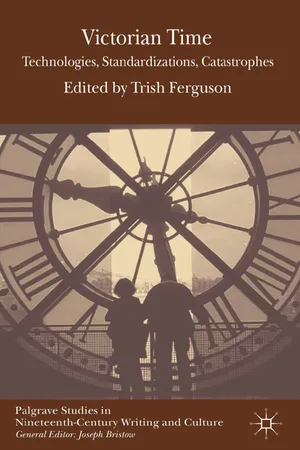
Victorian Time examines how literature of the era registers the psychological impact of the onset of a modern, industrialized experience of time as time-saving technologies, such as steam-powered machinery, aimed at making economic life more efficient, signalling the dawn of a new age of accelerated time.
Information
1
Introduction
In 1859 London witnessed the completion of the construction of ‘Big Ben’, a monument to standardized time in the heart of the city and the largest and most accurate timepiece in the world. The Astronomer Royal, Sir George Airy, had set out high standards for the clock to meet; the first stroke of each hour was to be accurate to within one second and the clock’s performance was to be telegraphed twice a day to Greenwich Observatory.1 This was the focal point of an increasingly disciplinary industrial world of factories, the mail system and transport schedules, all of which was facilitated by the strict observance of the newly developed concept of public time kept by the town clock. Standardized public time was also the means by which time discipline was imposed in the workplace, which was a vital component of the success of the Industrial Revolution in its infancy.2 Public time eventually obtained a central place in the Victorian consciousness, internalized to facilitate industrial capitalism, a central facet of the burgeoning global empire emanating from the heart of Victorian England. Yet in 1859, as the Victorians celebrated the completion of Big Ben and enjoyed the success of their endeavours to control and systematize time, such certainty about man’s supremacy over time was suddenly undermined from an unexpected angle as Darwin’s Origin of Species, published in that year, offered overwhelming evidence that the world itself was infinitely older than had previously been thought, influenced by the recent geological discoveries of James Hutton and Charles Lyell, which proposed the concept of deep time. For many the theory of evolution undermined Creationism and as a result, as Richard D. Altick notes, ‘the human imagination had to adjust itself to staggering new concepts of time’, which ‘profoundly affected the Victorians’ view of their own place in the cosmic sequence’.3 Also contributing to this chastened outlook was William Thompson’s Second Law of Thermodynamics, which, in 1852, predicted a time when the earth would no longer be habitable. New anxieties about the future emerged in this new world of temporal uncertainty and, as a result, literature of the era reflects radical new ways of thinking about time. In a series of chapters on literature spanning the era, Victorian Time: Technologies, Standardizations, Catastrophes documents the psychological impact of the onset of a modern, industrialized experience of time as a new age of accelerated time began. Providing a commentary on the Victorians’ complex relationship with modern time, the essays in this volume discuss the ambivalent literary responses to the impact and rate of industrial progress, from a wary acceptance of the need to facilitate a burgeoning global economy to narratives of dystopia and apocalypse that betray anxieties about time, technology and progress.
* * *
The Victorian era witnessed the development of a radically altered spatial and temporal environment as the predominantly agricultural world of the early nineteenth century gradually made way for an urban industrial landscape connected by the matrix of the railroad. With the development of the railway it was no longer practical for each town to keep their own local time and thus in 1840 Railway Time (London time) was applied in all town railway stations to facilitate the scheduling of trains. For a number of years both Local Time and Railway Time were kept until gradually Railway Time displaced district time altogether so that by 1892, Nature magazine noted that ‘so largely does the railway affect modern civilized life that railway time soon comes to regulate all affairs’.4 Railway Time was a mathematically regulated observance displacing the sidereal rhythm of the natural world, causing Dickens to reflect that it was ‘as if the sun itself had given in’.5 For Dickens the railway was not only reshaping the landscape but also threatening to replace the world of imagination with a utilitarian world of scientific calculation – the philosophy underpinning the dystopic Hard Times. Thackeray felt the same foreboding that ‘the world will be a dull world some hundreds of years hence, when Fancy shall be dead, and ruthless Science (that has no more bowels than a steam engine) has killed her’.6 Both Dickens and Thackeray acknowledged that the arrival of the railway entailed a profound psychological adjustment to an accelerated world. Railway travel offered a new kinetic experience in which the power of the steam engine could hurtle passengers through space at hitherto unimaginable speeds. Before the advent of steam trains, travel could never exceed the pace of a galloping horse. Railway time thus brought about a radically new sensory experience. J.M.W. Turner’s painting, Rain, Steam and Speed and Dombey’s phantasmagoric train journey in Dombey and Son both reflect the over-stimulated sense perception of train travel which placed demands on the sensorium of those forced to adapt to Railway Time.7 The railway also had a revolutionary impact on the pace of industrial life which became a competition of precision, efficiency and punctuality. The increased pressure of the competitive economic race, which trickled down from management to the workforce, resulted in ‘every manufacturer striving against each other, and against themselves … Every class, and every individual, in every department of industry, hurrying along, struggling with fortune and the times, and jostling his fellow sufferers … and especially the never-ceasing race of population against subsistence.’8 Thus while many proponents of industrialization commended the increased efficiency effected by railway transportation, industry was also perceived as being propelled by a Darwinian and Malthusian apprehensiveness about survival. Given the railway’s fundamental impact on the pace of industrial life it is no surprise that at the end of the century H.G. Wells wrote: ‘The nineteenth century, when it takes its place with the other centuries in the chronological charts of the future, will, if it needs a symbol, almost inevitably have as that symbol a steam-engine running upon a railway.’9
In a ground-breaking study of the cultural impact of the arrival of the railway Wolfgang Schivelbusch documents how train travel is linked with new forms of consciousness and the dawning of industrial subjectivity.10 As Schivelbusch demonstrates, the new experience of time and space brought about by the railway entailed new modes of perception but also in broader terms, a more extensive conditioning to cultural modernity. This new experience of the industrialized world is a phenomenon examined in detail in Nicholas Daly’s absorbing study of machine culture, Literature, Technology, and Modernity, 1860–2000. Daly demonstrates that literary responses to the arrival of the railway and other industrial technologies that form part of an accelerated existence can be read as ‘a species of temporal training’, the sensation novel bringing the reader ‘up to speed’ in order to synchronize its reader with industrial modernity.11 Using a similar methodology, examining literature as a system of ‘temporal training’, Jonathan H. Grossman’s study of Dickens’s novels examines how standardized time and the public transport revolution it facilitated created networks that not only changed the ways in which communities functioned but also radically changed the form of the novel, itself a system of networks that allowed readers to process and understand an entirely new transport technology.12 Drawing on the important connections made in recent scholarly studies between literature and the new technologies of the Victorian era, Victorian Time: Standardizations, Technologies, Catastrophes revisits this connection, exploring the concerns about time-saving and speed-enhancing technologies that are evident throughout a wide range of Victorian fiction.
Joseph W. Childers has observed that in the rapidly accelerated world of the Victorian era ‘as such fundamentals as space and time were challenged, the Victorians were existing differently’.13 The new temporal environment of the Victorian era was one of deadlines, efficiency and precision. This was to shape not only the literature but also the working practices of Victorian writers. It characterizes both Charles Dickens’s early journalistic role and his subsequent career as a serializing writer, in which he is subjected to ‘the new universe of disciplined time’,14 and as Daragh Downes observes in Chapter 2 below, ‘we cannot appreciate Dickens’s time ethos in his fictions without first appreciating the time ethos which led to the creation of those fictions’ (p. 18). In an expansive study of Dickens’s journalistic and fiction-writing career, Downes registers the effects of the industrialization of time on collective and individual experiences of time, in part through the pervasive presence of timepieces, from Gradgrind’s ‘deadly statistical clock’ to the clock in Dr Blimber’s study, so that clock time in Dickens’ fiction, ‘is like an atmospheric pressure in people’s heads’ (p. 17). From Sketches by Boz to The Mystery of Edwin Drood, Dickens documents the pressures attendant on a workforce subjected to the demands of time, reflecting the pressure of his own publication schedules. Thus Dickens documents the internalization of a new industrial world powered by steam and run like clockwork. The arrival of the railway, memorably depicted in Dombey and Son, marked the dawning of an age of speed-enhancing technologies and, as Downes demonstrates, Dickens oscillates dialectically between embracing time-thrift ideology as an existentially suggestive ethos and dreading it as an alienating objective force.
While the railway was a dominant factor in the standardization of time and a powerful psychological mechanism for the scheduling of working lives, it could as easily be argued that ‘the clock, not the steam-engine, is the key-machine of the modern industrial age’.15 Precise time-keeping was fundamental to the operation of the newly developed factory system; with the help of time-saving machinery, it facilitated the production of the maximum number of units with the minimum financial outlay in the shortest possible time. As clock time was drawn into the service of industrial capitalism, the worker became a wage slave whose labour was mechanically regulated. As early as 1831, Carlyle recognized the shift toward time-slavery inherent in new modes of production and while extolling the benefits of work and industry in Sartor Resartus, his Professor Teufelsdröckh observes that ‘Saturn or Chronos, or what we call TIME, devours all his Children: only by incessant Running, by incessant Working, may you (for some threescore-and-ten years) escape him: and you too he devours at last.’16 Stuart Sherman documents a paradigmatic shift in literature on account of the increased cultural presence of chronometry in the public sphere. This phenomenon, Sherman notes, led to the creation of innovative literary forms from the seventeenth century on, such as the diary and the newspaper, journals and travel-books, which closely replicated the diurnal form of clocks and calendars.17 These genres, Sherman argues, were ‘a means of enabling authors to write the time the new clocks told, and enabling readers to recognize, interpret, and inhabit the temporality by which the whole culture was learning to live and work’18 and thus, like the railway in nineteenth-century fiction, constituted a form of training in time discipline. Sherman notes that the already increasing proliferation of clocks and pocket watches escalated in the Victorian era, to the extent that by 1851 the Great Exhibition was described as ‘loud with clocks’.19 Victorian fiction increasingly registers an unease with this new disciplinary time culture and the control wielded by capital owners over wage slaves. This resistance is seen not only in the union negotiations over working hours in Condition of England novels but also in narratives that reject the principles of chronological standardized time, such as the parodies and inversions of logic of Lewis Carroll’s Alice in Wonderland (1865) in which the White Rabbit is nonsensically harried by clock time.
The dawning of the clock-controlled world of the Industrial Revolution was a defining moment of a revolution in man’s experience of time. It marked the onset of a paradigm shift that took place with the recognition that time was a construct that could be embedded in capitalist enterprise, as the Victorians attempted to construct and control time, to use it for their own purposes. E.P. Thompson has examined how industrialization ushered in a new age of modern time perception as public time forced workers to adapt to a new time discipline.20 Workers entered a complex new relationship with time-efficient technology, both belonging to it and contributing to it, creating time-saving technologies while also subject to the principle of time efficiency in the division of labour of the factory system, designed to enable the most efficient ratio of production to time. This shift is described by Lewis Mumford as one from pre-industrial ‘organic time’, where daily tasks are performed according to the natural world movement of the sun, and ‘mechanical time’, whereby tasks are dictated by the clock.21 As Durkheim recognized, this involved an essential rupture from a human, qualitative experience of time to an objective, universal notion of time as homogeneous and quantitative. In an era that preached the evil of wasting time, the new experience of time – measured and regulated in the interests of efficiency and value for money – was one that ultimately ...
Table of contents
- Cover
- Title
- Copyright
- Contents
- List of Illustrations
- Acknowledgements
- Notes on Contributors
- 1 Introduction
- 2 The Best of Time, The Worst of Time: Temporal Consciousness in Dickens
- 3 Emptying Time in Anthony Trollope’s The Warden
- 4 Hardy’s Wessex and the Birth of Industrial Subjectivity
- 5 ‘You Are Too Slow’: Time in Jules Verne’s Around the World in 80 Days
- 6 Brave New Worlds: Samuel Butler’s Erewhon, Settler Colonialism and New Zealand Mean Time
- 7 ‘Primitive Man’ and Media Time in H.M. Stanley’s Through the Dark Continent
- 8 ‘The Honest Application of the Obvious’: The Scientific Futurity of H.G. Wells
- 9 ‘The End of Time’: M.P. Shiel and the ‘Apocalyptic Imaginary’
- 10 ‘Gone Into Mourning … for the Death of the Sun’: Victorians at the End of Time
- Bibliography
- Index
Trusted by 375,005 students
Access to over 1.5 million titles for a fair monthly price.
Study more efficiently using our study tools.
Frequently asked questions
Yes, you can cancel anytime from the Subscription tab in your account settings on the Perlego website. Your subscription will stay active until the end of your current billing period. Learn how to cancel your subscription
No, books cannot be downloaded as external files, such as PDFs, for use outside of Perlego. However, you can download books within the Perlego app for offline reading on mobile or tablet. Learn how to download books offline
Perlego offers two plans: Essential and Complete
- Essential is ideal for learners and professionals who enjoy exploring a wide range of subjects. Access the Essential Library with 800,000+ trusted titles and best-sellers across business, personal growth, and the humanities. Includes unlimited reading time and Standard Read Aloud voice.
- Complete: Perfect for advanced learners and researchers needing full, unrestricted access. Unlock 1.5M+ books across hundreds of subjects, including academic and specialized titles. The Complete Plan also includes advanced features like Premium Read Aloud and Research Assistant.
We are an online textbook subscription service, where you can get access to an entire online library for less than the price of a single book per month. With over 1.5 million books across 990+ topics, we’ve got you covered! Learn about our mission
Look out for the read-aloud symbol on your next book to see if you can listen to it. The read-aloud tool reads text aloud for you, highlighting the text as it is being read. You can pause it, speed it up and slow it down. Learn more about Read Aloud
Yes! You can use the Perlego app on both iOS and Android devices to read anytime, anywhere — even offline. Perfect for commutes or when you’re on the go.
Please note we cannot support devices running on iOS 13 and Android 7 or earlier. Learn more about using the app
Please note we cannot support devices running on iOS 13 and Android 7 or earlier. Learn more about using the app
Yes, you can access Victorian Time by T. Ferguson in PDF and/or ePUB format, as well as other popular books in Literature & European Literary Criticism. We have over 1.5 million books available in our catalogue for you to explore.