eBook - ePub
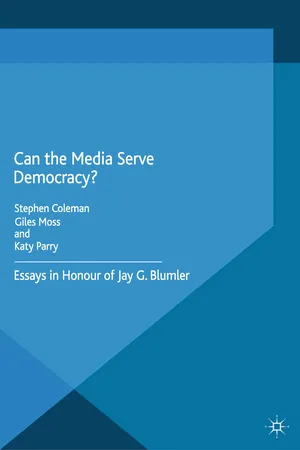
Can the Media Serve Democracy?
Essays in Honour of Jay G. Blumler
- English
- ePUB (mobile friendly)
- Available on iOS & Android
eBook - ePub
Can the Media Serve Democracy?
Essays in Honour of Jay G. Blumler
About this book
This landmark collection brings leading scholars in the field of political communication to debate one of the most important questions of our age: Can the media serve democracy? For the media to be democratic, they must enter into a positive relationship with their readers, viewers and listeners as citizens rather than consumers who buy things, audiences who gaze upon spectacles or isolated egos, obsessed with themselves. The media's first task is to remind people that they are inhabitants of a world in which they can make a difference. By enabling citizens to encounter and make sense of events, relationships and cultures of which they have no direct experience, the media constitute a public arena in which members of the public come together as more than passing strangers.
Information
Subtopic
Politica1
Introduction: Can the Media Serve Democracy?
Stephen Coleman, Giles Moss and Katy Parry
The problem
There has arguably never been a time when so many opportunities have been available for ‘the people’ to contribute to the democratic process, yet political participation seems to be in decline ...
(McHugh, D. and Parvin, P. Neglecting Democracy: Participation and Representation in 21st Century Politics, London, Hansard Society, 2005: pp. 7–8)
The general argument for a free press as a means of free communication ... has to do with a number of different things. These include the ability to give a powerful voice in the public domain to those unable to do so effectively for themselves ... Importantly, it is also to do with the constitution by the media in their own right of a public forum, where information, ideas and entertainment are both circulated and held up to scrutiny.
(Report of the Leveson Inquiry into the Culture, Practices and Ethics of the Press, 2012: Vol. I, p. 62, para 3.4)
It is sometimes said that the media is accountable daily through the choice of readers and viewers. That is true up to a point. But the reality is that the viewers or readers have no objective yardstick to measure what they are being told. In every other walk of life in our society that exercises power, there are external forms of accountability, not least through the media itself ... I do believe this relationship between public life and media is now damaged in a manner that requires repair. The damage saps the country’s confidence and self-belief; it undermines its assessment of itself, its institutions; and above all, it reduces our capacity to take the right decisions, in the right spirit for our future.
(Speech to Reuters by British Prime Minister Tony Blair, 12 June 2007, available at http://news.bbc.co.uk/1/hi/uk_politics/6744581.stm, date accessed 14 June 2014)
Something seems to be wrong. Talk of decline, disengagement and disenchantment dominates the debate about the state of contemporary democracy. All too often, such talk leads on to expressions of ill-concealed frustration about ‘apathetic’ citizens who have forgotten their civic ‘duty’ and ‘irresponsible’ media failing to serve the public interest. Avoiding these well-rehearsed lamentations, the aim of this book is to reflect upon the ways in which one of the key institutional actors in the public domain – the media in their various forms – both serve and undermine democratic objectives. Let us take the Leveson Report’s call for the media: ‘to give a powerful voice in the public domain to those unable to do so effectively for themselves’ and to provide ‘a public forum, where information, ideas and entertainment are both circulated and held up to scrutiny’ as a normative benchmark. To what extent do the media in developed political democracies reach that benchmark? How realistic is it to expect them to do so?
We start from the assumption that for the media to serve democracy they must enter into a positive relationship with their readers, viewers and listeners as citizens. To address people as citizens is to acknowledge that they are more than consumers who buy things, audiences who gaze upon spectacles, or isolated egos, obsessed with themselves. To act as a citizen is to engage in public situations of various kinds with people one might not know, who might not share one’s interests, tastes, values, or even language. Sometimes the interaction will involve relations with governments, authorities, or employers. At other times, it involves ways of living alongside neighbours and strangers. At all times, the work of citizenship is geared towards the sustenance and invigoration of shared political communities. Without strong and prevalent civic attitudes, the binding ties of social solidarity and the amicable co-existence of cultural differences are likely to be at risk.
But the work of being an active citizen can be complex and time-consuming. Firstly, it involves being sufficiently informed to know what’s going on in the world; what matters personally and what matters globally; how government works and how language is used both to illuminate and obfuscate political realities; where to access reliable information and how to compare sources so that rival perspectives can be transformed into useful knowledge. Secondly, active citizens need to arrive at judgements about who and what can be trusted. Can one party or politician be trusted more than another? Are elected representatives and governments able to do what they promise at election time? How far can friends, neighbours and strangers be depended upon to engage in the kind of collective action that might bring about desired changes? Can the existing constitutional system be trusted to serve the interests of all people, or should active citizens be thinking about working around the system, creating their own rules of engagement? Thirdly, active citizens need to make their voices heard and their presence felt. This involves using whatever skills and resources are available to develop networks of collective self-organisation, contributing to the political discourse and making a tangible impact upon the ways in which political power is exercised.
Most people find these challenges overwhelming. They know little about formal politics (Carpini, 1996; Eveland et al., 2005), rarely trust politicians or political processes (Norris, 2011; Hardin, 2013) and feel that they have little or no voice in policy formation and decision-making (Kenski and Stroud, 2006; Karp and Banducci, 2008). It is little wonder that many citizens seem to have given up on politics, believing that participation will probably result in confusion, manipulation or frustration.
The media have a crucial role to play here. Whether in the form of daily newspapers, radio discussion programmes, television news bulletins and issue documentaries, or the vast range of channels of public expression that have emerged online, it is the media’s first task to remind people that they are inhabitants of a world in which they can make a difference. By enabling citizens to encounter and make sense of events, relationships and cultures of which they have no direct experience, the media constitute a public arena in which members of the public come together as more than passing strangers. As media theorist Michael Schudson has argued,
When the media offer the public an item of news, they confer upon it public legitimacy. They bring it into a common public forum where it can be discussed by a general audience. They not only distribute the report of an event or announcement to a large group, they amplify it. An event or speech or document in one location becomes within a day, or within hours, or instantaneously, available to millions of people all over a region or country or the world. This has enormous effects. (1995: p.19)
How can the media perform this vital function in ways that might enable citizens to become better informed, more confident about making political judgements and more able to communicate in meaningful and influential ways? In short, how might the media play a role in nurturing and stimulating active democratic citizenship?
Many professional media producers would respond rather defensively by saying that they are already performing this role perfectly well. Their job, they would say, is to provide objective and balanced information to citizens who are free to decide what they want to do with it. They could point to numerous opportunities for the public to express themselves via newspaper letters’ columns, phone-ins, studio-based discussions in which politicians face direct questioning from the public, user-generated content that helps to shape and enrich media agendas – not to mention the numerous new forms of public expression afforded by social media. They would argue that it is not their job to persuade citizens to participate, but to provide them with a trusted guide to what’s going on and how they could, if they so wished, engage in various forms of civic activity.
Critics of the contemporary media argue that there is an element of self-delusion at play here: that by persistently presenting politics as a cynical game and politicians as manipulators who must be exposed, the media have become ‘complicit in a process which is degrading democracy’s institutions and undermining political representatives’ (Barnett, 2002: p. 400). This critique has taken a number of forms. Jay Blumler (1983b: p. 67) has argued that the media stand ‘accused of denigrating the political sphere instead of serving and invigorating it, encouraging opinion manipulation, and sapping participatory dispositions’. John Lloyd (2004: p. 1) has argued that ‘the British media are destructive ... of public communication and democratic practice’. His argument is that the media have become ‘ravenous for conflict, scandal, splits, rows and failure’ and have turned politics into ‘a spectator sport’ (ibid., p. 89). For all of these critics, the consequence of the media’s obsession with the Westminster bubble and the exposure of ignominious political behaviour is mass public disenchantment with both the people and institutions that claim to represent them.
How might the media better serve democracy?
But there are signs that this mediated relationship between the public and their representatives is changing in at least two highly significant ways. Firstly, the old tripartite model of political communication involving a fixed pyramid of relationships between politicians, journalists and citizens is not nearly as clear-cut as it once was. While many aspects of this model continue to prevail, they do so within an expanded media ecology that includes many more platforms for public communication, offering variety, while threatening fragmentation. The idea of the public as an audience that receives information and entertainment from vast industry-like transmission centres is still highly relevant to mass broadcasters and advertisers, but it must now compete with new forms of mediation which, in some contexts and for certain demographic groups, changes the terms of public communication. The rise and ubiquity of digital media makes it possible for messages, images and sentiments to circulate within social networks that lack centres and are characterized by many-to-many polylogue rather than monological one-to-many transmission. In this new media ecology, the gatekeeping role of editors and journalists is undermined by the prevalence of user-generated news content and digital networks with agendas that are no longer susceptible to elite management. Regardless of the extent to which one believes the balance between old and new media is currently weighted in favour of the former, there is little doubt that the latter have a capacity to disrupt the flow of the former; the hegemony of national media centres is atrophying.
Alongside this reconfiguration of the media ecology is a second significant change. Whereas the meaning of the term ‘political’ in political communication seemed pretty self-evident half a century ago, when scholars like Jay Blumler, Denis McQuail and Elihu Katz began to consider the impact of television on political life, it is no longer as simple as that. Politics was taken to refer to a narrow set of institutions and practices: national parliaments and executives; local government; mainstream parties; a political agenda that, while changing from week to week, tended to revolve around a fixed range of issues, policies and ideologies. The study of political communication, therefore, was mainly interested in the ways that political institutions disseminated messages to the public via the mainstream media; the strategic operations involved in election campaigning and government information initiatives; attempts by the media to set agendas and frame events; and attempts by party ‘spin doctors’ to influence or resist such priming and framing. Indeed, much contemporary political communication revolves around precisely these themes. But in recent decades political governance has moved on to a number of different and often competing levels: local, regional and transnational institutions vie with national polities for legitimacy, while unaccountable global organisations wield power that no government can control. The locus of political power and decision-making is no longer as apparent as it once seemed to be. Alongside this so-called ‘decentering’ of political power, there has been a profound sense in which the self-referential language and customs of institutional politics are giving way to new forms of public expression and popular accountability. Politics has become more personal, in the sense that power relationships are increasingly acknowledged to be taking place at the mundane, micro level of everyday experience. Political language has become more vernacular, as power is increasingly rehearsed, performed and resisted in terms that shun the exclusivity of institutional elites. Daily struggles over power, authority and norms, whether they take place in the home, the workplace, the playground or the pub, are increasingly recognized as political. People who do not think of themselves as acting politically frequently find themselves employing democratic discourses and principles in order to pursue what they might prefer to think of as personal campaigns for a better life (Eliasoph, 1998).
These two changes in the communication ecology and political culture are forcing the media to rethink their relationship to their audiences. Large, authoritative, regulated media organisations, such as broadcasting networks, newspapers and press agencies, can no longer hope to manage the production of news and its dissemination to mass national populations. The interruptive force of digital media places pressure on them to gather and tell their stories in different ways. Notions of democratic citizenship as a set of obligatory, somewhat ritualized practises, upon which politicians once based a thin and irregular conception of political representation, begin to look unsustainable in the face of public disenchantment. An urge to ‘do politics differently’ has led parties and media organisations to adopt a number of experimental strategies in recent years, ranging from online ‘conversations’ with supporters and well-rehearsed attempts to show their leaders being ‘ordinary’ and ‘spontaneous’ in the case of parties, to conspicuous audience feedback loops and satirical performances of political infotainment in the case of the mainstream media. But few of these initiatives have either taken root or convinced citizens that the citadels of official politics are open to them. Political communication seems to be in flux, stuck awkwardly between known ways that don’t work and unknown ways that might.
While political communication scholars are under pressure to expand their field of study and employ more innovative methods of tracking the interflow between elite and grass-roots politics, some norms remain persistently relevant. In his many writing collaborations, but especially that with the late Michael Gurevitch, Blumler has set out clearly what democracies should expect from the media, including
•surveillance of sociopolitical developments
•identifying the most relevant issues
•providing a platform for debate across a diverse range of views
•holding officials to account for the way they exercise power
•providing incentives for citizens to learn, choose, and become involved in the political process
•resisting efforts of forces outside the media to subvert their independence.
To what extent do these normative requirements encapsulate the requirements of democratic media in the current era? What are the obstacles to realising them? What sort of initiatives could feasibly be taken to implement them? In short, Can the Media Serve Democracy?
In celebrating the huge contribution that Jay Blumler has made to the study of political communication, not only as a pioneering and imaginative researcher in a range of areas, a theorist of uses and gratifications, a deeply thoughtful and influential policy thinker, and a generous leader in the field of media and communication studies, it is upon his unflinching normative commitment to a culturally enlarging conception of media democracy that we focus in this volume. In a recent lecture given at the University of Ljubljana, Blumler suggested that democracy should seek to realize ‘the ideal of collective self-determination’, and for this to happen, the media should adhere to what he called ‘four purposes of civic communication’. The first is ‘to feed citizens’ need for surveillance of those parts of the political environment that matter to them’. The second is ‘to uphold the norm of meaningful choice over those issues and problems that may ultimately determine how we live with each other’. The third is ‘inclusiveness: that all parts of society that are likely to be affected by or hold views upon alternative approaches to policies should be hearable on them’. Fourth, the media must ‘provide navigable avenues of comprehending exchange between citizens and decision-takers, affording the former real opportunities to influence the latter and for the latter to know the former better’. The simplicity, practicality and radicalism of these principles capture well Blumler the man and the thinker.
Some of the world’s leading political communication scholars were asked to write chapters (and agreed willingly as soon as they knew that the volume was in honour of Jay Blumler) addressing the title question of this book. In endeavouring to address this broad but thorny question, the contributors wrote from a variety of perspectives and methods of study, reflecting the rich diversity of scholarship across which Jay’s work has been a formative influence. There is inevitable overlap in the sections of the book, but we have organized chapters according to four broad subject areas: (1) Media Systems and Comparative Research, (2) Journalism and the Public Interest, (3) Public Cultures and Mediated Publics, and (4) Changing Media, New Democratic Opportunities, with a final section. (5) The Past, Present and Future of Political Communication, reflecting back on Jay’s career as a founding father of media studies. In addition to arranging the essays along thematic preoccupations, the structure of the collection allows us to explore questions at the heart of Jay’s body of work: the importance of empirical communications research and comparative studies; a strong normative concern with the public interest and the quality of public discourse and democratic politics; and an interest in the possible implications academic research can have for policymaking. In what follows, we outline the chapters in turn, noting the particular contribution of each author while placing their insights in wider debates within media and communications research.
Contributions
Part I: Media Systems and Comparative Research
The chapters in Part I focus on the institutions of political communication and the potential benefits afforded through comparative work and a macro-level overview of political and media systems. It is the notion of a ‘system’ which Paolo Mancini unpicks in his chapter, addressing how the term ‘media system’ has been defined (if at all) and understood by media scholars. Mancini suggests that as media scholars we can learn some lessons from ‘sister’ sciences, such as political science, which have used this notion for a longer period of time, and that their experience may be useful in creating a more precise definit...
Table of contents
- Cover
- Title
- 1 Introduction: Can the Media Serve Democracy?
- Part I Media Systems and Comparative Research
- Part II Journalism, Democracy and the Public Interest
- Part III Public Culture and Mediated Publics
- Part IV Changing Media, New Democratic Opportunities
- Part V The Past, Present and Future of Political Communication
- Bibliography
- Index
Trusted by 375,005 students
Access to over 1.5 million titles for a fair monthly price.
Study more efficiently using our study tools.
Frequently asked questions
Yes, you can cancel anytime from the Subscription tab in your account settings on the Perlego website. Your subscription will stay active until the end of your current billing period. Learn how to cancel your subscription
No, books cannot be downloaded as external files, such as PDFs, for use outside of Perlego. However, you can download books within the Perlego app for offline reading on mobile or tablet. Learn how to download books offline
Perlego offers two plans: Essential and Complete
- Essential is ideal for learners and professionals who enjoy exploring a wide range of subjects. Access the Essential Library with 800,000+ trusted titles and best-sellers across business, personal growth, and the humanities. Includes unlimited reading time and Standard Read Aloud voice.
- Complete: Perfect for advanced learners and researchers needing full, unrestricted access. Unlock 1.5M+ books across hundreds of subjects, including academic and specialized titles. The Complete Plan also includes advanced features like Premium Read Aloud and Research Assistant.
We are an online textbook subscription service, where you can get access to an entire online library for less than the price of a single book per month. With over 1.5 million books across 990+ topics, we’ve got you covered! Learn about our mission
Look out for the read-aloud symbol on your next book to see if you can listen to it. The read-aloud tool reads text aloud for you, highlighting the text as it is being read. You can pause it, speed it up and slow it down. Learn more about Read Aloud
Yes! You can use the Perlego app on both iOS and Android devices to read anytime, anywhere — even offline. Perfect for commutes or when you’re on the go.
Please note we cannot support devices running on iOS 13 and Android 7 or earlier. Learn more about using the app
Please note we cannot support devices running on iOS 13 and Android 7 or earlier. Learn more about using the app
Yes, you can access Can the Media Serve Democracy? by S. Coleman, G. Moss, K. Parry, S. Coleman,G. Moss,K. Parry in PDF and/or ePUB format, as well as other popular books in Politica e relazioni internazionali & Politica. We have over 1.5 million books available in our catalogue for you to explore.