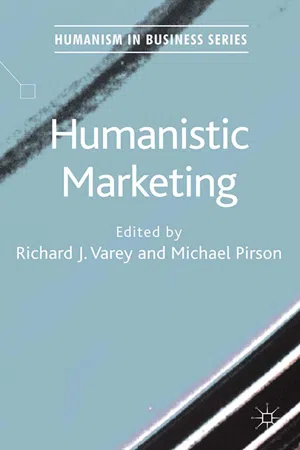
Humanistic Marketing is a response to the currently growing mega-trend call for rethinking marketing. The book organizes current thinking around the problems of marketing theory and practice as well as solutions and ways forward, providing a diverse exploration of the position of marketing in the face of challenges for societal transformation.
- English
- ePUB (mobile friendly)
- Available on iOS & Android
eBook - ePub
About this book
Information
Part I
What’s Wrong with Marketing in Theory and in Practice?
1
Where Marketing Causes Trouble
Verena E. Stoeckl and Marius K. Luedicke
Introduction
In its broadest sense, marketing is ‘what people do when they want to provide something to, or get something from, someone else’ (Levy, 1978, p. 14). Marketing is typically considered successful if (and only if) the parties involved consider the exchange of this ‘something’ of ‘positive value’ (Bagozzi, 1974). In pursuit of mutually beneficial exchanges, marketing no longer provides consumers only with everyday necessities and amenities – such as nutrition, shelter, sanitation, or transport – but also plays an increasing role in supporting consumers’ identity construction and expression.
From these perspectives of marketing as individual effort and beneficial exchange it is difficult to imagine how marketing practice can persistently produce negative effects. However, seen from meso-communal, macro-societal, or even global ecological perspectives, it is more readily imaginable that the sum of all marketing exchanges may gradually deplete local, regional, or global resources.
Since such negative effects of marketing behaviour are often not entirely comprehensible and affect a broad range of diverging stakeholder interests, they are easily exaggerated, overly moralized, overly generalized, or even overlooked. The premise of our chapter is that the question of where marketing causes trouble is an empirical one. We thus argue that, if the goal is to develop the idea of ‘humanistic marketing’, a first step is to illuminate where, in its wide field of operations, marketing activity is accused of producing specific ‘dehumanizing’ effects.
To get an empirically based sense of where (and for whom) marketing causes trouble we conducted a meta-level review of a wide range of academic and popular texts concerned with the intersections of marketing with consumer resistance, consumer boycott, ethics, moralism, and resource depletion. We captured 123 academic articles, 42 popular books, 12 newspaper articles, and 6 governmental publications that we analyzed with a focus on marketing practices that have repeatedly attracted criticism from consumers, public observers, or (marketing) scholars for their ‘dehumanizing’ implications.
The dehumanizing marketing practices that we outline next emerge from our analysis as academic/popular discourses about undesirable marketing practices, rather than as first-hand evidence of negative marketing conduct. The following summary may thus not only document actual marketing practices but also some degree of strategic myth-making. With this limitation in mind, we unfold the realms in which marketing practices are considered dehumanizing for consumers, communities, societies, and the natural environment.
Dehumanizing marketing practices
Our meta-analytical account of where marketing causes trouble reveals four different levels of socio-cultural criticism. These levels concern a range of negative marketing effects on consumers’ private and psychic spaces, on community relationships, societal values, and human and natural resources. The critique that permeates our data set addresses the discipline’s most despised practices, including deception, intrusion, exploitation, and hegemonic expansion.
The consumer level
The broadest range of criticism concerns the basic relationship of marketers and consumers that constitute the core of the discipline – mutually beneficial exchanges. Whereas marketers typically claim that they take all necessary steps to satisfy human needs and desires by offering products, services, and experiences that consumers actually buy, critics express their concerns about the ways in which desires are identified, manipulated, and satisfied.
To identify consumers’ potential desires, marketers routinely hunt for the most extensive and accurate consumer insight using, for instance, computerized online and offline consumption data-mining tools. Analyzing data from loyalty cards, internet cookies, or clickstream monitoring, even at the individual consumer level, allows marketers and their advertising brokers to more effectively target specific customer segments or to modify their products with (mostly minor) extensions. Critics do not generally ban such practices but consider the insufficient information provided by marketers (about their tracking, recording, and storing of consumer data) to be dehumanizing and illustrative of a new way of securing information asymmetries between marketers and consumers (Palmer, 2005).
When turning these insights into products and advertising the distinct relevance of offerings to consumers, marketers are widely accused of relying too excessively on persuasive, deceptive, and manipulative techniques. These techniques concern, for instance, marketers’ exaggerating claims about their products’ functional and hedonic value. Planned obsolescence – the idea (and practice) of deliberately designing products to fail too early or to quickly become unfashionable and outdated – has been particularly criticized. It includes, for instance, cases when the computer industry carefully plans new software that reduces the value of previous versions by hindering downward compatibility, or when suppliers build in inferior parts in washing machines that lead to malfunction after five years, rather than the 10–15 years proclaimed (cf., Slade, 2007). The dehumanizing effect criticized here is, again, the lack of objective information and transparency that feeds the image of marketers as untrustworthy exchange partners.
A similar kind of criticism is reflected in public discourses on marketers’ intrusion of consumers’ psychic space through an overabundance of commercial messages (Rumbo, 2002). Anti-advertising campaigners engage in a renewed critical discourse about invasive means that grab consumers’ attention in their daily routines and private spheres, limit personal freedom and contribute to mental, physical and economic harm (Cohen et al., 2005). Whereas critics typically acknowledge the general value of advertising for consumer information, increasingly pervasive practices result in negative consumer responses to its ‘intrusive, manipulative and deceptive nature’ (Mehta, 2000, p. 69). Consumers feel oppressed by these practices as most individuals currently lack the legal means to defend themselves against such intrusions.
From this marketing-critical account of one-sided rather than mutually beneficial exchanges, marketers emerge as highly skilled yet repressive ‘cultural engineers’ (Holt, 2002, p. 71), who leave the consumer in a disadvantaged, dehumanized position. These discourses perpetuate the view that consumers are targeted not as people, but are instead treated as the passive targets of marketing campaigns (Kotler et al., 2011).
The community level
When the realm of marketing influence expanded across consumers’ life spheres consumers gradually became more reflexive, ironic and aware of the ‘marketing game’. Marketers as a result lost credibility across traditional media and thus started to search for authentic, less commercially infiltrated spaces.
Consumers, for instance, (re-)engage in alternative subcultures, share their ideologies and experiences in voluntary simplified consumption communities, or chat away in special interest online forums. Marketers quickly adjust to these emancipatory and subcultural interests to position their brands as authentic members of these emerging communities. But consumers also begin to blame marketers for intruding into their communal spaces with commercial offerings, since – especially in the case of online communities – they are proclaimed by their members to be ‘made for people’, not for business (Fournier & Avery, 2011, p. 193). Marketers using aggressive viral campaigns or micro-targeting strategies that try to emulate online community practices are often regarded as ‘uninvited crashers of the Web 2.0 party’ (Fournier & Avery, 2011, p. 193). In search for market differentiation, marketers have developed another practice that is often regarded as dehumanizing because of its exploitation of the human spirit and creativity: that is, corporate co-optation. Co-optation refers to marketers searching out the creative ideas and symbolic resources that emerge within the (then) non-commercial corners of their cultures (Hebdige, 1979; Holt, 2002; Thompson & Coskuner-Balli, 2007). Critics render this corporate ‘conquest of cool’ (Frank, 1997) a mechanism for advancing culture commodification that gradually turns every unconventional, experimental idea and style that emerges in consumers’ subcultural epicentres into superficial commercial offerings.
In summary, the marketing practices that affect consumers’ place-, activity-, or theme-oriented (online) communities are considered dehumanizing because they strip consumers of their power to protect their creative and identity-marking resources against marketers that spy out and then incorporate one original cultural realm after the other into a hegemonic marketing and branding system.
The society level
The dynamics of marketing expansion, culture commodification, and demand generation contributed to a Western societal trend towards evaluating more and more aspects of human life and achievement in monetary terms (Edwards, 2000). In consequence, Western ‘citizen societies’ have gradually turned into ‘consumer societies’ (Cross, 2000), that are characterized by ‘superficial’ demands, ‘wasteful’ materialistic life-styles, and ‘over-spent’ consumers (Layard, 2005; Peñaloza & Barnhart, 2011; Schor, 1998).
At this societal level, marketers are accused of popularizing unsustainable social systems that rely on the perpetual cycle of desire and instant gratification (Belk et al., 2003) by constantly promoting the contested idea that, across all income levels, more consumption leads to more happiness (Kasser, 2002; Layard, 2005). In addition, critics argue that the emergence of global retailers and mega mergers gradually forces consumers to participate in a system of homogenized meanings, structures, and tastes embedded in global brands (Klein, 1999). This criticism echoes the above community co-optation critique of commodifying original culture, but on a global scale, and driven by the global expansion of (North American) marketing ideology and practice (Ritzer, 1993).
These discourses produce an image of marketers as hegemonic advocates of commodification, exerting their homogenizing influence on the world’s diverse markets, cultures and consumer tastes. This influence is considered dehumanizing because it creates and then fulfils consumer demands that, over time and in aggregation, bolster feelings of isolation, inauthenticity, and depersonalization.
The resource level
Among critical consumers, the increase in globalized, specialized, and resource-intensive modes of production posed new demands to ethical and political engagement through consumption choices and the moral accountability of marketers (Hertz, 2001).
With regards to the ethical treatment of human and ecological resources, critics charge marketers for pursuing self-interested, short-term profit maximization goals without accounting for human and ecological externalities (Varey, 2010). Even marketers of premium products are now frequently accused of carelessly depleting natural resources and exploiting cheap labour out of ‘economic egoism’ and at the expense of present and future generations (Desmond & Crane, 2004, p. 1228). This public and academic scepticism concerns the repercussions of aggressive and short-sighted marketing practices and the harmful side-effects of overconsumption on the preservation of environmental resources (e.g., Kotler, 2011; Peattie & Peattie, 2009; Sheth et al., 2011; Witkowski, 2005).
In this view, marketers pursue their profit maximization agenda and satisfy consumers’ needs, while the anonymous society is still left with the long-term ecological costs of a mass consumption society, that
range from rapidly depleting scarce resources, environmental degradation due to extractive and manufacturing processes, dangerous pollutants that persist in the environment, emissions and waste due to logistics and distribution, and emissions, waste and waste products due to the consumption and post consumption processes. (Achrol & Kotler, 2011, p. 44)
Diagnosis: ‘Over-marketing’
In the light of our above review of where public and scholarly observers see marketing practices causing trouble, the discipline has failed to consistently foster only mutually beneficial exchanges. Instead, critics frame marketers on the interpersonal level as mass-seducing and -deceiving consumers by abusing still prevalent information asymmetries. On the communal level, marketers are framed as ‘party crashers’ that invade consumer (sub-) cultures and co-opt their cultural innovations. On the societal level, marketers are held responsible for commodifying and homogenizing global cultures and bereaving consumers of more sustainable sources of happiness than consumption. And on the resource level, marketers are often considered free-riders on environmental resources and human labour that they ruthlessly exploit in search of the next big rush of profit.
Whereas most commentators generally acknowledge the socio-cultural value of conventional marketing, they categorize and reject the above practices as ‘over-marketing’ (Sheth et al., 2011, p. 31). Over-marketing results where marketers over-differentiate, -advertise, -sell, or -discount in order to keep up with tough competition or to drive consumption to fulfil over-ambitious growth goals. Marketers, animated by and assessed in terms of an economic egoist marketing ideology, tend to consider their business’ growth as a moral contribution which creates wealth and enhances value for companies, customers, and society at large (Desmond & Crane, 2004). In this view, ‘material progress, efficiency and effectiveness in satisfying needs, and the exercising of economic and political freedom’ operate as a ‘safety belt’ for the steady reproduction and legitimization of society (Marion, 2006, p. 249). The resulting push for growth protects companies against competitive takeover, advances economies of scale, and provides an extra edge in the rampant competition for sales territ...
Table of contents
- Cover
- Title
- Introduction
- Part I What’s Wrong with Marketing in Theory and in Practice?
- Part II Marketing as a Force for Good
- Closing Commentary: Towards Humanistic Marketing?
- Index
Trusted by 375,005 students
Access to over 1.5 million titles for a fair monthly price.
Study more efficiently using our study tools.
Frequently asked questions
Yes, you can cancel anytime from the Subscription tab in your account settings on the Perlego website. Your subscription will stay active until the end of your current billing period. Learn how to cancel your subscription
No, books cannot be downloaded as external files, such as PDFs, for use outside of Perlego. However, you can download books within the Perlego app for offline reading on mobile or tablet. Learn how to download books offline
Perlego offers two plans: Essential and Complete
- Essential is ideal for learners and professionals who enjoy exploring a wide range of subjects. Access the Essential Library with 800,000+ trusted titles and best-sellers across business, personal growth, and the humanities. Includes unlimited reading time and Standard Read Aloud voice.
- Complete: Perfect for advanced learners and researchers needing full, unrestricted access. Unlock 1.5M+ books across hundreds of subjects, including academic and specialized titles. The Complete Plan also includes advanced features like Premium Read Aloud and Research Assistant.
We are an online textbook subscription service, where you can get access to an entire online library for less than the price of a single book per month. With over 1.5 million books across 990+ topics, we’ve got you covered! Learn about our mission
Look out for the read-aloud symbol on your next book to see if you can listen to it. The read-aloud tool reads text aloud for you, highlighting the text as it is being read. You can pause it, speed it up and slow it down. Learn more about Read Aloud
Yes! You can use the Perlego app on both iOS and Android devices to read anytime, anywhere — even offline. Perfect for commutes or when you’re on the go.
Please note we cannot support devices running on iOS 13 and Android 7 or earlier. Learn more about using the app
Please note we cannot support devices running on iOS 13 and Android 7 or earlier. Learn more about using the app
Yes, you can access Humanistic Marketing by R. Varey, M. Pirson, R. Varey,M. Pirson in PDF and/or ePUB format, as well as other popular books in Business & Business Strategy. We have over 1.5 million books available in our catalogue for you to explore.