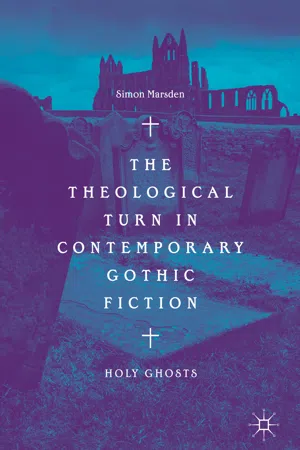
This study examines theological themes and resonances in post-1970 Gothic fiction. It argues that contemporary Gothic is not simply a secularised genre, but rather one that engages creatively – and often subversively – with theological texts and traditions. This creative engagement is reflected in Gothic fiction's exploration of theological concepts including sin and evil, Christology and the messianic, resurrection, eschatology and apocalypse. Through readings of fiction by Gothic and horror writers including Stephen King, Joyce Carol Oates, Peter Straub, William Peter Blatty and others, this book demonstrates that Christianity continues to haunt the Gothic imagination and that the genre's openness to the mysterious, numinous and non-rational opens space in which to explore religious beliefs and experiences less easily accessible to more overtly realist forms of representation. The book offers a new perspective on contemporary Gothic fiction that will be of interest to students and scholars of contemporary Gothic and of the relationship between literature and religion more generally.
- English
- ePUB (mobile friendly)
- Available on iOS & Android
eBook - ePub
About this book
Information
© The Author(s) 2018
Simon MarsdenThe Theological Turn in Contemporary Gothic Fictionhttps://doi.org/10.1007/978-3-319-96571-0_11. Introduction: Spectres of the Sacred
Simon Marsden1
(1)
Department of English, University of Liverpool, Liverpool, UK
Contemporary Gothic is haunted by Christianity. Theological themes and figures—sin, redemption, apocalypse, heaven and hell, angels and demons—are as integral to the Gothic imagination in the twenty-first century as they were in the eighteenth. Religious iconography is embedded in the Gothic aesthetic. Gothic retains a sense of the sacred, even if it appears at times in desecrated forms. Ritual, atonement and sacrifice remain prominent narrative tropes; (some) vampires still fear the sign of the cross, even if they—and we—have become less sure about why they do so. If the Gothic as a genre is defined by the coherence of its conventions, as Eve Sedgwick has argued, many of those conventions have a wider history in Christian belief, ritual, practice, architecture and iconography.1 Despite the proliferation of religious tropes, ideas and images in contemporary Gothic, however, relatively little critical attention has been paid to the ways in which recent Gothic texts have engaged with theology. If religion ‘is, once more, haunting the imagination of the West’, as the theologian Graham Ward has claimed, then its spectral presence in Gothic fiction remains curiously unrecognised by scholars, despite the significant expansion of critical work in recent years in the fields of both Gothic studies and literature and religion.2 This book seeks to expand the critical dialogue between Gothic studies and theology by exploring some of the ways in which contemporary Gothic texts have engaged with Christian ideas, tropes and images. It aims to demonstrate not only that Gothic writers continue to draw upon theology as a source of imaginative stimulation, contest and challenge but also that the Gothic offers distinctive imaginative and representational resources with which to explore theological concepts. In other words, this book attempts to reveal not only the theological threads in contemporary Gothic but the Gothic threads in contemporary theology.
The concept of the ‘contemporary’ can of course be a slippery one and, as I am taking a somewhat broader view of that term than is often the case in critical studies, it requires some comment. This book focuses on the period from 1970 to the present. This timescale has a practical convenience, as it spans the careers of prominent novelists such as Stephen King and William Peter Blatty. More broadly, however, this book is concerned with what the sociologist Zygmunt Bauman has described as the ‘“re-enchantment” of the world after the protracted and earnest, though in the end inconclusive, modern struggle to dis-enchant it’.3 For Bauman and others, this ‘re-enchantment’ of the world is an aspect of postmodernity’s challenge to the cultural, philosophical and epistemological structures of modernity. Ward claims that it is ‘the re-evaluation of ambivalence, mystery, excess and aporia as they adhere to, are constituted by and disrupt the rational, that lies behind the re-enchantment of the world’.4 The renewal of cultural and artistic interest in religious tropes, images and iconography—albeit often far removed from the religious traditions within which they emerged—is consistent with this re-evaluation of mystery and otherness. For the purposes of this book, then, the ‘contemporary’ is that period from the late twentieth century to the present in which this ‘re-enchantment’ of the world is most clearly recognisable. This is not to ignore the ways in which critical theory has now begun to challenge or move beyond postmodern thought—indeed, several of the theologians discussed in this book have offered extensive critiques of postmodernism—but simply to acknowledge the ways in which postmodernity has shaped and continues to shape the encounter with religion in recent art and culture.
The image of a contemporary imagination ‘haunted’ by religion is an ambivalent one. As any reader of Gothic fiction knows well, the appearance of a spectre is at least as likely to provoke an exorcism as a welcome. ‘A sceptical response’, writes Andrew Tate, ‘might be to observe, dryly, that the spectral motif…is surely a sign that the age of belief has passed away only to be reawakened as an unhappy revenant’.5 As Tate notes, the return of religion in Western cultural and political life has provoked concern (among believers as well as sceptics) about newly resurgent fundamentalisms and the threat of religious violence. Certainly, some of the writers discussed in this book and in Gothic fiction more widely are alert to the potential for religion to be imagined as a source and site of horror. Yet spectres of the sacred haunt Gothic fiction in other ways too: as nostalgic yearning for older forms of faith, ritual and belonging; as images of enchantment by which reality is encountered as more than the material and empirical; as tentative glimpses of redemptive possibility. ‘The ghost, post-Derrida’, writes Andrew Smith, ‘seemed to be transformed into a critically mobile figure whose presence helped to illuminate the complex origins and discrete political visions of a variety of intellectual contexts’.6 Though the ghost in Gothic criticism has more often been associated with broadly secular concerns—economics, labour, psychology, sexuality—it is my contention that religion too participates in the kind of literary haunting in which, as Joanne Watkiss argues, ‘texts are haunted by other texts through a series of uncanny inheritances that simultaneously renew the concepts afresh’.7 I will argue in this book not only that Christian theology is among the ‘uncanny inheritances’ of contemporary Gothic, but also that Gothic texts themselves provide space for the reimagining and renewal of that inheritance. This introductory chapter maps out some key areas of intersection between Christian thought and the Gothic imagination.
Gothic Fictions and the (Un)Death of God
According to a familiar narrative of secularisation, Western thought and culture in the nineteenth and twentieth centuries departed steadily and inevitably from their historical roots in Christian faith, theology and praxis. While some commentators have described this shift in terms of a clash between religion and science, or faith and reason, others have located the origins of disenchantment within an increasingly rationalist and materialist Christianity in the aftermath of the Reformation.8 Though the nature and causes of secularisation continue to be debated, there is no doubt that what Matthew Arnold called the ‘melancholy, long withdrawing roar’ of faith was for many people in Britain and the US a prominent aspect of the emotional, imaginative and intellectual life in the nineteenth century and beyond.9 In his pathfinding study The Disappearance of God (1963), J. Hillis Miller describes modern literature as shaped by the experience of God’s absence:
Miller’s ‘terrifying absence’ of God is not quite the Nietzschean ‘death of God’. Miller does not insist on the inevitability of atheism, but rather describes a widespread suspicion that God is absent from the places in which he was once encountered. Yet there is an unavoidable link between the concepts of divine absence and divine death; at the very least, it is easy to see how the imaginative experience of divine silence and the availability of intellectual challenges to God’s existence might be mutually reinforcing. In his influential book A Secular Age (2007), the philosopher Charles Taylor argues that one of the main characteristics of secularisation is ‘a move from a society where belief in God is unchallenged and indeed, unproblematic, to one in which it is understood to be one option among others, and frequently not the easiest to embrace’.11 In a secular culture, religious faith is not impossible, but it can no longer be held naively as self-evident or uncontested.The lines of connection between us and God have broken down, or God himself has slipped away from the places where he used to be. He no longer inheres in the world as the force binding together all men and all things. As a result the nineteenth and twentieth centuries seem to many writers a time when God is no more present and not yet again present, and can only be experienced negatively, as a terrifying absence.10
Gothic narratives of the nineteenth and twentieth centuries reflect both the specific shift in the conditions of belief described by Taylor and the broader modern experience of disenchantment. Some Gothic writers—most notably H. P. Lovecraft—saw in the Nietzschean proclamation of the death of God a vision of nihilistic horror and a Gothic mode in which the ideological and epistemological certainties of modernity were overwhelmed by forces of uncontainable chaos and disorder. In the wider Gothic tradition, however, disenchantment was registered in other ways. Lucie Armitt observes that
Though images of the spectral, supernatural an...if one were to identify elements that specifically characterise twentieth-century Gothic, one would have to signal, in the early part of the century, the manner in which the real-life horror of two world wars takes over from the imagined horrors of the supernatural and/or superstition; those tortured individuals who, in the nineteenth century, refused to play dead, began to do so on a mass(ive) scale during and after the First World War, as spirit photographers, theosophists, spiritualists and clairvoyants pandered to the devastation felt by parents grieving for their lost sons.12
Table of contents
- Cover
- Front Matter
- 1. Introduction: Spectres of the Sacred
- 2. Gothic Heresies
- 3. ‘There Were Some Stains That Could Not Be Removed’: Adam Nevill and the Stain of Sin
- 4. Much Ado About Nothing: Peter Straub and Privation
- 5. William Peter Blatty and the Presence of the Absent Christ
- 6. ‘Time to Let Go of All the Old Things’: Justin Cronin’s Radically Orthodox Christology
- 7. Sympathy for the Devil: Gothic Goes to Hell
- 8. The Sense of No Ending: (Re)Reading the Apocalyptic Stephen King
- Back Matter
Trusted by 375,005 students
Access to over 1.5 million titles for a fair monthly price.
Study more efficiently using our study tools.
Frequently asked questions
Yes, you can cancel anytime from the Subscription tab in your account settings on the Perlego website. Your subscription will stay active until the end of your current billing period. Learn how to cancel your subscription
No, books cannot be downloaded as external files, such as PDFs, for use outside of Perlego. However, you can download books within the Perlego app for offline reading on mobile or tablet. Learn how to download books offline
Perlego offers two plans: Essential and Complete
- Essential is ideal for learners and professionals who enjoy exploring a wide range of subjects. Access the Essential Library with 800,000+ trusted titles and best-sellers across business, personal growth, and the humanities. Includes unlimited reading time and Standard Read Aloud voice.
- Complete: Perfect for advanced learners and researchers needing full, unrestricted access. Unlock 1.5M+ books across hundreds of subjects, including academic and specialized titles. The Complete Plan also includes advanced features like Premium Read Aloud and Research Assistant.
We are an online textbook subscription service, where you can get access to an entire online library for less than the price of a single book per month. With over 1.5 million books across 990+ topics, we’ve got you covered! Learn about our mission
Look out for the read-aloud symbol on your next book to see if you can listen to it. The read-aloud tool reads text aloud for you, highlighting the text as it is being read. You can pause it, speed it up and slow it down. Learn more about Read Aloud
Yes! You can use the Perlego app on both iOS and Android devices to read anytime, anywhere — even offline. Perfect for commutes or when you’re on the go.
Please note we cannot support devices running on iOS 13 and Android 7 or earlier. Learn more about using the app
Please note we cannot support devices running on iOS 13 and Android 7 or earlier. Learn more about using the app
Yes, you can access The Theological Turn in Contemporary Gothic Fiction by Simon Marsden in PDF and/or ePUB format, as well as other popular books in Literature & Film & Video. We have over 1.5 million books available in our catalogue for you to explore.