Mary Shelley reappraises the significance of Frankenstein alongside other works by Shelley which could be considered to revise the significance and fluctuating meanings of `Gothic' during the Romantic period. It offers scholarly, fresh readings of the 1818 and 1831 editions of Frankenstein, as well as chapters upon the fiction that Shelley composed in between both editions, and during the same decade as its second edition.
In its broader examination of Mary Shelley's work, this study is the first of its kind within the field of Gothic studies. Alongside sustained explorations of Frankenstein, Matilda, Valperga and The Last Man, the volume Mary Shelley reappraises some of the shorter essays and tales that the author composed for contemporary magazines. Angela Wright argues that the time is now right for a re-examination of the extent to which Shelley participated in and redirected the Gothic tradition.
- 192 pages
- English
- ePUB (mobile friendly)
- Available on iOS & Android
eBook - ePub
Mary Shelley
About this book
Information
Publisher
University of Wales PressYear
2018Print ISBN
9781786831736
9781783168460
eBook ISBN
9781783168484
1
Frankenstein, or the Modern Prometheus (1818)
How can I describe my emotions at this catastrophe, or how delineate the wretch whom with such infinite pains and care I had endeavoured to form? His limbs were in proportion, and I had selected his features as beautiful. Beautiful! – Great God! His yellow skin scarcely covered the work of muscles and arteries beneath; his hair was of a lustrous black, and flowing; his teeth of a pearly whiteness; but these luxuriances only formed a more horrid contrast with his watery eyes, that seemed almost of the same colour as the dun white sockets in which they were set, his shrivelled complexion, and straight black lips.(Mary Shelley, Frankenstein, or the Modern Prometheus (1818), p. 40)

As the assembled parts of a newly invented body first convulse, Victor Frankenstein the creator feels only ‘breathless horror and disgust’. He lists the hideous parts of his creation in a perversion of Renaissance blazon, adumbrating beautiful parts only to emphasise the horror of the whole. As in Shakespeare’s Sonnet 130 (‘My mistress’s eyes are nothing Like the sun’), flowing black hair and pearly-white teeth are luxuriantly desirable qualities. But whereas Shakespeare’s sonnet focuses playfully on negating the overall effect of these attributes in order to emphasise a greater love, Frankenstein’s separation of the parts of his creature serves only to express horror, and nothing of the charge of excitement and imagination that characterises the process of the sublime.
Scientific discovery and research, as I will explore more fully further into this chapter, characterised the Romantic period to such an extent as to lead Richard Holmes to call it ‘The Age of Wonder’.1 At first glance Frankenstein (1818) offers us a deeply different perspective. Victor Frankenstein’s disgust at his nameless creation immediately precipitates us into a realm of horror and death. He compares his creature unfavourably with a reanimated mummy:
Oh! No mortal could support the horror of that countenance. A mummy again endued with animation could not be so hideous as that wretch. I had gazed on him while unfinished; he was ugly then; but when those muscles and joints were rendered capable of motion, it became a thing such as even Dante could not have conceived. 2
The effects of horror that Frankenstein notes here somewhat lose their charge as he tethers them so specifically to a particularly superficial realm of aesthetics. Horror becomes harnessed to disfigurement all too quickly, brutally reinforced through such terms as ‘hideous’ and ‘ugly’. This is a value judgement that we, as readers, are incapable of endorsing. It is only when the creature acquires mobility, when it can evade the scopophilic gaze of its creator, that it becomes an object of sublimity, ‘[A] thing such as even Dante could not have conceived’. Mary Shelley’s fascination with Dante’s Inferno, as we will see, extended throughout her writing career. Inferno, she later confided to Leigh Hunt, was ‘a poem I can only read bits of – the subject being to me so antipatetica but the Purgatorio and Paradiso – the Poet revels in beauty & joy there to the full as much as in the horrors below.’3 She appreciated the beauty of Dante’s Paradise as much as the horrors in Inferno but understood that from the juxtaposition of both sublimity arose. Frankenstein participates in this understanding; it offers an investigation into the extremes of our responses to beauty and deformity, the paradox of the sublime that had been explored so fully during the eighteenth century and Romantic period. The sublime of Frankenstein is a sublimity that seeks to expose the limitations of story-telling and of language itself as we encounter this incredible creation first and foremost as an object rather than a full subject. It is a version of the sublime that questions the myopic vision of the creator, that challenges his ability even to describe his creation, and that awards equal privilege to the natural and supernatural spheres.
‘It is the natural world,’ Angela Leighton has argued, ‘especially that which gives a promise of the supernatural, which is properly the locus of the sublime.’4 Frankenstein is no exception to this observation. It plays with the liminal spaces that separate the natural from the supernatural world not merely in the external world, but also in the internal worlds of its characters. As Victor Frankenstein knows best, he has created his creature from organic substances – a combination of animal and body parts – and yet he insists, as he brings him to life, on only its inhuman qualities. Frankenstein condemns the creature (rightly, as it transpires) for the murder of his beloved younger brother William on the most spurious of pretexts: ‘“Nothing in human shape could have destroyed that fair child. He was the murderer!’”5 This realisation dawns on Frankenstein just as he notices his creation ‘hanging among the rocks of the nearly perpendicular Mont Salêve’.6 While Frankenstein remains ‘motionless’ he considers the being ‘nearly in the light of my own vampire, my own spirit let loose from the grave, and forced to destroy all that was near to me’.7 Vampires and revenants were on the minds of the group assembled at the Villa Diodati during the Summer of 1816, with both Polidori and Byron composing vampiric tales in consequence of the ghost story competition. The vampiric image here that Victor uses first and foremost presupposes his own death as he contemplates the extraordinary mobility of his creation. Fred Botting, remarking on the processes of doubling and reversals in the novel, notes that ‘Frankenstein’s subjectivity disintegrates, its imagined and vain sovereignty turning into the passions and violence of a gothic villain: creation cedes to destruction, mastery to slavery, unity to monstrosity.’8 The process of transformation, of Frankenstein losing his self as his creature comes to life, gathers increasing force as the novel progresses. Later, Frankenstein perceives the approach of his creation in the grand surroundings of Mont Blanc. These surroundings owed more than a little to Percy Bysshe Shelley, whose poem ‘Mont Blanc’ famously cast the mountain as a living part of the ‘mind of man’. ‘Mont Blanc’ was first published as part of the collaborative work by Mary and Percy entitled History of a Six Weeks’ Tour through a Part of France, Switzerland, Germany and Holland: with Letters Descriptive of a Sail round the Lake of Geneva, and of the Glaciers of Chamouni. Published in 1817, this was a work which Mary compiled from old journal entries and letters that both had written between July and November 1814, detailing the tour of the title. A work of three parts, the first consisted of the journal entries that the pair had written concerning the tour undertaken by them in the company of Claire Clairmont during the summer of 1814, the second of four letters sent from Switzerland in 1816, and the third section consisted of the poem ‘Mont Blanc’.9 As a work of collaboration, it is hard to trace the precise authorial provenance of the first section.
The History of a Six Weeks’ Tour is a collaborative work whose imaginative potential is carried forward to the scenes in Frankenstein that are set among the Alps. We know that Percy edited these particular sections of Frankenstein and augmented the descriptions of Mont Blanc.10 It is interesting to note, then, just how detailed the descriptions of the pines, ravines, jutting rocks and summits are in the novel’s second volume. As the mountain comes alive as a dynamic object in chapter II of volume II, Frankenstein observes the ‘figure of a man, at some distance, advancing towards me with superhuman speed’.11 On his approach, however, Frankenstein’s bias transforms the creature from ‘man’, to ‘superhuman’ and to the ‘wretch whom I had created’. It is a chain of signifiers that moves us gradually from the natural to the supernatural. The textured descriptions of Mont Blanc fade into insignificance as he moves into focus, negating as he does so Frankenstein’s articulacy and his subjectivity. The creature’s approach slowly absorbs all of the imaginative space, consuming, as it does so, the ‘life’ and ‘spirit’ of Frankenstein’s narrative. Sublimity pulses to the surface of Frankenstein almost on almost every page; through the novel’s meta-commentary on articulacy and selfhood, through its careful dissection of the scientific debates of the day, through the attention to atmosphere and setting, and through the textured layers of the novel that create further fear, horror and terror as we become increasingly unsure of the truth.
If it seems odd that I began my chapter on Frankenstein by analysing Victor’s process of creation and rejection, it is because chapter IV, where these scenes occur, is the very place where Mary Shelley first began her novel in June 1816.12 As she would later recall in the 1831 Preface, she had what Emily W. Sunstein calls a ‘waking hypnagogic nightmare’ when challenged to write a ghost story by Lord Byron: 13
My imagination, unbidden, possessed and guided me, gifting the successive images that arose in my mind with a vividness far beyond the usual bounds of reverie. I saw – with shut eyes, but acute mental vision – I saw the pale student of unhallowed arts kneeling beside the thing he had put together. I saw the hideous phantasm of a man stretched out, and then, on the working of some powerful engine, show signs of life, and stir with an uneasy, half-vital motion. Frightful must it be; for supremely frightful would the effect of any human endeavour to mock the stupendous mechanism of the Creator of the world. His success would terrify the artist; he would rush away from the odious handiwork, horror-stricken. He would hope that, left to itself, the slight spark of life which he had communicated would fade; that this thing which had received such imperfect animation would subside into dead matter, and he might sleep in the belief that the silence of the grave would quench forever the transient existence of the hideous corpse which he had looked on as the cradle of life. He sleeps; but he is awakened; he opens his eyes; behold, the horrid thing stands at his bedside, opening his curtains and looking on him with yellow, watery, but speculative eyes.14
Shelley then ‘opened’ her eyes ‘in terror’. In thrall to this hypnagogic nightmare which kept her moving between waking and sleeping, Mary Shelley claims that she conceived Frankenstein. Her starting point was the moment of the artist’s creation of a new human being. The account that she offers asserts the Romantic ascendancy of the imagination in the way in which she is passively ‘possessed’ and ‘guided’ by her imagination. But that very passivity is also endowed with the language of terror in its repetition of ‘frightful’ and indeed, the way in which Shelley even repeats ‘I saw’, as if narrating a traumatic event that remains hard to articulate. Whilst the moralistic tone towards the blasphemous scientific endeavour was for commercial and contextual reasons sharper here, invoking ‘the Creator of the world’ as a censorial presence, it is interesting to note how Victor Frankenstein is called an ‘artist’ and that his hope that ‘imperfect animation would subside into dead matter’ is highlighted to such a degree. It is worth bearing in mind, as Andrew Smith has also argued in relation to the passage with which I began this chapter, that we should ‘read this moment figuratively, because Mary Shelley wants to stress the failure of an idealistic vision’, a vision that could be figured in terms of both science and politics.15 The failure of this vision is figured here in the ways in which the scientific imagery morphs into a Gothic vision. From the ‘spark of life’ fading, an image which alluded to the galvanic contexts on which the science of Frankenstein was founded, to the organic decomposition of the body subsiding ‘into dead matter’, we then encounter a language of fear with the hope that ‘the grave would quench forever the transient existence of the hideous corpse.’ With the grave becoming the active agent in this image, we are precipitated into a different form of figurative language, a form which comes, in part, from graveyard poems such as Robert Blair’s The Grave of 1743, which apostrophised the grave as the source of imaginative power.16 Shelley further makes us experience the terrors of ‘the pale student of unhallowed arts’ acutely as she moves into the present tense to describe the chain of events. Victor ‘sleeps’, he ‘opens his eyes’ to encounter the ‘yellow, watery, but speculative gaze’ of his creation. Victor too experiences a hypnagogic nightmare, and one which bears more than a little resemblance to Henry Fuseli’s famous painting of 1781 The Nightmare. Mary Shelley was acquainted with Fuseli, both through her mother’s famously unrequited infatuation with him, and her father Godwin’s continuing friendship with him.17 In Fuseli’s painting, the supine female weighed down by a simian incubus sitting just below her chest is gazed on through the curtains by a horse with bulging, watery eyes. In Shelley’s novel, the scene is transposed: a helpless, male artist is gazed on by the watery gaze of his own creation. Both are the same in terms of emotional charge, creating terror and confusion in their blurring of the distinctions between waking and sleeping.
Shelley’s 1831 account of her nightmare, then, was a powerful version of Gothic narratology in itself, and one which coerced the reader into sharing the terror of Victor Frankenstein. It drew on the beginning of chapter IV, where Mary Shelley began the novel in 1816:
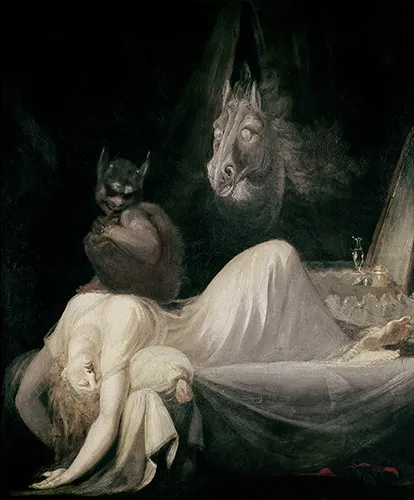
Henry Fuseli, The Nightmare (1871) © Bridgeman Library
It was on a dreary night of November, that I beheld the accomplishment of my toils. With an anxiety that almost amounted to agony, I collected the instruments of life around me, that I might infuse a spark of being into the lifeless thing that lay at my feet. It was already one in the morning; the rain pattered dismally against the panes, and my candle was nearly burnt out, when, by the glimmer of the half-extinguished light, I saw the dull yellow eye of the creature open; it breathed hard, and a convulsive motion agitated its limbs.18
Nature here again morphs into supernature through the careful attention paid to the atmospherics of the ‘dreary night’ and the ‘rain patter[ing]’. Each accordant circumstance is carefully evoked in order to prepare us for the ‘convulsive motion’. But this is no ghost; it is a new form of life that Victor Frankenstein tells us that he has laboured for more than two years to create. The attention to the flame of the candle, ‘nearly burnt out’, also brings to mind the Promethean subtitle of the novel, for Fr...
Table of contents
- Cover
- Title Page
- Copyright Page
- Dedication
- Contents
- Acknowledgements
- Mary Shelley: A Chronology
- Introduction
- 1 Frankenstein, or the Modern Prometheus (1818)
- 2 Testimonial and Refusal in Matilda (1819)
- 3 Of Women, History and Romance in Valperga (1823)
- 4 ‘On Ghosts’ and The Last Man: Mourning, Melancholia and Transformational Terror
- 5 Terror, Horror and Transformation: The 1831 Edition of Frankenstein and the Short Stories for The Keepsake
- Conclusion
- Notes
- Bibliography
Trusted by 375,005 students
Access to over 1.5 million titles for a fair monthly price.
Study more efficiently using our study tools.
Frequently asked questions
Yes, you can cancel anytime from the Subscription tab in your account settings on the Perlego website. Your subscription will stay active until the end of your current billing period. Learn how to cancel your subscription
No, books cannot be downloaded as external files, such as PDFs, for use outside of Perlego. However, you can download books within the Perlego app for offline reading on mobile or tablet. Learn how to download books offline
We are an online textbook subscription service, where you can get access to an entire online library for less than the price of a single book per month. With over 1.5 million books across 990+ topics, we’ve got you covered! Learn about our mission
Look out for the read-aloud symbol on your next book to see if you can listen to it. The read-aloud tool reads text aloud for you, highlighting the text as it is being read. You can pause it, speed it up and slow it down. Learn more about Read Aloud
Yes! You can use the Perlego app on both iOS and Android devices to read anytime, anywhere — even offline. Perfect for commutes or when you’re on the go.
Please note we cannot support devices running on iOS 13 and Android 7 or earlier. Learn more about using the app
Please note we cannot support devices running on iOS 13 and Android 7 or earlier. Learn more about using the app
Yes, you can access Mary Shelley by Angela Wright,Angela Wright in PDF and/or ePUB format, as well as other popular books in Literature & Gothic, Romance, & Horror Literary Criticism. We have over 1.5 million books available in our catalogue for you to explore.